Is Anti-Aging Treatment Safe in China? A 2026 Evidence Review
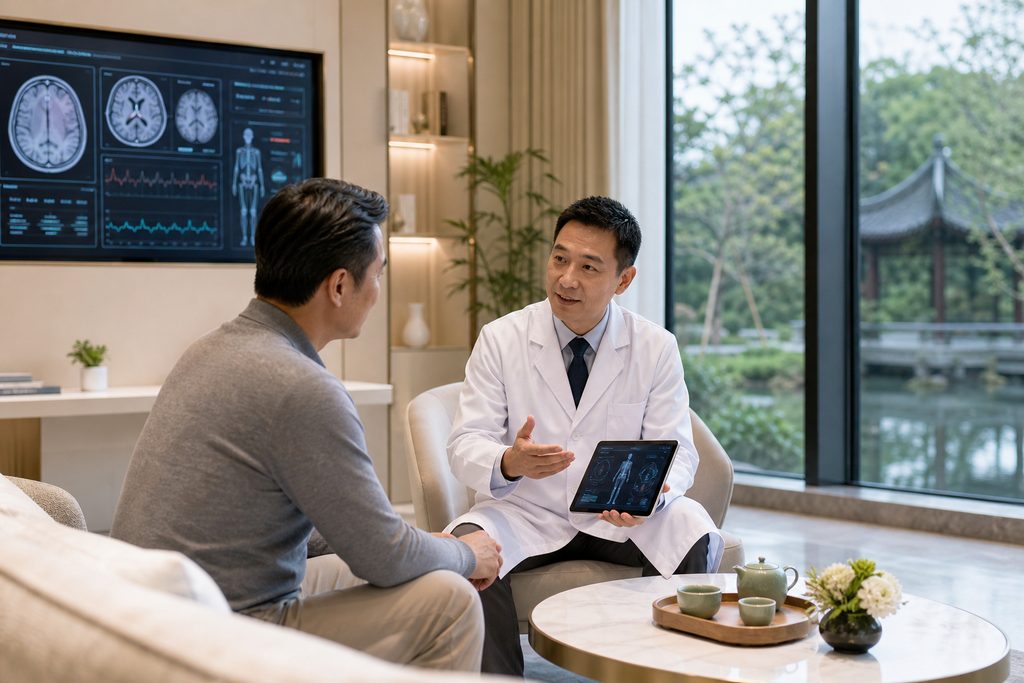
You’ve probably heard that “anti-aging” outside the West means unregulated injections and dubious stem cell promises. That assumption collapses quickly when you look at how China’s top-tier hospitals actually operate. The reality is a bifurcated market: a small number of rigorous, protocol-driven longevity programs inside major teaching hospitals, and a much larger gray zone of aesthetic clinics selling unproven infusions. Safety depends almost entirely on which one you walk into. A 2023 review in Frontiers in Public Health noted that China’s anti-aging market is projected to exceed $180 billion by 2027, but regulatory oversight remains uneven across facility types. That’s precisely why international patients need a filter — and why the anti-aging treatment cost China question cannot be answered without first asking where the treatment happens.
This guide separates evidence-based longevity medicine from marketing. We’ll walk through what actually happens inside a reputable Chinese anti-aging program, what it costs, where the risks concentrate, and how to verify a clinic before you commit.
How This Actually Works, Step by Step
The sequence matters more than most patients expect. Here is the real flow when you pursue anti-aging treatment through a hospital-based program in China, not a storefront clinic.
Step 1: You send your existing records. A written second opinion starts with your recent labs, imaging, medication list, and a brief health history. No travel required. The relevant department — often a longevity medicine or preventive health unit inside a major hospital — reviews your file. From $300 to $500 for a written second opinion from a top-tier specialist, this step filters out patients who would not benefit from the program.
Step 2: Video consultation. You speak directly with the medical team. They explain what they can measure, what they can treat, and what they cannot. This is where you hear the actual protocol — not a sales pitch. Video consultations with standard international departments run $100 to $300; top-specialist sessions range from $500 to $800.
Step 3: You decide on a package. If the remote evaluation confirms a feasible plan, the hospital proposes a structured program. This typically bundles diagnostics (advanced lipid panels, inflammatory markers, hormonal assays, sometimes epigenetic or telomere testing), physician consultations, and a defined intervention series. You are not buying a mystery vial. You are buying a measured, documented protocol.
Step 4: Travel and on-site care. You arrive in China on an S2 visa, which is the appropriate short-stay category for private medical treatment. Our team coordinates your airport pickup, hospital registration, and a bilingual medical companion who handles translation, queueing, and payment logistics. You are never navigating a 10,000-patient-per-day hospital alone.
Step 5: Follow-up at home. Reputable programs give you a written summary in English, including lab values, interventions received, and a follow-up schedule. Your home physician receives the documentation needed to continue care.
How Does Anti-Aging Medicine Work in China? The Hospital Model vs. the Clinic Model
Anti-aging medicine in China splits into two distinct worlds. Knowing the difference is the single most important safety decision you will make.
The hospital model operates inside public tertiary hospitals or JCI-accredited private international hospitals. These programs frame anti-aging as preventive and functional medicine. You get a comprehensive metabolic workup, cardiovascular risk stratification, hormone level assessment, nutritional and inflammatory profiling, and then a physician-supervised intervention plan. Interventions may include targeted supplementation, lifestyle and sleep optimization protocols, hormone replacement where clinically indicated, and — in some academic centers — monitored therapies like NAD+ precursor infusions or exosome-based treatments under clinical research protocols.
The clinic model is different. These are often aesthetic or “wellness” centers in commercial districts. They advertise stem cell injections, placental extracts, and “youth restoration” packages with glossy brochures and no published safety data. Some are legitimate. Many are not. The risk is not the molecule — it is the absence of sterility controls, dose standardization, and adverse event reporting.
So when someone asks, is anti-aging therapy safe in Shanghai, the honest answer is conditional. Inside Fudan-affiliated hospitals or JCI-accredited facilities, the safety bar is high. In an unaccredited storefront, it is not. Shanghai hosts both. Your job is to know which door you are entering.
A Realistic Timeline
People consistently underestimate the gap between first inquiry and first appointment. Here is what the calendar actually looks like.
| Stage | What Happens | Typical Duration |
|---|---|---|
| Days 1–3 | You submit records and health history via secure portal | 1–3 days |
| Days 4–10 | Document translation and specialist triage | 5–7 days |
| Week 2–3 | Written second opinion or video consultation scheduled | 7–14 days lead time |
| Week 4–6 | Visa application (S2) with hospital invitation letter | 2–4 weeks depending on consulate |
| Week 6–8 | Travel to China, on-site evaluation, treatment program begins | 5–10 days on site |
| Month 3 | First follow-up labs and protocol adjustment | Ongoing |
Document translation and appointment lead time are the steps people forget. A hospital cannot review records it cannot read. And top specialists do not hold same-week slots for international patients. Budget eight weeks from first email to walking into the hospital. If a clinic promises you a bed tomorrow, that is a red flag, not a convenience.
What Can Go Wrong — and What Happens Then
Let’s be direct. Things fail. The question is whether the system catches them.
Failure mode 1: The clinic is not what it claimed. You arrive and find a two-room office, not a hospital department. Recourse: you walk away. If you booked through a coordination service, a legitimate one will have verified the facility’s license and JCI status before you traveled. If you booked directly with the clinic, you may have no leverage. This is why verification happens before payment, not after.
Failure mode 2: The treatment causes an adverse reaction. Infusion reactions, allergic responses, or unexpected lab abnormalities happen even in good programs. Recourse: hospital-based programs have emergency departments and inpatient capacity. A storefront clinic does not. You call an ambulance. That is the entire plan.
Failure mode 3: The results underwhelm. You spend $8,000 and feel the same. Recourse: you review your labs with your home physician. Some interventions produce measurable biomarker changes without subjective effects. Some protocols simply do not work for a given patient. Reputable programs set expectations in writing before you commit. If a clinic guaranteed you would “feel 10 years younger,” you were never in a medical program.
Failure mode 4: Visa complications. The S2 visa process stalls because the hospital invitation letter is missing or incorrect. Recourse: a coordination team that has handled S2 applications before will catch documentation errors in week one, not week five. This is process competence, not luck.
Best Anti-Aging Clinic Beijing Price: What You Are Actually Paying For
The best anti-aging clinic Beijing price question usually comes from patients comparing a Beijing hospital program against a Bangkok or Seoul clinic. The comparison is not apples to apples. Here is what the numbers look like.
A comprehensive anti-aging evaluation at a top Beijing hospital — including advanced cardiovascular imaging, full hormonal and metabolic panels, physician consultation, and a written longevity plan — typically runs from $2,000 to $6,000. Add targeted interventions (IV nutrient protocols, hormone optimization, monitored peptide or NAD+ therapies) and the total often lands between $5,000 and $15,000 for a structured multi-week or multi-month program. Private international hospitals in Beijing, such as United Family or Jiahui, trend toward the higher end because they bundle English-speaking physician time and Western-style documentation.
Compare that to the US, where a comparable executive longevity assessment at a major academic center runs $10,000 to $25,000 before any interventions. The anti-aging treatment cost China advantage is real but not magical — you are paying 40% to 60% of US prices for hospital-grade care, not 5% for a mystery vial.
What you are paying for breaks down into three buckets. Diagnostics. Physician time. Facility overhead. If a clinic quotes you $300 for a “full anti-aging package,” the diagnostics alone would cost more than that in any legitimate lab. That price tells you everything.
JCI Accredited Anti-Aging Hospitals China: How to Verify Before You Book
JCI accreditation is the most useful international shorthand for hospital safety standards. But it is not a guarantee of anti-aging expertise. It is a floor, not a ceiling.
When evaluating JCI accredited anti-aging hospitals China, check three things. First, confirm the accreditation is current — JCI lists accredited organizations publicly, and accreditation expires. Second, confirm that the anti-aging or longevity program operates inside the accredited facility, not in a separately branded “wellness wing” that is technically a different legal entity. Third, ask for the names of the physicians who will actually see you. A JCI badge on the hospital does not mean every doctor in the building meets your standard. You want a named specialist with verifiable credentials in endocrinology, preventive medicine, or a related field.
Several private international hospitals in Shanghai, Beijing, and Guangzhou hold JCI accreditation and run structured longevity or preventive health programs. Public hospitals, including Fudan-affiliated and Peking Union Medical College Hospital, follow China’s own rigorous tertiary hospital standards, which are demanding but less familiar to Western patients. Our team can verify both types of credentials before you commit to anything.
Practical Considerations: Records, Visa, Payment, and Language
Records. Bring everything. Recent labs (within 6 months), imaging reports, current medications with dosages, and any prior hormone or supplement protocols. Translate them into English or Chinese before submission. Incomplete records delay everything.
Visa. You need an S2 visa for short-stay private medical treatment. The hospital provides an invitation letter and treatment confirmation, which you submit with your application. Family members accompanying you also apply for S2. Processing times vary by consulate; apply early. We never guarantee approval, and no legitimate service does.
Payment. Public hospitals require prepayment for scheduled services. Private international hospitals may bill insurance directly if you have a plan with international coverage. Most anti-aging programs are self-pay — insurers rarely cover elective longevity interventions. Budget accordingly.
Language. Top public hospitals handle thousands of patients daily. English-speaking staff are scarce outside international departments. A bilingual medical companion is not a luxury; it is the difference between a coherent experience and a confusing one. From $300 per day, you get someone who handles registration, payment, queueing, and translation.
Follow-up at home. The best program in China is worthless if your home physician cannot interpret the results. Request an English-language summary with reference ranges before you leave the hospital. Reputable programs provide this as standard practice.
Frequently Asked Questions
Yes and no. Hospital-based programs inside public tertiary hospitals or JCI-accredited facilities operate under strict clinical governance, infection control, and adverse event reporting. Independent aesthetic clinics fall under lighter oversight. The regulatory gap is real, which is why facility verification matters more than the treatment itself.
You start with a remote consultation, not a plane ticket. Send your records, speak with the medical team by video, and agree on a protocol before you travel. A coordination service handles hospital registration, visa documentation, and on-site support. You should never pay for a package before a physician has reviewed your case.
Unverified stem cell or placental extract injections at unaccredited clinics. These carry infection risk, immune reactions, and zero published safety data. Hospital-based programs avoid these interventions or offer them only under formal clinical research protocols with informed consent.
No. Photos are marketing. Lab values and physician documentation are evidence. A legitimate program will show you their published protocols and your own baseline labs, not a gallery of smiling patients.
Usually yes, if the lab is hospital-based and results are in English with standard reference ranges. Private international hospitals format results for Western physicians. Public hospital labs may require translation, which your coordination team can arrange.
Your Next Step
Anti-aging treatment in China can be safe, evidence-based, and meaningfully less expensive than US equivalents — if you enter through the right door. The filter is verification: hospital affiliation, physician credentials, and a protocol you can read before you pay.
We are China Medical Services, and we help international patients navigate China’s top 340+ hospitals across 37 cities. We do not provide medical advice or promise clinical outcomes. What we do is verify facilities, coordinate appointments, and put a bilingual companion beside you so the hospital experience is coherent, not chaotic. If you are considering anti-aging treatment in China, start with a written second opinion — request a free consultation and we will help you figure out which programs are worth your time.
For more medical information and treatment options in China, visit chinamedservices.com (China Medical Services).
