TCM for Cancer Support in China: How We Arrange Your Integrative Care
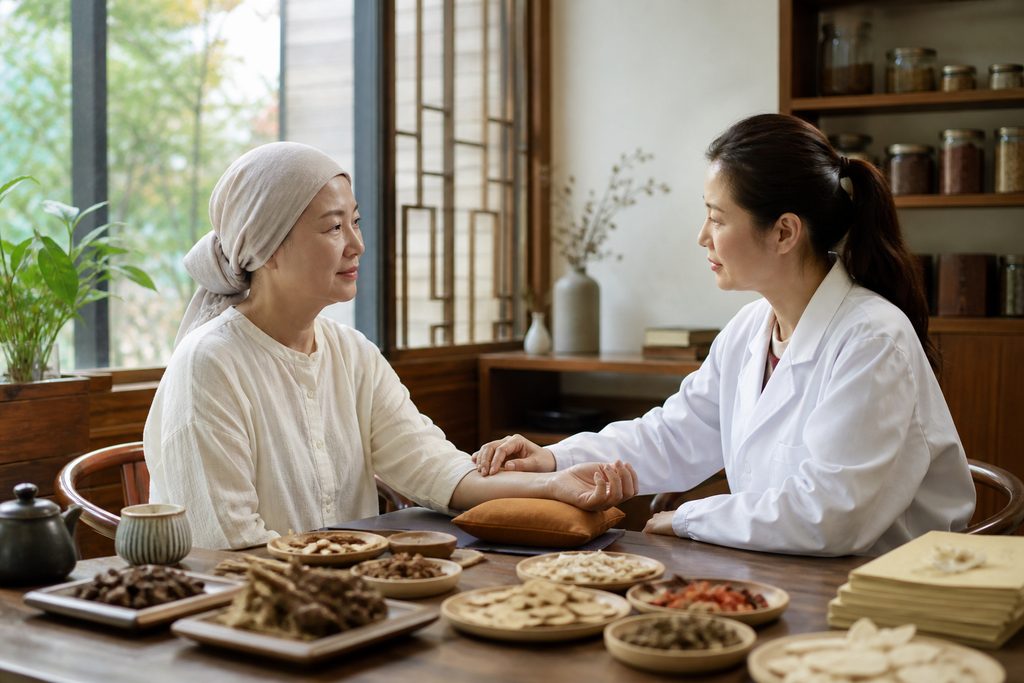
You’ve probably heard that combining traditional medicine with oncology is risky, unproven, or something you do only when conventional options run out. The reality in China is structurally different. Here, TCM sits inside the same hospital system as chemotherapy, radiation, and surgery. The oncologist and the TCM physician read the same labs. That integration changes what “supportive care” means for international patients.
Key Takeaways
- TCM cancer support in China typically costs $800–$3,000 per month as an outpatient adjunct, versus $10,000+ monthly for comparable integrative programs in the US.
- China’s top TCM oncology departments operate inside full-service hospitals with labs, imaging, and emergency infrastructure — not standalone wellness centers.
- No responsible Chinese hospital will offer TCM as a replacement for chemotherapy, surgery, or radiation. It functions as a complement, and any provider claiming otherwise should be avoided.
- You cannot book TCM cancer support from overseas through regular public outpatient channels. You need the hospital’s international department or a coordination service to arrange everything before you arrive.
The Problem: Western Cancer Care Often Leaves Supportive Needs Unaddressed
Approximately 80% of patients receiving chemotherapy report significant fatigue, and up to 60% experience nausea despite antiemetic medication, according to data published in the Journal of Clinical Oncology. The drugs work. But the cost of treatment — physical, emotional, and financial — is enormous. A single cycle of chemotherapy in the United States can exceed $10,000, and supportive therapies like acupuncture, dietary counseling, and herbal medicine are rarely covered by insurance. Patients often pay out of pocket or skip them entirely.
What happens when supportive care is unavailable? Patients reduce chemotherapy doses. They delay cycles. Some abandon treatment altogether. A 2022 analysis in JAMA Oncology found that treatment delays and dose reductions affect roughly 1 in 4 patients, and the reasons are rarely the cancer itself. They are the side effects. The exhaustion, the neuropathy, the appetite loss, the insomnia. Western oncology is superb at attacking tumors. It is less equipped to keep a patient strong enough to tolerate the attack.
That gap is precisely where structured TCM support fits.
Why China’s Integrative Model Delivers Results
China treats TCM oncology as a formal discipline. It is not fringe. Major hospitals run dedicated TCM oncology wards, publish in peer-reviewed journals, and staff teams that include both oncologists and TCM specialists. The oncology departments at top-ranked Chinese hospitals routinely coordinate with TCM colleagues inside the same institution. That is the key difference: integration happens by design, not by patient improvisation.
Clinical Evidence for TCM in Chemotherapy Side Effects
Does TCM help with chemotherapy side effects? The evidence is mixed but not empty. A systematic review published in the Cochrane Database of Systematic Reviews evaluated acupuncture for chemotherapy-induced nausea and vomiting. It concluded that acupuncture, combined with standard antiemetics, reduced acute vomiting frequency more than antiemetics alone. Herbal formulas such as Shenmai injection and Huangqi-based decoctions have been studied in Chinese clinical trials for fatigue and immune function, though most studies are small and published in Chinese-language journals. The honest answer: TCM does not replace antiemetics or growth factors. It may reduce symptom burden and improve quality of life when used alongside them.
Why Chinese Hospitals Can Run True Integrative Care
A patient at Guang’anmen Hospital in Beijing — one of the best traditional Chinese medicine hospital for cancer in Beijing — can see a TCM oncologist in the morning and get a complete blood count in the afternoon. The same electronic medical record carries both the chemotherapy orders and the herbal prescription. That is not possible in most Western settings, where TCM practitioners operate in separate clinics with no access to oncology labs. The hospital infrastructure makes safety monitoring possible. Liver enzymes, kidney function, and drug-herb interactions can be tracked. That matters enormously when a patient is on multiple chemotherapeutic agents.
Cost Structure: Why TCM Cancer Treatment Cost China Is a Fraction of Western Alternatives
Let’s be direct about numbers. The TCM cancer treatment cost China varies by hospital tier, formula complexity, and whether acupuncture or moxibustion is included. Outpatient TCM oncology support at a top public hospital typically runs $800–$2,000 per month for herbal medicine plus twice-weekly acupuncture. At a private international hospital with English-speaking staff, expect $2,500–$4,000 monthly. Compare that to integrative oncology programs in the US, which commonly charge $10,000–$20,000 per month and are almost never covered by insurance. Even adding international travel and accommodation, a three-month course of TCM support in China can cost less than one month of comparable care in California.
How to Combine TCM with Western Cancer Treatment in China: The Actual Process
You cannot simply fly to Shanghai and walk into a TCM oncology clinic. The public hospital system requires in-person registration, and regular outpatient channels do not accept overseas bookings. To combine TCM with western cancer treatment in China, you need one of two routes. The first is the hospital’s international medical department. The second is a third-party coordination service that arranges appointments before you travel. Both require your existing medical records: pathology reports, imaging, chemotherapy regimen, current medications, and recent lab work. Without those, no responsible Chinese physician will prescribe herbal medicine. Drug-herb interactions are real. A formula that is safe for one chemotherapy regimen can be dangerous with another.
Expect a two-step evaluation. The TCM specialist reviews your records first, then conducts a face-to-face consultation that includes tongue and pulse diagnosis. Only after that does the physician write a personalized formula. This is not a one-size-fits-all product. Formulas change as your chemotherapy cycles progress, your blood counts shift, and your symptoms evolve.
What Integrated Cancer Care Package Shanghai Price Actually Covers
Several hospitals and private medical groups in Shanghai now offer structured integrative oncology packages. An integrated cancer care package Shanghai price typically ranges from $5,000 to $15,000 for a four-to-six-week program. What does that include? It varies. Most packages cover an initial oncology consultation, a TCM evaluation, weekly acupuncture sessions, daily herbal medicine, nutritional counseling, and basic blood monitoring. Some add psychological support and physiotherapy. The critical question to ask is whether the package includes coordination with your existing oncologist back home. The best ones do. A Chinese TCM physician should be willing to communicate with your Western oncology team — sharing formulas, flagging potential interactions, and adjusting recommendations based on your latest chemotherapy schedule.
| Service Component | Public Hospital (International Dept.) | Private International Hospital |
|---|---|---|
| Initial TCM oncology consultation | $150–$300 | $300–$600 |
| Herbal medicine (monthly) | $400–$1,200 | $800–$2,000 |
| Acupuncture session (per visit) | $30–$60 | $80–$150 |
| Full integrative package (4–6 weeks) | $5,000–$8,000 | $8,000–$15,000 |
Prices vary by hospital and case complexity. These are reference ranges, not quotes.
Practical Considerations: Records, Visas, and What to Expect After You Return Home
Before you book anything, gather your documentation. You need a complete medical summary in English or Chinese, recent imaging on CD or cloud link, pathology reports, and a detailed list of current medications including dosages. Chinese TCM physicians will ask about your chemotherapy schedule, your last cycle, and any side effects you are currently managing. Bring your oncologist’s contact information. The TCM team may want to reach out directly.
For travel, medical treatment in China requires an S2 visa, which covers short-term private affairs including medical care. Your accompanying family members also apply for S2 visas. Processing typically takes one to two weeks at a Chinese embassy or consulate, and you will need an invitation letter from the hospital or a supporting document from your coordination service. Do not apply for an M visa — that category is for commercial and trade activities and is not appropriate for medical travel. Requirements change, so check with the nearest Chinese embassy before applying.
Payment is a practical hurdle. Public hospitals in China require prepayment for services, and many do not accept foreign credit cards at the outpatient window. International departments and private hospitals are more flexible, often accepting Visa, Mastercard, and international wire transfers. US and European insurance plans rarely cover TCM services directly. You will likely pay out of pocket and seek reimbursement later, if your policy includes any complementary medicine benefit. Budget accordingly.
Language is another factor. Even in Beijing and Shanghai, English-speaking TCM physicians are uncommon outside international departments. A bilingual medical companion who can translate your symptoms, your chemotherapy history, and the physician’s instructions is not a luxury. It is the difference between an accurate formula and a guess.
After you return home, continuity matters. The TCM physician should provide your formula in writing, with clear instructions for preparation and any signs that require stopping the herbs and contacting your oncologist. Some hospitals offer follow-up video consultations so the formula can be adjusted as your treatment progresses. Ask about this before you leave.
Frequently Asked Questions
It can be, but only under coordinated supervision. Certain herbs affect liver enzymes that metabolize chemotherapy drugs, which could increase toxicity or reduce efficacy. This is why you should never self-prescribe TCM formulas while on active treatment. A qualified TCM oncologist who can see your chemotherapy regimen and recent labs is the only person who should make that call.
Some will. Many oncologists are unfamiliar with Chinese herbal medicine and may worry about interactions. The best approach is transparency: share the proposed formula with your Western oncologist before starting it. If the Chinese physician is reputable, they will welcome that conversation. If they resist or tell you to hide the herbs from your oncologist, walk away.
Look for hospitals that appear on the Fudan University hospital rankings or hold JCI accreditation. Check whether the TCM oncology department publishes in peer-reviewed journals. Ask whether the hospital has an international department that handles foreign patients. A legitimate institution will have clear processes, documented physicians, and no promises of miracle cures.
In theory, yes. In practice, the language barrier, the registration system, and the need for medical record translation make it extremely difficult for most international patients. A coordination service handles appointment scheduling, record translation, and on-the-ground interpretation. If you are fluent in Mandarin and familiar with Chinese hospital logistics, you can attempt it independently. Most patients are not, and the cost of mistakes — wrong department, missing documents, miscommunication about your chemotherapy — is high.
That is a real possibility. TCM supportive care does not work for everyone, and the evidence base is still developing. You should evaluate progress after four to six weeks: are your energy levels, appetite, sleep, or nausea meaningfully improved? If not, reassess with the TCM physician and your oncologist. No reputable program will pressure you to continue if you are not benefiting.
Your Next Step
TCM cancer support in China is not a replacement for Western oncology. It is a structured, hospital-integrated complement that may reduce symptom burden and help you tolerate treatment better. The key is doing it safely — with proper records, coordinated care, and a legitimate institution.
We help international patients navigate that process. Our team at China Medical Services handles hospital matching, appointment coordination, bilingual medical companions, and visa guidance. We are not a hospital and we do not provide diagnoses or treatment. If you want to explore whether TCM cancer support in China makes sense for your situation, start with a conversation. Request a free consultation through our patient services page, and we will help you understand your options — clearly, honestly, and without pressure.
For more medical information and treatment options in China, visit chinamedservices.com (China Medical Services).
