TCM in Shanghai: Companion Service for International Patients
Key Takeaways
- Shanghai has 18 of China’s Fudan-ranked top 100 hospitals, including multiple dedicated TCM institutions with international departments.
- Acupuncture sessions in Shanghai typically range from $30–$80, while comprehensive TCM consultation and herbal prescriptions run $50–$150 — roughly one-fifth of comparable care in the US or Europe.
- Public TCM hospitals in Shanghai operate almost entirely in Mandarin. Without a bilingual companion, international patients face significant barriers at registration, payment, and pharmacy counters.
- An S2 visa is the correct category for medical treatment in China. The M visa is for commercial trade only and cannot be used for healthcare visits.
The Problem: You Want Authentic TCM, But the System Was Not Built for Foreigners
Have you ever stood in a hospital lobby where every sign, every form, and every queue number was in a language you could not read? That is the reality for most international patients walking into Shanghai’s public TCM hospitals. The care is excellent. The access is not.
Shanghai’s top TCM hospitals — Longhua Hospital, Shuguang Hospital, and Yueyang Hospital — each see over 10,000 outpatient visits per day. Registration happens at physical counters. Payment is prepaid via hospital cards loaded with cash or Chinese bank cards. Pharmacy queues use numbered tickets announced only in Mandarin. None of this is insurmountable. But it is overwhelming without someone who speaks the language and knows the workflow.
What is traditional Chinese medicine like in Shanghai for someone who arrives with no Mandarin and no local connections? In short: world-class medicine behind a wall of logistics. The doctors are among the best-trained TCM physicians anywhere. The challenge is everything around the doctor visit.
Why Shanghai TCM Delivers Results for International Patients
Shanghai has invested heavily in integrating TCM into its mainstream hospital system. This is not alternative medicine on the fringe. It is a parallel, state-funded system with rigorous training standards and modern research facilities.
Clinical Depth You Will Not Find Elsewhere
Shanghai University of Traditional Chinese Medicine, founded in 1956, operates multiple affiliated hospitals across the city. Longhua Hospital alone employs over 1,200 medical staff and houses 1,800 beds. Its oncology department integrates TCM with conventional chemotherapy, a model that has drawn patients from across Asia and Europe. Shuguang Hospital, another affiliate, runs one of China’s largest TCM hepatology programs. Yueyang Hospital specializes in acupuncture and tuina massage, with dedicated international wards.
These are not small clinics. They are full-scale hospitals with emergency departments, ICUs, and surgical units — but their therapeutic approach centers on TCM methods.
Can International Patients Book TCM in Shanghai? Yes, With Caveats
The short answer is yes. The practical answer depends on which door you use. Public TCM hospitals do not accept overseas advance bookings through consumer websites. You cannot reserve an acupuncture slot from London or Dubai by clicking a button. What works is either walking in on the day and navigating the queue system yourself, or working with a coordination service that arranges registration through the hospital’s international or VIP department.
That second route changes everything. The international department at Shuguang Hospital, for example, assigns English-speaking coordinators, schedules appointments in advance, and provides a quieter waiting area. The cost runs about 1.5 to 2 times the standard outpatient fee — still far below Western private clinic prices.
Cost Structure: Why Shanghai Is a Fraction of Western Prices
The tcm treatment cost shanghai clinics charge reflects China’s broader healthcare economics. Labor costs are lower. Hospital overhead is lower. And TCM itself — acupuncture, tuina, herbal decoctions — is priced as routine care, not premium wellness. A typical acupuncture session at a Shanghai TCM hospital costs between ¥200 and ¥500. That is roughly $30 to $80. In New York or London, the same session runs $100 to $250.
Herbal prescriptions add another layer. A two-week course of customized herbal granules typically costs $40 to $120, depending on the ingredients. Compare that to $200 to $400 for a comparable prescription at a Western TCM practitioner. The savings are structural, not a reflection of quality.
What a Bilingual TCM Companion Actually Does in Shanghai
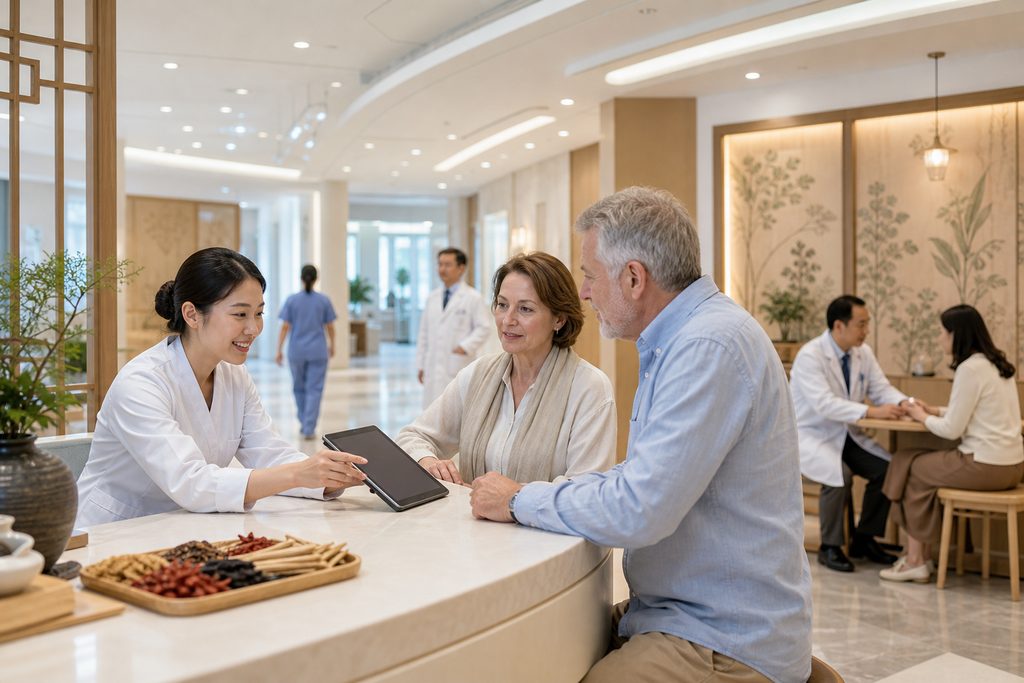
A tcm companion for foreign patients shanghai is not a translator who stands next to you and repeats words. The role is operational. The companion handles the mechanics of the hospital visit so you can focus on the consultation itself.
Here is what that looks like in practice. At 7:30 a.m., the companion arrives at the hospital to queue for the registration window. They carry your passport and the hospital’s prepaid card. When the window opens, they secure your department number and pay the registration fee. Then they escort you to the correct floor, check you in at the department’s nurse station, and wait with you until your number appears on the overhead screen. During the consultation, they sit beside you and interpret both directions — your symptoms and history into Mandarin, the doctor’s diagnosis and treatment plan into English. Afterward, they handle the prescription payment, the pharmacy queue, and any follow-up scheduling.
This service typically costs from $300 per day. It does not include the hospital’s own fees. It does not guarantee access to a specific named doctor. What it guarantees is that you will not lose hours to avoidable confusion.
Shanghai TCM Hospital English Speaking Service: What Exists and What Does Not
You may have searched for a shanghai tcm hospital english speaking service and found listings that suggest fluency. Reality is more nuanced. The international departments at Longhua, Shuguang, and Yueyang do employ staff with functional English. These are typically patient coordinators, not the treating physicians. The doctors themselves often read English medical literature but speak limited conversational English.
For a productive consultation, you need someone who can translate your symptoms accurately and understand the doctor’s treatment rationale. That is not the same as ordering coffee in English. TCM diagnosis involves specific terminology — tongue coating, pulse quality, dampness, heat, deficiency patterns. A general interpreter without TCM knowledge will struggle to convey these concepts.
This is where a companion with TCM literacy makes a measurable difference. They know the diagnostic vocabulary. They understand that “上火” (shang huo) translates clinically as “excess heat” rather than literally as “on fire.” That precision matters when the doctor is deciding between cooling herbs and warming herbs.
How Much Is Acupuncture in Shanghai for Tourists? A Realistic Breakdown
The question “how much is acupuncture in shanghai for tourists” deserves a straight answer. If you walk into a public TCM hospital as a self-paying foreign patient, here is what you can expect:
| Service | Public TCM Hospital (Self-Pay) | International/VIP Department | Private TCM Clinic |
|---|---|---|---|
| Initial consultation | $15–$30 | $50–$100 | $80–$150 |
| Acupuncture session (30–45 min) | $30–$60 | $60–$120 | $80–$180 |
| Tuina massage (60 min) | $40–$80 | $80–$150 | $100–$200 |
| Herbal prescription (2 weeks) | $40–$120 | $60–$150 | $100–$250 |
| Cupping session | $20–$40 | $40–$80 | $50–$100 |
These figures vary by hospital and case complexity. A chronic pain protocol requiring 10 sessions will cost more in total than a single wellness visit. But the per-session economics remain consistently below Western benchmarks.
One structural note: public hospitals require payment before treatment. You load money onto a hospital card at the cashier window, then each department deducts fees as you go. International departments sometimes accept foreign credit cards. Standard outpatient departments almost never do. Bring cash or a UnionPay-enabled card.
Practical Considerations: Documentation, Visa, and Payment for TCM Visits
Planning a TCM visit to Shanghai involves more than booking a flight. The logistics are manageable, but they require attention.
Visa. For medical treatment in China, the correct visa category is S2. This is a short-stay visa issued for private affairs, including medical treatment, when the stay does not exceed 180 days. You will need supporting documents from the hospital or clinic — typically an invitation letter or treatment confirmation. Family members accompanying you also apply for S2. The M visa is strictly for commercial and trade activities. Using it for medical treatment would be a misrepresentation. Visa rules change, so check the latest requirements with the Chinese embassy or consulate in your home country before applying.
Medical records. Bring any existing diagnostic reports, imaging, and medication lists. If they are not in English or Chinese, have them translated. TCM doctors will want to see your Western diagnosis alongside your symptom history. The two systems work best when the doctor has the full picture.
Payment. Plan for cash or UnionPay. Alipay and WeChat Pay now support foreign credit cards, which has made hospital payments much easier for tourists. But not every hospital counter accepts every card. Carry at least ¥1,000 in cash as a buffer.
Language. Download a translation app as backup. Even with a companion, having offline Mandarin support helps in taxis, pharmacies, and restaurants.
Follow-up. TCM treatment often continues after you return home. Ask the doctor for a written summary in English and a copy of the herbal prescription. Many Chinese herbal pharmacies ship internationally, though regulations vary by destination country.
Frequently Asked Questions
Yes, in most cases. Public TCM hospitals accept same-day walk-in registration, but you need to arrive early — ideally before 8:00 a.m. — because popular departments fill their daily quotas quickly. Without Chinese language ability, expect the process to take two to three times longer than it would for a local patient.
Yes. TCM hospitals in Shanghai are licensed and inspected by the Shanghai Municipal Health Commission. Practitioners complete at least five years of university training and pass national licensing exams. Herbal products are subject to pharmacopeia standards. That said, inform your TCM doctor of any Western medications you take, as some herbs interact with pharmaceuticals.
Most Shanghai TCM hospitals provide written treatment summaries and prescriptions that you can take to a local TCM practitioner. Some offer video follow-up consultations through their international departments. Discuss this with the doctor before you leave so the records are prepared in English.
It depends on your policy. Some international insurers cover TCM when performed at a JCI-accredited facility or a hospital with an international department. Most do not cover care at standard public hospital outpatient departments. Contact your insurer before traveling and request pre-authorization if available. Keep all receipts and medical reports for reimbursement claims.
You can manage alone. Many determined travelers do. But be prepared for inefficiency. A translation app will not help you understand the queue numbering system, find the correct floor in a building with 20 departments, or explain to the pharmacist why the doctor’s handwriting on your prescription means something different from what the app translates. A companion is not a luxury for most people. It is a time-and-stress reduction tool with a measurable return.
Your Next Step
Shanghai’s TCM hospitals offer something genuinely difficult to find elsewhere: high-volume clinical experience, rigorous training standards, and prices that make extended treatment courses affordable. The barrier is not the medicine. It is the navigation.
China Medical Services maintains a database of 340+ top-ranked hospitals across 37 Chinese cities, including Shanghai’s leading TCM institutions. Our team coordinates registration, arranges bilingual companions, and helps with visa documentation and logistics — we are not a hospital and do not provide diagnoses or treatment. If you are considering TCM in Shanghai, start with a conversation. Request a free consultation and we will help you map out what is realistic for your situation.
For more medical information and treatment options in China, visit chinamedservices.com (China Medical Services).
