Cancer Treatment Timeline in China: How Long Your Journey Takes
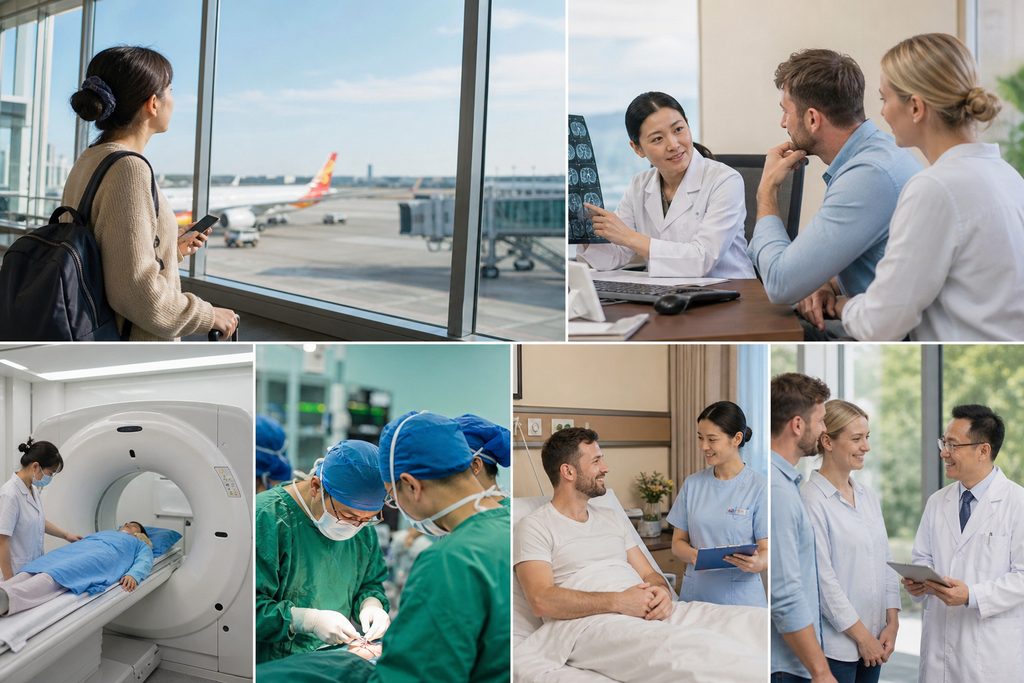
If you or a family member has received a cancer diagnosis, the question that keeps you up at night is probably not what the treatment is — it’s how long everything takes. How many weeks between sending your records and sitting in a Chinese oncologist’s office? How long does chemotherapy actually run? When can surgery be scheduled? The cancer treatment cost China matters too, but time is the currency you feel slipping away first. Our team coordinates treatment journeys for international patients across 340+ top-ranked hospitals in 37 cities, and we’ve learned that a realistic timeline — with its waiting periods, document steps, and clinical phases — is the single most valuable thing we can give a worried family. So here it is, plainly.
How This Actually Works, Step by Step
You don’t fly to Shanghai tomorrow and get admitted on Wednesday. That’s not how any serious oncology program works, in China or anywhere else. The process moves through distinct stages, and understanding them removes a lot of anxiety.
First, you send your existing medical records. Pathology reports, imaging (CT, PET-CT, MRI), surgical notes, current medication list, and a brief summary of your diagnosis and treatment history. Our team translates these into Chinese and submits them to the appropriate oncology department at a hospital matched to your cancer type.
Then comes the remote review. A Chinese oncology team examines your case and provides either a written second opinion or a video consultation. This step alone typically takes 3 to 7 working days once records are complete. The written second opinion from a top-tier specialist runs $300–500; a video consultation with a senior oncologist costs $500–800. Any of these fees are credited in full toward on-the-ground coordination if you proceed to treatment in China within 90 days.
After the review, if both sides agree there’s a feasible treatment plan, you move to scheduling. This is where the timeline becomes concrete. A hospital appointment coordination fee starts from $300, and if we cannot secure the appointment shown in your order, that fee is refunded in full.
What the Cancer Treatment Timeline China International Patient Journey Actually Looks Like
The phrase “cancer treatment timeline China international patient” gets searched a lot, but most results describe domestic Chinese patients, not foreigners. Your timeline as an international patient includes steps a local never thinks about: document translation, visa processing, and hospital international department coordination.
Here’s what you’re really asking: from the day you decide to explore treatment in China, how long until active treatment begins? For most patients, the answer falls between 3 and 8 weeks. That’s not a marketing number — it’s the range we see across oncology cases, depending on disease stage, hospital choice, and how quickly you can gather records and travel.
Chemotherapy, if that’s the recommended path, typically runs in cycles. A common regimen might be 4 to 6 cycles, each cycle lasting 3 to 4 weeks. That means how many weeks for chemotherapy in China usually lands between 12 and 24 weeks of active treatment, not counting recovery and follow-up imaging. Some protocols are shorter; some maintenance therapies extend much longer. Your oncologist will define this precisely after reviewing your pathology.
A Realistic Timeline
This table reflects what we tell families during their first consultation. Ranges are honest — some patients move faster, others slower. The waiting steps people forget are included.
| Stage | What Happens | Typical Duration |
|---|---|---|
| Day 1–7 | You gather and send medical records; our team translates them | 3–7 days |
| Week 1–2 | Remote written second opinion or video consultation with oncology team | 3–7 working days after records complete |
| Week 2–3 | Treatment plan agreed; hospital appointment coordination begins | 5–10 days |
| Week 3–5 | S2 visa application with hospital invitation documents | 1–3 weeks depending on your embassy or consulate |
| Week 4–6 | Travel to China; first in-person consultation and additional testing if needed | 2–5 days |
| Week 5–8 | Treatment begins — surgery, chemotherapy, or radiation as planned | Varies by protocol |
Notice the gap between “visa application” and “treatment begins.” That’s where most international patients underestimate time. Chinese public hospitals generally require an in-person consultation before scheduling surgery — you cannot book an operation from overseas through standard channels. The hospital’s international department or VIP pathway is the route that allows pre-arranged scheduling, and it costs roughly 1.5 to 2 times the standard rate. For many patients, that premium is worth the certainty.
What Can Go Wrong — and What Happens Then
We’d rather tell you now than have you discover it in an airport terminal. Several things routinely derail timelines.
Incomplete pathology. You send a CT report but not the actual imaging files. Or the pathology slides are missing. The Chinese oncology team cannot make a treatment decision without complete data. Fix: we send you a specific checklist before you gather anything. Missing items are caught early, not after submission.
Visa delays. The S2 visa — used for short-term private affairs including medical treatment — requires supporting documents from the hospital. If the hospital issues an invitation letter slowly, your visa appointment slips. We cannot guarantee visa approval, but we can ensure the hospital documents are correct and complete the first time, which prevents the most common rejection reason.
Disease progression. Sometimes the remote review reveals that the cancer has advanced beyond what the original records suggested. The Chinese team may request fresh imaging before agreeing to a treatment plan. This adds 1 to 2 weeks but protects you from traveling for a treatment that no longer fits.
Hospital mismatch. You requested a specific hospital, but your cancer type is better handled elsewhere. We tell you that directly. Better to adjust the plan before you fly than after you arrive.
Choosing Where to Go: What “Best” Actually Means
Search “best oncology hospital Shanghai for foreigners” and you’ll get a list of impressive names. But “best” without context is meaningless. A hospital ranked among China’s top 10 for oncology may be a poor choice for a rare sarcoma subtype. The right question is: which hospital has the strongest department for your specific cancer?
Fudan University’s hospital rankings — the most authoritative in China — evaluate 45 specialties separately. A hospital can be mediocre overall yet exceptional in thoracic surgery. That’s why we match by department, not by brand name.
Public hospitals in the Fudan Top 100 are concentrated in a few cities: Beijing has 21 of them, Shanghai 18, Guangzhou 10. For international patients, Shanghai and Beijing offer the most developed international departments with English-speaking staff. But a smaller city like Chengdu or Hangzhou may have a top-10 department in your specific cancer type at a lower overall cost. The oncology department rankings on our site break this down by specialty, so you can see which hospitals actually lead in your diagnosis.
Private international hospitals — United Family, Jiahui, Parkway, Raffles — offer English-speaking care, JCI accreditation, and direct insurance billing. They’re excellent for consultations, chemotherapy administration, and follow-up. For complex surgeries, however, many patients choose a public top-tier hospital for the operation and a private facility for recovery. We can coordinate both. See our private hospital directory for options with direct billing.
Practical Considerations: Records, Visa, Payment, and Follow-Up
Let’s get specific about the logistics that eat time if ignored.
Records. You need: pathology report (full, not summary), all imaging on CD or DICOM files, surgical notes if applicable, current medication list with dosages, and a one-page treatment history written by your current oncologist. The translation step is where we add the most early value — a mistranslated pathology term can change a treatment recommendation.
Visa. Medical treatment in China uses the S2 visa for stays under 180 days. Accompanying family members also apply for S2. The hospital provides an invitation letter and treatment confirmation. The M visa is for commercial and trade activities — it is not the correct category for medical travel. Processing times vary by country; apply as soon as the hospital documents are ready.
Payment. Chinese public hospitals require prepayment for treatment. International insurance typically works on a reimbursement basis — you pay the hospital, then claim from your insurer. Some private international hospitals offer direct billing, which eliminates the cash-flow burden. Cancer treatment cost China ranges widely: a course of standard chemotherapy might run $8,000–30,000 depending on drugs and cycles, while complex surgery with hospitalization can range from $15,000 to $50,000. Compare that to US costs, which are routinely 5 to 10 times higher for equivalent procedures.
Language. Even in international departments, you’ll encounter Chinese-language forms, pharmacy labels, and scheduling systems. A bilingual medical companion — from $300 per day — handles registration, queueing, payment, directions, and translation. It’s not a luxury; it’s the difference between a smooth visit and a disorienting one.
Follow-up at home. Before you leave China, your oncology team should provide a written summary in English: what was done, what the next 6 months should look like, which scans to schedule, and what symptoms warrant immediate attention. We ensure this document exists before you fly home.
Frequently Asked Questions
For most international patients, expect 3 to 8 weeks from sending complete records to beginning active treatment. The biggest variables are visa processing speed, how quickly you can travel, and whether the hospital requires additional testing after your arrival.
Public hospitals generally do not sell pre-packaged treatment bundles to overseas patients. What you can do is complete a remote evaluation, agree on a treatment plan, and then coordinate scheduling through the hospital’s international department. Our appointment coordination service starts from $300, with a full refund if we cannot secure the appointment shown in your order. That’s the closest thing to booking in advance — and it’s how serious international patients do it.
Yes, for equivalent procedures. Chemotherapy, surgery, and radiation in top Chinese hospitals typically cost one-fifth to one-tenth of US prices. A course of standard chemo might be $8,000–30,000 in China versus $50,000–100,000 in the US. But costs vary significantly by hospital tier, drug choice, and case complexity. Always get a written quote from the specific hospital before committing.
This happens occasionally, usually because the remote review was based on incomplete records. The hospital will order fresh imaging and bloodwork, adding 3 to 7 days before treatment starts. This is why we insist on complete records before you travel — it minimizes surprises.
No, but you need someone who does. International departments have English-speaking doctors, but the surrounding systems — registration, pharmacy, imaging, billing — are largely Chinese-language. A bilingual medical companion handles these interactions so you can focus on treatment.
Your Next Step
You now have a realistic picture of the timeline, the costs, and the failure points. That clarity is what lets you make a decision without panic. China Medical Services coordinates the entire journey — records translation, hospital matching across 340+ top-ranked hospitals, appointment scheduling, visa document support, and on-the-ground bilingual accompaniment. We do not provide medical treatment, and we never promise outcomes. What we do is remove the logistical chaos so you can focus on the medicine. If you’re weighing treatment in China, start with a conversation. Send your records for a remote review, or ask us which hospital fits your diagnosis. The first step costs nothing but a little time — and it might save you months of it later.
For more medical information and treatment options in China, visit chinamedservices.com (China Medical Services).
