Dental Implant Failure Repair in China: Our Specialist Match Service
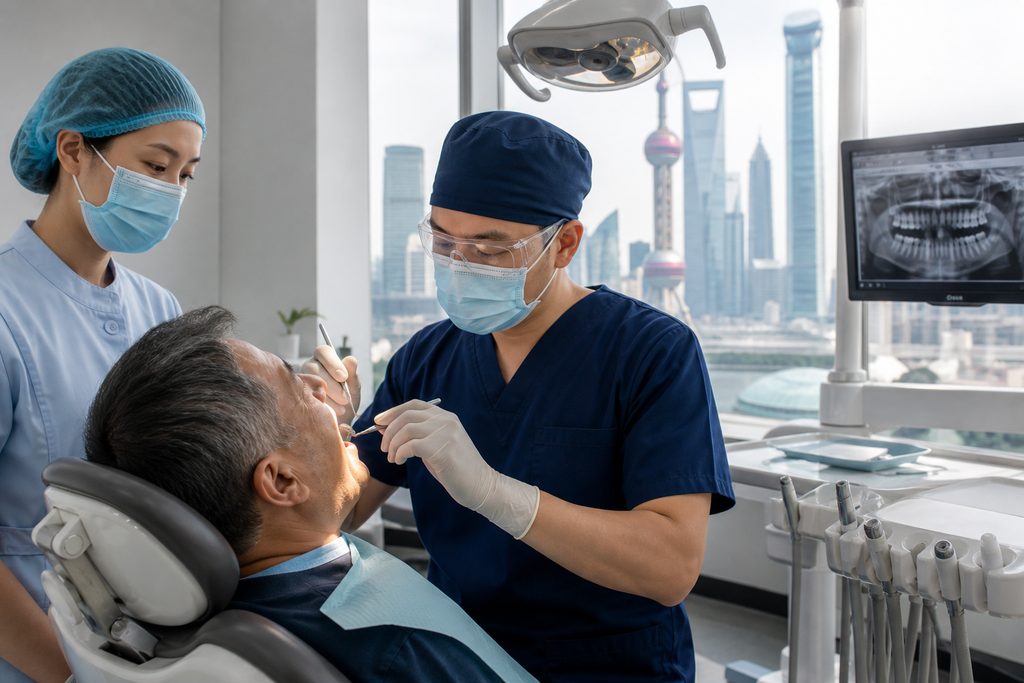
You might think a failed dental implant means another expensive surgery in your home country with the same uncertain outcome. The reality is more nuanced. Dental implant failure repair in China has become a serious option for international patients who want access to high-volume oral surgeons, advanced diagnostic imaging, and fees that often run at a fraction of Western prices. Our team at China Medical Services does not perform surgery. What we do is remove the friction between you and the right specialist — someone who has seen your specific complication many times before.
How This Actually Works, Step by Step
You are probably sitting on a set of panoramic X-rays, maybe a CBCT scan, and a letter from your local dentist explaining what went wrong. That is enough to start. You send us those records. We translate them into Chinese and forward them to the oral and maxillofacial department of a hospital that matches your case profile. Within 3 to 7 business days, you get a written assessment back — what the specialist thinks happened, whether the implant can be salvaged, and what repair would involve.
If you want to speak directly with the specialist before committing to travel, we arrange a video consultation. That typically costs between $100 and $300 for a standard international department specialist, or $500 to $800 if you want a top-tier expert. The fee is credited in full toward on-the-ground coordination if you proceed to treatment within 90 days.
Only after you have a clear plan and a realistic cost estimate do we help with hospital registration, appointment scheduling, and bilingual accompaniment. You are never asked to book a flight on a guess.
Why Dental Implant Failure Repair in China Attracts International Patients
Implant failure is not rare. Studies in peer-reviewed journals report failure rates between 5% and 10% over a 10-year period, with higher rates for smokers, patients with uncontrolled diabetes, and cases involving insufficient bone volume. The question is not whether failure happens. The question is who has the volume of experience to fix it properly.
China’s top oral and maxillofacial departments handle volumes that most Western clinics will never see. A single department at a major tertiary hospital in Shanghai or Beijing may perform several thousand implant-related procedures per year. That repetition matters when a case involves peri-implantitis, a fractured abutment, nerve proximity, or a failed sinus lift. Specialists at institutions featured on our department rankings pages routinely manage the complications that general dentists refer out.
Cost is the second factor. Repair surgery in the United States or Western Europe commonly runs $4,000 to $8,000 for a single implant removal and replacement, before bone grafting. In China, the same procedure at a top public hospital’s international department typically costs between $1,200 and $3,000. That range varies by hospital and case complexity, but the gap is real.
A Realistic Timeline
People underestimate how long a repair takes. Here is what we tell patients to expect, based on the standard flow at public tertiary hospitals.
| Stage | What Happens | Realistic Duration |
|---|---|---|
| Week 1 | You send records; we translate and submit them | 3–7 business days for written response |
| Week 2–3 | Video consultation if you want one | Schedule within 5–10 days |
| Week 3–5 | Visa application (S2 for medical treatment) | 2–4 weeks depending on your embassy |
| Month 2 | In-person consultation and imaging at the hospital | 1–2 days |
| Month 2–3 | Repair surgery scheduled after face-to-face evaluation | Usually 1–3 weeks after first visit |
| Month 4–6 | Healing and osseointegration before final restoration | 3–6 months, sometimes longer with grafting |
That last row surprises most people. You cannot fly in, get a failed implant replaced, and fly home with a finished crown in a week. Bone needs time. If a bone graft is required, the full sequence — removal, grafting, healing, new implant placement, second healing, final crown — can stretch to 8 months or more. Some patients split the process: surgery in China, final restoration with their home dentist. That is a legitimate plan, but it requires coordination between two providers.
What Can Go Wrong — and What Happens Then
We would rather you hear this from us than discover it in China. The public hospital system does not let you book surgery from abroad. You must be seen in person first. That is not a service failure; it is the rule. Anyone who promises you a guaranteed surgery date before you have set foot in the hospital is not being straight with you.
Another failure mode: records are incomplete. If your X-ray is a blurry phone photo, the Chinese specialist may ask for a new CBCT scan before giving an opinion. That means either getting one at home or arriving a few days early to have it done in China. We flag this early because it changes your timeline.
What if the specialist says the implant cannot be saved? That happens. Peri-implantitis with severe bone loss sometimes leaves no choice but removal and ridge reconstruction. In that case, the written opinion will say so plainly, and you will have a decision to make about whether to proceed with a staged reconstruction in China or at home. Our role is to make sure you get an honest answer, not a convenient one.
And if we cannot secure the appointment you wanted, the hospital appointment coordination fee is refunded in full. That is our rule, not a marketing line.
Choosing a Provider: What Actually Matters for Repair Cases
Most patients start by asking which hospital is best. The better question is which department sees your specific complication most often. A hospital that excels at cardiac surgery may have a perfectly competent oral surgery unit — but you want the place where implant failure repair is a routine part of the week, not an occasional referral.
Look for three things. First, does the department publish or report a high volume of implant and reconstructive cases? Second, does it have CBCT imaging on site, not just panoramic X-ray? Third, can you communicate with the specialist before traveling? If the answer to the third question is no, you are gambling. That is where our written second opinion service matters: you get a documented specialist review for $300 to $500, which is far cheaper than a wasted trip.
Also consider the hospital tier. The top 5% of China’s 35,000+ hospitals — ranked by the Fudan University hospital rankings and JCI accreditation — are concentrated in 37 cities. Our database covers 340+ top-ranked hospitals across those cities. For oral surgery specifically, Beijing, Shanghai, and Chengdu have particularly strong reputations, but the right match depends on your case details, not just city prestige.
One more thing: private international hospitals exist and offer English-speaking staff and direct insurance billing. They are convenient. But for complex implant failure repair, the deepest surgical experience usually sits in the public tertiary hospitals’ international departments. That is a trade-off worth understanding before you choose.
Practical Considerations: Records, Visa, Payment, and Follow-Up
Records come first. You need your original implant placement records if you have them, current panoramic X-rays, and ideally a CBCT scan. If the implant failed due to infection, bring any culture or antibiotic history. The more complete the file, the more useful the remote assessment.
Visa is straightforward but takes time. Medical treatment in China falls under the S2 visa category, which covers short-term private affairs including medical treatment. Accompanying family members also apply for S2. Your embassy will want a letter from the Chinese hospital confirming your appointment. We help you obtain that document once the hospital accepts your case. Processing time varies from 2 to 4 weeks depending on your country, so start early.
Payment works differently in China’s public hospitals. You prepay a deposit, and treatment is billed against it. Insurance reimbursement is usually retrospective — you pay, then claim from your insurer. Private international hospitals like those on our private hospital listings often bill insurers directly, but their surgical fees run higher. Decide which model fits your financial situation before you commit.
Language is the hidden barrier. A public hospital’s international department will have some English-speaking staff, but the moment you step into imaging, the lab, or the pharmacy, that support thins out. A bilingual medical companion — from $300 per day — handles registration, payment, directions, and translation. It is not a luxury for complex cases. It is the difference between a smooth day and a stressful one.
Follow-up after you fly home is the part nobody plans for. Your Chinese surgeon will want to see healing progress. That means you need a local dentist willing to take follow-up X-rays and share them. Some home dentists are cooperative; others are territorial. Sort this out before you travel, not after.
Frequently Asked Questions
At a top public hospital’s international department, a single implant removal and replacement typically ranges from $1,200 to $3,000. Bone grafting adds $500 to $1,500. Private international hospitals run higher, usually $3,000 to $6,000. Final costs vary by hospital and case complexity.
No. Public hospitals require an in-person consultation before scheduling surgery. What you can do remotely is get a written specialist opinion and a video consultation, so you arrive with a clear plan and realistic expectations. Surgery itself is scheduled after your first face-to-face visit.
Then you will receive an honest recommendation for removal and reconstruction, possibly with bone grafting. You are never obligated to proceed in China. The written opinion gives you a documented second view that you can also take to a local surgeon for comparison.
Your Next Step
Dental implant failure repair in China works best when you arrive with a specialist’s eyes already on your case. That is what we arrange. We are not a clinic and we do not perform treatment — we connect you with the right department, translate your records, coordinate your appointments, and put a bilingual companion beside you on the day. Start with a free consultation at our patient services page. Tell us what failed, send what you have, and we will show you what the path forward looks like. No pressure, no obligation — just a clear-eyed look at your options.
You came here worried about a failed implant. You leave with a plan. That is the whole point.
For more medical information and treatment options in China, visit chinamedservices.com (China Medical Services).
