Adding Endoscopy to Your Checkup in China: Cost, Safety, and How to Book
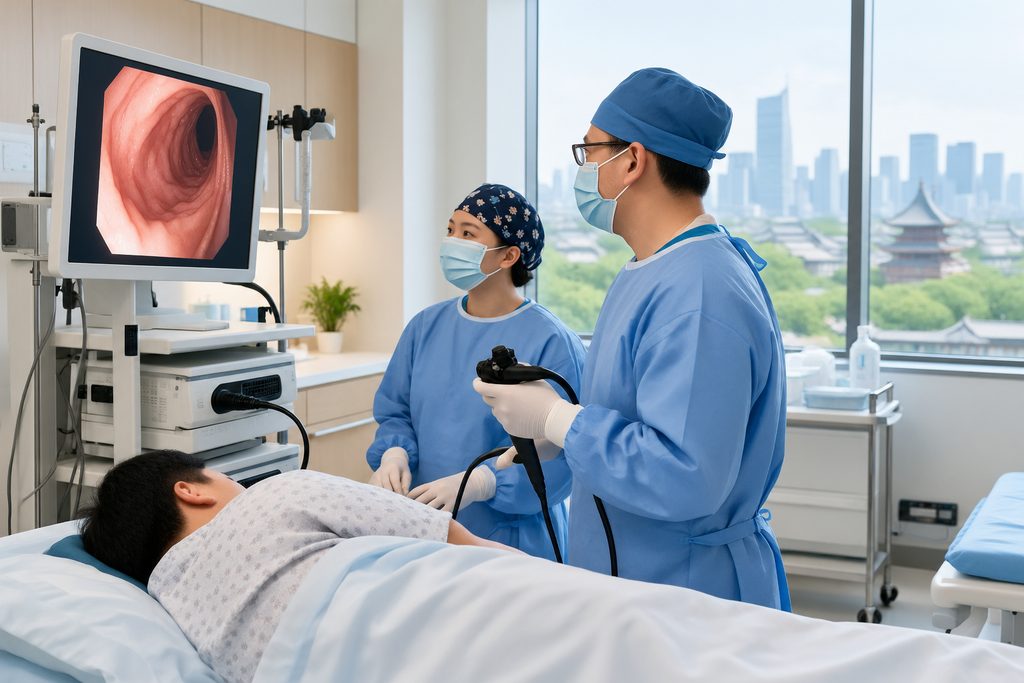
What if the most useful hour of your entire medical trip to China turned out to be the one you almost skipped?
That’s often how it goes with endoscopy. Patients come for a cardiac workup, a joint replacement, or a full-body physical, and somewhere in the planning they ask whether it’s worth adding a scope. Short answer: for many people over 40, yes. And the endoscopy checkup cost China hospitals charge is usually a fraction of what the same procedure runs in the United States or Western Europe.
But the details matter more than the headline number. Who should actually do this? Which hospital? How does a foreigner without Chinese language skills get an appointment? Let’s walk through it properly.
Adding Endoscopy to Your Checkup in China: The Short Answer
A diagnostic upper endoscopy (gastroscopy) at a top-tier Chinese public hospital typically runs $150–$400 for the procedure itself, and a colonoscopy generally lands between $250–$600. Sedation, biopsy pathology, and pre-procedure labs push the total higher. At private international hospitals, expect roughly two to four times those figures.
Here’s the complication. Price is the easy part. The hard part is that most public hospital endoscopy slots cannot be reserved from overseas in advance the way you’d book a specialist in London or Toronto. You generally need an in-person outpatient visit first, then the scope gets scheduled. That single rule reshapes how you should plan your trip.
Who This Is Right For — and Who It Isn’t
Endoscopy is not a spa treatment. It’s an invasive procedure with real, if uncommon, risks. Being honest about candidacy is the whole point.
Typically a reasonable candidate:
- Adults over 40 who have never had a colonoscopy and want colorectal screening while already traveling for another medical reason
- Anyone with persistent reflux, difficulty swallowing, unexplained weight loss, or a family history of gastric or esophageal cancer
- Patients with documented anemia or a positive fecal occult blood test who need a source identified
- People already in China for a comprehensive physical exam who want to consolidate procedures into one trip
Probably not the right move:
- Anyone with an acute active bleed, suspected perforation, or unstable cardiac status — that’s an emergency, not a checkup add-on
- Patients on certain anticoagulants who cannot safely pause them without their own cardiologist’s clearance
- Someone whose only motivation is curiosity. If you have no symptoms, no risk factors, and no screening indication, the yield is low
- Travelers staying fewer than five days. The scheduling reality usually won’t cooperate
The Options, Compared
Most international patients weigh three paths: a Chinese public hospital’s standard endoscopy unit, a Chinese public hospital’s international or VIP department, and a private international hospital. The differences are real and worth seeing side by side.
| Factor | Public Hospital — Standard | Public Hospital — International/VIP | Private International Hospital |
|---|---|---|---|
| Upper endoscopy (approx.) | $150–$400 | $400–$900 | $700–$1,600 |
| Colonoscopy (approx.) | $250–$600 | $600–$1,200 | $1,000–$2,500 |
| English-language service | Limited | Usually available | Standard |
| Advance booking from abroad | Generally not possible | Often possible | Yes |
| Wait time for a slot | Days to a few weeks | Shorter | Often within days |
| Insurance direct billing | No — pay first, claim later | Rarely | Common |
| Volume and case depth | Very high | High | Moderate |
Which column fits you? If budget drives everything and you have a Chinese-speaking companion, the standard public route delivers excellent clinical value. If you need English communication and predictable scheduling, the international department is the middle path most patients pick. Private hospitals suit people with international insurance that bills directly, or those who simply want a Western-style experience and don’t mind paying for it.
For a broader view of how these tiers differ by city, our ranked list of top hospitals in China groups facilities by Fudan ranking tier.
Is Endoscopy Safe in China Hospitals?
This is the question that keeps people up at night, and it deserves a straight answer.
China’s leading public hospitals perform enormous volumes of endoscopic procedures. Large tertiary centers run dedicated endoscopy suites with reprocessing protocols that follow national standards, and top facilities increasingly hold JCI accreditation or maintain international department protocols aligned with global practice. Volume itself is a meaningful safety signal — units that perform thousands of scopes annually tend to manage complications well because they’ve seen them before.
That said, safety is not uniform across all 35,000+ hospitals in the country. The gap between a top-tier tertiary center and a small local clinic is wide. This is precisely why hospital selection matters more than the price tag. Choosing a facility ranked in the top tier of the Fudan Hospital Rankings, or a JCI-accredited private hospital, meaningfully changes your risk profile.
Complication rates for diagnostic endoscopy are low in competent hands — bleeding and perforation are uncommon, and sedation-related events are the main concern for patients with cardiac or respiratory conditions. If you have significant comorbidities, that needs to be disclosed and assessed before scheduling, not on the day.
How Long Does Endoscopy Take — and What the Day Looks Like
The procedure itself is quick. A diagnostic upper endoscopy takes roughly 10 to 20 minutes. A colonoscopy typically runs 20 to 45 minutes, longer if polyps are removed. Add recovery time from sedation, usually 30 to 60 minutes, and you’re looking at a couple of hours in the facility.
The preparation is what eats your calendar. Colonoscopy requires bowel prep starting the day before — dietary restrictions and a cleansing solution that most patients describe as the least enjoyable part of the whole experience. Upper endoscopy usually requires fasting for six to eight hours beforehand.
If biopsies are taken, pathology results typically come back within 3 to 7 business days at major hospitals. Plan your departure accordingly, or arrange for results to be sent to you afterward.
Booking an Endoscopy Appointment in China as a Foreigner
Here’s where expectations need calibrating. Public hospitals in China generally do not offer overseas online scheduling for standard endoscopy. The workflow is: register on-site, see a gastroenterology outpatient physician, get the procedure ordered, then schedule the scope — sometimes same week, sometimes not.
International departments and VIP channels at major hospitals operate differently. They can often arrange appointments in advance, provide English-speaking staff, and coordinate the whole sequence. The trade-off is cost, typically 1.5 to 2 times the standard rate.
So when people ask how to book an endoscopy appointment in China, the honest answer depends on which tier you’re targeting. Standard route: arrive, register, see the doctor, schedule. International route: arrange ahead through the hospital’s international office or a coordination service.
If you’re specifically looking at the capital, the Beijing hospital directory breaks down which facilities offer international departments and English-language gastroenterology services. Peking Union Medical College Hospital and several other top-tier Beijing institutions are commonly cited for digestive disease expertise.
What Drives the Endoscopy Checkup Cost in China
Several variables move the final number, and understanding them prevents surprises.
- Sedation type. Conscious sedation costs less than monitored anesthesia care. Some patients opt for unsedated upper endoscopy, which is cheaper but uncomfortable
- Biopsies and pathology. Each specimen adds a charge. Multiple biopsies for screening protocols add up
- Hospital tier. A Fudan top-100 hospital charges more than a district facility — and is generally worth it
- Additional findings. If the physician removes polyps or treats a bleed during the same session, the procedure shifts from diagnostic to therapeutic and the price changes
- Pre-procedure workup. Blood tests, ECG, and anesthesia clearance are separate line items
For a rough planning figure: a foreign patient adding both an upper endoscopy and a colonoscopy at a top public hospital, with sedation and a few biopsies, should budget somewhere between $600 and $1,500 all-in. Private hospitals can exceed $3,000 for the same combination. These are estimates only — final pricing varies by hospital and case complexity, and every case is different.
Medical Tourism Endoscopy Packages in China: What to Expect
You’ll see the phrase “medical tourism endoscopy package China” floating around online. Some of what’s advertised is genuine; some is vague marketing. A legitimate package usually bundles the consultation, pre-procedure labs, the scope itself, sedation, and a follow-up review of results.
What a package cannot do is guarantee a specific physician or a specific date at a public hospital, because those slots are controlled by the hospital, not the intermediary. Be skeptical of anyone promising otherwise. Also be wary of packages that skip the pre-procedure consultation — that step exists for a reason, and it’s where contraindications get caught.
The most reliable approach is staged. Get a remote evaluation first, confirm whether endoscopy is even indicated for your situation, then commit to travel. Our team at China Medical Services structures it this way because it saves patients from flying across the world for a procedure they may not need.
Practical Considerations: Records, Visa, Payment, Follow-Up
Records. Bring prior endoscopy reports, imaging, medication lists, and allergy documentation in English or with translation. Chinese physicians work fast and appreciate organized records.
Visa. Medical travel to China uses the S2 visa, which covers short-stay medical treatment and private affairs; stays beyond 180 days fall under S1. Accompanying family members apply for S2 as well. Note that the M visa is for commercial and trade activity and has nothing to do with medical treatment. Requirements shift, so confirm current rules with the nearest Chinese embassy or consulate and bring supporting hospital documentation.
Payment. Public hospitals require prepayment. International insurance is typically reimbursed after the fact rather than billed directly, except at many private international hospitals. Bring a payment method that works in China — international cards are accepted at major hospitals but not everywhere.
Language. This is the practical wall. A top Chinese hospital may see tens of thousands of outpatients daily. Without Mandarin, navigating registration, payment, and the endoscopy suite is genuinely difficult. A bilingual medical companion handles queuing, registration, payment, wayfinding, and translation — it’s labor and coordination, not a shortcut around hospital rules.
Follow-up. Arrange for pathology reports and procedure documentation in a format your home physician can read. If a follow-up scope is recommended in one or three years, put it in your calendar now.
Frequently Asked Questions
At top-tier tertiary and JCI-accredited hospitals, yes — complication rates for diagnostic endoscopy are low and comparable to international norms. Safety varies by facility, so hospital selection matters more than price. Avoid small, unvetted clinics.
Usually not at standard public hospital outpatient departments, which require an in-person visit first. International and VIP departments, and private hospitals, can often arrange appointments in advance. Plan for flexibility either way.
For both an upper endoscopy and colonoscopy with sedation and biopsies at a top public hospital, budget roughly $600–$1,500. Private hospitals can exceed $3,000. Final pricing varies by hospital and case complexity.
Biopsies are sent for pathology, with results typically in 3–7 business days. If findings require treatment, the hospital will outline options, and you can decide whether to continue care in China or return home. Nothing commits you to treatment in advance.
Medical travel falls under the S2 visa category, with S1 for stays over 180 days. Accompanying family members also apply for S2. Confirm current requirements with your nearest Chinese embassy or consulate.
Your Next Step
Adding an endoscopy to a China checkup is a practical, cost-effective move for many international patients — provided you pick the right hospital tier, understand the scheduling reality, and plan enough buffer time. The clinical capability is there. The logistics are what trip people up.
We’re China Medical Services, a coordination service, not a hospital. We don’t diagnose or treat anyone. What we do is connect international patients with 340+ top-ranked hospitals across 37 cities, arrange written second opinions and video consultations with Chinese specialists, coordinate appointments through official international departments, and provide bilingual medical companions on the ground. A written second opinion runs $300–$500, and any consultation fee is credited in full toward on-the-ground coordination if you travel within 90 days.
If you’re weighing whether endoscopy belongs in your checkup, start with a conversation. Reach out for a free consultation — no pressure, no obligation, just a clear picture of what’s possible.
This article is for general information only and is not medical advice. Endoscopy carries risks and is not appropriate for everyone. Always consult a qualified physician about your individual situation before scheduling any procedure.
For more medical information and treatment options in China, visit chinamedservices.com (China Medical Services).
