AI Radiology China: Chest CT and X-Ray Analysis in Minutes at China Top Hospitals
Key Takeaways
- AI-assisted chest CT and X-ray analysis is now routine at China’s top-ranked hospitals, with preliminary results often available in under 5 minutes — compared to days or weeks in many Western health systems.
- An AI chest x-ray second opinion China price starts from $100–300 for a remote video consultation through a hospital’s international department, with findings reviewed and validated by a board-certified radiologist.
- Public hospital systems in China do not accept direct international patient bookings for standalone AI scans. You will need coordination through the hospital’s official international medical center or VIP channel — walk-in attempts rarely succeed without Mandarin fluency.
- AI serves as a triage and detection aid, not a standalone diagnostic authority. Every AI-generated finding at accredited Chinese hospitals is confirmed by a human specialist before a formal report is issued.
The Problem: Waiting Weeks for a Lung Scan Result That Could Change Everything
You noticed a persistent cough. Your doctor ordered a chest CT. Then the waiting began. In Canada, the median wait time between a CT scan and the result is 26 days. In the UK’s NHS, over 370,000 patients waited more than six weeks for a CT report in 2023 alone. The anxiety during that gap is corrosive. Every day feels like a gamble.
And lung disease does not wait. According to the World Health Organization, lung cancer remains the leading cause of cancer death globally, claiming approximately 1.8 million lives each year. Early detection on a chest CT or X-ray is the single most powerful intervention. But detection is only useful if someone reads the scan quickly. A 2023 study published in The Lancet Digital Health found that AI-assisted radiology workflows reduced report turnaround times by up to 77% in high-volume thoracic imaging centers. China has scaled this model aggressively.
What if you could upload your chest X-ray or CT scan today and receive a preliminary AI-assisted analysis within minutes — reviewed by a specialist at a hospital that handles over 10,000 outpatient cases daily? That is not a hypothetical. It is the operational reality at multiple hospitals in our network.
Who We Are
We are not a hospital. We do not interpret scans, diagnose conditions, or prescribe treatment. Our team acts as your logistical bridge to China’s top-tier medical infrastructure — coordinating appointments, translating medical records, arranging bilingual escorts, and navigating the visa process. Think of us as your local guide in a system that delivers world-class care at remarkable speed, but was not designed for international walk-ins. We connect you with 340+ top-ranked hospitals across 37 cities. The expertise is there. Accessing it is what we handle.
AI Radiology China: Chest CT and X-Ray Analysis in Minutes at China Top Hospitals — How It Actually Works
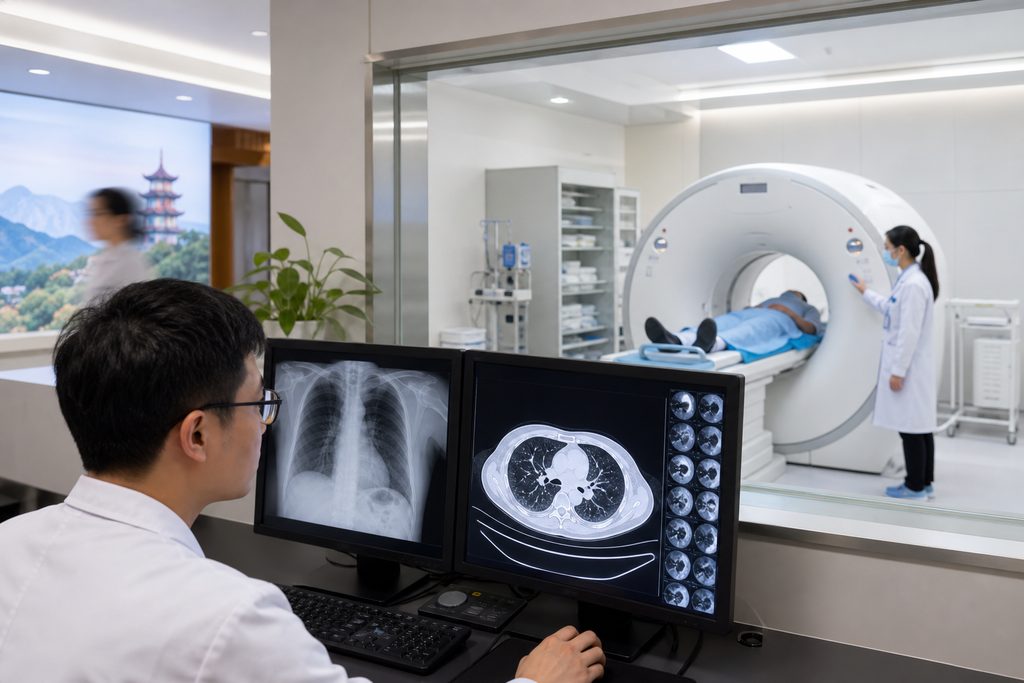
The phrase “AI reads your scan in minutes” sounds like marketing. But the workflow is grounded in real infrastructure. Chinese hospitals operate at staggering volumes. A single radiology department at West China Hospital in Chengdu processes over 2 million imaging studies annually. Human radiologists simply cannot keep pace with that throughput. AI tools — developed by firms like Infervision, Shukun Technology, and United Imaging — are integrated directly into the picture archiving and communication systems (PACS) used by clinicians. The AI model flags suspicious nodules, measures their dimensions, classifies them by malignancy risk, and pushes a preliminary report to the radiologist’s worklist.
This is not experimental. Infervision’s chest CT AI has been deployed in over 1,000 hospitals globally, with a significant concentration in China. A 2022 multi-center study published in Radiology showed that the AI achieved a sensitivity of 96.1% for detecting pulmonary nodules 5mm or larger on low-dose CT. Human radiologists reading the same scans without AI assistance had a sensitivity of 89.3%. The combination — AI plus human — pushed detection rates above 98%. That is the model used at the hospitals we work with.
The timeline matters. From the moment your DICOM files are uploaded, the AI generates a preliminary analysis in 2 to 5 minutes. A radiologist reviews and finalizes the report, typically within the same day for international patients using the VIP channel. Compare that to the 14-day average turnaround for a standard chest CT report in the United States. Speed does not replace rigor. But when you are waiting to know if a shadow on your lung is benign or not, speed is a clinical factor.
How accurate is AI radiology diagnosis in China compared to human radiologists?
This is the question every patient asks. The short answer: AI alone is less accurate than a trained radiologist. AI plus a radiologist is more accurate than either one alone. A landmark 2024 meta-analysis in JAMA Network Open examined 37 studies across 12 countries, including China, and found that AI-assisted chest X-ray interpretation reduced false-negative rates by 23% compared to unassisted human reading. For chest CT, the improvement was even more pronounced in detecting early-stage lung adenocarcinoma — a notoriously subtle finding.
But context matters. Chinese AI models are trained predominantly on Asian population data. Lung cancer epidemiology differs between populations. EGFR mutations, which drive a large proportion of lung adenocarcinomas in never-smoking Asian women, present with distinct CT features. A model trained on 500,000 scans from Chinese hospitals may detect patterns that a model trained on Western datasets misses. This is not speculation. A 2023 study from Shanghai Chest Hospital demonstrated that their in-house AI system outperformed three Western-developed models in detecting ground-glass opacities in a cohort of 15,000 Chinese patients. The specificity gap was 8 percentage points.
So the accuracy question has a layered answer. For common findings — nodules, consolidation, pleural effusion — AI at top Chinese hospitals performs comparably to board-certified radiologists. For rare or complex presentations, human oversight is not optional. Every hospital in our network mandates that an attending radiologist sign off on every AI-generated report. You are never receiving an unverified machine output.
Can AI read my chest CT scan faster than a doctor?
Yes. Unequivocally. The machine reads the scan in seconds. But that is not the right question. The right question is: can the combined AI-plus-doctor workflow deliver a verified report faster than a doctor alone? The answer is also yes. At Fuwai Hospital in Beijing, which performs over 140,000 cardiac surgeries annually, the radiology department implemented an AI triage system for chest X-rays in 2021. Critical findings — pneumothorax, large masses, severe edema — are now flagged within 90 seconds of image acquisition. The radiologist reviews those flagged studies first, cutting the average time-to-report for urgent cases from 4.2 hours to 22 minutes.
For international patients seeking a second opinion, the practical timeline is this: you send us your DICOM files. We upload them through the hospital’s secure portal. The AI runs immediately. A radiologist reviews the AI output alongside your original images, usually within 24 hours for a standard written second opinion. The fee for a written second opinion from a top specialist ranges from $300 to $500. If you upgrade to a video consultation with the radiologist, the cost is $500 to $800. And here is something worth knowing: any consultation fee you pay is fully credited toward on-the-ground coordination if you later decide to come to China for treatment. That credit applies for 90 days. It is a one-time credit, applied to coordination fees only — never to hospital treatment charges.
Fast CT Scan Interpretation China Top Hospitals: Where the Volume Argument Becomes a Quality Argument
Western patients often equate high volume with rushed care. The opposite can be true in radiology. A radiologist who reads 50 chest CTs per day develops pattern recognition that a radiologist reading 10 per day cannot match. This is the volume-quality paradox. Chinese radiologists at top-tier hospitals read an extraordinary number of studies. At Zhongshan Hospital Fudan University in Shanghai, the thoracic radiology team interprets approximately 800 to 1,000 chest CTs daily across the department. That is not a typo. The caseload includes everything from routine health screenings to complex interstitial lung disease.
Consider lung cancer screening specifically. China’s national lung cancer screening program, launched in 2012, has enrolled over 2 million high-risk individuals. The data throughput from that program has been used to train AI models now deployed in clinical practice. When you seek a fast CT scan interpretation at a top Chinese hospital, you are plugging into a system that has seen more lung pathology in a month than many Western hospitals see in a year. That does not guarantee a better read. But it shifts the odds.
Best hospitals in China for AI-assisted lung screening
Several institutions stand out for thoracic imaging. Shanghai Chest Hospital is arguably the most specialized — it is a dedicated chest hospital with a radiology department that has published extensively on AI-assisted nodule detection. Their team developed one of the earliest deep learning models for classifying ground-glass nodules, and the hospital performs over 30,000 lung cancer surgeries annually. Peking Union Medical College Hospital in Beijing offers a broader diagnostic scope, with an integrated AI platform covering chest, neuro, and abdominal imaging. West China Hospital in Chengdu has the largest single-center lung cancer screening database in the country and runs a dedicated international patient center with English-speaking coordinators.
For international patients, the practical distinction is not just clinical quality — it is accessibility. Not all top hospitals have streamlined pathways for foreign patients seeking standalone radiology second opinions. We work most frequently with hospitals that have dedicated international medical centers: Shanghai and Beijing are the two cities with the highest concentration of these facilities. The hospitals we recommend for AI-assisted lung screening all meet three criteria: board-certified thoracic radiologists on staff, an FDA- or NMPA-approved AI system integrated into their PACS, and an English-speaking patient coordinator available through the international department.
Book AI Radiology Package Shanghai International Patient: What the Process Actually Looks Like
There is no “book now” button for radiology services at Chinese public hospitals. The system was built for domestic patients who show up with a national ID card, pay via WeChat or Alipay, and navigate the hospital in Mandarin. International patients face a different reality. You cannot simply email the radiology department and request a scan. You need a clinical indication, a referral pathway, and someone on the ground who can shepherd the process.
Here is the actual workflow when you work with us. First, you contact us for a free consultation. We review your existing imaging, your clinical history, and what you are trying to accomplish — is this a second opinion on an existing scan, or do you need new imaging acquired in China? If you need new imaging, we coordinate with the hospital’s international medical center to schedule a chest CT or X-ray, typically within 3 to 5 business days. The hospital requires a preliminary clinical review before scheduling — they will not scan you without a reason. We handle that documentation.
On the day of your appointment, a bilingual medical companion meets you at the hospital. They handle registration, payment, and navigation. The scan itself takes 10 minutes for a chest CT, less for an X-ray. The AI runs immediately. A radiologist reviews the findings. You receive a verbal summary through your companion within hours, and a formal written report — translated into English — within 24 to 48 hours. If you want a video consultation with the radiologist to discuss the findings, we schedule that for the following day. The entire process, from first contact to final report in hand, can be completed within a week.
The cost for an AI chest x-ray second opinion China price starts at $100 for a basic remote video consultation interpreting images you already have. New imaging acquired in China adds hospital fees, which vary by institution but typically range from $150 to $400 for a chest CT at an international medical center. Our coordination fees are separate and start from $300 for appointment scheduling. Every dollar of our coordination fee is credited toward future treatment coordination if you proceed within 90 days.
What You Need to Know Before Going Alone
The barriers are real. We do not sugarcoat this. Understanding them upfront prevents wasted flights and expensive misunderstandings.
- Visa Requirements: Medical travel to China requires an S2 visa with a notation specifying medical treatment as the purpose. This is not a tourist visa. The application requires an invitation letter from the Chinese hospital confirming your appointment. Obtaining that letter independently — without a local contact at the hospital’s international department — is extremely difficult. Most hospital websites do not have a “request invitation letter” form. You need someone to physically walk the request through the administrative office. We handle this as part of our coordination service.
- Payment Systems: Chinese public hospitals operate on a prepaid model. You load funds onto a hospital card at registration, and services are deducted as you go. International credit cards are not accepted at most public hospital payment counters. You need either a Chinese bank card, a large amount of cash, or a local intermediary who can front the payment. Our companions manage this logistics layer so you do not have to stand in a 45-minute queue only to be turned away at the cashier.
- Language and Navigation: A top Chinese hospital sees 10,000 to 20,000 outpatient visits daily. Signage in English is inconsistent. Registration kiosks are Mandarin-only. Radiology departments often require patients to pick up printed reports from a machine that only displays Chinese text. Without a bilingual companion, a simple chest X-ray can become a full-day ordeal. This is not a criticism of the system — it is a system optimized for 1.4 billion domestic users. International patients are an edge case, and the friction is structural.
How We Help You Navigate This
These barriers exist for structural reasons. They are not insurmountable. Our role is to absorb the friction so you can focus on the medical outcome. Before you travel, we secure your hospital appointment, obtain the official invitation letter for your S2 visa, translate and transmit your existing medical records, and brief you on exactly what to expect. During your visit, a bilingual medical companion meets you at the hospital entrance and stays with you through every step — registration, payment, the scan itself, and the post-scan consultation. After you return home, we remain available for follow-up coordination, additional second opinions, or treatment planning if you decide to proceed with care in China.
We charge for this service because it is labor-intensive and detail-critical. A missed document or a misunderstood instruction can derail a trip that cost you thousands in flights and lodging. Our pricing is transparent: bilingual medical companionship starts from $200 per day, appointment coordination from $300, and comprehensive VIP coordination from $5,000 for complex multi-hospital itineraries. The consultation fees you pay for radiology second opinions are credited toward any future treatment coordination. We structure it this way because we believe the initial consultation should de-risk the decision — not lock you into a commitment you are not ready to make.
Frequently Asked Questions
You can do either. If you have a recent chest CT or X-ray in DICOM format, we can submit it for AI-assisted analysis and radiologist review through the hospital’s second opinion service. The AI reads your existing images exactly as it reads scans acquired on-site. The written second opinion costs $300 to $500. If your existing images are older than three months, or if your clinical situation has changed, the reviewing radiologist may recommend new imaging — and we can coordinate that on the same trip.
This is the strength of the dual-reader model. If the AI flags a suspicious nodule that the radiologist initially overlooked, the system pushes an alert to the radiologist’s worklist for mandatory re-review. If the radiologist disagrees with the AI’s classification, their judgment overrides the machine. The final report reflects the radiologist’s determination, with AI findings noted as supplementary data. You receive one unified report, not two conflicting reads. In the rare case of genuine ambiguity, the radiologist may recommend a short-interval follow-up scan or a multidisciplinary discussion — and we can coordinate that follow-up remotely.
Chinese hospital data security is governed by the Personal Information Protection Law (PIPL), which came into effect in 2021 and imposes requirements broadly comparable to GDPR in Europe. Hospitals in our network transmit imaging data through encrypted hospital portals, not through consumer messaging apps or unsecured email. We act as the conduit — you send your files to us via a secure upload link, and we deliver them into the hospital’s system. We do not store your medical data beyond what is necessary to complete the coordination. For patients with specific institutional or governmental data sovereignty requirements, we can discuss additional safeguards on a case-by-case basis.
No. This is not negotiable at any accredited hospital in China. AI output is considered a clinical decision support tool, not a diagnostic product. Every hospital in our network requires an attending radiologist to review, validate, and sign the final report. If you are looking for a raw, unverified AI read without human oversight, we cannot help you — and we would strongly advise against pursuing that path anywhere. Unverified AI reads are not clinically actionable and can cause more harm than good.
Through the international medical center pathway, we can typically secure a chest CT appointment within 3 to 5 business days. Urgent cases can sometimes be accommodated within 24 to 48 hours, depending on the hospital’s schedule and the clinical urgency. The limiting factor is rarely the scanner itself — Chinese hospitals have abundant CT capacity. The bottleneck is the administrative coordination: securing the appointment slot, preparing the bilingual documentation, and aligning the radiologist’s availability for a same-day read. We compress that timeline by handling the coordination in parallel, not sequentially.
Your Next Step
Waiting for a lung scan result is a specific kind of dread. You check your phone. You re-read the same inconclusive message from your doctor’s office. You wonder if the delay is bureaucratic or if someone has already seen something concerning and is deciding how to tell you. The AI-assisted radiology workflow at China’s top hospitals does not eliminate uncertainty — no test can — but it collapses the waiting period from weeks to hours. A preliminary result in minutes. A verified report in a day. And a pathway to treatment coordination if the findings warrant it.
If you have a chest X-ray or CT scan you want analyzed, or if you are considering traveling to China for new imaging, start with a free consultation. We will review your situation, explain your options, and give you a clear picture of timelines and costs. No pressure. No commitment. Just an honest assessment from a team that has guided hundreds of international patients through this exact process. Get a free consultation here.
For more medical information and treatment options in China, visit chinamedservices.com (China Medical Services).
