Airport Security and Chinese Implants: What to Do If You Get Flagged
While the average American patient receiving a total knee replacement faces a bill north of $35,000, the same procedure using an equally robust, internationally certified implant at a top-tier Chinese orthopedic center costs between $8,000 and $15,000. That stark price difference has driven a quiet but steady flow of medical travelers to hospitals in Beijing and Shanghai. The surgery goes well. The recovery is on track. And then, months later, you’re standing in the security line at O’Hare or Heathrow, and the body scanner lights up on your hip. The agent pulls you aside. Your mind goes blank. What to do if airport security flags my medical implant from China is a question that catches too many returning patients off guard. It shouldn’t. The solution is almost always straightforward, but only if you prepared for it before you left the hospital.
How This Actually Works, Step by Step
Airport body scanners don’t identify the brand or origin of your implant. They detect density anomalies. A titanium femoral component or a cobalt-chrome acetabular cup shows up as a dark void on the millimeter-wave image because the signal can’t penetrate it. The machine flags the area. The officer performs a secondary screening. That’s the entire process in a technical nutshell.
The human side is what trips people up. An officer sees a flagged hip on a passenger who flew in from China. They ask for documentation. You fumble through your carry-on. You realize the discharge papers are in Mandarin. The officer can’t read them. You get nervous. They get more thorough. The pat-down takes longer. You might miss your connection.
Here is the sequence that prevents that scenario:
Before you leave the Chinese hospital, you request two specific documents. The first is a formal implant identification card. Every legitimate orthopedic manufacturer provides these. It lists the implant model, serial number, material composition, and the date of surgery. The second is a hospital letter on official letterhead, in English, stating that you underwent a specific procedure, the implant was placed, and it contains metallic components that will trigger security screening. The letter should include a contact number for the hospital’s international department.
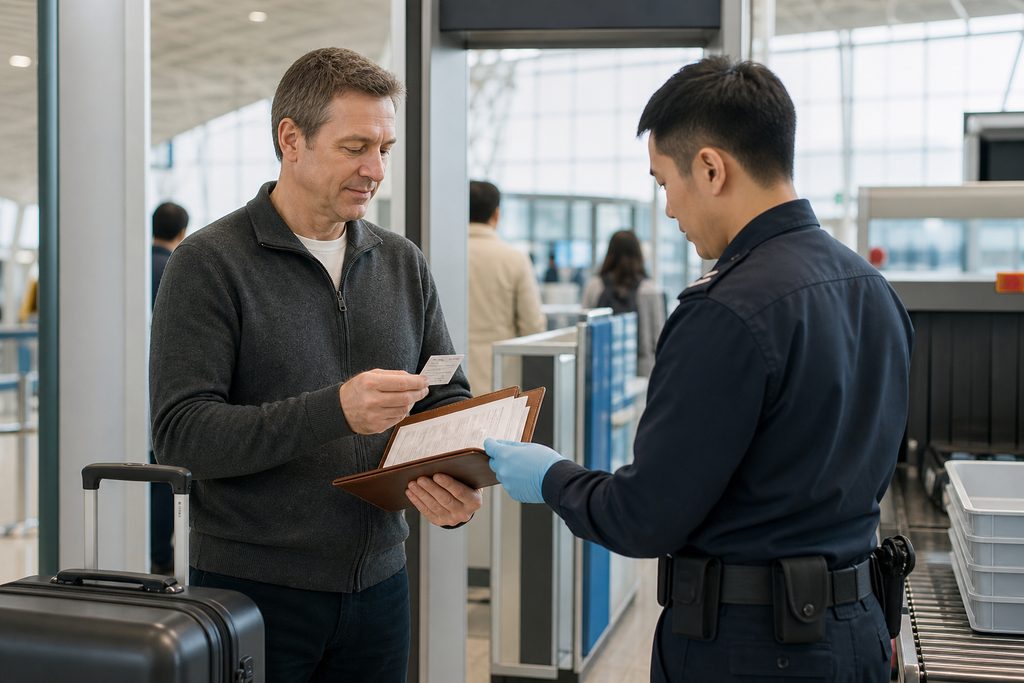
You carry these documents in your hand luggage. Not checked. When the scanner flags you, you state calmly: “I have a surgical implant. Here is my documentation.” You hand over the implant card and the English-language hospital letter. The officer reviews them. They may still perform a swab test or a limited pat-down. But the interaction stays professional and brief. You clear secondary screening. You board your flight.
The entire episode takes five minutes instead of thirty. The difference is the paperwork.
What to Do If Airport Security Flags My Medical Implant from China: The Documentation You Actually Need
Let’s get specific about the documents. Patients often assume their discharge summary is enough. It isn’t. A discharge summary describes your hospital stay. It might mention the procedure in clinical shorthand. It rarely lists the implant manufacturer, model, and serial number in a format a TSA or airport security officer can quickly verify.
The gold standard is the manufacturer-issued implant card. Companies like Johnson & Johnson’s DePuy Synthes, Zimmer Biomet, Stryker, and Smith & Nephew supply these cards with every implant kit. Chinese hospitals use the same multinational implant brands that Western hospitals use. A hip implant placed at Peking University Third Hospital is likely a DePuy or Zimmer product, identical to what you’d receive in Boston or Berlin. The card is in English because the manufacturer is a global entity.
If the hospital used a domestic Chinese implant brand—companies like Wego, AK Medical, or Chunli—the card may be bilingual or primarily in Chinese. In that case, you need the hospital to provide a certified English translation of the card’s key fields: patient name, implant name, model number, serial number, material, and implanting hospital. Our team handles this routinely. We’ve seen too many patients leave Beijing with a card written entirely in Chinese characters and then face a confused security officer in Frankfurt. The fix is simple if you address it before departure.
The second essential document is the hospital verification letter. This is different from the implant card. The letter serves a different function: it establishes that a licensed medical institution performed the surgery. The implant card says what is inside you. The hospital letter says who put it there and why. Together, they answer the two questions a security officer is trained to ask: “What is this object?” and “Is there a legitimate medical reason for it?”
A proper hospital letter includes:
- Hospital name, address, and official stamp
- Treating physician’s name and department
- Date of surgery
- Procedure performed
- Implant type and location
- Statement that the implant contains metal and will trigger security detectors
- 24-hour contact number for the hospital’s international desk
One practical note: get two original copies. Keep one in your carry-on. Pack the other in your checked luggage as a backup. Documents get lost. Having a spare in your suitcase has saved more than one patient from a very long conversation with airport security.
Can Airport Body Scanners Detect Chinese Titanium Hip Implants? The Technical Reality
This is a difficult situation. Contact the hospital’s international department and request a duplicate. If they refuse or are unreachable, contact the implant manufacturer directly. Provide your name, surgery date, and hospital. The manufacturer can often verify the implant from their shipment records and issue a duplicate card. This process takes weeks, not days. If you’re traveling imminently without a card, bring whatever surgical records you have, arrive early, and expect extended screening. You’ll still get through.
No. There is no official TSA-issued implant card that exempts you from screening. TSA PreCheck and Global Entry speed up the document-check portion of security but do not exempt you from the body scanner. If your implant flags the scanner, you will undergo secondary screening regardless of your trusted traveler status. The implant card is not a free pass. It’s documentation that explains the flag and keeps the secondary screening brief and professional.
The leading Chinese orthopedic manufacturers produce implants that meet NMPA standards and, in many cases, hold CE certification for the European market. Clinical outcomes data has improved significantly, with several studies showing comparable short- to mid-term survival rates. That said, long-term data beyond 10–15 years is still accumulating for some domestic brands, whereas multinational brands have 20–30 year registry data. This is a conversation to have with your surgeon before the procedure, not something an airport security officer will ask about.
You can, but it’s not required. Some travelers choose to inform the officer before stepping into the scanner: “I have a hip implant, just so you know.” This can smooth the interaction because the officer is expecting the flag. Others prefer to wait until flagged and then present documentation. Either approach works. What doesn’t work is saying nothing, getting flagged, and then having no documentation ready.
Your Next Step
Airport security and Chinese medical implants is a solvable problem. It requires exactly two documents—an implant card and an English-language hospital letter—and the presence of mind to keep them in your carry-on. The stress comes from not knowing what to expect. Now you know.
Our team at China Medical Services helps international patients navigate Chinese hospitals from the first consultation through post-operative documentation. We don’t perform surgery. We make sure you leave the hospital with the paperwork that lets you travel home without a security checkpoint ordeal. If you’re considering orthopedic surgery in China or have already had a procedure and need help obtaining proper travel documentation, we can help. Reach out for a free consultation and we’ll walk you through what you need.
Frequently Asked Questions
Yes. The hospitals used for international patients are JCI-accredited and follow the same international safety standards as top hospitals in the US and Europe. Surgical teams perform high volumes of procedures — often more than their Western counterparts — which studies show leads to better outcomes.
Costs vary by procedure and hospital, but international patients typically save 40-80% compared to US prices — even when factoring in travel and accommodation. A consultation with our team will give you an exact, all-inclusive quote with no hidden fees.
Send us your existing medical reports to get started. We handle everything from hospital selection and appointment scheduling to visa assistance and post-operative recovery planning. Your medical records are reviewed by the specialist before you even book a flight.
For more medical information and treatment options in China, visit chinamedservices.com (China Medical Services).
