Can I Get Aligners and Travel to China? Costs, Clinics, and Realistic Planning
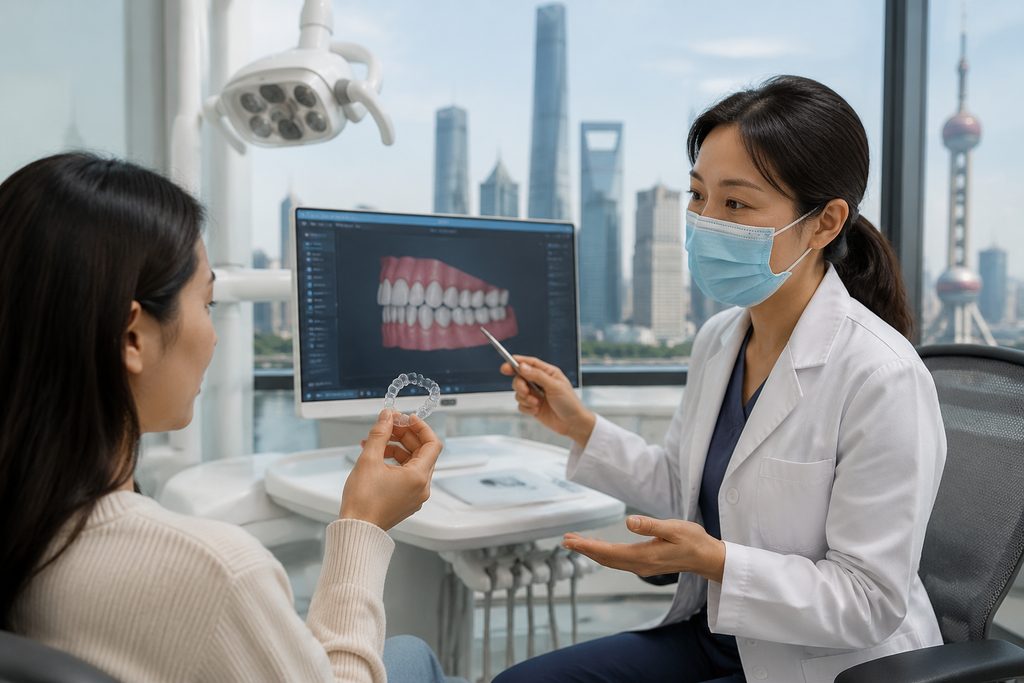
Can I Get Aligners and Travel to China? A Practical Guide to Invisalign Cost China and Treatment Logistics
Key Takeaways
- Invisalign cost China typically ranges from $3,500 to $6,500 for a full treatment plan — roughly 40-60% less than the $6,000-$9,000 average quoted in the United States.
- China’s top dental clinics in Beijing and Shanghai use the same FDA-cleared aligner systems and digital scanning technology found in Western practices, with many orthodontists trained internationally.
- Orthodontic treatment requires multiple visits over 12-18 months — a single “dental tourism” trip cannot complete a full aligner course, so hybrid remote monitoring plans are essential.
- Foreign patients use an S2 visa for private medical treatment, not an M visa; you will need an invitation letter from the treating clinic and a detailed treatment plan before applying.
Have you ever stared at a $7,500 orthodontic quote and wondered if there is a smarter way to get the smile you want? What if the same aligner system, prescribed by a comparably trained orthodontist, cost half as much — and the only catch was a flight you were already considering?
The search phrase “can I get aligners and travel to China” is more common than you might think. Dental patients from the US, UK, Australia, and the Middle East routinely ask us about Invisalign cost China comparisons, treatment timelines, and whether combining orthodontics with international travel is realistic. The short answer: yes, with careful planning. The longer answer involves understanding what aligner treatment actually requires, how Chinese clinics structure care for international patients, and which costs are genuinely lower versus which are not.
This guide breaks down the real numbers, the clinical workflow, the visa mechanics, and the hard questions you should ask before booking anything. We do not sell aligners. We help patients navigate China’s medical system — and that starts with honest information.
The Problem: Orthodontic Care in Western Markets Has Become Prohibitively Expensive
Modern aligner treatment begins with an intraoral scan — no messy impressions. Chinese clinics adopted this technology rapidly. At major private dental groups in Shanghai and Beijing, you will find iTero scanners, cone-beam CT imaging, and ClinCheck treatment planning software — the same tools used in any high-end Western practice. The digital records can be shared across borders, which matters enormously for international patients who cannot stay in China for the full 12-18 month treatment course.
Let us address the obvious objection directly: does lower cost mean lower quality? Not in this case. The lower cost is structural, not clinical. Chinese orthodontists earn less than their American counterparts — not because they are less skilled, but because the overall wage scale for medical professionals differs. Clinic rents in Shanghai’s central districts, while high, remain below comparable spaces in Manhattan or central London. And patient volume spreads fixed costs across more cases.
Clinical outcomes for aligner treatment depend on case complexity, patient compliance, and the orthodontist’s treatment planning skill — not on the country where the scan was taken. A well-planned Invisalign case in Shanghai uses the same ClinCheck software, the same aligner material, and the same biomechanical principles as one in San Francisco.
Real Numbers: Comparing Invisalign Cost China, Shanghai, and Beijing
If you search for clear aligner treatment Shanghai price or best dental clinic Beijing for aligners, you will find a wide range. That range reflects different clinic tiers — from public hospital dental departments to premium private international clinics. Here is what current market data shows for full comprehensive aligner treatment, including all aligners, attachments, and retention:
| Treatment Setting | Typical Cost Range (USD) | Notes |
|---|---|---|
| US Private Orthodontist (Invisalign) | $6,000 – $9,000 | Comprehensive case, includes retainers |
| UK Private Orthodontist | £3,500 – £5,500 ($4,400 – $6,900) | NHS does not cover adult cosmetic orthodontics |
| Shanghai Premium Private Clinic (Invisalign) | $3,800 – $6,500 | English-speaking staff, international patient coordination |
| Beijing International Dental Clinic | $3,500 – $6,000 | Includes digital scanning and ClinCheck planning |
| Chinese Public Hospital Dental Department | $2,500 – $4,500 | Lower cost, but limited English support and longer queues |
| Domestic Chinese Aligner Brand (Angelalign) | $2,000 – $3,800 | Comparable technology, less international brand recognition |
These figures are directional, not quotes. Final pricing varies by case complexity, number of aligner stages, and whether refinement rounds are needed. But the pattern holds: even at the premium end of the Chinese market, you are paying roughly half to two-thirds of US prices for the same aligner system.
How Long Is Orthodontic Treatment Abroad? The Timeline Problem
Here is the uncomfortable truth that every dental tourism China packages search should surface: you cannot complete a full aligner course on a two-week trip. How long is orthodontic treatment abroad? The aligner phase itself typically runs 12-18 months. Then you need retention — wearing a retainer full-time for several months, then nightly indefinitely.
So what does a realistic international aligner plan look like? It has three phases:
Phase 1 — In-Person Start (3-7 days in China): You fly to Shanghai or Beijing for the initial consultation, intraoral scan, radiographs, and treatment plan approval. The orthodontist places attachments (small composite buttons on teeth that help aligners grip) and fits your first set of aligners. You leave with the first 3-6 months of aligners in hand.
Phase 2 — Remote Monitoring (6-14 months): You wear aligners at home, changing them every 1-2 weeks as prescribed. You submit progress photos through a monitoring app. The Chinese orthodontist reviews them remotely and approves progression. If issues arise — a tooth not tracking, an aligner not seating — you may need a video consultation.
Phase 3 — Refinement and Finish (return trip, 3-5 days): Most cases need a refinement round — a second scan and a new set of aligners to fine-tune positioning. You return to China for the scan, receive refinement aligners, and eventually return once more for final assessment and retainer fitting. Some patients complete the refinement scan locally in their home country and have records sent to China, but this requires a cooperative local dentist.
Total travel: two to three trips over 18-24 months. That is the real cost of combining aligners with international travel. The aligner fee itself is lower in China — but you must budget for flights, accommodation, and time away from work.
Who Should NOT Fly to China for Braces or Aligners
Let us be blunt about when can I fly to China for braces has a negative answer. This path is not for everyone.
If your case is complex — severe skeletal discrepancies, impacted teeth, surgical orthodontic needs — remote monitoring is riskier. You need frequent in-person adjustments that a remote arrangement cannot provide. A Chinese orthodontist will tell you this honestly during the initial consultation. Some will decline to start treatment if they judge the case unsuitable for hybrid management.
If you cannot commit to two or three trips over two years, do not start. Aligner treatment abandoned midway can leave your bite worse than when you began. Teeth drift unpredictably without retention. A half-finished orthodontic case is a clinical problem, not a discount.
If you have active periodontal disease, uncontrolled diabetes, or a history of poor compliance with medical instructions, aligner treatment — anywhere — is a poor fit. These are patient factors, not country factors.
And if your primary motivation is saving money without regard for clinical quality, reconsider. The savings are real but modest when travel costs are included. The better reason to choose China is access to high-quality care at a price that makes supervised treatment feasible — not a bargain-bin alternative to proper orthodontics.
Practical Considerations: Visas, Payments, and Follow-Up for Aligner Patients
Foreign patients traveling to China for medical treatment apply for an S2 visa — the short-stay visa category for private affairs, which includes medical treatment. The M visa is for commercial and trade activities and is not appropriate for medical travel. To apply for an S2 visa, you will need an invitation letter from the treating clinic, a confirmed treatment plan, and proof of sufficient funds. Processing typically takes 5-10 business days, though this varies by embassy and country of origin. Always check the latest requirements with the Chinese embassy or consulate in your home country before booking flights.
Payment methods in Chinese clinics have evolved. Most premium private dental clinics in Shanghai and Beijing accept international credit cards, but transaction limits and foreign transaction fees apply. WeChat Pay and Alipay dominate domestic payments, and while international cards can now be linked to these platforms, setup can be finicky. Bank transfers are common for larger treatment deposits. Some clinics require staged payments — an initial deposit at scan appointment, then installments as aligner sets are dispensed.
Insurance is a mixed picture. Most US dental insurance plans do not cover treatment received abroad. Some international health insurance policies include dental riders with out-of-network international coverage, but orthodontics is frequently excluded or capped. Check your policy language carefully. You will likely be paying out of pocket and seeking reimbursement if your plan allows it.
Language matters. Public hospital dental departments in China are high-volume operations where English support is limited. Private international clinics — including groups like United Family, Jiahui, and Raffles — employ English-speaking staff and are accustomed to international patients. That convenience is priced into their higher fees, but for a multi-visit treatment relationship, communication quality is worth the premium.
Finally, think about follow-up. After your aligner course finishes, you need retainers. Some Chinese clinics will ship replacement retainers internationally. Others require an in-person visit. Clarify this before you commit. A retainer that cannot be replaced when lost or worn becomes a long-term problem.
Frequently Asked Questions
Can I really get Invisalign in China and then continue treatment at home?
Yes, but only if the Chinese clinic offers hybrid remote monitoring. You start treatment in China, receive several months of aligners, and submit progress photos through a monitoring app for the orthodontist to review. If you need refinement aligners, you will likely need to return to China for a new scan. Not every clinic offers this model — ask directly before booking.
How much cheaper is Invisalign cost China compared to the US, after travel expenses?
The aligner fee itself is typically 40-60% lower in China. But add two or three round-trip flights, accommodation for 3-7 days per trip, and time away from work. For a patient flying from the US East Coast, total travel costs might run $3,000-$5,000. Net savings versus a $7,500 US treatment could be $1,000-$3,000 — meaningful but not dramatic. Patients from closer regions like the Middle East or Southeast Asia save more.
What happens if something goes wrong with my aligners after I return home?
This is the hardest question. If a tooth stops tracking, an aligner cracks, or an attachment falls off, you need a local dentist willing to help. Some patients establish a relationship with a home-country dentist who agrees to provide “limited supervision” for a fee. Others return to China. The risk is real — remote orthodontics has limitations, and you should have a contingency plan before starting.
Do Chinese orthodontists have the same qualifications as American ones?
Orthodontic specialty training in China requires a master’s degree in orthodontics after dental school — typically 3 years of additional training. That is comparable in duration to US residency programs. Many orthodontists at international clinics in Beijing and Shanghai have also completed observerships or continuing education in the US or Europe. Look for clinicians with international training and membership in organizations like the World Federation of Orthodontists.
Will my home dentist accept treatment records from a Chinese clinic?
Most will, especially if records are in English and include digital scans, radiographs, and a written treatment summary. Ask the Chinese clinic whether they provide English-language documentation as standard. Some do; others charge a translation fee. Having complete records also helps if you later need a local dentist to take over mid-treatment.
Your Next Step
Combining aligner treatment with travel to China is a legitimate option for patients who understand the timeline, the travel commitment, and the remote monitoring model. The savings are real, the clinical standards at top clinics are solid, and the digital workflow makes cross-border care more feasible than ever. But this is not a decision to make casually — your bite, your teeth, and your long-term oral health are at stake.
Our team at China Medical Services helps international patients evaluate Chinese dental and medical providers, coordinate appointments, and navigate the logistics of treatment in China. We are not a clinic and we do not provide diagnoses or treatment recommendations. If you want to explore whether aligner treatment in China makes sense for your case, start with a conversation. We will help you ask the right questions before you spend a dollar.
Get a free consultation to discuss your aligner options and understand what a realistic treatment plan looks like at our patient services page.
Your smile is a long-term investment. Make the decision with your eyes open — and with the right information in hand.
For more medical information and treatment options in China, visit chinamedservices.com (China Medical Services).
