Ankle Surgery and Fusion Cost China with Companion: Full Pricing Breakdown
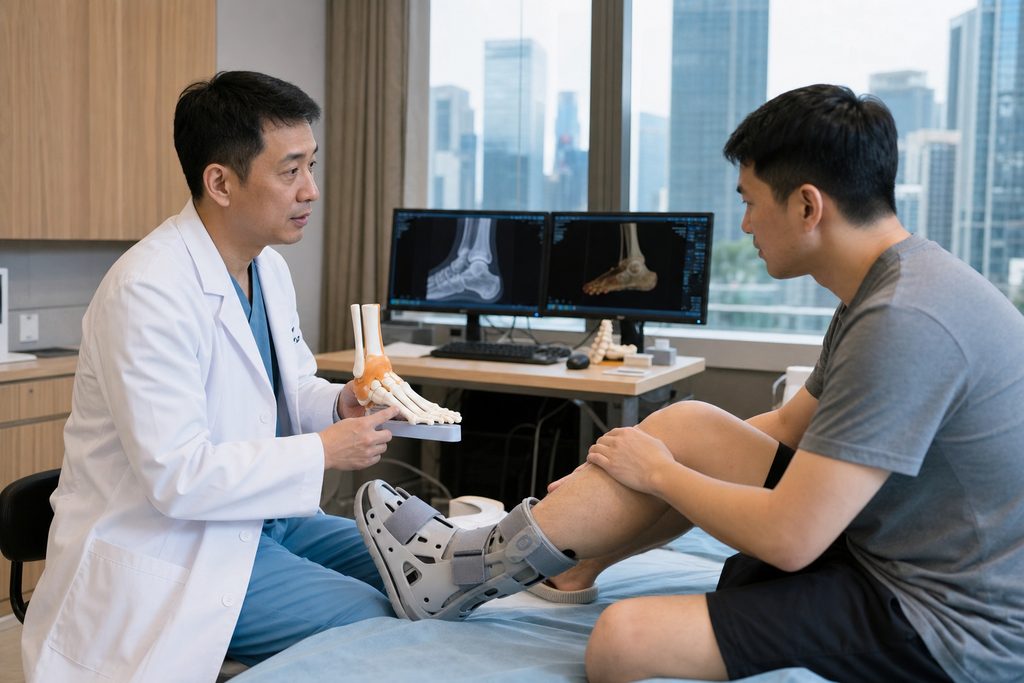
Ankle Fusion Surgery Cost China: The Short Answer
Ankle fusion surgery cost China typically runs between $8,000 and $18,000 USD for the procedure alone, depending on hospital tier and case complexity. Add a bilingual medical companion and logistical support, and the all-inclusive figure lands closer to $14,000 to $24,000. That is roughly one-fifth to one-third of what the same surgery costs in the United States, where uninsured patients face bills exceeding $70,000.
But a single number never tells the whole story. The real cost hinges on whether you go through a public hospital’s international VIP wing, a private JCI-accredited facility, or a top-tier orthopedic center like those ranked in the Fudan specialty lists. And then there is the hardware — the plates, screws, and graft material your surgeon selects. Titanium implants from a Western manufacturer add to the bill. Domestic equivalents, equally sterile and biomechanically sound, cost less. This is where having someone who speaks the system matters.
Who This Is Right For — and Who It Isn’t
Ankle fusion is not a first-line treatment. It is the endpoint after conservative measures have failed. The typical candidate has end-stage osteoarthritis, a severe post-traumatic deformity, or a failed total ankle replacement that left the joint unstable. They have tried bracing, injections, and physiotherapy. Walking hurts. Standing hurts. Sleep gets interrupted by a dull, grinding ache.
Good candidates for traveling to China for this procedure share a few traits. They are stable enough to fly and sit through a long-haul flight with the leg elevated. They have exhausted local options or been quoted a price they cannot afford. They understand that recovery is measured in months, not weeks, and that the first six weeks are non-weight-bearing. They have a family member or companion who can travel — or they are willing to hire one.
This path is not for everyone.
Patients with active infections, severe vascular disease that compromises healing, or uncontrolled diabetes should not travel for elective orthopedic surgery until those conditions are managed. Smokers face a significantly higher non-union rate — some surgeons will not operate until nicotine is out of the system for at least four weeks. And if you cannot be away from home for a minimum of three to four weeks post-operatively, the logistics simply do not work. A fusion requires follow-up imaging before you are cleared to fly back.
The Options, Compared
Not all ankle fusion surgeries are created equal. The approach — open versus arthroscopic — changes the recovery timeline. The hospital tier changes the price. And the inclusion of a companion changes the experience entirely. Here is what the landscape actually looks like for international patients.
| Option | Procedure Cost (USD) | Hospital Stay | Included Support | Best For |
|---|---|---|---|---|
| Public Hospital, Standard Ward | $8,000–$12,000 | 5–7 days | Minimal English support; family must navigate | Budget-conscious patients with Mandarin-speaking family |
| Public Hospital, International VIP Wing | $12,000–$18,000 | 5–7 days | English-speaking nurses; private room; expedited imaging | Patients wanting top surgical teams with Western-comfort amenities |
| Private JCI-Accredited Hospital | $16,000–$22,000 | 3–5 days | Full English staff; direct insurance billing possible | Patients with international insurance; those wanting hotel-like recovery |
| VIP Wing + Bilingual Companion Package | $14,000–$24,000 all-in | 5–7 days | Dedicated translator; logistics; post-op coordination | First-time visitors to China; solo travelers; complex cases |
The public hospital VIP wing strikes the balance most international patients are looking for. You get the surgical team that performs hundreds of these procedures annually — the same surgeons training fellows and publishing research — with the communication infrastructure that makes a foreigner’s stay manageable. Private hospitals offer a smoother experience but may not have the same case volume in complex post-traumatic reconstructions. Volume matters in orthopedics. A surgeon who does fifteen ankle fusions a month has seen complications that a surgeon doing fifteen a year has only read about.
What “Complex Foot Procedure Full Pricing” Actually Covers
When patients search for “ankle surgery package with companion China,” they are usually trying to understand what an all-inclusive quote looks like. The phrase gets thrown around loosely. Here is what a transparent package should itemize — and what it should not.
A properly structured ankle fusion surgery cost China package includes the surgeon’s fee, the anesthesiologist’s fee, the operating theater charge, the implant hardware, the inpatient stay, and the initial post-operative imaging before discharge. It should also cover the companion’s daily rate for hospital days plus one or two pre-op consultation days. Airport pickup, visa invitation letter preparation, and hotel recommendations are standard logistical inclusions.
What it does not include — and no ethical provider will claim otherwise — are complications requiring extended ICU stays, revision surgeries, or physical therapy beyond the initial inpatient sessions. Those are billed separately if they occur. Airfare, accommodation outside the hospital, and meals for the companion are also on the patient. So is the cost of the S2 visa application itself, which is paid directly to the Chinese embassy or consulate in your home country.
The companion’s role during a complex foot procedure extends far beyond translation. They are the person who ensures your pre-op CT scan gets to the right radiologist, who confirms the surgeon has reviewed your overseas imaging, who sits with you during the anesthesia consent process when the forms are in Mandarin. After surgery, they coordinate discharge medications, schedule the follow-up X-ray, and make sure you have a wheelchair-accessible vehicle to the airport. For a procedure where you will be non-weight-bearing for six weeks, that logistical layer is not a luxury. It is the difference between a smooth recovery and a stressful one.
What Drives the Final Cost Up or Down
The price range for ankle fusion surgery is wide for a reason. Several variables shift the final bill by thousands of dollars in either direction.
Implant selection is the biggest swing factor. A standard titanium ankle fusion plate and screw set from a domestic Chinese manufacturer approved by the NMPA adds roughly $800–$1,200 to the hardware line item. The equivalent system from DePuy Synthes or Stryker, imported and distributed through Chinese channels, runs $2,500–$4,500. Both are safe. Both achieve union. The decision often comes down to surgeon preference and patient comfort level.
Graft material changes the equation if you need it. An autograft harvested from your iliac crest adds surgical time but no material cost. An allograft or synthetic bone graft substitute can add $1,000–$2,500. Patients with significant bone loss from prior trauma or a failed total ankle replacement are more likely to need grafting.
Hospital tier matters. A Fudan-ranked orthopedic center like Peking University Third Hospital or Shanghai Sixth People’s Hospital commands higher fees through their international departments than a well-regarded but unranked provincial hospital. The surgical skill may be comparable. The international patient infrastructure is not. Ranked hospitals have dedicated international wards with English-speaking nursing staff and streamlined pathways for foreign patients — and those resources are reflected in the price.
Length of stay varies. An uncomplicated ankle fusion typically requires five to seven inpatient days. If post-operative swelling is severe or wound healing looks slow, the surgeon may keep you an extra three to five days. Each additional day in a VIP ward costs $300–$600. It is not a punitive charge — it is simply the reality of cautious post-operative care in a system that does not rush discharge.
The companion cost itself is straightforward. A bilingual medical companion starts from $300 per day. For a surgery requiring two pre-op consultation days, the operative day, and five inpatient days with daily check-ins, that is roughly $2,400–$3,000. Some patients bring a family member and use the companion only for critical translation moments, which reduces the daily count. Others rely on the companion entirely and budget for ten to fourteen days of support.
Practical Considerations: The Logistics That Determine Success
The surgery itself is half the equation. The other half is everything that happens before you enter the operating room and after you leave it.
Documentation. Chinese orthopedic surgeons will want weight-bearing X-rays, a CT scan if available, and a full surgical history if you have had prior ankle procedures. MRI images help assess the subtalar joint — if that joint is also arthritic, an ankle fusion alone may not resolve your pain, and the surgeon may recommend a tibiotalocalcaneal fusion instead. Have these images on a CD or USB drive. Cloud links work, but Chinese hospital networks sometimes block foreign file-sharing services. A physical copy never fails.
Visa. Medical treatment in China falls under the S2 visa category, specifically endorsed for private affairs including medical treatment. The hospital’s international department will issue an invitation letter confirming your admission and treatment plan. That letter, along with your passport, application form, and a recent photo, goes to the Chinese embassy or consulate. Processing takes roughly one week in most countries. Your accompanying family member applies for the same S2 category. Do not let anyone tell you to apply for an M visa — that is for commercial and trade activities, and showing up at the hospital with one creates paperwork problems that delay your admission.
Payment. Public hospitals in China operate on a prepayment system. You deposit a lump sum at admission — typically the full estimated procedure cost — and the hospital draws down from that balance. Any remainder is refunded at discharge. International VIP wings accept wire transfers, UnionPay, and major credit cards, though card acceptance is not universal. Private international hospitals are more flexible and may bill your insurer directly if they have a pre-existing agreement. Confirm payment methods before you book the flight.
Insurance. Most U.S. and European insurers will not cover elective surgery performed in China unless you have a specific international plan or a self-funded employer plan with global coverage. What they may cover is the post-operative care once you return home — physical therapy, follow-up X-rays, hardware removal if needed later. Get pre-authorization for that portion before you travel. The procedure cost itself will almost certainly be out-of-pocket.
Follow-up after returning home. You will need X-rays at six weeks, twelve weeks, and six months to confirm union. The Chinese surgeon will provide a discharge summary and imaging recommendations. Take those to a local orthopedic surgeon and establish a follow-up relationship before you travel. Some surgeons are reluctant to manage another surgeon’s post-operative care. Be upfront. Most will agree when they understand the financial context.
Frequently Asked Questions
In the United States, the cash price for an ankle fusion — surgeon, hospital, anesthesia, and hardware — commonly ranges from $50,000 to $90,000, with complex revisions pushing past $100,000. The same procedure in China, performed at a top-ranked orthopedic center through the international VIP wing, runs $12,000 to $18,000. Add a companion and logistics, and the total reaches $16,000 to $24,000. Thailand and India offer comparable pricing, but China’s advantage lies in surgical volume at major centers like Shanghai Sixth People’s Hospital, where orthopedic teams handle a caseload that few Western hospitals match.
A genuine package should include the surgeon’s fee, anesthesiologist, operating room, inpatient stay, implant hardware, pre-discharge imaging, and the companion’s services for hospital days and key consultations. Airport transfers, visa invitation letters, and hotel guidance are standard logistical support. Airfare, accommodation, meals, and any post-discharge physical therapy are separate. Complications requiring extended care or revision surgery are not bundled — they are billed as they arise. Always get a line-item breakdown, not a single number.
Yes, through a structured remote evaluation process. You send your imaging and medical history. The Chinese orthopedic team reviews it and provides a written second opinion with a treatment recommendation and a preliminary surgical plan. If both sides agree to proceed, the hospital issues an invitation letter for your S2 visa, and a date is scheduled. This is not the standard public hospital pathway — it operates through the international VIP department, which is designed precisely for patients who cannot make two separate trips. The remote evaluation itself costs $300 to $500 and is credited toward the coordination fee if you proceed to surgery within 90 days.
Non-union occurs in roughly 5 to 10 percent of ankle fusions, depending on patient factors like smoking, diabetes, and bone quality. If the fusion fails, revision surgery may be needed. The Chinese surgical team will review follow-up imaging remotely if you send it. Whether the revision is performed in China or locally depends on the nature of the problem, your insurance situation, and your willingness to travel again. No provider can guarantee a complication-free outcome. What a reputable international department will do is maintain communication and provide your full operative records so a local surgeon can take over if needed.
A translation app handles simple phrases. It does not understand the difference between “your incision looks normal” and “your incision shows early signs of dehiscence and we need to adjust the wound care protocol.” During pre-op consent, when the anesthesiologist explains the risks of a nerve block, or during discharge, when medication instructions include tapering schedules and warning signs for deep vein thrombosis, the stakes are too high for machine translation. A companion also navigates the physical environment — finding the right building in a hospital complex the size of a small town, knowing which window processes your deposit refund, and recognizing when a delay is routine versus when it needs escalation. For a procedure where you will be immobile and reliant on others for days, the companion is not a luxury add-on.
Your Next Step
Ankle fusion surgery is a serious decision, and traveling abroad for it adds a layer of complexity that demands clear information and reliable support on the ground. The cost advantage is real — $14,000 to $24,000 all-in versus five figures at home — but only if the logistics are handled properly. Our team at China Medical Services connects international patients with the orthopedic departments best suited to their specific case, from initial remote evaluation through post-operative departure. We are not a hospital, we do not provide medical advice, and we do not make diagnoses. What we do is ensure that when you arrive in an unfamiliar city for a life-changing procedure, someone competent is standing beside you, speaking both languages, and making sure nothing falls through the cracks.
If you are considering ankle fusion surgery in China and want to understand what a realistic treatment plan and cost breakdown would look like for your specific situation, reach out for a free consultation. No pressure. No sales pitch. Just an honest conversation about whether this path makes sense for you.
For more medical information and treatment options in China, visit chinamedservices.com (China Medical Services).
