Anti-Aging Treatment Cost in China: 2026 Price Guide for International Patients
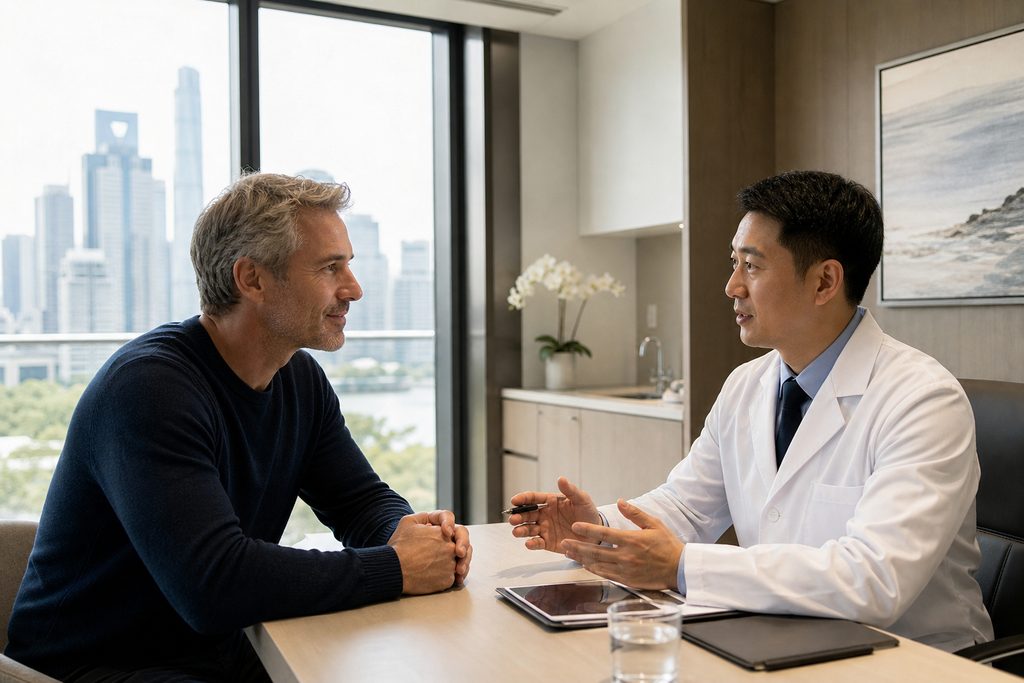
Anti-aging treatment is not one procedure. It is an umbrella term covering everything from injectable fillers and laser resurfacing to hormone optimization, NAD+ IV therapy, hyperbaric oxygen sessions, and experimental stem cell protocols. When a patient searches for anti aging treatment cost China, they are usually comparing two very different tiers of care: cosmetic dermatology that costs a few hundred dollars, and regenerative medicine that can run into five figures. The honest answer is that most international patients land somewhere in the middle.
Our team has coordinated care for patients from London, Dubai, and Singapore who wanted to understand the real numbers before committing to a trip. The price spread is wide because the category is wide. A single session of Botox or dermal filler in a Shanghai private clinic will not cost the same as a three-week longevity program at a Beijing hospital’s international department. This guide breaks down the actual cost bands, what drives the variation, and where the genuine bargains are — without pretending that “cheap” and “safe” always overlap.
How This Actually Works, Step by Step
You cannot simply book an anti-aging package online the way you would reserve a hotel room. Chinese public hospitals do not allow overseas patients to pre-book outpatient appointments through a website. The realistic sequence looks like this:
You send us your medical history, current medications, and any recent lab work. We translate the records into Chinese and route them to the appropriate department — often dermatology, endocrinology, or a hospital’s international medical center. A physician reviews the file and tells us whether you are a candidate for the treatment you are considering. If yes, we schedule a video consultation so you can speak with the doctor before traveling. That call typically costs between $100 and $300 through a standard international department, or $500 to $800 if you want a top-specialist opinion.
Only after the doctor confirms the plan do we coordinate the on-the-ground logistics: hospital registration, in-person consultation slots, treatment sessions, and a bilingual medical companion if you need one. The companion handles queueing, payment, translation, and navigation — which matters more than you might expect in a hospital that sees 10,000 outpatient visits per day.
What Anti-Aging Treatment Actually Costs in China
Let us get specific. The anti aging treatment cost China patients typically ask about falls into five bands. These are 2026 reference ranges in USD, based on pricing we have seen across our partner hospitals in 37 cities. All figures vary by hospital tier, physician seniority, and case complexity.
| Treatment Category | Typical Cost Range (USD) | Notes |
|---|---|---|
| Injectable fillers & botulinum toxin | $200 – $800 per session | Per area; private international clinics charge more |
| Laser skin resurfacing (Fraxel, CO2) | $300 – $1,200 per session | Full-face treatment; 3–5 sessions usually recommended |
| NAD+ IV therapy | $150 – $400 per infusion | Often sold as a package of 5–10 infusions |
| Hormone replacement evaluation & management | $500 – $2,000 initial workup | Includes labs, consultation, and 3-month follow-up plan |
| Stem cell / regenerative therapy | $8,000 – $25,000+ | Highly variable; requires extensive pre-screening |
| Comprehensive 2-week longevity program | $10,000 – $30,000+ | Private hospitals; includes diagnostics, IV protocols, imaging |
Compare that to the United States, where a single syringe of dermal filler averages $700 to $1,000, laser resurfacing runs $1,500 to $3,000 per session, and concierge longevity clinics charge $40,000 to $100,000 for annual programs. The savings in China are real, but they are most dramatic at the higher end of the spectrum.
How Much Does Anti-Aging Therapy Cost in Shanghai?
Shanghai is China’s most expensive city for private healthcare, and that holds true for anti-aging services. How much does anti aging therapy cost in Shanghai depends heavily on whether you choose a public hospital’s international department or a private expat-oriented clinic like Jiahui or Parkway.
At a public top-tier hospital’s international wing — Zhongshan Hospital or Ruijin Hospital, for instance — a dermatology consultation with a senior physician costs $100 to $250. Injectable treatments run at the lower end of the national range, often 20–30% below private clinic pricing. But you will wait longer for appointments, and the environment is clinical rather than spa-like.
Private international clinics in Shanghai charge a premium for English-speaking staff, JCI accreditation, and direct insurance billing. Expect to pay $400 to $800 for the same injectable session that costs $250 at a public international department. The trade-off is speed, comfort, and a more Western-style consultation experience. Neither option is objectively better; it depends on your tolerance for friction versus your budget.
A Realistic Timeline
Patients consistently underestimate how long the pre-travel phase takes. Here is a realistic sequence based on cases we have coordinated:
| Stage | Duration | What Happens |
|---|---|---|
| Day 1–3 | Initial inquiry | You submit medical records and treatment goals |
| Day 4–10 | Document translation & review | We translate records into Chinese; hospital department reviews |
| Day 11–20 | Video consultation scheduling | Doctor confirms candidacy; treatment plan drafted |
| Week 3–6 | Visa processing | S2 visa application with hospital invitation letter; varies by embassy |
| Week 6–8 | Travel & first in-person visit | Registration, physical exam, treatment begins |
| Month 2–4 | Follow-up sessions | Depending on protocol; may require return visit or remote monitoring |
The S2 visa is the correct category for short-term medical treatment and private affairs in China. Processing times vary by country, but four to six weeks is a safe planning window. Your accompanying family members apply for the same category. We provide the hospital invitation letter and guidance, but approval is always at the discretion of the Chinese embassy or consulate.
What Can Go Wrong — and What Happens Then
We tell every patient the same thing: the risks in Chinese anti-aging care are not where most people think. The danger is rarely the needle. It is the gap between expectation and reality.
The most common failure mode is a patient arriving with a specific treatment in mind — often stem cell therapy — and discovering after the in-person evaluation that the physician does not consider them a candidate. That is a good outcome medically, but a frustrating one financially. You have already paid for flights, a visa, and possibly a hotel. The recourse is to have the video consultation before you travel, which is exactly why we insist on it. A $300 remote consult can save a $3,000 wasted trip.
Another failure mode is choosing a clinic based on a glossy website rather than physician credentials. China has thousands of aesthetic clinics, and quality varies enormously. Some market “stem cell anti-aging” treatments that are not approved by the National Medical Products Administration and have no published safety data. If a clinic refuses to name the specific cell type, source, and dose before you pay, walk away. If a treatment goes wrong, your recourse is limited — foreign patients have fewer legal protections than Chinese citizens, and medical malpractice litigation across borders is notoriously difficult. The best protection is choosing a hospital that is on the Fudan ranking or holds JCI accreditation, and confirming the treating physician’s credentials before you commit.
Is Anti-Aging Treatment Safe in China?
Is anti aging treatment safe in China is the question we hear most often from patients in Europe and North America. The honest answer: yes, if you choose the right institution, and no, if you chase the lowest price.
China’s top-tier public hospitals — the 340+ institutions on our platform, drawn from the top 5% of the country’s 35,000+ hospitals — operate at international standards. Fuwai Hospital performs more than 14,000 cardiac surgeries annually. Peking Union Medical College Hospital and West China Hospital are globally recognized. The dermatology and endocrinology departments at these institutions follow evidence-based protocols, and their international departments are accustomed to treating foreign patients.
But the anti-aging market also includes thousands of private aesthetic clinics with no international accreditation, no English-speaking staff, and aggressive marketing. Some offer “stem cell” treatments that are little more than saline or autologous fat injections. The regulatory environment for regenerative medicine in China is evolving, and not all clinics comply. The safety question is therefore not about China as a whole — it is about which specific hospital or clinic you select. That is where a careful pre-screening process matters more than any brochure.
Stem Cell Anti-Aging in China: What the Price Actually Buys
No topic in this field generates more confusion than stem cell anti aging China cost. Patients see prices ranging from $5,000 to $50,000 and assume the higher number means better treatment. That assumption is dangerous.
China’s regulatory framework for stem cell therapy is strict. Clinical applications are limited to approved trials and specific hospital programs. What many private clinics market as “stem cell anti-aging” is not what a researcher at a top hospital would call stem cell therapy. Some use umbilical cord-derived mesenchymal stem cells. Others use exosomes, growth factors, or platelet-rich plasma and label it loosely. The price difference often reflects marketing spend, not biological quality.
If you are considering this route, the questions to ask are specific: What is the cell source? What is the dose? What is the route of administration? Has this protocol been published in a peer-reviewed journal? What are the exclusion criteria? A legitimate hospital-based program will answer all of these without hesitation. A clinic that answers with “trust us” should be crossed off your list.
We do not recommend stem cell anti-aging as a first-line option for most patients. The evidence base for longevity benefits in healthy people is thin. The risks — infection, immune reaction, tumor formation — are real, if rare. If a patient insists, we will only coordinate with hospital departments that have formal research protocols and institutional review board approval. We will not facilitate treatment at unaccredited private clinics, regardless of price.
Practical Considerations: Records, Visa, Payment, and Follow-Up
Not through the standard outpatient system. Public hospitals require an in-person consultation before treatment. What you can do is complete the remote evaluation — records review and video consultation — so that the in-person visit is streamlined. Some private international clinics do offer pre-booked packages, but we recommend confirming the treating physician’s credentials first.
Some hospital-based programs are legitimate and operate under research protocols. Many private clinic offerings are not. The price alone tells you nothing. Ask for the cell source, dose, route, and published safety data. If the clinic cannot provide all four, do not proceed.
For a two-week visit including flights, S2 visa, accommodation, a video consultation, and a moderate treatment plan (injectables plus laser plus IV therapy), budget $5,000 to $10,000. For a comprehensive longevity program at a private hospital, budget $15,000 to $35,000. These are planning figures, not quotes.
Most international insurers classify anti-aging treatments as elective and do not cover them. Coverage exceptions exist for certain hormone deficiencies or dermatological conditions, but you should confirm with your insurer in writing before traveling. Chinese public hospitals require upfront payment regardless of your insurance status.
Your Next Step
The anti aging treatment cost China patients actually pay depends on three decisions: which city, which hospital tier, and which treatment category. Shanghai and Beijing private clinics charge the most. Public hospital international departments offer the best value for evidence-based treatments. Stem cell and regenerative therapies are the wild card — expensive, variably regulated, and not right for everyone.
Our team at China Medical Services helps international patients navigate these choices. We translate records, coordinate video consultations, arrange bilingual companions, and guide you through the S2 visa process. We do not sell treatments, and we do not promise outcomes. What we offer is a clear-eyed assessment of your options before you spend a dollar on a plane ticket. If you want to explore whether China makes sense for your anti-aging goals, start with a free consultation — we will tell you honestly if the answer is no.
Anti-aging medicine in China is neither a miracle nor a scam. It is a market with excellent hospitals and questionable clinics, real savings and real risks. The patients who do best are the ones who ask hard questions before they book. You now know which questions to ask.
Frequently Asked Questions
Yes. The hospitals used for international patients are JCI-accredited and follow the same international safety standards as top hospitals in the US and Europe. Surgical teams perform high volumes of procedures — often more than their Western counterparts — which studies show leads to better outcomes.
Costs vary by procedure and hospital, but international patients typically save 40-80% compared to US prices — even when factoring in travel and accommodation. A consultation with our team will give you an exact, all-inclusive quote with no hidden fees.
Send us your existing medical reports to get started. We handle everything from hospital selection and appointment scheduling to visa assistance and post-operative recovery planning. Your medical records are reviewed by the specialist before you even book a flight.
For more medical information and treatment options in China, visit chinamedservices.com (China Medical Services).
