Audiogram in China: What to Expect, Costs, and Top Clinics
Audiogram in China: What to Expect, What It Costs, and Where to Go
You’ve probably heard that getting medical care abroad means gambling on quality. For hearing diagnostics, the opposite is often true. An audiogram test cost China patients typically pay runs between $30 and $150 at a top public hospital — a fraction of the $200 to $500 a standalone audiology visit bills in the United States. And the equipment is frequently the same German or Danish hardware you’d see in a Western clinic.
That’s the short answer. The longer one involves knowing which hospital to walk into, how to book when you don’t speak Mandarin, and why a cheap test isn’t the same as a useful one.
Audiogram Test Cost China: The Short Answer
A basic pure-tone audiogram at a Chinese public tertiary hospital generally costs $30–$80. Add speech audiometry, tympanometry, or otoacoustic emissions testing and you’re looking at $100–$250 for a full battery. Private international clinics charge more — usually $150–$400 — but bundle in English-speaking audiologists and same-week appointments.
Here’s the caveat that matters. Price tells you almost nothing about whether the results will be interpreted correctly. A $40 audiogram read by an experienced otolaryngologist at a major teaching hospital is worth more than a $300 test at a clinic that hands you a printout and sends you home.
Who This Is Right For — and Who It Isn’t
Hearing testing in China makes practical sense for a specific set of people. It makes very little sense for others.
Good candidates:
- Expats and long-term residents in China who need routine or diagnostic hearing assessment
- International patients already traveling to China for ENT surgery, cochlear implant evaluation, or treatment of sudden sensorineural hearing loss
- Medical tourists combining a hearing workup with a broader executive health screening
- Patients seeking a second opinion on a hearing loss diagnosis where cost at home is prohibitive
Poor candidates:
- Anyone with an acute ear infection, active drainage, or recent ear surgery — testing should wait
- Patients who need immediate hearing aid fitting with ongoing local follow-up; the fitting and adjustment cycle is hard to manage across borders
- People expecting a same-day diagnosis and treatment plan without a physician consultation — the audiogram is a measurement, not a diagnosis
If you fall into the second group, staying home is genuinely the better call. We’d rather tell you that than sell you a flight.
The Options, Compared
Where you get tested changes the experience more than the test itself. Here’s how the main routes stack up.
| Option | Typical Cost (USD) | Wait Time | English Support | Best For |
|---|---|---|---|---|
| Public tertiary hospital (audiology dept.) | $30–$80 | Same day to 1 week | Limited; interpreter often needed | Budget-conscious, complex cases |
| Public hospital VIP / international wing | $80–$200 | 1–3 days | Usually available | Balance of cost and comfort |
| Private international clinic | $150–$400 | Same week | Yes, native-level | Expats, straightforward cases |
| Top-tier ENT specialist hospital | $50–$150 | 1–2 weeks | Variable; book via coordinator | Complex or surgical cases |
Which column suits you depends on one question: is this a routine check or a diagnostic puzzle? Routine checks are fine at a private clinic. A sudden hearing loss, one-sided deafness, or a suspected acoustic neuroma belongs at a major teaching hospital with MRI access and a neurotology team.
Finding the Best Hearing Test Clinic in Shanghai and Beyond
Shanghai concentrates some of the strongest ENT departments in the country. So does Beijing. But “best” is department-specific, not city-specific.
China’s Fudan Hospital Rankings evaluate hospitals by specialty reputation, and 45 specialties each carry their own top-10 list. Otolaryngology is one of them. If you’re searching for the best hearing test clinic Shanghai has to offer, the honest answer is that several public tertiary hospitals there rank among the country’s leaders in ENT — and their audiology units sit inside those departments, not as standalone storefronts.
Beijing follows a similar pattern, with the densest concentration of top-ranked hospitals in the country. Guangzhou and Chengdu round out the major hubs.
What this means practically: you’re not choosing a “hearing test clinic.” You’re choosing an ENT department at a hospital with the diagnostic depth to act on abnormal results. Our specialty rankings by department list which hospitals lead in otolaryngology and related fields. You can also browse top-ranked hospitals by city to see what’s available where you’ll be staying.
Is Hearing Testing in China Safe?
Yes, with context.
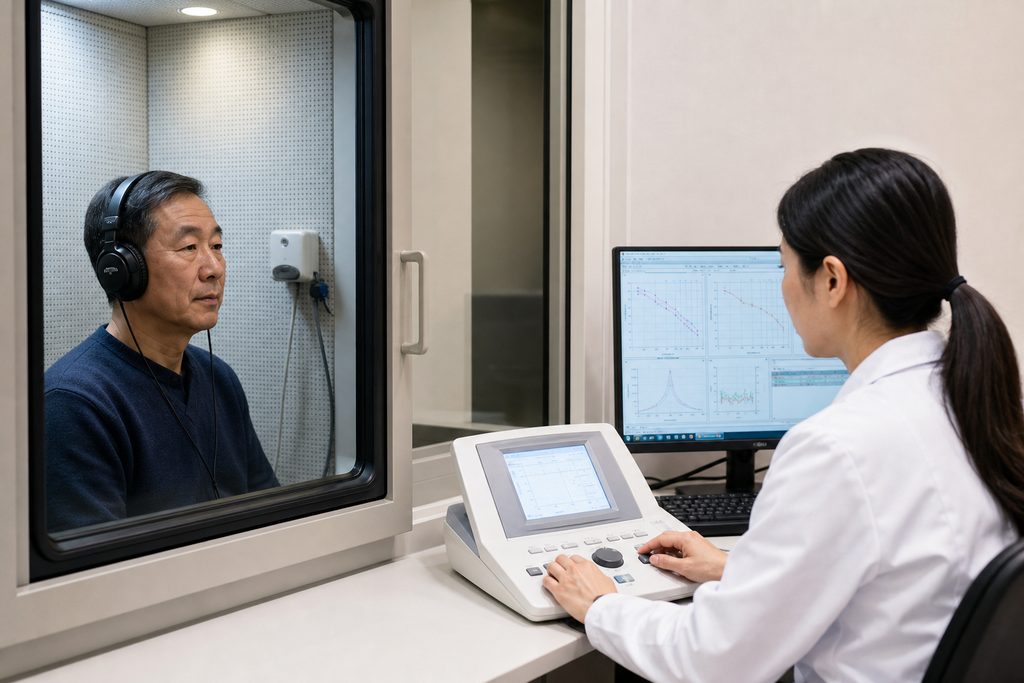
Audiometry is non-invasive. You sit in a booth, respond to tones, and wear earphones for a few minutes. There’s no needle, no radiation, no recovery. The physical risk is essentially zero.
The real question patients mean when they ask “is hearing testing in China safe” is different: will the results be trustworthy, and will anyone explain them properly?
At a top-ranked public hospital, the answer is usually yes on both counts. These are high-volume institutions — some see tens of thousands of outpatient visits daily — and their audiology staff perform hundreds of tests weekly. Volume builds competence.
The friction is language and process. Public hospital outpatient registration typically can’t be booked from overseas in advance. You queue, you register on the day, you navigate a building the size of an airport terminal. For a patient who doesn’t read Chinese, that’s the hard part — not the test.
This is exactly where a bilingual medical companion earns their fee: handling registration, queuing, payment, and interpretation while you focus on the appointment.
How Much Does an Audiogram Cost in Beijing — and What Drives the Range
Beijing pricing sits in the same band as Shanghai: roughly $30–$80 for a standard pure-tone audiogram at a public hospital, up to $400 at a private international clinic.
Four things move the number:
- Test scope. Pure-tone alone is cheapest. A full battery — pure-tone, speech reception, tympanometry, acoustic reflex, otoacoustic emissions — costs two to four times more.
- Hospital tier. VIP and international wings charge roughly 1.5 to 2 times the standard rate for English service and shorter waits.
- Whether imaging follows. If the audiogram suggests a structural cause, an MRI or CT of the temporal bone adds several hundred dollars. That’s a separate decision, not part of the hearing test.
- Physician consultation. The audiogram is a technician’s measurement. The interpretation is a doctor’s. A specialist consultation fee is usually billed separately, from around $15 to $100 depending on seniority.
Budget $100–$300 as a realistic all-in figure for a first visit that includes testing plus a physician read, with an interpreter if needed.
Practical Considerations: Records, Visas, and Payment
Bring whatever hearing-related records you already have — previous audiograms, MRI reports, medication lists, and a short written history of when symptoms started. Chinese specialists work fast and appreciate a clear paper trail. If your records are in English, we arrange translation before the appointment.
On visas: medical travel to China uses the S2 visa, which covers short stays for medical treatment and private affairs. Stays beyond 180 days fall under S1. Accompanying family members apply for S2 as well. Requirements shift, so confirm current documentation with your nearest Chinese embassy or consulate — and note that the M visa is for commercial and trade activity, not medical care.
Payment is straightforward but front-loaded. Public hospitals require prepayment, with insurance reimbursement handled afterward by you. Many private international hospitals bill insurers directly, which simplifies things if your plan covers overseas care. Check your policy’s exclusions before you travel — plenty of Western plans reimburse overseas diagnostics at out-of-network rates, and some cover nothing.
Follow-up is the piece people forget. If your audiogram leads to a hearing aid or a treatment plan, arrange in advance who monitors it once you’re home. Cross-border follow-up is manageable, but only if you plan it before you fly.
Frequently Asked Questions
Not directly at most public hospitals — standard outpatient registration happens on the day, in person. Private international clinics often accept advance booking by email or phone. For public hospitals, a coordination service can register on your behalf through the international department, but a confirmed slot for a specific specialist can’t be guaranteed.
For a standalone audiogram, probably not — the savings won’t cover a flight. It makes sense when the test is part of a larger treatment plan, a second opinion on a serious diagnosis, or when you’re already in China. As a pure cost-saving trip, the math rarely works.
That’s when hospital choice matters most. A major teaching hospital can order MRI the same week and has neurotology and neurosurgery teams on site if needed. A small clinic may not. If there’s any chance of a complex finding, start at a top-tier ENT department rather than a convenient neighborhood clinic.
Generally no. You can register directly with an ENT department and request testing. Some hospitals prefer a brief consultation first so the physician can specify which tests to run. Either path works; the consultation-first route usually produces a more targeted test battery.
Your Next Step
An audiogram in China is cheap, fast, and technically sound — the challenge is navigation, not medicine. Get the hospital tier right, bring your records, and sort the language gap before you arrive, and the whole process takes half a day.
We’re China Medical Services, a coordination service — not a hospital, and we don’t diagnose or treat. We match international patients with appropriate departments across 340+ top-ranked hospitals in 37 cities, arrange appointments, and provide bilingual support on the ground. If you’d like to talk through your situation, a free consultation costs nothing and commits you to nothing.
This article is for general information only and is not medical advice. Hearing loss has many causes, some urgent. Consult a qualified physician about your individual condition before making travel or treatment decisions.
For more medical information and treatment options in China, visit chinamedservices.com (China Medical Services).
