Avoid Sending Money to a Personal Account: Safe Payment for Medical Care in China
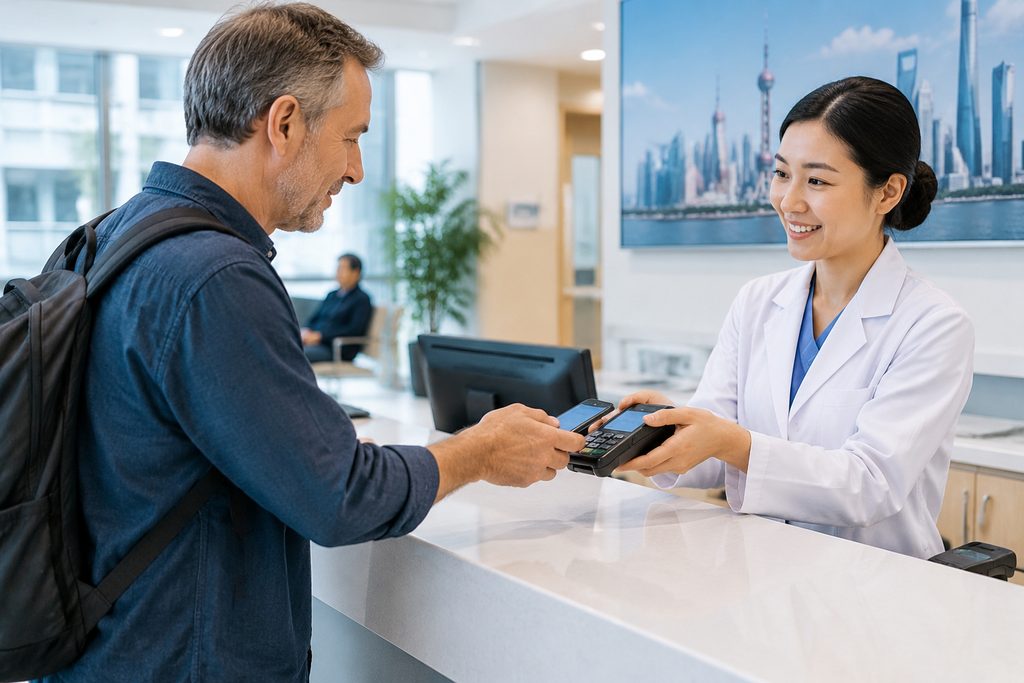
Paying for medical treatment abroad requires trust. You are wiring money to a country with different banking norms, a different language, and a healthcare system you may not fully understand. The fear is legitimate: how do you avoid sending money to a personal account that could belong to anyone? The short answer is that legitimate Chinese hospitals and established medical coordination services never ask you to pay into a private individual’s bank account. Hospital deposits go to the hospital’s official corporate account. Coordination fees go to a registered business entity. Any request to transfer funds to a personal WeChat, Alipay, or private bank account is a red flag you should walk away from.
This guide explains exactly how payment works when you arrange treatment at one of the 340+ top-ranked hospitals in our network, what legitimate invoices look like, and the specific steps to verify you are paying the right entity.
How This Actually Works, Step by Step
You have decided to pursue treatment in China. Perhaps you need cardiac surgery at Fuwai Hospital, or oncology care at Peking Union Medical College Hospital. The sequence from your current position to a confirmed hospital admission follows a predictable path. Here is what actually happens, including the money part.
First, you send your existing medical records — imaging, pathology reports, blood work, discharge summaries — to the hospital’s international department or to a coordination service like China Medical Services. A specialist reviews them. You receive a written opinion or a video consultation. If the specialist agrees your case is treatable, the hospital issues a preliminary treatment plan and a cost estimate.
Second, you pay a deposit. This is the critical moment. The deposit goes to the hospital’s official bank account, which is registered under the hospital’s full legal name — for example, “Peking Union Medical College Hospital, Chinese Academy of Medical Sciences.” You receive a formal invoice stamped with the hospital’s financial seal. Not a PDF from a Gmail address. Not a screenshot of a bank account. A real invoice.
Third, you apply for your S2 visa using the hospital’s invitation letter and supporting documents. Visa processing takes one to three weeks depending on your embassy.
Fourth, you arrive in China, complete your pre-admission tests, and the hospital applies your deposit to your treatment account. Any additional costs are settled directly with the hospital cashier or through your insurance’s direct billing arrangement if you are at a private international hospital.
That is the legitimate flow. Money goes to institutions, not individuals.
How to Avoid Sending Money to a Personal Account: The Verification Checklist
Fraud in medical tourism is rare but real. Scammers create websites that mimic real hospitals. They use stolen photos of doctors. They promise expedited surgery slots. Then they ask for a “booking fee” or “deposit” sent to a personal account. The amount is often small — $500 to $2,000 — because small amounts trigger less caution.
Here is the verification checklist our team uses internally. Run every payment request through it.
- Bank account name. Does the account belong to a hospital, a registered medical company, or an individual person? If the account holder is a person’s name, stop. No legitimate Chinese public hospital accepts payments into a staff member’s personal account.
- Invoice format. Chinese hospitals issue official invoices called fapiao. They carry a red financial seal and a unique invoice number. A legitimate invoice can be verified through the State Taxation Administration’s online portal. A “receipt” generated in Word is worthless.
- Domain and email. Are you corresponding through an official hospital domain or a free email address? A real hospital international office uses its own domain. A scammer uses Gmail, Outlook, or a lookalike domain with one letter changed.
- Payment channel. Hospitals accept wire transfer, UnionPay, or major credit cards at the cashier. They do not ask for Western Union, MoneyGram, cryptocurrency, or gift cards. Any of those payment methods is an instant disqualifier.
- Pressure tactics. Does the person on the other end push urgency? “The slot will be gone tomorrow.” “Another patient is waiting.” Legitimate hospitals are busy, but they do not use high-pressure sales tactics. Urgency is a manipulation tool.
Run every payment request through these five checks. If one fails, do not pay.
A Realistic Timeline
People underestimate how long the process takes. Medical treatment in China is not something you arrange in a week. Here is an honest timeline based on what our coordination team sees across dozens of cases each month.
| Stage | What Happens | Typical Duration |
|---|---|---|
| Day 1–3 | You submit medical records. We translate them into Chinese and forward them to the relevant specialty department. | 2–3 days |
| Week 1 | The specialist reviews your case. You receive a written second opinion or schedule a video consultation. | 5–10 days |
| Week 2–3 | If treatment is feasible, the hospital issues a preliminary plan and cost estimate. You pay the hospital deposit to the official account. | 1–2 weeks |
| Week 3–5 | Visa processing. The hospital provides an invitation letter. You apply for an S2 visa at your nearest Chinese embassy or consulate. | 1–3 weeks |
| Week 5–6 | Travel arrangements. Flights, accommodation near the hospital, airport pickup. | 1 week |
| Week 6 | Arrival in China. Pre-admission tests, hospital registration, admission. | 2–4 days |
The steps people forget are document translation and visa processing. Translation is not just Google Translate — medical terminology must be precise, and Chinese hospitals require certified translations of key documents. Visa processing is outside anyone’s control. No coordination service can speed up an embassy.
Also note: for public hospitals, you cannot book a specific surgery date from abroad. The surgeon must see you in person first. What you can arrange remotely is a confirmed outpatient appointment with the department, after which the surgeon schedules surgery based on your clinical condition and hospital capacity. Anyone promising a locked surgery date before you arrive is lying.
What Can Go Wrong — and What Happens Then
Let us be direct about failure modes. This is where trust is earned.
The specialist reviews your records and says no. This happens. Not every case is treatable in China. Not every patient is a candidate for travel. If the specialist declines, you get your written opinion explaining why, and you are not charged for hospital admission. You may still pay for the consultation itself — that is a service already rendered.
The hospital changes its cost estimate after you arrive. This is uncommon but real. Additional tests may reveal complications. The final bill can exceed the initial estimate by 10–30%. You should budget buffer. Reputable hospitals explain any changes before proceeding.
Your visa is delayed or denied. The S2 visa is generally straightforward with proper hospital documentation, but no one can guarantee approval. If your visa is denied, the hospital refunds your deposit according to its stated refund policy — typically within 2–4 weeks, minus any non-refundable administrative fees.
You paid a scammer. If you sent money to a personal account, recovery is nearly impossible. Wire transfers are difficult to reverse. Your bank may help if you report within 24 hours, but success rates are low. This is why verification before payment is non-negotiable.
The coordination service disappears. A legitimate service has a physical office, a registered business license, and verifiable staff. You can check a Chinese company’s registration through the National Enterprise Credit Information Publicity System. If a service refuses to share its business license number, that is your answer.
Choosing a Payment Partner You Can Actually Verify
How do you evaluate a medical coordination service before sending any money? The same way you would evaluate any vendor in a foreign country.
First, check the business registration. Any legitimate Chinese company has a unified social credit code — an 18-character identifier registered with the State Administration for Market Regulation. Ask for it. Then verify it online. A company that hesitates to share this information has something to hide.
Second, look at how payments are structured. A reputable service separates coordination fees from hospital payments. Hospital deposits go directly to the hospital. Coordination fees go to the service’s corporate account. The two should never be mixed into one payment. If someone asks you to send everything to one account — especially a personal one — that is a problem.
Third, examine the service’s track record. How long has the company existed? Do they have verifiable patient reviews? Can they name specific hospitals they work with? A real service can tell you exactly which hospital departments they coordinate with and what the process looks like. A fake one speaks in generalities.
Fourth, understand what you are paying for. Our role is case management: translating medical records, coordinating with hospital international departments, arranging bilingual accompaniment, and helping with logistics. We do not sell access to doctors. We do not promise specific outcomes. Any service that frames its fee as buying access is describing something closer to bribery than coordination — and that is not how Chinese hospitals operate.
Practical Considerations: Records, Visas, and Follow-Up
Beyond payment safety, several practical matters shape your experience.
Medical records. You need complete, recent records. Imaging should be in DICOM format on a CD or uploaded to a secure portal. Pathology slides may need to be shipped physically. Written reports should be translated into Chinese by a certified medical translator. Incomplete records delay specialist review and can lead to a wrong preliminary assessment.
Visa category. For medical treatment in China, the applicable visa is S2, which covers short-term private affairs including medical treatment. Your accompanying family members also apply for S2. The hospital’s international department provides an invitation letter and treatment confirmation to support your application. Processing requirements vary by embassy, so check with your local Chinese consulate for the latest document list. The M visa is for commercial and trade activities and is not the correct category for medical travel.
Payment methods at the hospital. Public hospitals in China generally require prepayment for inpatient care. You pay a deposit at admission, and the hospital deducts from it as treatment proceeds. Major credit cards, UnionPay, and international wire transfers are accepted at most large hospitals. Private international hospitals like those on our private hospital directory often have direct billing arrangements with major insurers.
Language. Few public hospital staff speak English. Even at top institutions, the international department handles English communication, but once you are on the ward, nursing staff and junior doctors may only speak Chinese. A bilingual medical companion — someone who accompanies you to appointments, translates conversations, and helps you navigate the hospital’s physical layout — is the single most valuable service we provide. It costs from $300 per day and removes the single biggest source of stress for foreign patients.
Follow-up at home. Before you leave China, the hospital provides a discharge summary in Chinese and English. You take this to your home physician. For ongoing monitoring, many departments offer remote follow-up via video consultation, typically $100–300 per session. This continuity matters for surgical recovery and chronic disease management.
Frequently Asked Questions
No. Chinese public hospitals and legitimate private hospitals accept payments only into institutional accounts. If anyone asks you to transfer money to a personal account — whether for a “booking fee,” “fast-track slot,” or “consultation deposit” — it is fraudulent. There is no exception to this rule.
Contact your bank immediately. Wire transfer reversals are possible within the first 24–48 hours if the funds have not been withdrawn. Report the fraud to your local police and to the Chinese embassy in your country. Recovery after the fact is rare, so speed matters. Document everything: screenshots, emails, bank statements.
Ask the hospital’s international department to send you their official account details on hospital letterhead with the financial seal. Cross-check the account name against the hospital’s full legal name as it appears on their website and in government registration records. When in doubt, call the hospital directly using the phone number on their official website — not a number provided by the person emailing you.
No reputable service can promise that. Surgery depends on the surgeon’s in-person assessment, your clinical condition, and hospital capacity. What a legitimate service can do is coordinate your records review, arrange your outpatient appointment, and support you through admission — with a refund if the appointment cannot be secured as agreed.
Your Next Step
You should now have a clear picture of how payment works — and how to avoid sending money to a personal account. The core principle is simple: money goes to institutions with verifiable registrations, and every payment leaves a paper trail you can independently check.
Our team at China Medical Services coordinates treatment across top-ranked public hospitals and JCI-accredited private hospitals in 37 cities. We handle record translation, hospital communication, and bilingual accompaniment. We do not sell access, we do not promise outcomes, and we never route hospital payments through our own accounts. If you are considering treatment in China and want to understand your options, request a free consultation through our patient services page. We will review your case and tell you honestly whether China is a good fit for you.
Stay skeptical of personal-account payment requests. Verify every invoice. And when you are ready to take the next step, do it with a partner who welcomes your scrutiny.
For more medical information and treatment options in China, visit chinamedservices.com (China Medical Services).
