Post-Surgery Hotel Recovery in Beijing: Nursing & Daily Companion Costs
Post-Surgery Hotel Recovery in Beijing: The Short Answer
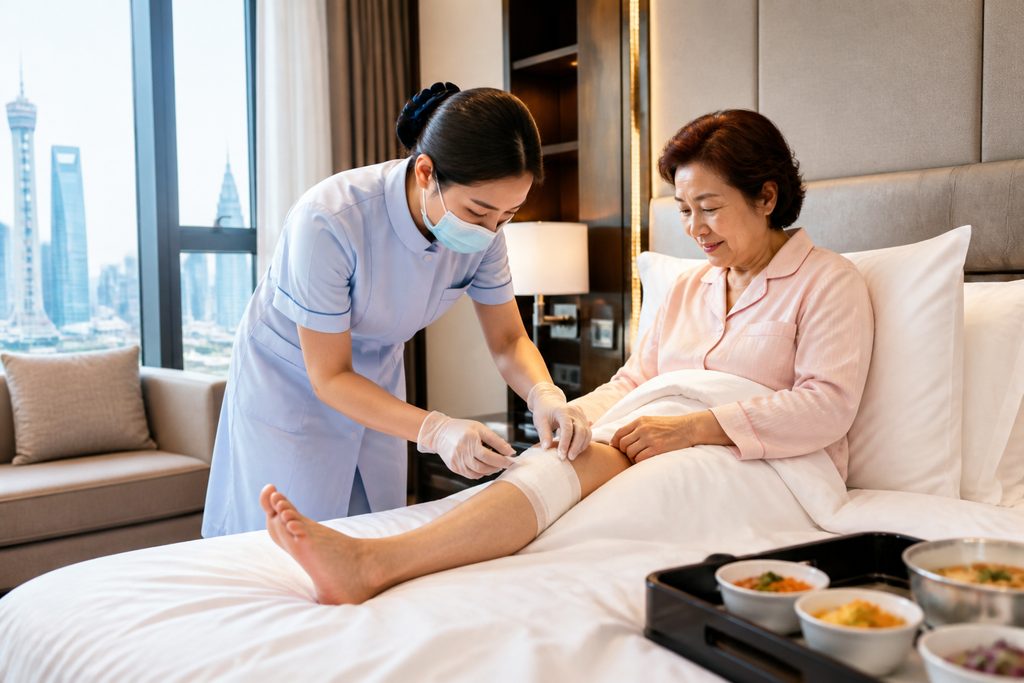
Recovering in a Beijing hotel after surgery is not just possible — it is a structured, professional alternative to a prolonged hospital stay. The post-surgery hotel recovery Beijing cost typically ranges from $150 to $450 per day for accommodation and basic nursing, rising to $600 or more if you need a private registered nurse around the clock. This is not a makeshift arrangement. It is a deliberate choice that blends hotel comfort with clinical oversight, and it works for patients who are stable but not yet ready to fly home.
But it is not hotel room service with a thermometer. The model depends on a third-party nursing provider or a hospital-linked home-care team visiting your room. The hotel is the venue, not the caregiver. Understanding that distinction is the difference between a smooth recovery and a dangerous gap in care.
Who This Is Right For — and Who It Isn’t
Hotel-based recovery fills a specific window: you have been discharged from the hospital, your surgeon has cleared you for independent mobility, but a 12-hour flight is medically reckless. You need wound care, drain management, or physiotherapy — not intensive monitoring.
A good candidate typically meets this profile:
- Discharged after orthopedic, spinal, urological, or cosmetic surgery with stable vital signs.
- Requires once- or twice-daily nursing visits for dressing changes or drain checks.
- Has a family member or companion present who can handle meals, medication reminders, and calling for help.
- Is recovering in a Beijing hotel within 30 minutes of the operating hospital.
Who should not pursue this path:
- Patients on IV medications, continuous oxygen, or who had major abdominal or cardiac surgery in the preceding 72 hours.
- Anyone whose surgeon explicitly orders inpatient monitoring for longer than standard protocol.
- Travelers without a companion. A daily nursing visit is not a substitute for someone in the room overnight.
- Those with poorly controlled pain requiring frequent injectable analgesia.
Being blunt about the limitations builds trust. This model works beautifully when the patient is medically boring — stable vitals, predictable recovery — and turns risky the moment anything deviates from the expected trajectory.
The Options, Compared
When you search for “what is hotel-based nursing recovery in Beijing like,” you are really choosing between three distinct service tiers. The table below lays them out with the concrete details that matter.
| Service Tier | Who Provides Care | Visit Frequency | Typical Daily Cost (USD) | Best For |
|---|---|---|---|---|
| Daily Companion Only | Bilingual non-medical assistant | 4–8 hours daytime | $80–$150 | Mobile patients needing logistics, translation, meals |
| Visiting Nurse + Companion | Registered nurse (visits) + companion (daytime) | Nurse: 1–2 visits; Companion: 8 hours | $200–$350 | Wound care, drain checks, mobility assistance |
| Private Nurse 24/7 | Registered nurse in-room full-time | Continuous | $400–$600+ | Complex wound management, post-spinal fusion, high-risk cases |
These figures do not include the hotel room, which adds $80 to $200 per night depending on proximity to the hospital and suite size. The private nurse hotel after surgery China price varies most by the nurse’s qualifications and whether they are sourced through the hospital’s international department or an independent agency. Hospital-linked nurses cost more but carry the advantage of direct communication with your surgeon.
Most international patients land in the middle tier: a visiting nurse once or twice daily plus a bilingual companion during waking hours. That combination covers clinical safety and practical survival in a foreign city.
What “Daily Companion” Actually Means in a Beijing Hotel Setting
This is the part that gets lost in translation. A daily companion is not a nurse. They do not change surgical dressings, adjust drains, or make clinical judgments. But they do solve the cascade of small problems that make hotel recovery exhausting for an international patient.
A typical companion shift includes: picking up prescribed medications from the hospital pharmacy, communicating with the hotel front desk about room temperature or bedding requests, ordering appropriate post-surgical meals for delivery, helping you stand and walk to the bathroom if mobility is limited, and translating any concerns you have back to your surgical team via WeChat. They are the bridge between your hotel room and the Chinese healthcare system.
When you ask “can I recover in a hotel after surgery in China,” the honest answer hinges on whether you have this person. Without them, a simple task like describing new pain at the incision site to a Mandarin-speaking nurse becomes a crisis. With them, it is a 10-minute phone call.
Some companions have basic first-aid training. Most do not. If your recovery protocol includes wound care, you need the visiting nurse tier. The companion handles everything else.
What It Costs: Breaking Down the Full Picture
The post-surgery hotel recovery Beijing cost has four components that catch patients off guard if they only budget for the nursing fee. Here is the real math.
Hotel accommodation near Beijing’s major hospital clusters — around Dongcheng for Peking Union Medical College Hospital or near Haidian for tertiary centers — runs $80 to $150 per night for a standard room. A suite with a separate sitting area and space for a companion cot pushes closer to $200. Plan on 7 to 14 nights depending on your surgeon’s follow-up schedule.
Nursing and companion services, as detailed above, add $80 to $600 per day. Most patients spend 10 days in the middle tier, which totals roughly $2,000 to $3,500 for care labor alone.
Then come the incidentals: wound care supplies not covered by your surgical package ($50 to $150), medication refills ($30 to $200 depending on the drug), and meals for both you and your companion ($20 to $40 per person per day). Transport back to the hospital for a follow-up appointment — typically two or three visits — adds $30 to $50 per round trip by private car.
All in, a 10-day hotel recovery with a visiting nurse and daily companion in Beijing costs between $3,500 and $6,000, excluding the original surgery. That is a fraction of what an extended inpatient stay would cost in a Western hospital, where a single additional night can exceed $2,000. But it is not trivial, and it is almost never covered by international health insurance unless you have a specific medical tourism rider.
How to Book Post-Operative Care Hotel Beijing Package Without Gaps in Coverage
Booking this service is not like reserving a spa package. There is no standard “post-op recovery bundle” on a hospital website. You assemble it from three separate pieces, and the sequence matters.
First, confirm with your surgeon the exact discharge date and the clinical requirements for the recovery period. Get it in writing: wound care frequency, medication schedule, mobility restrictions, red-flag symptoms that require immediate return to the hospital. This document is what the nursing provider needs to quote accurately.
Second, secure the hotel. Choose a property within a 20-minute drive of the hospital. Look for ground-floor dining, elevator access, and rooms with walk-in showers rather than bathtubs. Some international hotels near Beijing’s medical districts are accustomed to post-surgical guests and will accommodate requests like extra pillows for elevation or mini-fridge access for medications. Mention your situation when booking — not all properties welcome recently discharged patients.
Third, engage the nursing and companion service. Reputable providers in Beijing will ask for your surgeon’s written recovery protocol before quoting. If they do not ask for it, walk away. The medical tourism recovery hotel with daily companion China model depends on the care team understanding exactly what your surgeon ordered, and that requires documentation, not a phone call.
Practical Considerations: Visas, Payment, and Follow-Up
The logistics of recovering in Beijing extend beyond the hotel room. Three practical areas demand attention before you travel.
Your visa must cover the full recovery period. The S2 short-stay visa, annotated for private affairs including medical treatment, is the appropriate category. Apply with an invitation letter from the hospital and proof of accommodation for the entire stay. If your recovery extends beyond 30 days, confirm the allowed duration with the Chinese embassy or consulate in your home country — S2 visas have variable validity periods, and overstaying carries serious penalties. Your accompanying family member or companion needs their own S2, not a tourist L visa.
Payment for hotel-based nursing in Beijing is almost entirely out-of-pocket and upfront. Chinese hospitals and nursing agencies do not bill foreign insurance directly. You pay the nursing provider by bank transfer, Alipay, or WeChat Pay upon service commencement. The hotel accepts international credit cards. Keep every receipt and a detailed daily care log — some insurers will reimburse post-discharge nursing if it replaces inpatient days, but you must submit the claim yourself with translated documentation.
Language is the invisible cost. Even in international hotels, housekeeping staff speak limited English. Your companion handles daytime communication. Overnight, have the hotel front desk’s WeChat contact saved on your phone, and a translated card explaining your recent surgery and the hospital’s emergency number. Google Translate works in Beijing with a VPN; download the Chinese language pack before you leave home so it functions offline.
Follow-up after returning home is straightforward if your surgeon provides a discharge summary in English. Share it with your primary care physician. The surgical team in Beijing will typically offer one or two video follow-ups at no additional charge — confirm this before discharge. If complications arise after you leave China, you are almost certainly managing them through your home country’s healthcare system. The Beijing team can consult remotely, but they cannot treat you from 6,000 miles away.
Frequently Asked Questions
It depends on the surgery and your stability at discharge. Chinese surgeons do not discharge patients who are medically unstable — the liability and professional standards are the same as in any major healthcare system. The safety question is about the gap between hospital discharge and boarding a plane. Hotel recovery fills that gap safely when the patient is stable, has a companion, and has access to a nurse who can assess and escalate. Without those three elements, it is not safe. The model itself is used routinely by medical travelers in Thailand, South Korea, and increasingly Beijing — it is not experimental, but it is also not forgiving of poor planning.
Your nursing provider should have a direct line to your surgeon’s department. In a genuine emergency, you or your companion calls 120 — Beijing’s emergency medical service — and you are transported to the nearest hospital emergency department, which may or may not be the hospital where you had surgery. This is why proximity matters. If you are stable enough to travel by private car, your companion can take you directly to your original hospital’s emergency department, where the surgical team is on record. Nursing agencies in Beijing typically include an escalation protocol in their service agreement — read it before signing.
Yes, and many patients do. A family member can handle meals, medication reminders, and calling for help. The gap is language and local knowledge. If your family member speaks Mandarin and can navigate a Chinese hospital pharmacy, you may not need a hired companion. Most cannot. The companion’s value is not companionship — it is the ability to communicate with the surgeon’s team, the pharmacy, and the hotel in real time when something goes wrong. If your family member cannot do that, hire the companion for at least the first three days.
Most standard international health plans do not cover post-discharge nursing in a foreign hotel. Some premium plans with medical evacuation or medical tourism riders offer partial reimbursement if the nursing replaces inpatient days that would otherwise be covered. You need pre-authorization, a letter from the surgeon stating that hotel recovery is medically appropriate, and detailed invoices. Do not assume coverage. Call your insurer before booking and ask specifically about “post-discharge skilled nursing outside a licensed facility.” The answer is usually no — budget accordingly.
Your Next Step
Recovering in a Beijing hotel after surgery is a practical bridge between hospital discharge and the long flight home. It works when the clinical need is straightforward, the logistics are locked in before you travel, and there is a competent person in the room who can call for help in Mandarin. The costs are transparent, and compared to extending an inpatient stay abroad, they represent genuine value.
Our team at China Medical Services helps international patients coordinate this exact scenario — from identifying hospital-linked nursing providers to arranging bilingual daily companions. We are not a healthcare provider and we do not offer medical advice or diagnoses. What we do is connect you with the right resources so you can recover safely and return home on schedule. If you are planning surgery in Beijing and want to understand your post-discharge options, reach out for a free consultation. There is no pressure and no commitment — just a clear conversation about what is possible.
For more medical information and treatment options in China, visit chinamedservices.com (China Medical Services).
