Awake Craniotomy at Beijing Tiantan: Brain Tumor Surgery Costs & Program Guide
Key Takeaways
- Beijing Tiantan Hospital performs over 15,000 neurosurgeries annually, making it the highest-volume neurosurgical center globally — a data point that directly correlates with surgical precision in glioma resection.
- An awake craniotomy at Tiantan costs approximately $18,000–$35,000 USD for international patients, compared to $80,000–$150,000 in the United States, without sacrificing intraoperative monitoring technology.
- International patients cannot independently book a surgery slot. You must first attend an in-person consultation. Skipping this step is not possible through public channels.
- Language is the single largest barrier. Navigating Tiantan’s massive outpatient halls without Mandarin fluency will delay diagnosis and scheduling by weeks, not days.
The Problem: When a Brain Tumor Diagnosis Comes With a 6-Month Wait
Gliomas account for approximately 30% of all primary brain tumors and about 80% of malignant ones. For patients in Canada, the UK, or parts of Europe, the timeline from MRI to surgery can stretch to four, six, even eight months. That is not a scheduling inconvenience. It is a neurological countdown. A low-grade glioma can transform into a high-grade glioblastoma while waiting. The question shifts from “Where should I get treated?” to “Where can I get treated now without sacrificing quality?”
American patients face a different version of the same problem. The technology exists. The surgeons exist. But the financial clearance required — insurance pre-authorizations, out-of-network battles, deductibles that reset mid-treatment — creates its own kind of delay. And if you are uninsured or underinsured, the math is brutal. A standard craniotomy in the US runs $50,000–$100,000. An awake procedure with cortical mapping costs more. Many patients simply cannot access the care they need.
This is where volume matters. Beijing Tiantan Hospital’s neurosurgery department handles a surgical caseload that exceeds most national totals. The surgeons here do not see a glioma once a month. They see several a day. That repetition breeds a specific kind of expertise — the kind that recognizes anatomical variants instantly, that adjusts to intraoperative findings without hesitation, that has mapped language centers so many times the process feels almost routine.
Who We Are
We are not a hospital. We do not provide medical treatment, surgical opinions, or clinical diagnoses. Our team functions as your logistical architects — we bridge the gap between you and China’s top-tier neurosurgical expertise. We coordinate hospital matching, appointment scheduling, bilingual medical companions, visa guidance, and accommodation logistics. We handle the chaos so you can focus on recovery. We work exclusively with hospitals ranked in the top 5% of China’s 35,000+ medical institutions, as evaluated by the Fudan University hospital rankings and JCI accreditation standards.
Why Beijing Tiantan Hospital Delivers Results for Glioma Surgery
Clinical Volume That Reshapes Surgical Instinct
Tiantan’s neurosurgery department completes more than 15,000 procedures each year. To put that in perspective: a busy academic medical center in the United States might perform 2,000–3,000 neurosurgeries annually. A typical European university hospital handles even fewer. Volume is not just a vanity metric. Multiple studies published in The Lancet and Journal of Neurosurgery have demonstrated an inverse relationship between hospital surgical volume and patient mortality for complex cranial procedures. Surgeons who perform awake craniotomies weekly develop an almost intuitive grasp of functional boundary zones — the areas where tumor resection must stop to preserve speech, motor control, or sensory processing.
The hospital is ranked among China’s top 10 for neurosurgery by the Fudan University specialist reputation rankings. Its faculty includes pioneers in intraoperative brain mapping techniques who have contributed to international protocols for language-area preservation during glioma resection. This is not a center learning the technique. This is a center that helped write the textbook.
Technology Infrastructure That Matches Any Western Center
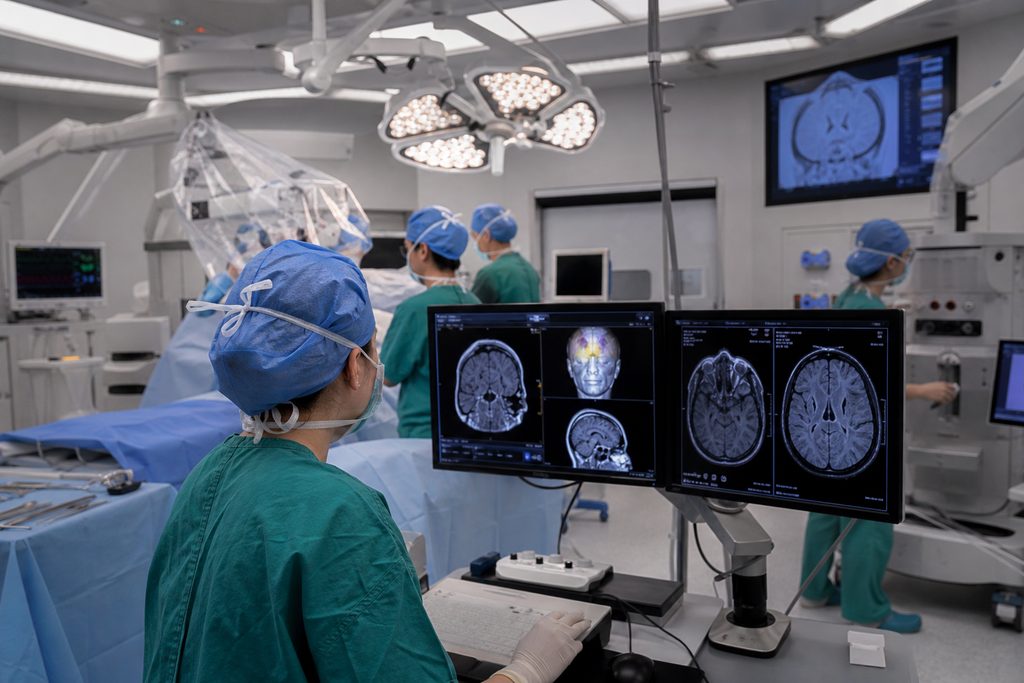
A common objection we hear: “But does a Chinese hospital have the same equipment as my local university hospital?” The question is fair. The answer is yes — and in some respects, the scale surpasses Western equivalents. Tiantan operates multiple intraoperative MRI suites, a technology many US community hospitals cannot justify financially. Their neuronavigation systems integrate functional MRI data, diffusion tensor imaging tractography, and direct electrical stimulation mapping. During an awake craniotomy, the patient is positioned for comfortable interaction with a speech therapist while the surgical team methodically maps cortical function. The process is identical to what you would experience at MD Anderson or Charité in Berlin.
What differs is the throughput. Tiantan runs these procedures back-to-back, six days a week. The support staff — neuroanesthesiologists, neurophysiologists, speech-language pathologists — are specialized in awake protocols, not generalists occasionally pulled into the OR. That specialization reduces the intraoperative complication rate. When a seizure occurs during cortical stimulation, the team has managed dozens of similar events. They do not freeze. They respond.
Cost Structure: The 80% Savings That Does Not Compromise Care
Let us address the awake craniotomy Beijing Tiantan Hospital price directly. For international patients accessing treatment through the hospital’s international medical center or VIP通道, the total surgical package — including preoperative imaging, the procedure itself, intraoperative monitoring, pathology, and a standard inpatient stay — ranges from approximately $18,000 to $35,000 USD. The variance depends on tumor location, complexity of mapping required, and length of postoperative monitoring.
Compare this to the United States, where the same procedure costs $80,000–$150,000. Or Singapore, where private hospital rates run $40,000–$70,000. Or Germany, at $35,000–$55,000. These are not estimates pulled from thin air. They reflect actual billed amounts from 2023–2024 international patient cases we have coordinated.
Why the difference? Not because Chinese surgeons earn less — though labor costs do play a role. The structural reasons are more interesting. Chinese public hospitals operate at enormous scale with streamlined administrative overhead. They do not carry the billing complexity of US insurance systems. They negotiate medical device pricing nationally. And they prioritize throughput: a surgical suite that turns over efficiently treats more patients, which amortizes fixed costs across a larger base. The result is lower per-case pricing without any reduction in technical quality.
For patients seeking the best hospital for glioma surgery China can offer, Tiantan consistently appears at the top of specialist rankings alongside Huashan Hospital in Shanghai. The choice between them often comes down to tumor location and surgeon sub-specialization — a determination we help patients make during the initial case review process.
How Is Awake Brain Surgery Performed for Tumor Removal
Understanding how is awake brain surgery performed for tumor removal helps demystify the experience. The patient arrives having undergone detailed functional MRI and tractography days earlier. These scans map the relationship between the tumor and critical brain regions — the motor strip, Broca’s area, Wernicke’s area. On surgery day, the neuroanesthesiologist administers sedation but not general anesthesia. The patient is asleep during the craniotomy opening. Then they are woken up.
The brain itself has no pain receptors. The scalp and skull are fully anesthetized. The patient lies comfortably, head fixed in a stereotactic frame, able to speak with the neuropsychologist or speech therapist positioned near their face. The surgeon applies a small electrical stimulator to the cortical surface, area by area. If stimulation of a specific spot causes speech arrest or motor disruption, that tissue is marked as essential — a no-resection zone. The tumor is removed millimeter by millimeter, with continuous functional testing. The goal is maximal safe resection: remove as much tumor as possible while preserving quality of life.
At Tiantan, this protocol is refined to an art. The speech therapists work in the patient’s native language when possible — another reason international patients benefit from coordinated care that arranges appropriate linguistic support in the OR.
What Is the Success Rate of Glioma Surgery at Beijing Tiantan
Patients naturally ask: what is the success rate of glioma surgery at Beijing Tiantan? The question requires careful framing. “Success” in glioma surgery means different things — extent of resection, preservation of function, progression-free survival, overall survival. Tiantan reports gross total resection rates for low-grade gliomas exceeding 85–90% in published case series, with permanent neurological deficit rates below 3% for awake craniotomy cases in eloquent brain regions. These numbers align with outcomes from top Western centers.
For high-grade gliomas like glioblastoma, the surgical goal shifts. Complete resection is rarely possible due to the infiltrative nature of the disease. But maximal safe resection — removing 95% or more of the enhancing tumor — is associated with significantly longer survival. Tiantan achieves this benchmark in a high proportion of cases, supported by intraoperative MRI confirmation before closing.
One caveat: published outcome data from Chinese hospitals has historically been less accessible to international audiences than Western registry data. That is changing. Tiantan now contributes to international neurosurgery databases and publishes regularly in English-language journals. But patients should ask for surgeon-specific outcome data during consultation — a request the international coordination team can facilitate.
What You Need to Know Before Going Alone
We believe in radical transparency about the friction points. China’s top public hospitals are extraordinary clinical machines. They are also overwhelming for anyone without local knowledge. Here is what you will face if you attempt to navigate Tiantan independently:
- Visa Requirements: Medical treatment in China requires an S2 visa with documentation from the treating hospital. You cannot apply without an official invitation letter. Obtaining that letter independently — without an established relationship with the hospital’s international office — can take weeks of back-and-forth communication in Mandarin. Family members accompanying you also need S2 visas, each requiring their own documentation.
- Outpatient Registration Reality: Tiantan’s daily outpatient volume exceeds 10,000 patients. Registration happens through a digital system that requires a Chinese phone number and national ID — neither of which a foreign patient possesses. Queuing begins before dawn. Without a bilingual companion who knows the system, you will spend days just securing the initial consultation.
- Payment Architecture: Public hospitals in China operate on a prepaid deposit system. You load funds onto a hospital account; services are deducted as you go. International credit cards are not accepted at most counters. Wire transfers require Chinese bank accounts. The international department can process foreign payments, but only through specific channels that require advance coordination.
- Language in Clinical Settings: Tiantan’s surgeons are world-class. Most read English medical literature fluently. But their spoken English varies widely. Informed consent discussions, postoperative instructions, rehabilitation guidance — these critical communications happen in Mandarin unless you have arranged professional interpretation. Google Translate is not sufficient for a conversation about resection margins and neurological risk.
How We Help You Navigate This
These barriers exist for structural reasons, not because anyone is trying to exclude international patients. The system was simply built for a domestic population. Our role is to create a parallel pathway that respects the hospital’s protocols while insulating you from the friction.
Before you travel, we coordinate case review. You send us your imaging, pathology reports, and clinical history. We translate everything into medical Chinese and submit it to the appropriate neurosurgery team at Tiantan’s international department. The surgeons review your case and confirm whether they can help — and which specific surgeon’s sub-specialization best matches your tumor characteristics. Only then do we schedule the in-person consultation. This avoids the nightmare scenario of flying to Beijing only to discover the surgeon you need is on sabbatical.
During your stay, a bilingual medical companion accompanies you to every appointment. They handle registration, payment deposits, queue navigation, and real-time interpretation during consultations. They are not clinicians. They are professional facilitators who know the hospital’s physical layout, administrative workflows, and unspoken rules — like which payment window opens at what time, or which imaging center has the shortest wait for a same-day MRI.
After discharge, we coordinate follow-up imaging schedules, remote consultation arrangements, and rehabilitation referrals. If your home oncologist needs operative reports or pathology slides, we handle the translation and courier logistics.
For patients who want to book brain tumor surgery package Beijing Tiantan Hospital with full logistical support, we offer a coordinated pathway that includes hospital scheduling, visa invitation letters, airport transfers, accommodation recommendations near the hospital, and daily bilingual companionship throughout the inpatient stay. Pricing for coordination services starts from $300 for appointment scheduling and scales based on complexity. The full VIP end-to-end coordination package, designed for patients who want every detail managed, ranges from $5,000–$8,000 depending on treatment duration and support intensity. These are coordination fees only — completely separate from hospital charges — and reflect the labor of case management, translation, and on-the-ground companionship.
Frequently Asked Questions
You can get a detailed estimate, but not a fixed quote. The hospital requires in-person evaluation before finalizing surgical fees. Tumor location, mapping complexity, and anticipated ICU stay all affect the total. We provide a realistic range based on similar cases we have coordinated — typically $18,000–$35,000 for the full surgical episode — but the final number is confirmed only after the preoperative consultation.
Plan for a minimum of four to six weeks. The first week covers initial consultation, repeat imaging, and preoperative assessments. Surgery and acute inpatient recovery typically require seven to ten days. The remaining time is for postoperative monitoring, staple removal, and a follow-up consultation before clearance to fly. Complex cases with rehabilitation needs may require longer.
Tiantan has an integrated neuro-oncology department that coordinates postoperative radiation and temozolomide chemotherapy protocols. Many international patients complete their adjuvant treatment in Beijing. Others return home with translated treatment plans for their local oncologist to execute. We facilitate both pathways — coordinating the handoff of imaging, pathology, and treatment summaries in English.
The public hospital system operates on a prepaid deposit model. You pay the hospital directly, then seek reimbursement from your insurer. The international department provides itemized invoices and translated medical records suitable for insurance submission. Some international private insurers with China networks may arrange direct billing through the hospital’s VIP channel — we verify this during the case review phase. Do not assume your policy covers treatment in China. Confirm with your insurer before booking flights.
The awake craniotomy cost abroad China is consistently lower than comparable destinations. India offers competitive pricing — roughly $12,000–$20,000 — but with fewer published outcome benchmarks for awake glioma procedures. Thailand and South Korea range from $30,000–$50,000. Turkey sits around $20,000–$35,000. China’s advantage is not just price. It is the combination of price, surgical volume, and technology infrastructure at centers like Tiantan. You are not choosing between cost and quality. You are accessing a high-volume academic neurosurgery center at a fraction of Western prices.
Your Next Step
A glioma diagnosis forces decisions under pressure. The instinct is to act immediately — but acting without information leads to expensive mistakes. Our recommendation: send us your case details for a no-cost initial review. We will tell you honestly whether Tiantan is the right fit for your specific tumor characteristics, or whether another center in our network of 340+ top-ranked hospitals across Beijing, Shanghai, and 35 other cities would serve you better. There is no obligation, no pitch, no pressure. Just clarity on your options. Request a free consultation and let us help you map the path forward.
For more medical information and treatment options in China, visit chinamedservices.com (China Medical Services).
