Suzhou BenQ Mingji Hospital: Taiwan JCI-Accredited Care Near Shanghai
Key Takeaways
- BenQ Mingji Hospital holds JCI accreditation and operates under Taiwan medical standards — a rare combination within a 30-minute high-speed train ride from Shanghai.
- International patient pricing is transparent and typically 50-70% lower than equivalent private hospital care in Shanghai, with English-speaking coordinators managing the entire visit.
- The hospital does not offer direct online booking for international patients without a Chinese ID. Attempting to self-navigate the registration system usually fails at the payment verification stage.
- Visa requirements are specific: S2 visa with a hospital-issued invitation letter. Tourist visas explicitly prohibit medical treatment and can result in denied admission.
The Problem: Finding JCI-Quality Care Outside Shanghai Without the Chaos
Shanghai’s top international hospitals deliver excellent care. Nobody disputes that. But the cost has climbed sharply over the past five years. A standard executive health screening at a Shanghai JCI hospital now runs $1,500 to $3,000. An orthopedic consultation with imaging can exceed $800 before treatment even begins. For patients who need ongoing care — monthly follow-ups, rehabilitation, repeat lab work — those numbers compound fast.
Then there is the operational reality. Shanghai’s international hospital wings are operating at near-capacity. Appointment windows stretch to two or three weeks for non-urgent specialist consultations. Walk-in? Forget it. The registration counter will politely redirect you to a booking app that requires a Chinese phone number and local payment method. Approximately 1 in 4 international patients we speak with has already tried and failed to book independently before contacting us.
What patients actually need is straightforward: JCI-accredited care, English-speaking staff, transparent pricing, and a location that does not require a domestic flight from Shanghai. Suzhou BenQ Mingji Hospital checks every box. But most foreign patients have never heard of it. That is a gap worth closing.
Who We Are
We are not a hospital. We do not provide medical treatment, clinical diagnoses, or emergency care. Our team functions as your logistical architects — we bridge the gap between you and China’s top-tier medical institutions. We maintain verified relationships with 340+ top-ranked hospitals across 37 cities, including Suzhou BenQ Mingji Hospital. When you contact us, we translate your medical needs into a concrete plan: the right hospital, the right department, the right visa pathway, and a bilingual companion who ensures nothing gets lost between languages.
Why Suzhou BenQ Mingji Hospital Deserves Serious Attention
JCI Accreditation With Taiwan Medical Governance
Joint Commission International accreditation is the global benchmark for hospital quality and patient safety. BenQ Mingji earned its JCI gold seal and maintains it through rigorous re-assessment cycles. That alone puts it in a small group of hospitals in the Yangtze River Delta region. But the deeper differentiator is the hospital’s operational DNA. BenQ Mingji is a Taiwan-invested hospital. Its clinical protocols, nursing ratios, infection control standards, and patient communication workflows follow Taiwan’s medical system — which itself is modeled on Western evidence-based practice with strong patient-centered design principles.
For a foreign patient, this translates into something tangible. The hospital’s documentation is bilingual by default. Informed consent forms are available in English. Nursing stations operate with lower patient-to-nurse ratios than typical mainland Chinese public hospitals. Discharge planning includes written English-language instructions. These are small operational details that dramatically reduce anxiety when you are receiving care in a country where you cannot read the signage.
This is what makes it the best JCI accredited hospital near Shanghai for foreigners who want structured, protocol-driven care without the premium pricing of downtown Shanghai international wings.
Geographic Logic: 30 Minutes From Shanghai, a World Apart in Cost
Suzhou is not a compromise location. The high-speed train from Shanghai Hongqiao Station to Suzhou Industrial Park Station takes 23 to 28 minutes. From there, BenQ Mingji Hospital is a 10-minute taxi ride. Door-to-door from central Shanghai, you are looking at roughly 50 to 70 minutes. That is comparable to crossing Shanghai by metro during peak hours.
The cost differential, however, is substantial. A comprehensive health screening package at BenQ Mingji runs $400 to $800 depending on scope. The equivalent package at a Shanghai JCI international hospital starts around $1,500. An MRI scan: $300 to $500 at BenQ Mingji versus $800 to $1,200 in Shanghai. These are not promotional rates. They reflect Suzhou’s lower operational overhead — real estate costs, staff salaries, and administrative burden all run below Shanghai levels.
Patients often ask us: what is the cost of treatment at BenQ Mingji hospital compared to going back home? Against US private hospital pricing, the gap is even wider. A knee arthroscopy that bills at $25,000 to $40,000 in the United States typically lands between $6,000 and $10,000 at BenQ Mingji, including surgeon fees, anesthesia, and a private recovery room. The hospital publishes package pricing for common procedures — something almost unheard of in Chinese public hospitals and still rare among private providers.
The Taiwan Medical Service Model in Mainland China
Taiwan’s healthcare system consistently ranks among the world’s best for accessibility and outcomes. BenQ Mingji imports that philosophy directly. Appointments run on time — typically within 15 minutes of the scheduled slot. Consultations are not rushed. A specialist will spend 20 to 30 minutes with a new patient, reviewing history and explaining findings. This stands in stark contrast to the 5-to-8-minute consultations common in overloaded Chinese public hospital outpatient departments.
The hospital also operates what it calls an international medical center — a dedicated unit that handles everything from appointment scheduling to insurance coordination for foreign patients. This is where the Suzhou BenQ Mingji international medical package concept comes into play. The hospital offers structured packages for health screenings, obstetrics, orthopedic surgery, and select cardiac procedures. Each package bundles consultation, diagnostics, procedure fees, and post-operative follow-up into a single upfront quote. No surprise billing. No line-item negotiation with a billing department that does not speak your language.
What You Need to Know Before Going Alone
BenQ Mingji Hospital welcomes international patients. That is not the same as saying it is easy to access independently. Several structural barriers exist, and they are not the hospital’s fault — they are features of how the Chinese healthcare system operates.
- Visa Requirements: Medical treatment in China requires an S2 visa with a hospital-issued invitation letter. Tourist (L) visas do not permit medical treatment. If you arrive on a tourist visa and attempt to register for a surgical procedure, the hospital’s international department will flag the visa mismatch. Best case: your procedure is delayed while you exit and re-enter on the correct visa. Worst case: treatment is denied. The invitation letter must come from the hospital’s official stamp — a booking confirmation email is not sufficient.
- Registration and Payment Systems: The hospital’s online booking platform requires a Chinese national ID number or a mainland China-issued residence permit. Foreign passport numbers are not accepted in the standard registration flow. Payment at the hospital can be made by international credit card at the international medical center counter, but the self-service kiosks only accept WeChat Pay, Alipay, or UnionPay bank cards. Without a Chinese bank account or mobile payment setup, you are functionally locked out of self-service options.
- Medical Records and Imaging: If you bring imaging from overseas, the hospital’s radiology department can read DICOM files on CD or USB. But the intake process requires a Chinese-language referral form to be generated in the hospital’s system before any scan can be ordered. This form must be completed by a hospital-registered physician — it cannot be pre-filled or submitted remotely by the patient.
How We Help You Navigate This
These barriers exist for structural reasons. They are not designed to exclude foreign patients — the system was simply built for a domestic user base. Our job is to route around them efficiently.
Before you travel, we handle the hospital invitation letter and guide you through the S2 visa application at your nearest Chinese embassy or visa center. We coordinate directly with BenQ Mingji’s international medical center to lock in your appointment dates and confirm which specialist will see you. If you need a Suzhou BenQ hospital international patient price estimate, we obtain a written quote from the hospital based on your medical history and required procedures. This quote is binding for 30 days.
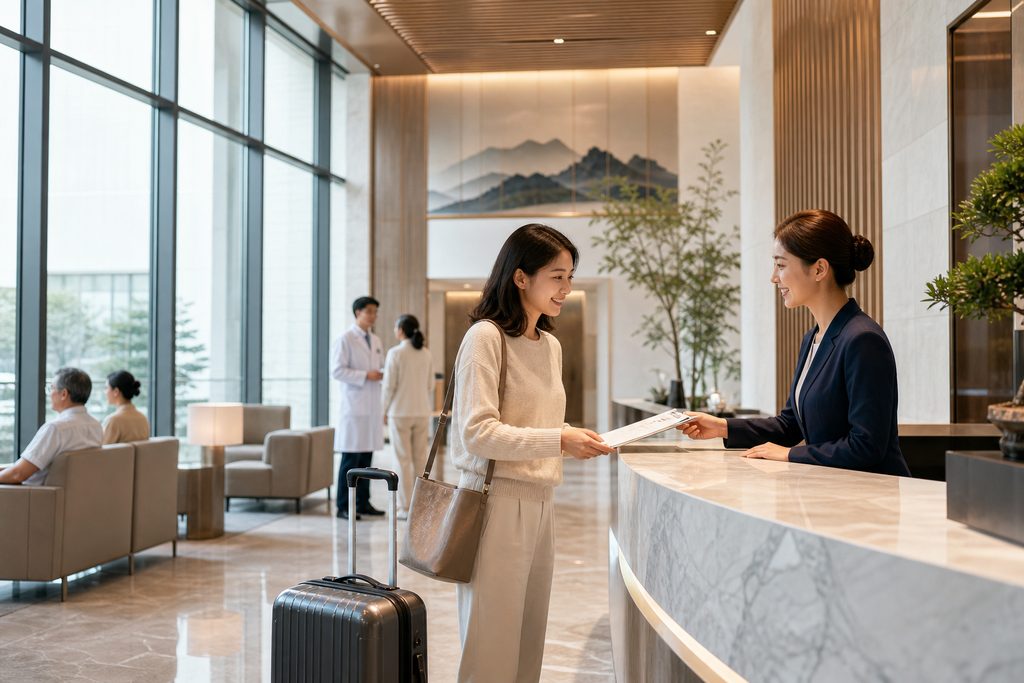
On the day of your visit, a bilingual medical companion meets you at the hospital entrance. They manage registration, payment, queue tracking, and real-time interpretation during your consultation. They also handle the discharge process — collecting your English-language medical report, imaging files, and medication instructions. If follow-up visits are needed, we schedule them before you leave the building.
This is case management, not concierge fluff. We charge from $200 per day for bilingual companion services. Hospital appointment coordination starts from $300. These fees are separate from your hospital bill, but any coordination fee you pay is fully credited toward on-the-ground services if you upgrade within 90 days. The hospital’s treatment charges go directly to the hospital — we never mark up medical fees.
Frequently Asked Questions
You cannot book directly through the hospital’s public website or app without a Chinese ID. The pathway is through the hospital’s international medical center, which requires initial contact by phone or email — and the intake staff primarily speak Mandarin. We handle this coordination on your behalf, securing confirmed appointment slots and a written treatment quote before you travel. The hospital typically confirms international patient appointments within 2 to 3 business days.
Packages vary by procedure but generally bundle the specialist consultation, required diagnostics (lab work, imaging), the procedure itself, anesthesia, a private inpatient room, and one follow-up consultation. Medication is usually billed separately. The hospital provides a line-item breakdown upon request. Package pricing is fixed for the scope defined — if additional procedures become medically necessary during treatment, those are quoted and approved before proceeding.
BenQ Mingji accepts direct billing from several major international insurers, including Cigna, Aetna International, and Allianz Worldwide Care. However, direct billing must be confirmed before your visit — the hospital’s international medical center will verify coverage with your insurer. If direct billing is not available for your plan, you pay upfront and submit for reimbursement. We recommend obtaining a pre-authorization letter from your insurer before traveling.
BenQ Mingji is a full-service general hospital with a 24/7 emergency department, intensive care unit, and on-call specialist coverage across all major departments. For complications requiring transfer, the hospital has formal referral relationships with tertiary hospitals in Shanghai, including Zhongshan Hospital and Ruijin Hospital. Medical liability follows Chinese law, and the hospital carries institutional malpractice insurance. We strongly recommend that all international patients carry their own medical travel insurance with evacuation coverage as a backstop.
Yes. JCI accreditation is a uniform standard — a hospital either meets it or it does not. BenQ Mingji’s most recent JCI survey resulted in full accreditation with no conditional findings. The hospital’s Taiwan-trained leadership team maintains clinical governance standards that align with international benchmarks for surgical site infection rates, medication error rates, and patient fall rates. The main difference from a Shanghai JCI hospital is price and location, not clinical quality.
Your Next Step
BenQ Mingji Hospital represents a genuine option for international patients who want JCI-accredited, Taiwan-standard care at a price point that does not match Shanghai’s premium tier. The hospital exists, the quality is verifiable, and the logistics are manageable. What makes it difficult to access independently is the administrative layer — visas, registration systems, language barriers — not the medicine itself.
If you are considering treatment at BenQ Mingji, or if you want to compare it against other Shanghai and Yangtze River Delta hospitals in our database, we can provide a candid assessment based on your specific medical needs. Our China Medical Services team handles the coordination so you can focus on your health. Visit our patient services page to start a free consultation — no commitment, no pressure, just an honest conversation about your options.
For more medical information and treatment options in China, visit chinamedservices.com (China Medical Services).
