Bhutanese Patient Medical Tourism Service China: Himalayan Region Patient Guide
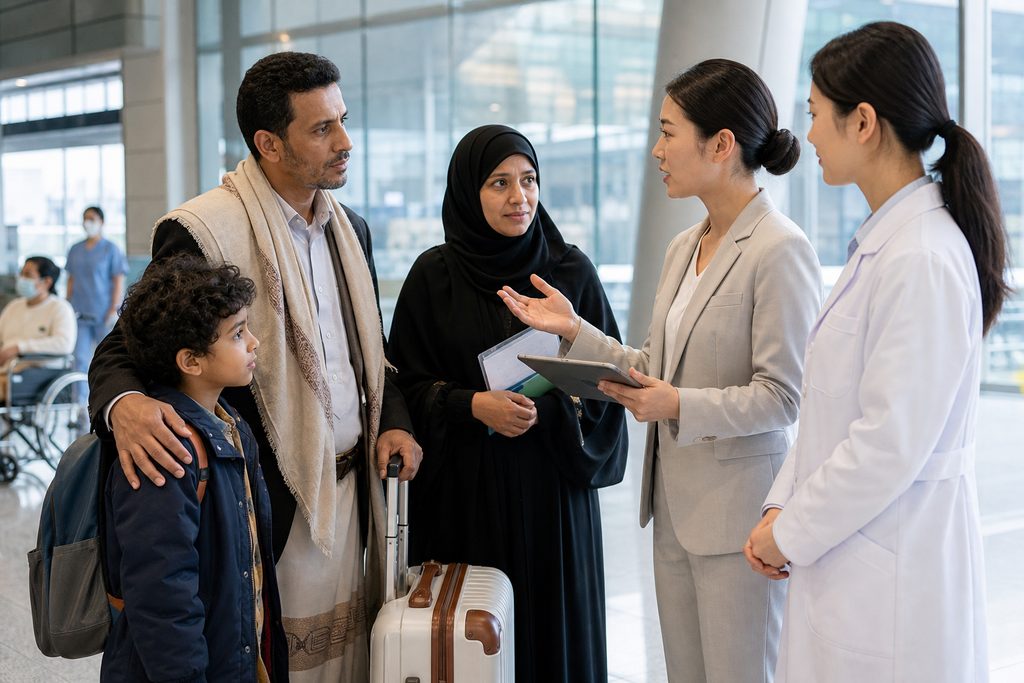
Have you ever calculated what a six-month wait for cardiac surgery actually costs your family — not in dollars, but in lost time, mounting anxiety, and a condition that does not pause while you queue? For many Bhutanese patients facing serious diagnoses, that wait is not an inconvenience. It is the entire treatment window.
Key Takeaways
- A coronary artery bypass graft in China costs approximately $12,000–$20,000 at a top-tier public hospital, compared to $120,000+ in the United States and $25,000–$40,000 in private Indian facilities — with outcomes that match or exceed international benchmarks.
- China’s Fuwai Hospital performs over 14,000 cardiac surgeries annually, making it the highest-volume heart center on the planet. Volume drives precision, and precision drives survival rates.
- No Bhutanese patient can directly book surgery at a Chinese public hospital from abroad. The system requires an in-person consultation first. Anyone promising otherwise is misleading you.
- Visa rules are rigid and specific. Using the wrong visa category — M for business, L for tourism — will get you turned away at the hospital registration desk or, worse, at the border.
The Problem: When Distance Determines Your Diagnosis
Bhutan’s healthcare system has achieved remarkable things for a nation of its size. The country provides universal health coverage. Primary care reaches into the most remote dzongkhags. But the reality for patients facing complex oncology, advanced cardiothoracic surgery, or rare pediatric conditions is stark. The pool of sub-specialists is small. The volume of high-complexity procedures is low. And when a diagnosis demands a level of surgical repetition that only comes from a surgeon performing 300 iterations of the same operation every year, Bhutan’s referral hospitals — through no fault of their own — cannot always provide that.
The default pathway has long been India. It is familiar, geographically close, and supported by longstanding bilateral health agreements. But Indian private hospitals catering to international patients have grown expensive. A Bhutan patient medical treatment cost China comparison reveals something worth examining closely: for many high-acuity procedures, Chinese top-tier hospitals now undercut Indian private centers by 30–50%, with clinical volumes that frequently exceed them. The question is no longer “why China?” It is “why not at least look?”
Who We Are
China Medical Services is not a hospital. We do not employ doctors, prescribe treatments, or make clinical recommendations. Our team operates as the logistical layer between Bhutanese patients and China’s 340+ top-ranked hospitals across 37 cities — institutions drawn from the top 5% of the country’s 35,000+ hospitals, ranked by the Fudan University hospital rating system and JCI accreditation standards. We handle hospital matching, appointment coordination through official international departments, bilingual medical companion services, and visa guidance. The clinical decisions remain between you and your Chinese physician. Everything else — the language barrier, the registration queues, the payment logistics, the accommodation — that is where we step in.
Why China Delivers Results for Himalayan Region Patients
Clinical Volume Creates a Different Kind of Surgeon
The math is uncomfortable but true. A joint replacement surgeon at a major Chinese orthopedic center completes 200–500 procedures annually. The average US orthopedic surgeon performs roughly 65. That gap is not about talent. It is about system design. Chinese top-tier hospitals run on high-throughput surgical schedules that would be unrecognizable in Western settings. A single operating theater might handle eight to ten major procedures in a day. For the patient, this means your surgeon has seen your exact complication before — not once or twice, but dozens of times.
Fuwai Hospital in Beijing, the world’s highest-volume cardiac surgery center, logs over 14,000 heart operations each year. Zhongshan Hospital at Fudan University in Shanghai handles a case volume in cardiac and thoracic surgery that rivals entire national health systems. West China Hospital in Chengdu — geographically closer to Bhutan than Beijing — runs one of the largest oncology programs in Asia. These are not just big numbers. They are statistical shields against rare surgical complications. When you are the one on the table, you want the surgeon who has seen everything.
The best hospital in China for Himalayan region patients Depends on the Condition
There is no single right answer. The Fudan University hospital rankings, updated annually, evaluate hospitals across 45 specialties. For oncology, the top-ranked institutions include the Cancer Hospital Chinese Academy of Medical Sciences in Beijing and Fudan University Shanghai Cancer Center. For orthopedics, Beijing Jishuitan Hospital and West China Hospital consistently appear in the top tier. For neurosurgery, Beijing Tiantan Hospital and Huashan Hospital in Shanghai dominate the specialty reputation rankings.
Proximity matters too. Chengdu — reachable via a short flight from Paro through Bangkok or Kathmandu — hosts West China Hospital, a comprehensive giant with elite departments in oncology, respiratory medicine, and orthopedics. For Bhutanese patients who want to minimize travel distance without sacrificing clinical quality, Chengdu is a logical first look. Our top-ranked hospital database organizes these institutions by city and specialty, so you are not guessing.
Cost Advantage Without Quality Compromise
Let us address the elephant in the room. China’s medical costs are lower than Western benchmarks — and increasingly lower than India’s private sector for international patients. That triggers skepticism. Does cheaper mean worse?
It does not. The cost differential is structural, not qualitative. Chinese public hospitals operate on thin margins with heavy state subsidization. Physician salaries are a fraction of US levels — not because Chinese surgeons are less skilled, but because the labor market is different. Hospital infrastructure is built at scale. A single hospital campus might serve 10,000 outpatient visits per day. That volume spreads fixed costs across an enormous patient base. The result: a cardiac bypass that costs $120,000 in the US and $25,000–$40,000 at a private Indian hospital runs $12,000–$20,000 at a top Chinese public hospital’s international department.
| Procedure | China (Top Public Hospital) | India (Private International) | United States |
|---|---|---|---|
| Coronary Artery Bypass Graft | $12,000–$20,000 | $25,000–$40,000 | $120,000+ |
| Total Knee Replacement | $8,000–$15,000 | $12,000–$20,000 | $35,000–$50,000 |
| Cancer Chemotherapy (per cycle) | $1,500–$4,000 | $2,000–$5,000 | $10,000–$30,000 |
| Liver Transplant | $40,000–$70,000 | $45,000–$80,000 | $300,000+ |
Ranges reflect international department pricing. Final costs vary by hospital and case complexity.
For Bhutanese patients specifically, the cheap cancer treatment China for international patients search query reflects a real calculation. Oncology care in China’s top cancer centers — with access to immunotherapy regimens, targeted therapies, and radiation oncology technology that matches any Western facility — costs a fraction of what it would in Bangkok or Singapore, let alone New York or London. The drugs are often the same. The linear accelerators are the same models. The difference is the system around them.
What You Need to Know Before Going Alone
We have seen what happens when a well-intentioned family tries to navigate this system independently. It does not end well. Not because the hospitals are hostile — they are not. But because the friction points are invisible until you hit them.
- Visa Requirements Are Non-Negotiable: Medical treatment in China requires an S2 visa with a notation specifying the medical purpose. Accompanying family members also need S2 visas. The M visa is for commercial trade — it has nothing to do with healthcare. Showing up at a hospital registration desk with an L tourist visa will get you refused. Hospitals check. Immigration checks. The S2 application requires an invitation letter from the Chinese hospital — which you cannot obtain without a confirmed appointment. This is the circular dependency that stops most independent attempts cold.
- Public Hospital Registration Is a Physical Event: You cannot book a public hospital outpatient appointment online from Bhutan. The system requires in-person registration, often on the same day, often starting at 6:00 AM. Queues form hours earlier. The registration terminals are in Chinese. The staff at the window speak Chinese. If you do not have someone physically present who can navigate this, you do not have an appointment. The international departments and VIP channels bypass this — but they are separate systems with separate coordination requirements.
- Payment Systems Do Not Speak to Each Other: Chinese public hospitals operate on a prepaid deposit model. You load funds onto a hospital card at admission. Treatment is deducted from the balance. International credit cards are not accepted at most public hospital cashiers. Wire transfers from Bhutanese banks to Chinese hospital accounts involve currency conversion hurdles, intermediary bank delays, and documentation requirements that can stall admission by days or weeks. Private international hospitals like United Family or Jiahui accept direct insurance billing — but their procedure costs run higher, closer to Indian private hospital pricing.
How We Help You Navigate This
These barriers exist for structural reasons. They are not designed to exclude international patients — but they effectively do. Our role is to build a bridge across each one.
Before you travel, we match your medical records and diagnostic imaging to the appropriate specialty department at a hospital that fits your condition, budget, and geographic preference. We coordinate with the hospital’s official international patient center to secure an appointment — not through back channels, but through the legitimate VIP and international department pathways that exist for exactly this purpose. We prepare the invitation letter required for your S2 visa application. We brief you on exactly what documents to bring, what to expect at the border, and how to handle the registration process once you arrive.
During your treatment, a bilingual medical companion — a Mandarin-English speaker trained in hospital navigation — handles every logistical touchpoint. Registration, queue management, payment deposits, pharmacy runs, test result collection, translation during consultations, clarification of discharge instructions. You focus on your health. We handle the friction.
After discharge, we coordinate follow-up appointments, medication refills, and — if needed — remote video consultations with your Chinese physician. Any consultation fees you paid are credited in full toward on-the-ground coordination if you upgrade within 90 days. That credit applies to our coordination fee, never to hospital treatment charges.
If you are researching how can a Bhutanese patient book surgery in China, the short answer is: through the hospital’s international department, with a confirmed in-person consultation first. No surgeon will schedule an operation without examining you. That is universal. What we do is collapse the time between “I need this” and “I am in front of the doctor” — from months of independent trial-and-error to a structured, predictable timeline.
Is China Safe for Bhutanese Medical Tourists?
The question behind the question is usually about something specific: discrimination, communication breakdown, or being lost in a system that does not recognize you. Let us take each one honestly.
Chinese top-tier hospitals in major cities treat international patients routinely. Beijing, Shanghai, Guangzhou, and Chengdu see thousands of foreign patients annually — from the Middle East, Southeast Asia, Russia, Africa, and increasingly South Asia. Hospital international departments are staffed with English-speaking coordinators. The physicians themselves often speak functional medical English, particularly in specialties with high international publication rates. That said, outside the international department bubble — in the general wards, at the pharmacy window, in the CT scan queue — English evaporates. This is where a companion becomes non-negotiable.
Safety in the broader sense is straightforward. Violent crime rates in Chinese cities are low by global standards. Hospital security is present. Medical standards at Fudan-ranked institutions are subject to rigorous accreditation. The concern is not physical danger. It is system opacity. You are safe walking down the street. You are not safe assuming the system will bend to accommodate your lack of Mandarin. It will not. Prepare accordingly, or have someone prepare for you.
For families considering a medical tourism package China from Bhutan, the concept of a “package” deserves scrutiny. Some facilitators sell all-inclusive bundles that promise fixed prices, guaranteed surgery dates, and hotel-like hospitality. Be careful. Legitimate hospital international departments do not sell fixed-price surgery packages sight-unseen. Costs depend on diagnostic findings, surgical complexity, implant choices, and length of stay. Anyone quoting a firm all-in price before a physician has examined you is guessing — or worse, locking you into a low-ball estimate that will balloon later. Our approach is different. We quote coordination fees transparently. Hospital costs are estimated in ranges based on typical cases for your condition, with the explicit caveat that final costs depend on clinical findings. No surprises. No bait-and-switch.
Frequently Asked Questions
No formal referral is required by Chinese hospitals. However, having your complete medical records — including diagnostic reports, imaging (CT, MRI, X-ray films on CD or cloud link), pathology slides if relevant, and a summary letter from your treating physician — is essential. Chinese specialists will conduct their own evaluation, but they need your baseline data to do it efficiently. We help organize and translate these records before submission.
It varies sharply by condition and hospital. For a non-emergency orthopedic procedure, expect 3–6 weeks from initial record submission to in-person consultation, and potentially another 2–4 weeks to a surgery slot. For urgent oncology cases, the timeline compresses — some patients are in consultation within 7–10 days. The bottleneck is rarely the hospital. It is visa processing and your own travel readiness. We cannot guarantee specific surgery dates. We can guarantee that we will push for the earliest medically appropriate timeline.
China’s top cancer centers — including the Cancer Hospital Chinese Academy of Medical Sciences and Fudan University Shanghai Cancer Center — offer the full spectrum of modern oncology: immunotherapy, targeted therapy, precision radiation (including proton therapy in Shanghai), and complex surgical oncology. The drug formularies include recently approved agents that may not yet be available through Bhutan’s public procurement system. Costs for cheap cancer treatment China for international patients are not “cheap” in absolute terms — a full course of immunotherapy can still run $30,000–$60,000 — but that is 50–70% less than equivalent regimens in Western private hospitals. The key is matching your specific cancer type and stage to the center with the deepest experience in that sub-specialty. Our specialty department rankings are built for exactly this matching process.
Yes. A translation app will help you order food. It will not help you understand a surgical consent form, argue with a pharmacy technician about the correct dosage, or catch the nuance when a specialist explains that Plan A is off the table and Plan B carries different risks. Clinical communication is high-stakes. Errors compound. A bilingual medical companion who understands hospital workflows is not a luxury — it is insurance against a catastrophic misunderstanding.
Your Next Step
The decision to seek medical care across a border is never easy. It involves cost, distance, trust in an unfamiliar system, and the weight of a diagnosis that is already heavy enough. What we hope you take from this guide is that China is not a black box. It is a system with rules, strengths, and weaknesses — and for many Bhutanese patients, the clinical value proposition is real. The Bhutan patient medical treatment cost China comparison stands up to scrutiny. The surgical volumes at top centers are unmatched. The barriers — language, registration, payment, visa — are surmountable with the right logistical support.
If you want to explore whether a specific Chinese hospital is a fit for your condition, China Medical Services offers a free initial consultation. No commitment. No pressure. Just an honest conversation about what is possible, what it costs, and whether it makes sense for your situation. Start with a free consultation here.
For more medical information and treatment options in China, visit chinamedservices.com (China Medical Services).
