Body Composition in China: English Reports, Real Prices, Fast Results
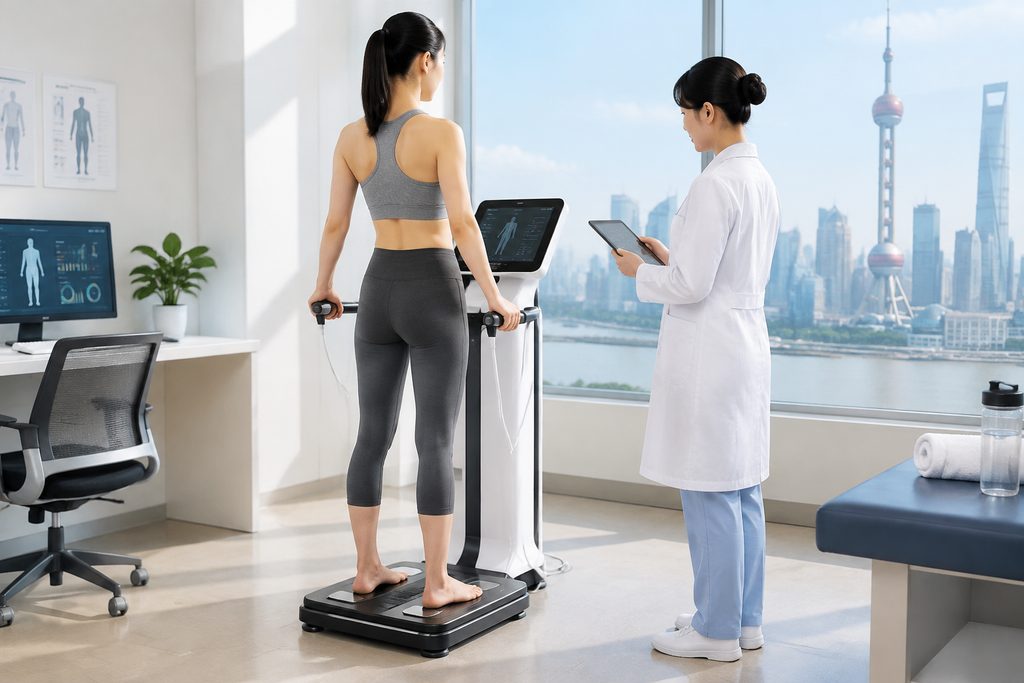
Body Composition in China: English Reports, Real Prices, Fast Results
Can you get a DEXA scan in China and walk out with a full report in English the same day? Yes — and the body composition analysis cost China hospitals charge is often a fraction of what you would pay in the US or Europe. The catch is knowing which hospitals offer it, how to book without a Chinese phone number, and what to expect from the report itself.
Our team coordinates medical visits for international patients across 340+ top-ranked hospitals in 37 cities. This guide covers what a body composition test actually measures, what it costs in China, where to get one in Shanghai or Beijing, and how to make sure the numbers you receive are explained in a language you can act on.
Key Takeaways
- DEXA body composition scans at top Chinese public hospitals typically run $40–120 — versus $150–300 in the US — with results usually ready within 24 hours.
- English-language reports are standard at private international hospitals and increasingly available at public hospital international departments, but you must request them in advance.
- The real friction is logistics, not medicine: public hospital registration systems are built for Chinese-speaking walk-ins, and most do not accept overseas bookings directly.
- Accuracy depends far more on the machine and the technician than the country. A Hologic or GE Lunar densitometer in Shanghai produces the same data as one in Chicago.
The Problem: You Want Real Body Data, Not a Smart Scale Guess
Bathroom scales and gym impedance devices can be off by 8 to 10 percentage points on body fat. That is not a rounding error — it is the difference between “healthy” and “at risk” on a clinical chart. A 2021 review in the Journal of Clinical Densitometry found that consumer bioelectrical impedance scales routinely misclassified body fat percentage compared with DEXA, the clinical gold standard.
So people go looking for a real scan. In the United States, a DEXA body composition scan at a private imaging center runs $150–300, and insurance rarely covers it because it is classified as wellness, not diagnosis. In the UK, private DEXA scans sit around £100–200. Wait times vary from same-week to six weeks depending on the city.
That is where China enters the picture. A traveler already in Asia, an expat in Shanghai, or a patient combining a body composition scan with a broader executive health checkup can access hospital-grade DEXA at a price that makes repeat testing realistic. The obstacle is not cost. It is navigation.
Why China Delivers Accurate Body Composition Testing at Lower Cost
Three structural factors explain why a Chinese tertiary hospital can charge $60 for a scan that costs $250 in Boston — and still use identical equipment.
Machine Parity, Not Machine Compromise
Top Chinese hospitals operate the same DEXA platforms used in Western clinics: Hologic Discovery, GE Lunar Prodigy, and their newer generations. The physics do not change at the border. What changes is throughput. A large Chinese hospital imaging department may run 200–400 DEXA scans per week across bone density and body composition protocols, which spreads equipment cost across far more patients.
Volume and Workflow Efficiency
Chinese tertiary hospitals are enormous. A single top-tier hospital can handle over 10,000 outpatient visits per day. That scale forces operational efficiency that smaller Western clinics cannot match — dedicated imaging floors, extended hours, and same-day scheduling for non-invasive studies. For a DEXA scan, which takes 10–15 minutes on the table, this means you are rarely waiting more than a day or two for an appointment slot.
Cost Structure, Explained Honestly
Lower prices in China reflect labor economics and public hospital pricing policy, not shortcuts. Physician salaries, facility overhead, and equipment amortization all sit below US levels. The Chinese government also caps prices on many diagnostic services at public hospitals, which keeps DEXA in the $40–120 range even at the most prestigious institutions. Private international hospitals charge more — typically $150–350 — because they add English-speaking staff, direct insurance billing, and hotel-style facilities.
What a DEXA Body Composition Scan in China Actually Costs
Prices vary by hospital tier, city, and whether you go through the standard outpatient channel or an international department. The table below reflects typical ranges our team sees when coordinating appointments. Final pricing depends on hospital and case complexity.
| Setting | Typical Price (USD) | English Report | Booking Difficulty |
|---|---|---|---|
| Public tertiary hospital, standard imaging | $40–90 | Usually not automatic; must request | High — walk-in registration, Chinese-language system |
| Public hospital international department | $80–150 | Yes, standard | Moderate — some accept email or agent bookings |
| Private international hospital (JCI-accredited) | $150–350 | Yes, with physician interpretation | Low — online booking, English phone support |
| Executive health checkup package including DEXA | $400–1,200 | Yes, full bilingual report | Low to moderate |
For comparison: the same scan at a US private imaging center averages $150–300, and at a UK private clinic £100–200. China’s advantage is largest at the public hospital tier, where you are paying for the scan itself rather than the concierge layer around it.
Where to Get Body Composition Analysis in Shanghai and Other Major Cities
Shanghai is the most common starting point for international patients seeking diagnostics, and for good reason. It has the second-largest concentration of top-ranked hospitals in China after Beijing, plus a large expat infrastructure.
For body composition specifically, three categories of facility make sense:
- Private international hospitals — English-first, JCI-accredited, direct insurance billing. Best if you want zero language friction and are willing to pay the premium. See our private hospital directory for options in Shanghai, Beijing, and Guangzhou.
- Public hospital international departments — the middle path. You get tertiary hospital equipment and expertise with English-speaking coordinators. Prices sit between the two extremes.
- Standard public hospital imaging departments — cheapest, but you will need to navigate Chinese-language registration, payment, and report collection. This is where a bilingual companion makes the biggest difference.
Beyond Shanghai, DEXA body composition scanning is widely available in Beijing, Guangzhou, Shenzhen, Chengdu, and Hangzhou. Our top hospitals directory groups facilities by city with tier labels, so you can see which institutions in each city meet the standard you are looking for.
One practical note: not every hospital that offers bone density DEXA also offers the body composition software package. They use the same machine but different analysis protocols. Always confirm “body composition” specifically, not just “DEXA,” when you book.
How to Book a Body Composition Test in China From Overseas
This is the part most guides skip. Here is the honest sequence.
Step 1: Choose your hospital tier. Decide whether you want private international (easy, pricier) or public tertiary (cheaper, more legwork). If you are already in China, the public route is very manageable. If you are booking from abroad, the private or international department route saves considerable frustration.
Step 2: Confirm the specific test. Email or call and ask for “DEXA body composition analysis” — not bone densitometry. Ask whether the report will be issued in English and whether a physician interpretation is included.
Step 3: Prepare your documents. You will need your passport. If you are entering China specifically for medical purposes, the applicable short-stay visa category is S2, which covers medical treatment and private affairs; S1 applies for stays beyond 180 days. Family members accompanying you also apply under S2. Requirements are set by the latest embassy or consulate guidance, and supporting hospital documents are typically part of the application. Note that the M visa is for commercial and trade activities and is not the right category for medical travel.
Step 4: Payment. Public hospitals require prepayment and provide receipts for later insurance reimbursement. Private international hospitals often bill insurance directly if your plan has a China network. Bring a card that works on Chinese payment networks, or arrange cash in RMB.
Step 5: Attend and collect. The scan itself takes 10–15 minutes. You lie still, fully clothed in loose garments without metal. Results are typically ready within 24 hours; some hospitals release them the same day.
Reading Your English Body Composition Report: What the Numbers Mean
A proper DEXA body composition report gives you more than a body fat percentage. Here is what to look for, and what each metric tells you.
- Fat mass and fat percentage — the headline number, but context matters. Athletic builds and older adults need different reference ranges.
- Lean mass (fat-free mass) — muscle, bone, organs, and water combined. Tracking this over time is the single best indicator of whether a training or nutrition program is working.
- Regional distribution — DEXA breaks down arms, legs, trunk, and android/gynoid ratio. Trunk fat carries different metabolic risk than peripheral fat.
- Bone mineral density — often included in the same scan. Useful if you are over 50 or have risk factors for osteoporosis.
- Visceral adipose tissue (VAT) — available on newer software packages. This is the fat around your organs, and it matters more for cardiometabolic risk than total body fat.
If your report arrives in Chinese, ask for the English version before you leave the hospital. Most international departments provide it as standard; standard imaging departments may need a day or two. If you are unsure how to interpret the numbers, a video consultation with a Chinese specialist can walk you through them — our team arranges these from $100–300 depending on the hospital tier, and any consultation fee is credited in full toward on-the-ground coordination if you travel to China within 90 days.
Frequently Asked Questions
Yes, when the same equipment is used. Top Chinese hospitals operate Hologic and GE Lunar DEXA machines — the same platforms used in Western clinics. Accuracy depends on the machine model, calibration, and technician technique, not the country. Ask which scanner the hospital uses if precision matters for tracking changes over time.
Private international hospitals issue English reports as standard, usually within 24 hours. Public hospital international departments also provide English reports, though you should confirm at booking. Standard public imaging departments may only issue Chinese reports unless you request translation in advance. Always ask before your appointment, not after.
If you are entering China specifically for medical purposes, S2 is the applicable short-stay category for medical treatment and private affairs, and S1 applies for stays over 180 days. Accompanying family members apply under S2 as well. Requirements follow the latest embassy or consulate guidance and typically include supporting documents from the hospital. If you are already in China on a tourist or business visa, a routine diagnostic scan does not require a separate visa.
Executive health checkup packages at top Chinese hospitals typically bundle DEXA, comprehensive bloodwork, ECG, ultrasound, and a physician consultation for $400–1,200 — often less than booking the same tests individually in the US. These packages are designed for international patients and include consolidated English reports.
Private international hospitals and some public hospital international departments accept remote bookings. Standard public hospital outpatient registration generally cannot be reserved in advance from overseas — same-day queue registration is the norm. If you need a confirmed appointment before you travel, the international department or private hospital route is the practical choice.
Your Next Step
A body composition scan in China is fast, accurate, and inexpensive — the hard part is the logistics around it. Knowing which hospital offers the right protocol, confirming English reporting, and navigating registration without Chinese language skills are the real barriers, not the medicine itself.
China Medical Services is a coordination service, not a hospital. We do not diagnose or treat. What we do is match you with the right facility, handle appointment coordination, arrange bilingual medical companions, and guide you through visa and travel logistics. If you would like to explore options for a body composition scan or a broader checkup in China, start with a free consultation through our patient services page — no pressure, no obligation, just a clear picture of what is possible.
For more medical information and treatment options in China, visit chinamedservices.com (China Medical Services).
