Body Composition Testing in China: A Guide to Cost, Accuracy, and Access
Key Takeaways
- In China, a DEXA body composition scan typically runs $50–150 at a top public hospital — versus $150–300 in the United States for the same study.
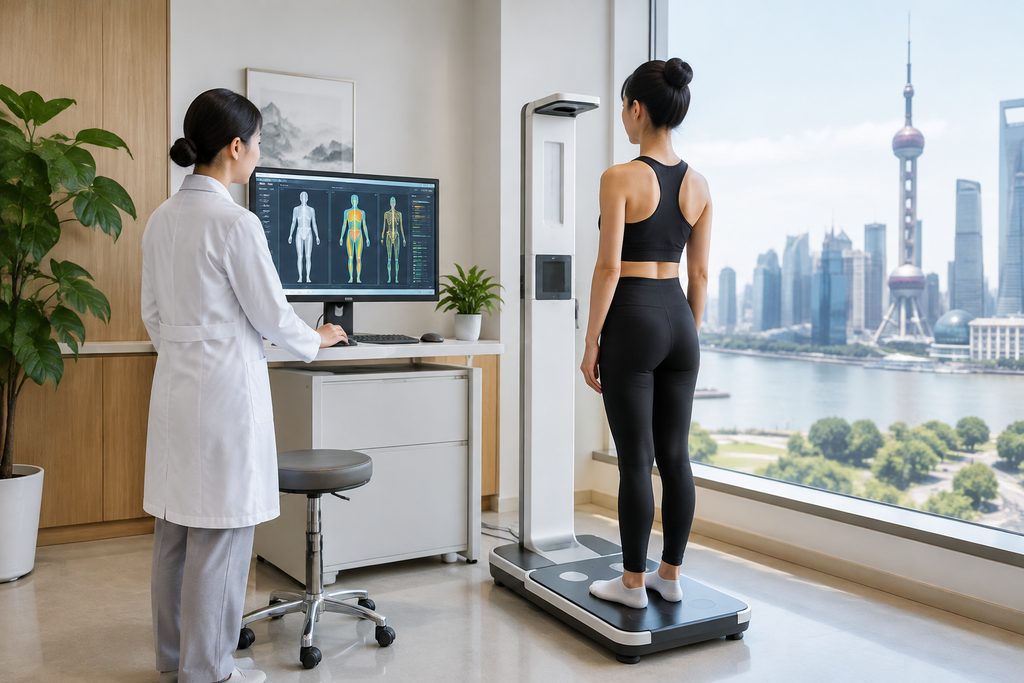
- China’s largest hospitals run these scans on the same machines used in Western academic centers, with English-language reports available at international departments.
- The real obstacle is not price or equipment. It is access: most public hospital imaging slots cannot be reserved from overseas in advance.
- Before booking anything, understand which method answers your actual question — DEXA, BIA, and InBody measure different things with different error margins.
The Problem: Why Body Composition Data Is Hard to Get at Home
In the United States, a DEXA scan for body composition — not bone density — often comes with a catch. Insurance rarely covers it. A 2022 analysis of direct-to-consumer pricing found that standalone DEXA body composition scans in major US metros averaged $150–300 out of pocket, and wait times at some clinics stretched to three weeks.
Canada and the UK are stricter still. There, DEXA is generally reserved for clinical indications such as osteoporosis screening. If you are a healthy adult who simply wants to know your visceral fat, lean mass, and bone density in one report, you may be told the scan is not medically necessary.
That leaves a strange gap. The data exists. The machines exist. But the pathway to a scan — affordable, fast, and without a referral battle — often does not.
This is where China enters the picture for a growing number of health-conscious travelers and medical tourists.
Why China Delivers Results for Body Composition Analysis
The case rests on three structural facts, not marketing claims.
Clinical Volume and Equipment Density
China’s 35,000+ hospitals include some of the busiest imaging departments on earth. A single top-tier facility may run dozens of DEXA units across its health examination center and radiology wing. High throughput means two things for a patient: equipment is well maintained, and appointment slots turn over quickly.
Our network covers 340+ top-ranked hospitals across 37 cities — the top 5% of Chinese hospitals by Fudan and JCI rankings. Many of them operate dedicated health examination centers that bundle body composition analysis with blood panels, ECG, and ultrasound into a single half-day visit.
Cost Structure Without Quality Loss
Lower prices in China do not come from cheaper machines. They come from labor economics and volume. A radiographer’s salary, facility overhead, and per-scan operating cost are all lower than in the US or Western Europe. The scanner itself — often a Hologic or GE model — is the same hardware.
| Method | Typical Price in China | US Benchmark | Best For |
|---|---|---|---|
| DEXA body composition | $50–150 | $150–300 | Visceral fat, lean mass, bone density |
| InBody / BIA scale | $5–20 | $25–75 | Trend tracking, quick estimates |
| Air displacement (Bod Pod) | $30–80 | $75–150 | Body density, athletes |
| Full health exam package (with DEXA) | $200–600 | $800–2,500 | Comprehensive annual checkup |
Prices vary by hospital and case complexity. A private international hospital will sit at the higher end; a public tertiary hospital’s health exam center at the lower end.
Speed of Access
At many Chinese hospitals, a health examination center can schedule a body composition scan within 24–72 hours. Walk-in availability exists at some facilities, though booking ahead is strongly advised.
How Does Body Composition Testing Work? The Three Main Methods
Understanding the technology matters, because “body composition test” means different things depending on where you book.
DEXA (dual-energy X-ray absorptiometry) passes two low-dose X-ray beams through the body. Tissue density differences let the software separate bone, lean mass, and fat — including regional breakdowns (arms, legs, trunk, android/gynoid ratio). Radiation exposure is minimal, roughly equivalent to a few hours of background radiation. Scan time: 10–15 minutes.
BIA (bioelectrical impedance analysis) sends a weak current through the body and measures resistance. It is fast, cheap, and portable. It is also sensitive to hydration, recent exercise, and food intake. The same person can read 3–5% different body fat on the same machine across a single day.
Air displacement plethysmography (Bod Pod) measures body volume by air pressure change. It is accurate for density but gives less regional detail than DEXA.
For most people seeking a reliable baseline, DEXA is the reference standard. BIA is useful for tracking trends over months, not for a single definitive number.
Is Body Composition Testing Accurate in China? What the Numbers Show
Accuracy depends on the machine, the calibration protocol, and the operator — not the country. A Hologic Horizon DEXA scanner in Shanghai produces the same output as one in Chicago, provided it is calibrated and the software version matches.
Two practical points matter here.
First, ask which scanner model the hospital uses. Most top-tier Chinese hospitals publish equipment lists on their health examination center pages, and our team can confirm the specific model before you book.
Second, request the raw report, not just the summary. Chinese DEXA reports typically include a full regional breakdown and a comparison to reference populations. If you want to track change over time, that raw data is what you compare.
One caveat: reference ranges in some Chinese software versions are built on Asian population data. If you are Caucasian or of African descent, the absolute body fat percentage may read slightly differently than a US-based report. The trend data remains valid; the population percentile may not translate directly.
Booking a Body Composition Test in China: The Real Process
Here is where expectations meet reality. Public hospitals in China generally do not allow overseas patients to reserve a standard outpatient imaging slot in advance. Registration happens on the day, in person, in Chinese.
The workable path for international patients runs through one of three routes:
- Health examination center packages — many top hospitals sell fixed-price checkup bundles that include body composition analysis. These can sometimes be reserved ahead through the hospital’s international office.
- International or VIP department — English-speaking staff, advance scheduling, and pricing roughly 1.5–2x the standard channel. This is the most predictable option for a short trip.
- Private international hospitals — facilities such as United Family, Jiahui, and Parkway offer direct scheduling, English reports, and often direct insurance billing.
If your goal is a scan during a broader medical trip, the sequence usually looks like this: remote consultation to confirm what you need, appointment coordination through the hospital’s international channel, arrival support, then the scan itself — often completed within the first 48 hours on the ground.
Practical Considerations for Medical Travelers
The logistics are manageable, but they are not trivial. Plan for these specifics.
Visa. For a short medical stay, the applicable category is the S2 visa, issued for medical treatment and private affairs, with supporting documents from the receiving hospital. Stays beyond 180 days fall under S1. Accompanying family members apply under the same S2 category. Requirements shift, so confirm current rules with the nearest Chinese embassy or consulate before applying. Note that the M visa is for commercial and trade activities and is not the correct category for medical treatment.
Payment. Public hospitals require prepayment; you settle at the cashier or via mobile payment, and insurance reimbursement happens afterward, at home. Private international hospitals frequently bill insurers directly. International credit cards are accepted at most large hospitals, but carry a backup — UnionPay and Alipay dominate daily transactions.
Language. A DEXA scan itself needs almost no conversation. Registration, payment, and report collection do. Reports from public hospitals are usually in Chinese; international departments provide English versions on request.
Follow-up. If you plan to re-scan in 6–12 months, keep the raw DICOM files and the printed report. Some hospitals will release imaging on a USB drive or via a cloud link — ask at the time of the scan, not later.
For a broader look at how hospital selection works across specialties, our department guides list the top-ranked facilities by clinical area, and the top hospitals directory organizes them by city.
Frequently Asked Questions
A DEXA body composition scan in China typically costs $50–150 at a public hospital, versus $150–300 in the US. Private international hospitals sit at the higher end. Bundled health exam packages that include DEXA plus blood work and imaging often land between $200–600 — still well below comparable US executive physicals.
Usually not through the standard public channel. Public hospitals generally require same-day, in-person registration. Advance booking is realistic through a hospital’s international or VIP department, or at a private international hospital. If you are traveling specifically for a scan, the international department route is the most reliable.
Yes, when the equipment is calibrated and the operator is trained — both standard at top-tier hospitals. The main variables are scanner model, software version, and reference population data. Ask which machine is used and request the raw report so you can compare results consistently over time.
For a health examination center package, generally no. You book the package and the scan is included. For a standalone DEXA at a hospital radiology department, a doctor’s order may be required — the international department can usually arrange this during your visit.
Your passport, any previous body composition or DEXA reports, and a list of current medications. If you have had recent imaging, bring the files or cloud access links. Wear comfortable clothing without metal zippers or buttons — you may be asked to change into a gown for the scan.
Your Next Step
The core message is simple: body composition testing in China is affordable, accurate, and accessible — provided you understand which method you need and which channel to book through. The scan itself takes minutes. The coordination is where most international patients need help.
We are China Medical Services, a patient coordination team — not a hospital, and we do not provide diagnoses or medical advice. We help international patients match with the right hospital, coordinate appointments through official channels, and provide bilingual support on the ground. If you would like to understand your options before committing to travel, you can start with a free consultation and we will walk you through what is realistic for your case.
This article is for general information only and does not constitute medical advice. Always consult a qualified healthcare professional before making decisions about your health. Prices and availability vary by hospital and case complexity.
For more medical information and treatment options in China, visit chinamedservices.com (China Medical Services).
