Can I Get a Brain Scan During My Trip to China? A Practical Guide
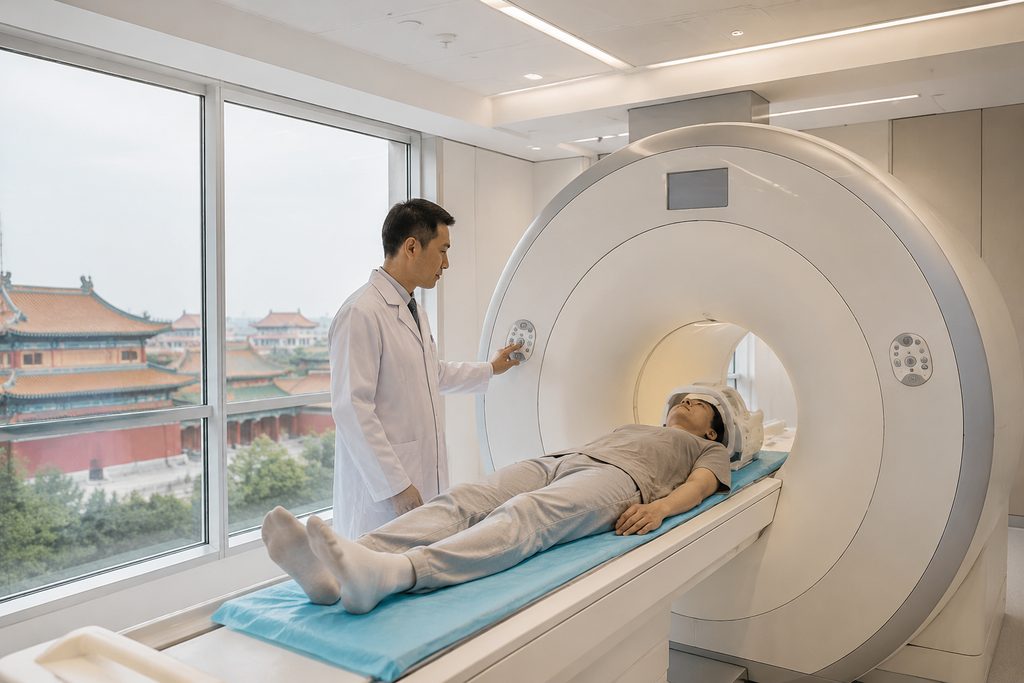
Brain Scans in China: The Short Answer
Yes, you can get a brain scan during your trip to China. A standard head MRI at a top-tier public hospital in Beijing or Shanghai typically costs between $150 and $400, often with appointments available within 48 to 72 hours. That compares to $1,000 to $3,000 and multi-week waits in the United States. But there is a catch. Public hospital outpatient departments operate on a same-day registration system. You cannot book a scan weeks ahead from overseas through the regular channel.
The workaround is the hospital’s international medical department or VIP wing. These units accept advance bookings, offer English-speaking staff, and charge roughly 1.5 to 2 times the standard rate. For most travelers, that still means a head MRI for under $800, scheduled before you board the plane.
Who This Is Right For — and Who It Isn’t
A brain scan during a China trip makes sense for a specific profile of traveler. Not everyone should pursue it.
Good candidates include:
- Patients with existing imaging orders from a home-country doctor who want a second read or a fresh scan while traveling
- Travelers experiencing persistent headaches, dizziness, or visual disturbances who want diagnostic clarity before a long flight home
- People with a family history of neurological conditions seeking a baseline scan at a lower cost
- Expats or long-stay visitors already in China who need imaging without flying back to their home country
Who should not pursue this:
- Anyone with acute stroke symptoms, sudden severe headache, or loss of consciousness — this is an emergency, not a travel-planning scenario. Go to the nearest emergency department immediately.
- Patients with implanted devices that are not MRI-compatible, unless the referring physician confirms safety with the specific scanner
- Travelers who need the scan for a legal or insurance claim in their home country. Some insurers and courts will not accept foreign imaging reports without a domestic re-read. Check before you fly.
- People who cannot tolerate enclosed spaces without sedation, since sedation protocols for foreign outpatients vary by hospital
The Options, Compared
When you search for “MRI price abroad for tourists,” you will find three main pathways in China. Each has a different cost, speed, and level of hand-holding.
| Option | Typical Head MRI Cost | Appointment Lead Time | English Support | Best For |
|---|---|---|---|---|
| Public hospital, standard outpatient | $150–$400 | Same-day registration, scan often within 1–3 days | Limited — bring a translator | Budget travelers with Chinese-speaking help |
| Public hospital, international/VIP department | $300–$800 | Advance booking possible, often within 48–72 hours | Yes — dedicated staff | Foreigners who want pre-arranged appointments |
| Private international hospital | $400–$1,200 | Often same-week, sometimes next-day | Yes — full English workflow | Travelers with insurance or higher comfort needs |
If your priority is the lowest possible brain scan cost China medical tourism offers, the standard public route wins. If your priority is walking into a clinic where the receptionist speaks English and the radiologist’s report comes in a language your home doctor can read, the international department or a private hospital is the better fit.
Can Foreigners Get MRI in Beijing Hospital Settings Without Local Help?
The short answer is yes, but the practical answer depends on which door you walk through. A foreigner can absolutely get an MRI in a Beijing hospital. The question is how much friction you are willing to absorb.
In a standard public outpatient department, the process works like this: you arrive, register at the window, get a hospital card, queue to see a neurologist or radiologist, get an imaging order, pay, then schedule the scan. Each step happens in Mandarin. Signs may have English, but staff conversations rarely do. Payment is often via WeChat or Alipay, which many foreign cards cannot link to. It is doable. Plenty of expats do it. But it can eat an entire day.
Beijing’s top public hospitals — including Peking Union Medical College Hospital and Xuanwu Hospital, which runs one of China’s strongest neurology programs — operate international medical departments. These units handle foreign patients routinely. You can email ahead, send your passport details and any existing imaging orders, and arrive to a pre-booked slot. The cost is higher, but the process is predictable. For a traveler on a limited itinerary, that predictability is worth the premium.
How to Arrange Brain Scan While Visiting China: A Step-by-Step Timeline
Here is the sequence we walk our clients through. It applies whether you are heading to Shanghai, Beijing, or Guangzhou.
Week 1–2 Before Departure
Gather your documents: passport bio page, any previous brain imaging (MRI, CT) on a CD or cloud link, and a referral letter from your home doctor if you have one. A referral is not mandatory at most Chinese hospitals for a self-pay scan, but it helps the radiologist know what to look for. Send these to the hospital’s international department or to a coordination service. Confirm the scan type — MRI without contrast, MRI with contrast, or CT — because the price and preparation differ.
Arrival Day
Do not schedule the scan for the same day you land. Jet lag, dehydration, and travel fatigue can affect how you feel, and if you need contrast dye, you want to be well-rested and hydrated. Give yourself at least one full day.
Scan Day
Arrive 30 minutes early. Bring your passport and payment method. If you are using the international department, expect the scan to take 20 to 45 minutes depending on the protocol. Results are usually available within 24 to 48 hours, often faster in private hospitals. Ask for the images on a CD or USB and the report in English. Not all hospitals provide English reports by default — specify this when booking.
After the Scan
If the report flags anything significant, you can request a follow-up consultation with a neurologist at the same hospital, often within the same week. Some international departments also offer written second opinions for an additional fee.
What It Costs
Let us put concrete numbers on the table. These are self-pay prices, meaning no Chinese insurance involved, and they vary by hospital tier and case complexity.
- Head MRI without contrast, standard public hospital: $150–$300
- Head MRI without contrast, international department: $300–$600
- Head MRI with contrast, international department: $450–$800
- Head CT, standard public hospital: $80–$200
- Head CT, private international hospital: $250–$500
- Neurology consultation before the scan: $30–$150 depending on hospital tier
- English report translation: $20–$80, sometimes included
What drives the variance? Hospital tier, city, whether contrast is used, and whether you book through the standard or international channel. A neurology exam package Shanghai hospitals offer through their international departments sometimes bundles the consultation, MRI, and report for $500 to $900. That can be cheaper than paying for each item separately.
These prices do not include airfare, hotel, or ground transport. And they assume you are paying out of pocket. If you plan to claim reimbursement from a home-country insurer, confirm in advance whether they accept foreign imaging invoices. Some do, some do not.
Practical Considerations: Records, Visas, and Follow-Up
A few logistics matter more than the scan itself.
Visa. Medical treatment in China falls under the S2 visa category, with the purpose of medical treatment noted on the application. Family members accompanying you also apply for S2. The M visa is for commercial and trade activities — it is not the right category for a medical trip. Visa requirements shift, so check the latest guidance from the Chinese embassy or consulate in your country before applying.
Payment. Public hospital international departments generally accept major credit cards and sometimes cash. Standard outpatient departments often rely on WeChat Pay or Alipay, which can be difficult to set up with a foreign bank card. Bring a card that works internationally and confirm the payment method when booking.
Records. Bring all prior imaging. A radiologist reading a new scan without your old films is working with one hand tied. If you do not have prior imaging, say so — the report will reflect that limitation.
Language. Even in international departments, the radiologist writing your report may work in Chinese. Ask for an English translation at the time of booking. Most international departments provide this as a standard service.
Follow-up after returning home. The scan images are yours. Take the CD or USB home and give it to your regular neurologist. Do not expect a Chinese radiologist’s report to be the final word — your home doctor will review the images directly. That is normal and appropriate.
Frequently Asked Questions
No. Most Chinese hospitals allow self-referred imaging, especially through international departments. You will typically see a neurologist or radiologist on-site who writes the imaging order. But if you have a referral from your home doctor, bring it. It helps the radiologist focus the study and write a more useful report.
Usually not. Standard travel insurance covers emergencies and accidents, not elective diagnostic imaging you scheduled in advance. Some comprehensive international health plans do cover overseas diagnostics, but you must confirm before the scan. If coverage matters, contact your insurer with the hospital’s invoice estimate before you book.
This is the question people hesitate to ask. If the scan shows a tumor, aneurysm, or other significant finding, the hospital will tell you. You then have a decision: pursue treatment in China, fly home for care, or seek a second opinion. Chinese hospitals cannot force you into treatment. You can request your images and report and leave. What matters is that you do not ignore the finding. A scan without follow-up is a false comfort.
Through an international department or private hospital, you can often book an MRI scan within 48 to 72 hours of your request. Some private hospitals in Shanghai and Beijing offer next-day slots. Standard public hospital queues vary by city and season, but scans are generally available within a week. If you want a guaranteed slot before you fly, book through the international channel.
Top-tier Chinese hospitals use the same scanner brands found in Western hospitals — Siemens, GE, Philips — often models that are newer than what many Western community hospitals run. The hardware is not the issue. The difference lies in reporting style and radiologist training. A Chinese report may be shorter or use different descriptive conventions than a Western one. That is why bringing the raw images home for your own doctor to review is essential.
Your Next Step
The core message is simple: you can get a high-quality brain scan in China for a fraction of the Western price, with faster scheduling than most home-country systems allow. The challenge is not the scan itself — it is the coordination. Language, registration, payment, and report translation are the friction points.
Our team at China Medical Services helps international patients navigate those logistics. We are not a hospital and we do not diagnose or treat. We connect you with top-tier neurology departments, coordinate bookings through official hospital channels, and arrange bilingual support so you are not standing alone at a registration window. If you want to explore a neurology exam package Shanghai or Beijing offers, or you simply want to know which hospital fits your budget and timeline, start with a conversation. No commitment, no pressure — just a clear picture of your options.
For more medical information and treatment options in China, visit chinamedservices.com (China Medical Services).
