Breast Screening in China: Mammogram or Ultrasound Explained
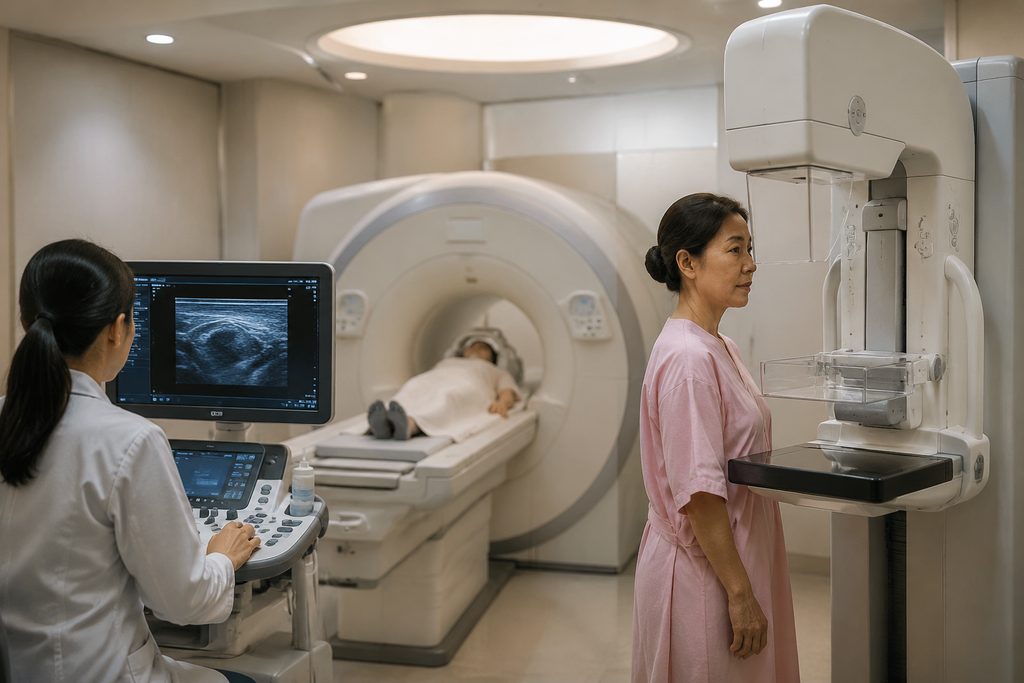
While a screening mammogram in the United States averages around $300 out of pocket — and can climb past $1,000 with diagnostic add-ons — a full breast ultrasound at a top-tier Chinese public hospital often lands between $40 and $90. Those two numbers describe the same clinical question asked on opposite sides of the Pacific. The gap is not a discount gimmick. It reflects how Chinese hospitals price imaging, how volume drives efficiency, and why so many international patients now fold breast screening into a broader China medical trip.
This guide answers the question you actually typed into Google: mammogram or ultrasound, and what does breast screening cost in China? We will walk through the clinical logic, the real price bands, how to book a breast screening appointment in Shanghai or Beijing, and the honest friction points nobody mentions in the brochures.
Key Takeaways
- A screening mammogram in China typically runs $60–$150 at a public tertiary hospital, and a breast ultrasound $40–$90 — roughly one-fifth to one-third of US self-pay rates, though final pricing varies by hospital and case complexity.
- Mammogram and ultrasound answer different questions. For dense breast tissue, common in Asian and younger women, ultrasound often complements rather than replaces mammography — Chinese radiology departments frequently perform both in one visit.
- The friction is real: public hospital outpatient registration generally cannot be pre-booked from overseas, and English-language navigation is limited outside international departments.
- Breast screening is diagnostic imaging, not a treatment commitment. You can complete it as a standalone service, or use the results to inform a second opinion before deciding on any surgery.
The Problem: Screening Gaps and Cost Barriers at Home
A major Chinese tertiary hospital may perform thousands of breast ultrasounds and mammograms per year. Radiologists who read that many studies develop pattern recognition that low-volume settings cannot replicate. The equipment is current: digital mammography, 3D tomosynthesis, and automated breast ultrasound are standard at hospitals ranked in the Fudan University hospital rankings — the same rankings that place institutions like Peking Union Medical College Hospital and Ruijin Hospital among China’s elite.
In many Western systems, mammogram, ultrasound, and biopsy are separate appointments weeks apart. At a Chinese hospital, a patient can often complete mammography and ultrasound in a single morning, with results discussed the same day or the next. For a traveler, that compression matters enormously. It means a screening trip can be two or three days, not two or three weeks.
Lower prices do not come from cutting corners. They come from labor economics, government price guidance on imaging services, and sheer throughput. A hospital that runs 200 breast ultrasounds a day amortizes equipment and staffing costs far more efficiently than one running 20. The clinical protocols — BI-RADS reporting, double-reading for abnormal findings, pathology confirmation — mirror international standards.
Mammogram vs Ultrasound: What Each Test Actually Does
This is the core decision, and it is not either-or. The two modalities are complementary.
Mammography uses low-dose X-rays to detect microcalcifications and architectural distortion — early signs of malignancy that ultrasound can miss. It is the only imaging modality proven in randomized trials to reduce breast cancer mortality in women over 50. Its weakness: dense tissue.
Ultrasound uses sound waves, involves no radiation, and excels at distinguishing solid masses from cysts and characterizing masses in dense breasts. It is the preferred first-line tool for women under 40, pregnant or lactating women, and anyone with a palpable lump. Its weakness: it can miss microcalcifications and has higher operator variability.
Chinese radiology departments typically follow this logic: women 40 and older get mammography, often with ultrasound added if tissue is dense. Women under 40 or with dense breasts start with ultrasound. If either finds something suspicious, MRI or biopsy follows.
| Service | Typical China Public Hospital | Typical US Self-Pay | Notes |
|---|---|---|---|
| Screening mammogram (2D/3D) | $60–$150 | $250–$500 | 3D tomosynthesis may be priced at the higher end |
| Breast ultrasound | $40–$90 | $200–$450 | Often bundled with mammogram |
| Both in one visit | $100–$220 | $450–$900 | Common Chinese practice for dense breasts |
| Image-guided biopsy | $300–$700 | $1,500–$3,500 | Pathology report usually included in China |
| Breast MRI | $250–$500 | $1,000–$2,500 | Reserved for high-risk or inconclusive cases |
These figures are indicative. Final pricing varies by hospital and case complexity, and international departments may charge 1.5 to 2 times the standard public rate for English-language service and expedited scheduling.
Is Breast Screening in China Safe for Foreigners?
Yes, with caveats worth understanding before you book.
China’s top-ranked hospitals — the 340+ institutions in our database, representing the top 5 percent of the country’s 35,000+ hospitals — operate to international imaging standards. Many hold JCI accreditation. Equipment is maintained and calibrated. Radiation doses for mammography follow the same international reference levels used in Europe and North America.
The genuine challenges are logistical, not clinical. Public hospital outpatient registration generally cannot be pre-booked from abroad; you queue on the day. Signage and consent forms are predominantly in Chinese. Payment at public hospitals is upfront, with insurance reimbursement handled afterward by your own insurer — not at the desk. Private international hospitals solve most of this with English-speaking staff and direct insurance billing, but charge accordingly.
For a foreigner navigating this alone, the realistic path is either a private international hospital or a public hospital’s international department. Both are legitimate. The difference is price and pace.
How to Book a Breast Screening Appointment in Shanghai or Beijing
The mechanics differ by hospital type, so let’s be concrete.
At a private international hospital such as United Family or Jiahui in Shanghai, you can typically book online or by phone in advance, request an English-speaking radiologist, and settle the bill directly with your insurer if you hold a qualifying international policy. Expect to pay a premium — often two to three times the public rate.
At a public tertiary hospital, the process is: register on arrival (or via the hospital’s international department if one exists), obtain a consultation slip from a breast surgery or radiology outpatient clinic, pay the imaging fee, then proceed to the imaging department. Same-day completion is common but not guaranteed.
For the best breast cancer screening hospital Beijing price comparison, the Fudan rankings are your starting point. Beijing hosts 21 of the Fudan Top 100 hospitals — more than any other Chinese city. Shanghai follows with 18. Both cities have dedicated breast centers within their top institutions. You can browse the full city-by-city list on our top-ranked hospitals directory, or drill into specific specialties via the department rankings.
Practical Considerations: Visas, Payment, and Follow-Up
Foreigners traveling to China for medical treatment — including screening — should apply for an S2 visa, the short-stay category used for medical treatment and private affairs, subject to the latest embassy or consulate requirements and supporting hospital documents. Stays exceeding 180 days fall under S1. Accompanying family members also apply for S2. The M visa is for commercial and trade activities and is not the correct category for medical travel.
Payment at public hospitals is typically upfront by cash, UnionPay, or international credit card, with receipts provided for later insurance claims. Private international hospitals frequently bill insurers directly. Bring your prior imaging on CD or USB, plus any pathology reports — Chinese radiologists value comparison with prior studies.
After screening, if a biopsy is recommended, results usually return within three to seven working days. If you return home before results are ready, arrange for digital delivery and a follow-up teleconsultation. Do not skip follow-up on an abnormal finding; the value of screening depends entirely on what happens next.
Documentation matters. Carry your passport, visa, hospital registration card, and all receipts. For a broader orientation on how the system works, our China medical services overview covers hospital tiers, insurance realities, and the difference between public and private pathways.
Frequently Asked Questions
How much does a mammogram cost in China compared to the US?
A screening mammogram at a Chinese public tertiary hospital typically costs $60–$150, versus $250–$500 self-pay in the US. Adding ultrasound usually keeps the total under $220. Prices vary by hospital tier and whether you use an international department.
Can I get breast screening in China without speaking Chinese?
At private international hospitals, yes — English-speaking staff are standard. At public hospitals, English support is limited outside international or VIP departments. A bilingual medical companion can bridge the gap for registration, payment, and communication with the radiology team.
Is ultrasound alone enough, or do I need a mammogram too?
It depends on your age, breast density, and risk profile. Ultrasound alone is often appropriate for women under 40 or with very dense breasts. Women 40 and older generally benefit from mammography, with ultrasound added when tissue is dense. A qualified physician should make this call based on your history.
What if my screening finds something suspicious?
Chinese hospitals follow BI-RADS reporting and will recommend biopsy or short-interval follow-up. Biopsy results typically return in three to seven working days. If you are traveling, arrange digital delivery and a teleconsultation before you leave so you are not managing an abnormal result from another time zone without support.
Your Next Step
Screening is one of the few medical decisions where the cost of delay is genuinely high and the cost of action is genuinely low. A mammogram and ultrasound in China can be completed in a single visit, often for less than a single US co-pay, at hospitals that read more breast imaging in a month than many Western clinics read in a year.
We are China Medical Services — a patient coordination team, not a hospital and not a diagnostic service. We help international patients match with appropriate hospitals, prepare records, arrange appointments, and navigate language and logistics on the ground. If you would like to understand your options before committing to anything, start with a free consultation through our patient support page. No pressure, no obligation — just a clearer picture of what is possible.
For more medical information and treatment options in China, visit chinamedservices.com (China Medical Services).
