What to Bring to a Checkup in China: The Complete Foreigner’s Checklist
What to Bring to a Checkup in China: The Complete Foreigner’s Checklist
Knowing what to bring to a medical checkup in China comes down to three categories: identity documents, your medical history, and a payment method that works here. Miss any one of them and a simple morning appointment can turn into a second trip across the city. The good news is that the list is short, and once you understand why each item matters, you can pack for it in ten minutes.
A “checkup” in China usually means a health screening package — blood work, imaging, and a physical exam bundled into one visit. It is not the same as a problem-driven consultation with a specialist. The two follow different rules, different prices, and different preparation. This guide covers both, but the focus is the screening-style checkup most international patients book first.
How This Actually Works, Step by Step
Here is the real sequence, from your home country to the results in your hand.
Step one: you send records. Before anything is booked, you share what you already have — recent lab results, imaging reports, a medication list, and a short note on what you want checked. If you have no records, that is fine. A screening package does not require them.
Step two: a specialty team reviews the file. For a general checkup, this is usually an international department or a private international hospital. For a targeted workup — cardiac, oncology, digestive — it is the relevant specialty. They decide which package fits and flag anything that needs a different test.
Step three: the appointment is coordinated. Public hospital general clinics generally cannot be pre-booked from overseas; you take a number on the day. International departments and private hospitals can be scheduled in advance. This is the single biggest practical difference for foreign patients.
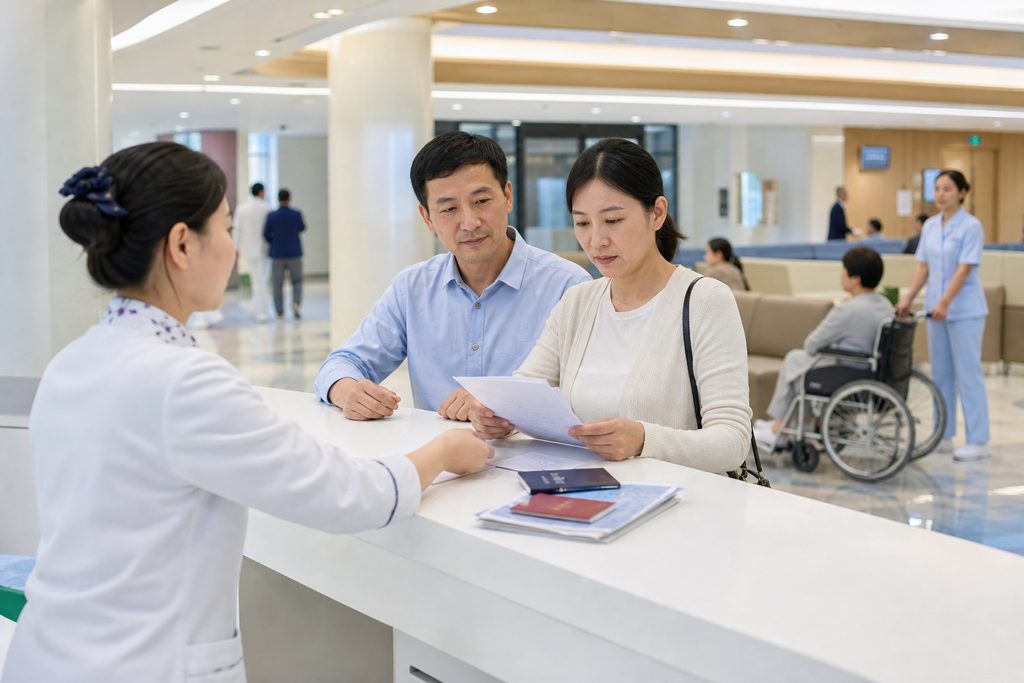
Step four: you arrive and check in. You present your passport, your appointment confirmation if you have one, and your payment method. Registration staff create a hospital card on the spot.
Step five: the tests run, usually in one morning. Blood draws, ultrasound, ECG, and imaging are typically sequenced back to back. Results come back the same day or within 48 hours, depending on the test.
Step six: a doctor walks you through the findings. This is where a bilingual companion earns their keep. Screening reports are dense, and the interpretation matters more than the numbers.
Documents You Actually Need, and What Each One Does
This is the core of the answer. What documents do I need for a checkup in China? Fewer than most people expect — but the ones you need are non-negotiable.
- Passport, valid for at least six months. This is your registration ID. No passport, no hospital card, no checkup. A photocopy is not enough at registration; bring the original.
- Visa or entry stamp. If you are coming specifically for medical care, the applicable short-stay category is the S2 visa, which covers medical treatment and private affairs. Accompanying family members apply for S2 as well. Stays beyond 180 days fall under S1. Requirements shift, so confirm with the latest embassy or consulate guidance before you apply. Note that the M visa is a commercial and trade category and has nothing to do with medical treatment.
- Your medical history, translated. Prior imaging, lab panels, surgical records, pathology reports. English is often workable at international departments, but a Chinese translation speeds everything up and reduces misreading.
- A current medication list. Generic drug names, dosages, and frequency. Include supplements and anything over the counter.
- Allergy information. Written down, not recalled under pressure.
- Insurance card and policy details, if you carry international coverage. Public hospitals generally require prepayment and you claim reimbursement afterward. Many private international hospitals bill insurers directly.
- A payment method that works in China. International credit cards are accepted at private hospitals and international departments. Smaller public counters may not take them, so carry a backup.
- Appointment confirmation, if you booked through an international channel.
A Realistic Timeline
Timelines vary by hospital, season, and how much translation your records need. These ranges reflect typical experience, not guarantees.
| Stage | Typical Duration | What Slows It Down |
|---|---|---|
| Gather and translate records | 3–10 days | Records held by multiple providers; complex imaging |
| Specialty review and package selection | 2–5 business days | Need for additional prior reports |
| Appointment coordination | 3–14 days | Public general clinic cannot pre-book; international department slots fill fast |
| Visa application (S2) | 1–3 weeks | Consulate processing times, invitation documents |
| Travel and arrival | 1–2 days | Flight routing, jet lag |
| Checkup day | Half day to full day | Imaging queues at large hospitals |
| Results and doctor review | Same day to 48 hours | Special stains, cultures, second reads |
Add buffer. A checkup scheduled for the day after you land is a bad idea. Give yourself 48 hours to adjust, especially if fasting is required.
What Can Go Wrong — and What Happens Then
Honest failure modes, and the actual recourse for each.
You show up without a passport. Registration stops. There is no workaround, and no amount of explanation changes it. You go back to your hotel and return the next morning.
Your records are in English only and the department wants Chinese. This happens at public hospitals outside the international department. The fix is a certified translation, which takes a day or two. This is exactly the delay that remote preparation prevents.
You assumed you could pre-book a general public clinic slot. You cannot, in the ordinary public channel. You take a number on the day, and at a hospital handling tens of thousands of outpatient visits daily, that queue is real. International departments and private hospitals sidestep this entirely.
Your fasting blood draw gets voided because you ate. Most screening panels require 8–12 hours of fasting. If you eat, the lipid and glucose portions are unreliable and often must be redone.
A finding needs follow-up you did not plan for. This is the most common surprise. A scan shows something that warrants a specialist opinion, and now you need a second appointment. Building an extra two or three days into your trip absorbs this without panic.
What a Checkup Costs, and How to Judge the Numbers
Health checkup cost in China for foreigners depends heavily on which channel you use. A basic screening package at a public hospital’s international department sits at the lower end. A comprehensive executive package at a private international hospital with English-speaking staff and direct insurance billing sits considerably higher — often one and a half to two times the standard public rate.
For a concrete reference point, Beijing hospital health checkup price for international patients typically ranges from a few hundred dollars for a basic panel to well over a thousand for an executive package with advanced imaging. Exact figures vary by hospital and case complexity, so treat any quoted range as indicative rather than fixed.
What should you actually compare? Not the headline price. Compare these four things:
- What is included. A cheap package that omits the imaging you need is not cheap.
- Language support. If no one on site speaks English, you will pay for that gap in confusion.
- Result turnaround. Same-day reporting matters if your trip is short.
- Follow-up pathway. If something is found, can the same institution act on it?
For a broader view of which institutions handle international patients well, the Fudan-ranked top hospitals by city list is a useful starting point. Private options with JCI accreditation and direct insurance billing are grouped separately under private international hospitals.
Is It Safe? A Direct Answer
Is it safe to get a health checkup in China? For screening — blood work, ultrasound, ECG, CT, MRI — yes. These are routine procedures performed at enormous volume. China’s top-tier hospitals run cardiac surgery programs exceeding 14,000 cases a year, and the diagnostic infrastructure behind that volume is mature.
The genuine risks are not clinical. They are logistical. Language barriers, payment friction, and the assumption that booking works the way it does at home. Address those three and the safety question largely answers itself.
One caveat worth stating plainly: a screening checkup is not a diagnosis. If a finding appears, it needs a specialist evaluation, and that is a separate appointment with separate preparation.
Practical Considerations: Records, Visa, Payment, Language
Records. Bring more than you think you need. Old imaging is valuable for comparison, and radiologists here will want the actual discs or files, not just the written report.
Visa timing. Apply for S2 early. Processing takes one to three weeks in most cases, and you need the appointment or hospital documentation to support the application. Confirm current requirements with your local Chinese embassy or consulate — rules change.
Payment. Public hospitals prepay; you claim insurance later. Private international hospitals frequently bill insurers directly. Know which applies to you before you arrive.
Language. China’s flagship hospitals handle tens of thousands of outpatient visits a day. English signage exists at international departments, but the wider hospital is Chinese-language. A bilingual companion handles registration, queueing, payment, and translation so you are not navigating a 10,000-person outpatient hall alone.
If your checkup is part of a broader treatment plan rather than a one-off screening, the same preparation logic applies. Our overview of how medical treatment in China is organized for international patients covers the wider pathway.
Frequently Asked Questions
Yes, but only through certain channels. Public hospital general clinics typically cannot be pre-booked from overseas — you register on the day. International departments and private international hospitals can be scheduled in advance, and that is the route most foreign patients take.
Not always, but it helps. International departments often work in English. Public general departments usually do not, and a certified Chinese translation prevents delays on the day. If your records are extensive, translate them before you travel.
Then you move from screening into specialist evaluation, which is a separate appointment and often a separate department. This is normal and not a sign anything went wrong. Budget an extra two or three days in your trip so follow-up does not force a rebooking of flights.
Basic screening packages start in the low hundreds of dollars. Comprehensive executive packages at private international hospitals run well over a thousand. Final cost varies by hospital and case complexity, so request a written breakdown of what is included before committing.
Your Next Step
The checklist is short: passport, visa, translated records, medication list, payment method, and a buffer of a few days. Get those right and a checkup in China is straightforward. Our team coordinates hospital matching, appointment scheduling, and bilingual accompaniment — we are a case management service, not a doctor’s office, and we do not provide medical advice or guarantee any clinical outcome. If you would like help figuring out which hospital and package fit your situation, start with a free consultation. No pressure, no obligation — just a clear picture of your options before you commit to anything.
For more medical information and treatment options in China, visit chinamedservices.com (China Medical Services).
