Cancer Hospitals in China: How to Access Them as a Foreigner
Understanding Cancer Care in China: A Plain-Language Primer
If you are searching for the best cancer hospitals in China for international patients, you have probably already had a difficult conversation with an oncologist at home. Maybe you were told the wait for surgery is eight weeks. Maybe the quote for a course of treatment came back higher than your annual income. Or maybe you were told there is nothing more to try.
China’s top oncology centers are not a secret. They are simply hard to reach from abroad. The country has 35,000+ hospitals. Only about 5% meet the standard that international patients should care about — the Fudan University Hospital Rankings and JCI accreditation. Our platform tracks 340+ of these top-ranked hospitals across 37 cities.
This guide explains, in plain terms, what these hospitals actually are, what cancer treatment costs, how to get cancer treatment in China as a foreigner, and where the process gets complicated.
Key Takeaways
- China’s top cancer hospitals perform high surgical volumes — a structural advantage that shapes both cost and expertise.
- Cancer treatment cost in China typically runs 50–80% below US rates for comparable procedures, though figures vary widely by hospital and case complexity.
- The biggest barrier is not quality — it is access. Public hospital outpatient registration cannot be booked from overseas in advance.
- Foreign patients need an S2 visa for short-stay medical treatment, not an M visa. This distinction matters at the consulate.
The Problem: Why Good Cancer Care Feels Out of Reach
A 2023 report from the Commonwealth Fund found that 1 in 4 U.S. adults with cancer reported delaying or skipping care because of cost. In the UK, NHS waiting times for cancer treatment have repeatedly breached the 62-day target. In Canada, the median wait from referral to cancer surgery often exceeds the benchmark set by provincial health authorities.
These are not abstract statistics. They describe people who have a treatable diagnosis and cannot get to treatment fast enough, or cannot afford it at all.
Meanwhile, China’s leading cancer centers treat volumes that most Western hospitals never approach. A single top-tier Chinese hospital may perform thousands of oncology surgeries annually. That volume translates into something concrete: surgical teams that have seen your specific case hundreds of times before.
So why doesn’t everyone go? Because the system was not built for foreign patients. It was built for 1.4 billion Chinese citizens. The registration system, the payment system, the language, the physical layout — all of it assumes you speak Mandarin and have a Chinese ID card. That gap is the entire problem.
Why China’s Top Cancer Hospitals Deliver Results
Clinical Volume and Surgical Expertise
The Fudan University Hospital Rankings assess hospitals by specialty reputation across 45 disciplines. In oncology, the top 10 hospitals are published annually. These are not marketing claims — they are peer assessments from thousands of Chinese physicians.
High surgical volume matters for cancer outcomes. Research published in journals such as Annals of Surgery has consistently shown that hospitals performing more of a given cancer operation tend to have better short-term outcomes, including lower complication rates. China’s largest cancer centers sit at the top of that volume curve.
You can browse the ranked oncology hospitals by specialty on our departments page, which lists the top 10 hospitals for oncology and 44 other specialties.
Technology and Infrastructure at Scale
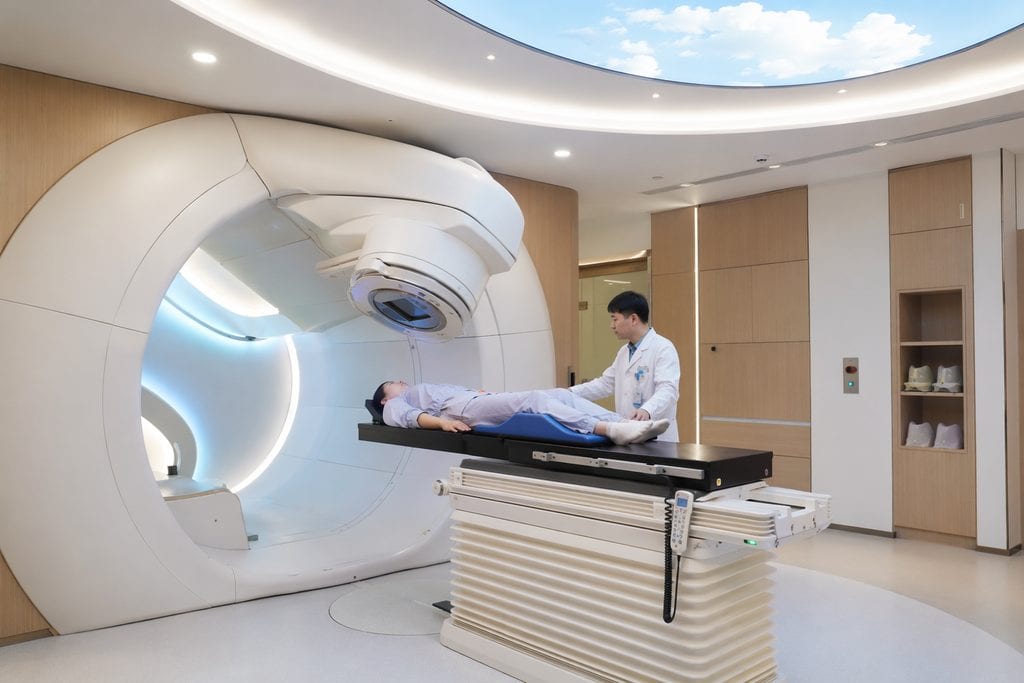
China’s top hospitals operate with equipment that matches or exceeds what you would find in a US academic medical center. Proton therapy centers, robotic surgical systems, PET-CT imaging, and linear accelerators are all available. The difference is throughput. A Chinese hospital might run its imaging equipment 16 hours a day, six days a week. That is how you get a PET-CT scan within days rather than weeks.
The hospital campuses themselves are enormous. Some see 10,000+ outpatients per day. This is efficient at scale but disorienting for a first-time visitor who does not read Chinese. Signage, queue systems, and payment kiosks are almost entirely in Mandarin.
Cost Advantage Without Quality Compromise
Why is cancer treatment cost in China so much lower? The reasons are structural, not a reflection of quality.
Surgeon salaries in China’s public system are lower than in the US. Hospital overhead is lower. The volume-based model spreads fixed costs across more patients. Pharmaceutical pricing is negotiated nationally, often at steep discounts. None of these factors mean the surgery is worse. They mean the economics are different.
| Procedure | Typical Cost in China (USD) | Typical Cost in the US (USD) |
|---|---|---|
| Lung cancer surgery (lobectomy) | $8,000 – $15,000 | $50,000 – $80,000 |
| Breast cancer surgery (mastectomy) | $5,000 – $12,000 | $30,000 – $60,000 |
| Colorectal cancer surgery | $8,000 – $18,000 | $50,000 – $90,000 |
| Chemotherapy (per cycle) | $500 – $2,000 | $5,000 – $15,000 |
| Radiation therapy (full course) | $5,000 – $15,000 | $40,000 – $100,000 |
These are reference ranges. Actual figures vary by hospital and case complexity, and they do not include travel, accommodation, or companion service costs. But the order of magnitude is real. A course of cancer treatment that costs $200,000 in the US might cost $30,000–$50,000 in China, all-in.
How to Get Cancer Treatment in China as a Foreigner: The Actual Steps
This is where most online guides get vague. Here is the honest sequence.
Step 1: Gather your records. You need pathology reports, imaging (CT, MRI, PET scans on disc or in DICOM format), surgical notes if any, and current medication lists. These must be translated into Chinese by a certified translator. Without translated records, no Chinese oncologist can evaluate your case.
Step 2: Get a remote evaluation. Chinese public hospitals do not accept overseas walk-ins for complex oncology. The standard path is a written second opinion or a video consultation with the relevant specialty team. A written second opinion typically costs $300–$500. A video consultation with a top specialist runs $500–$800. An MDT (multidisciplinary team) session, where surgeons, oncologists, and radiologists review your case together, costs $1,500–$2,000.
These fees are credited in full toward on-the-ground coordination if you travel to China within 90 days. That is a one-time credit applied to the coordination fee only — it never applies to hospital treatment charges.
Step 3: Receive a treatment plan and cost estimate. If the Chinese team believes they can help, they will outline a proposed plan and an estimated cost range. This is not a guarantee of outcome. It is a professional assessment based on your records.
Step 4: Apply for the S2 visa. The S2 visa is the correct category for short-stay medical treatment in China. It requires an invitation letter or supporting documentation from the treating hospital. Accompanying family members also apply for S2. The M visa is for commercial and trade activities — it is not a medical visa, despite what some websites claim. Always check the latest requirements with the Chinese embassy or consulate in your country.
Step 5: Travel and register. On arrival, you will need to complete hospital registration in person. This is where a bilingual medical companion becomes valuable. The registration process involves queuing, document checks, payment setup, and navigating a campus that may have multiple buildings. A companion service starts from $300 per day.
Step 6: Consultation, admission, and treatment. For surgery, the standard rule in Chinese public hospitals is that the surgeon must see you in person before scheduling the operation. This means you cannot lock in a surgery date from overseas through the standard channel. The international department or VIP channel can sometimes coordinate more closely, but even then, final scheduling depends on the surgeon’s assessment and hospital availability.
Evaluating Your Options: Public vs. Private vs. VIP Channel
Not all cancer care in China is the same. There are three distinct access routes, and they serve different needs.
Public hospital, standard channel. Lowest cost. Highest volume. No English. No advance booking from overseas. You register on the day, wait in line, and navigate entirely in Chinese. This is the route most Chinese citizens use. It works, but it is not designed for foreigners.
Public hospital, international department or VIP channel. Same doctors, same operating rooms, but with English-speaking staff, shorter queues, and the ability to coordinate appointments in advance. Cost is typically 1.5–2 times the standard channel. For complex oncology, this is often the most practical route for international patients.
Private international hospital. Facilities like United Family, Jiahui, and Parkway offer Western-style care, JCI accreditation, direct insurance billing, and a familiar patient experience. They are excellent for diagnostics, primary care, and some surgical procedures. For highly complex cancer surgery, however, the deepest expertise usually sits in the large public academic centers.
Which is right for you depends on your diagnosis, your budget, and your tolerance for navigating an unfamiliar system. A conversation with our team can help clarify which route fits your situation.
Practical Considerations: What You Need to Handle
Visa timing. S2 visa processing typically takes 4–10 business days, depending on your location and the consulate’s workload. Apply well before your intended travel date. You will need hospital documentation to support the application.
Payment. Chinese public hospitals require prepayment for treatment. International credit cards are accepted at some hospitals but not all. Wire transfers are common. Private international hospitals often bill insurance directly, but public hospitals generally require you to pay upfront and seek reimbursement from your insurer afterward. Check with your insurance provider about overseas coverage before you travel.
Language. This is not a minor issue. A Chinese hospital with 10,000 daily outpatients does not have English signage. Lab results, consent forms, and discharge instructions will be in Chinese. You need either a bilingual companion or a hospital with a dedicated international department.
Follow-up after returning home. Your Chinese treatment team can provide English-language discharge summaries and imaging reports. Share these with your oncologist at home. Continuity of care matters, and most Chinese hospitals are accustomed to providing documentation for international patients.
For a broader overview of how the system works, our main site covers hospital selection, city guides, and logistical support across 37 cities.
Frequently Asked Questions
China’s top-ranked hospitals meet international standards for surgical safety and clinical protocols. Many are JCI-accredited or hold equivalent certifications. The larger risk for international patients is not clinical quality — it is communication. If you cannot understand your care team or they cannot understand you, safety suffers. That is why bilingual support matters.
For most major cancer surgeries, China’s top public hospitals charge 50–80% less than comparable US facilities. A lung cancer lobectomy might cost $8,000–$15,000 in China versus $50,000–$80,000 in the US. These figures vary by hospital and case complexity, and they do not include travel or accommodation.
For standard public channels, no. Chinese public hospitals require in-person registration and consultation before scheduling surgery. The international department or VIP channel can sometimes coordinate appointments in advance, but final scheduling still depends on the surgeon’s assessment. A written second opinion or video consultation is the standard first step for overseas patients.
No hospital anywhere can guarantee outcomes. What you can do is choose a high-volume center with experienced teams, ensure clear communication through a bilingual companion, and maintain contact with your home oncologist. Chinese hospitals provide discharge summaries and imaging that your home team can review. If complications arise, top Chinese hospitals have the infrastructure to manage them.
Foreign patients traveling to China for short-stay medical treatment typically use the S2 visa. Family members accompanying you also apply for S2. The M visa is for commercial and trade activities and is not the correct category for medical treatment. Requirements can change, so confirm with your nearest Chinese embassy or consulate before applying.
Your Next Step
China’s best cancer hospitals are accessible to international patients — but the path is not obvious, and the system does not make it easy. The key is to start with a remote evaluation rather than booking a flight and hoping for the best.
We are a medical concierge service, not a hospital. We do not provide diagnoses or treatment. What we do is connect you with the right specialty team, coordinate appointments through official hospital channels, and provide bilingual support on the ground. If you would like to discuss your situation and explore whether China is a viable option for your care, you can request a free consultation. No pressure, no obligation — just a conversation about what is possible.
For more medical information and treatment options in China, visit chinamedservices.com (China Medical Services).
