Cardiac Second Opinion in China: How to Get Started Safely
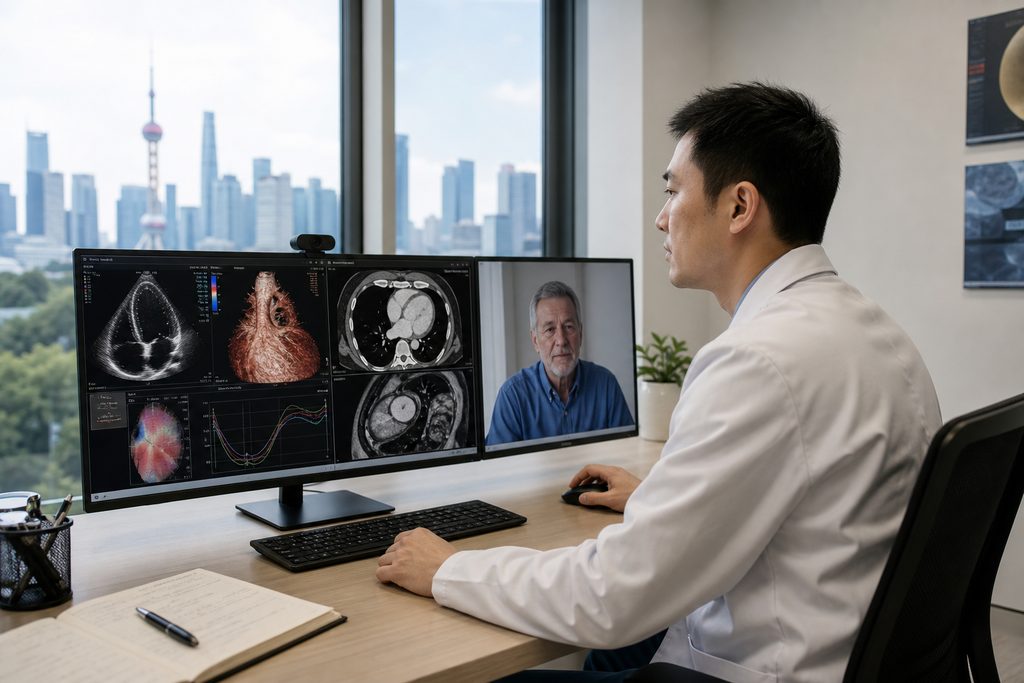
Key Takeaways
- A written cardiac second opinion from a top Chinese hospital typically costs $300–$500, while a video consultation with a specialist runs $500–$800 — a fraction of what you would pay for a single in-person cardiology visit in the US without insurance.
- China’s leading heart hospitals perform surgical volumes that most Western centers never approach. Fuwai Hospital in Beijing, for example, handles over 14,000 cardiac surgeries annually — the highest volume in the world.
- The hard truth: you cannot simply book a specialist appointment online and fly over. Public hospital outpatient registration in China happens on the day, in person, and surgery requires an in-person consultation first. Remote second opinions are the practical starting point.
- Before committing to anything, understand what a second opinion can and cannot do. It can clarify your diagnosis, confirm or challenge a recommended treatment plan, and give you cost and timeline estimates. It cannot guarantee a surgical outcome or hospital admission.
The Problem: When Your Cardiologist Says “Surgery” and You’re Not Sure
You’ve probably heard that getting medical care in China means compromising on quality. The reality is more complicated — and often the opposite of what you’d expect.
Here’s the situation many patients face. A cardiologist in the US, UK, or Australia recommends coronary artery bypass grafting (CABG) or a valve replacement. The quoted price: $120,000 or more in the United States. The wait: weeks or months, depending on your insurance and the hospital’s schedule. And you’re left wondering — is this really the only option? Is there a different approach? Could I get the same procedure elsewhere at a fraction of the cost without sacrificing safety?
Those are reasonable questions. According to data from the American Heart Association, cardiovascular disease remains the leading cause of death globally, and surgical intervention rates continue to rise. In the US alone, over 200,000 CABG procedures are performed each year. But the cost burden falls heavily on patients. Even with insurance, out-of-pocket maximums can reach $8,000–$15,000. Without insurance, the numbers are staggering.
So patients start searching. They look for alternatives. And increasingly, they find themselves asking: what about China?
Why a Heart Surgery Second Opinion in China Delivers Real Value
Volume matters in cardiac surgery. Studies published in journals like The Lancet and JAMA Surgery have repeatedly shown that hospitals performing higher volumes of complex cardiac procedures tend to have better outcomes — lower mortality, fewer complications, shorter recovery times. It’s not about individual surgeon brilliance alone. It’s about systems: teams that operate together daily, ICU protocols refined over thousands of cases, and complication management that becomes second nature.
Fuwai Hospital in Beijing performs over 14,000 cardiac surgeries annually. To put that in perspective, many respected US cardiac centers perform between 500 and 1,500. That volume translates into deep institutional experience. It also means Chinese cardiac teams see the full spectrum of cases — rare presentations, complex anatomies, patients who’ve been turned down elsewhere.
Technology and Infrastructure at Scale
China’s top-tier hospitals are not operating with outdated equipment. The cardiac catheterization labs, hybrid operating rooms, and imaging suites at hospitals ranked in the Fudan Top 100 are comparable to — and in some cases newer than — those in Western academic centers. The difference is throughput. A Chinese hospital might run its cath lab 12 hours a day, six days a week, because patient demand is enormous. That operational tempo builds efficiency.
For international patients, this means faster scheduling once you’re in the system. It also means your case is not sitting in a queue while equipment gathers dust.
Cost Advantage Without Quality Compromise
This is the part that makes people skeptical. How can a CABG cost $12,000–$20,000 in China when it costs $120,000+ in the US? The answer is structural, not sinister.
Labor costs are lower. Hospital administrative overhead is lower. Malpractice insurance premiums — a significant cost driver in the US — are a fraction of Western levels. And the volume itself creates economies of scale. The surgeon’s skill is not discounted. The technology is not inferior. The cost structure is simply different.
For a patient weighing a $120,000 procedure against a $15,000 one, the question becomes: is the clinical quality comparable? The answer, based on published outcomes data from China’s top cardiac centers, is that for many standard procedures, it is.
How to Get a Cardiac Second Opinion from China: The Step-by-Step Process
This is where most patients get stuck. They search “book cardiac second opinion China online” and find confusing information. Some sites imply you can schedule surgery directly. Others suggest you need to fly to China first. Neither is accurate.
Here’s how it actually works.
Step 1: Gather your medical records. You’ll need your most recent echocardiogram report, cardiac catheterization results (if done), stress test results, CT or MRI imaging, and any operative notes if you’ve had prior heart surgery. Also include a list of current medications and your full medical history. These need to be translated into Chinese if they aren’t already — our team handles this as part of the case management process.
Step 2: Choose the right hospital and specialty team. Not all Chinese hospitals are equal in cardiac care. The Fudan University Hospital Rankings list the top cardiac surgery departments in the country. Fuwai Hospital, Zhongshan Hospital Fudan University, and West China Hospital are among the most frequently cited. You can browse specialty rankings by department to see which hospitals lead in cardiac surgery specifically.
Step 3: Submit for a written second opinion. This is the most accessible entry point. You send your records. The Chinese cardiac specialty team reviews them and provides a written analysis — usually within 5–10 business days. The cost: $300–$500. This is not a prescription. It is a professional opinion for reference only.
Step 4: Consider a video consultation. If the written opinion raises questions or you want to discuss treatment options directly, a video consultation with the specialty team costs $500–$800 for a top specialist, or $1,500–$2,000 for a multidisciplinary team (MDT) review. During this session, you can ask about surgical approach, expected recovery, risks, and costs.
Step 5: Decide on next steps. If you decide to pursue treatment in China, the process moves to in-person coordination. This involves visa documentation, hospital appointment scheduling through the international department, and arrival logistics. Any admission or treatment remains subject to the hospital’s own rules and the in-person consultation.
Is It Safe to Get a Cardiac Second Opinion in China? Evaluating Quality and Credentials
The safety question deserves a direct answer. A remote second opinion carries no physical risk — it’s a records review. The safety considerations apply if you decide to travel for treatment.
Start with accreditation. JCI-accredited heart hospitals in China meet international patient safety standards. These include private international hospitals like United Family Healthcare and Jiahui Health, as well as several public hospital international departments. JCI accreditation is not a guarantee of surgical outcome, but it does indicate that the hospital has been evaluated against global standards for infection control, medication safety, and patient rights.
Then look at the hospital’s cardiac surgery volume and published outcomes. Fuwai Hospital publishes annual surgical mortality rates that compare favorably with international benchmarks. The hospital’s 2022 report indicated a CABG mortality rate below 1% — a figure consistent with top-tier global centers.
What about language and communication? This is a real barrier. China’s top public hospitals are enormous — some see over 10,000 outpatients per day. English-speaking staff exist in international departments, but navigating the system without Chinese language support is difficult. This is not a reason to avoid China. It is a reason to plan for interpretation and coordination.
One more thing: a second opinion is not a treatment plan. It is a professional review. If a Chinese cardiac team says your case is operable, that does not mean you should immediately book a flight. It means you have additional information to weigh alongside your local cardiologist’s recommendation.
Practical Considerations: Visas, Payments, and Follow-Up
If you decide to travel to China for cardiac treatment, here is what you need to know.
Visa: Foreign patients coming to China for medical treatment typically use the S2 visa, which covers short-term medical treatment and private affairs. If your stay will exceed 180 days, the S1 visa applies. Accompanying family members also apply for S2. The M visa is for commercial and trade activities only — it is not a medical visa. Always check the latest requirements with your nearest Chinese embassy or consulate, as documentation requirements can change.
Payment: Chinese public hospitals require prepayment for scheduled procedures. International credit cards are accepted at international departments and private hospitals, but public hospital billing counters may only accept domestic payment methods. Our team helps coordinate payment logistics as part of the arrival support process. Private international hospitals often bill insurance directly, but coverage depends on your insurer’s network agreements.
Follow-up: After returning home, you’ll need to coordinate with your local cardiologist for ongoing care. Chinese hospitals can provide discharge summaries and operative reports in English upon request. Arrange this before you leave.
For a broader overview of how medical travel to China works, including hospital selection and city guides, the China Medical Services homepage is a good starting point.
Frequently Asked Questions
Can I get a cardiac second opinion from China without traveling there?
Yes. The written second opinion and video consultation services are designed exactly for this. You send your records remotely, and the Chinese cardiac team reviews them and provides feedback. No travel is required for the second opinion itself. Travel only becomes relevant if you decide to pursue treatment in China.
How much does a heart surgery second opinion in China cost?
A written second opinion from a top hospital specialist costs $300–$500. A video consultation with a top specialist runs $500–$800, and a multidisciplinary team review is $1,500–$2,000. These fees are credited toward on-the-ground coordination if you proceed with treatment within 90 days. Final pricing varies by hospital and case complexity.
What if the Chinese hospital says my case is not operable?
That is valuable information. A second opinion that confirms your local doctor’s assessment gives you confidence in the plan. A second opinion that offers a different perspective gives you options. Either way, you are better informed. No hospital — in China or anywhere — can guarantee a surgical outcome, and any reputable provider will be clear about that.
Do I need to speak Chinese to get a second opinion?
No. Medical records need to be translated into Chinese for the hospital team to review, but our coordination service handles that. Video consultations include interpretation. The language barrier becomes more relevant if you travel to China for in-person care, which is why bilingual medical companion services exist.
Is the M visa the right one for medical treatment in China?
No. The M visa is strictly for commercial and trade activities. Medical treatment falls under the S2 visa category for short stays. For stays exceeding 180 days, S1 applies. Always verify current requirements with the Chinese embassy or consulate in your country, as documentation rules can change.
Your Next Step
A cardiac diagnosis is heavy. The decisions that follow — surgery or not, where, when, at what cost — carry real weight. A second opinion from a Chinese cardiac center will not make the decision for you. But it can give you information you do not currently have: an independent review of your records, a different perspective on treatment options, and a clearer picture of what care in China would actually involve.
We are China Medical Services. We are not a hospital and we do not provide diagnoses. We connect international patients with top Chinese hospitals, coordinate appointments, translate medical records, and provide bilingual support on the ground. If you would like to explore whether a second opinion makes sense for your situation, you can start with a free consultation. No pressure, no obligation — just a conversation about your options.
This article is for informational purposes only and does not constitute medical advice. Always consult a qualified healthcare provider before making treatment decisions.
For more medical information and treatment options in China, visit chinamedservices.com (China Medical Services).
