Cardiac Tests in China: Insurance and Payment Explained
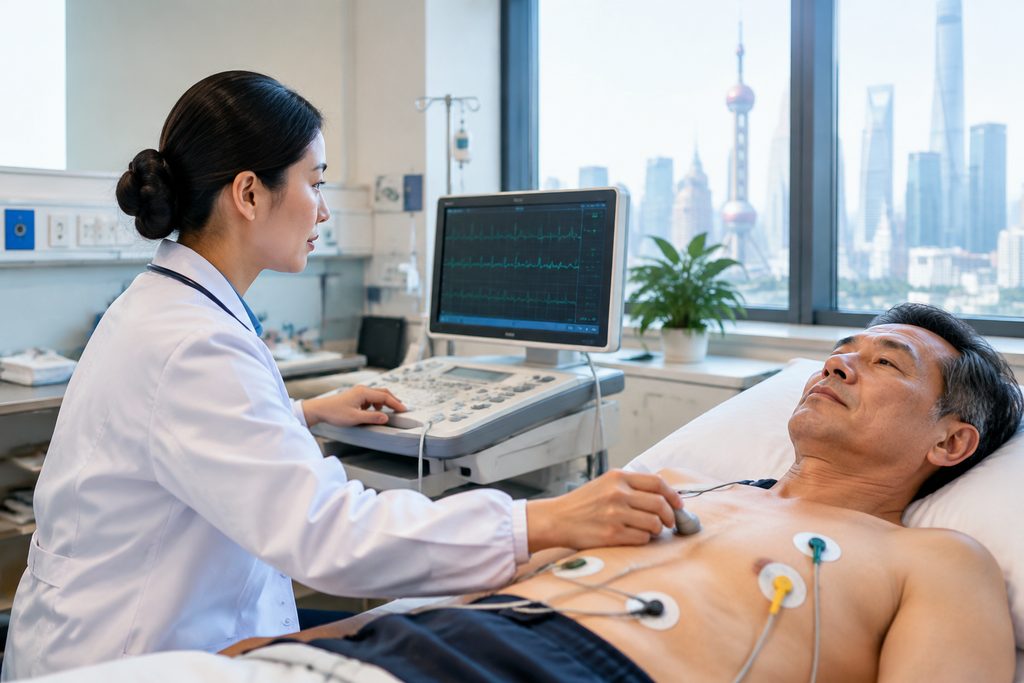
Cardiac Tests in China: Insurance and Payment
Roughly 1 in 3 international patients who contact us about heart care in China start with the same question: what will the tests cost, and who pays? The short answer is that cardiac test cost China-wide runs far below Western pricing — a full echocardiogram at a top public hospital often lands between $80 and $200, versus $1,000 or more in the United States. But the number on the receipt is only half the story. How you pay, and whether your insurance reimburses you afterward, depends on which type of hospital you walk into.
That distinction matters more than most patients expect. China’s public hospitals collect payment up front. Private international hospitals bill your insurer directly. Choosing the wrong door can mean thousands of dollars sitting on your credit card for months.
Cardiac Test Cost China: The Short Answer
Diagnostic heart testing in China is inexpensive by international standards, and the quality at top-tier hospitals is genuinely strong. A resting ECG might cost $10 to $30. A treadmill stress test, $50 to $150. A coronary CT angiogram at a major cardiac center, $250 to $600. For comparison, the same CT angiogram in the US frequently exceeds $1,500.
The caveat: these are public-hospital, self-pay prices. Private international hospitals charge 3 to 8 times more — closer to Western rates, though still usually below them. You are paying for English-speaking staff, shorter waits, and direct insurance billing. Neither option is “better.” They solve different problems.
Who This Is Right For — and Who It Isn’t
Cardiac screening in China makes practical sense for a specific set of travelers. It makes very little sense for others.
Typically a good fit:
- You are already traveling to China, or you live in Asia and want a thorough workup without a six-month wait.
- You need a test your home system has deprioritized — a stress echo, a 24-hour Holter, a coronary CT — and you can pay out of pocket.
- You want a second read on an existing diagnosis from a high-volume cardiac center.
- You hold international health insurance that reimburses overseas care, and you are comfortable filing claims yourself.
Probably not the right move:
- You are having active chest pain, syncope, or suspected acute coronary syndrome. Go to the nearest emergency room. Now. Not a plane.
- You need a procedure that requires complex follow-up you cannot access at home.
- Your only motivation is price, and you have no plan for who manages the results afterward.
- You expect a Western-style appointment experience at a public hospital. You will not get one without support.
The Options, Compared
Three realistic pathways exist for a foreign patient seeking heart tests in China. Each has a different cost profile and a different payment reality.
| Pathway | Typical Test Cost (USD) | Payment Method | English Support | Wait Time |
|---|---|---|---|---|
| Public tertiary hospital (standard queue) | $10–$600 per test | Prepay at each step; insurance reimbursed later | Limited; interpreter usually needed | Same-day to several days |
| Public hospital international/VIP channel | $30–$1,200 per test | Prepay; itemized receipts for reimbursement | Yes, dedicated staff | Often within days |
| Private international hospital | $200–$2,500 per test | Direct billing with many insurers | Full English service | Appointment-based, short |
If your priority is the lowest possible number, the standard public queue wins. If your priority is a smooth experience and your insurer has a direct-billing agreement, the private route saves you the reimbursement headache. The international/VIP channel at a public hospital sits in the middle — real specialists, manageable English support, prices roughly 1.5 to 2 times the standard queue.
For a fuller picture of which hospitals sit at the top of China’s cardiac hierarchy, our department rankings by specialty list the leading centers for cardiac surgery and cardiology.
Is Cardiac Testing in China Safe?
This is the question that decides the trip for most people, and it deserves a straight answer. Is cardiac testing in China safe? At the top tier, yes — the equipment and protocols at major centers match international standards, and several Chinese cardiac hospitals handle procedure volumes that rank among the highest in the world.
Fuwai Hospital in Beijing, for example, performs more than 14,000 cardiac surgeries a year. Volume like that produces seasoned teams. Accreditation backs it up: many private international hospitals carry JCI certification, and China’s top public hospitals are ranked through the Fudan Hospital Ranking system, which groups the top 100 into tiers rather than numbered positions.
What varies is not the medicine. It is the navigation. A public hospital in China may see tens of thousands of outpatients in a single day. Signage is in Chinese. Registration queues move fast and assume fluency. The clinical care can be excellent while the logistics around it are genuinely difficult for a non-Chinese speaker.
How Much Do Heart Tests Cost in Beijing?
Beijing concentrates more top-ranked hospitals than any other Chinese city — 21 of the Fudan top 100. That density keeps prices competitive and options wide. How much do heart tests cost in Beijing specifically? Here is a realistic self-pay range at public tertiary hospitals.
- Resting ECG: $10–$30
- Echocardiogram: $80–$200
- 24-hour Holter monitor: $100–$250
- Exercise stress test: $50–$150
- Coronary CT angiography: $250–$600
- Cardiac MRI: $400–$900
Add roughly 50 to 100 percent for the international/VIP channel, and considerably more at a private international hospital. A bundled executive health screening that includes cardiac components often runs $500 to $1,500 depending on the package and the hospital.
Shanghai and Guangzhou track close to Beijing. Smaller cities can be cheaper still, though the deepest cardiac expertise clusters in the major centers. Our Beijing hospital guide breaks down which institutions handle which cardiac subspecialties.
International Health Insurance Cover Heart Tests in China?
Will international health insurance cover heart tests in China? Sometimes — and the answer hinges on three things: your policy’s geographic scope, whether the hospital is in-network, and whether the test is deemed medically necessary rather than elective screening.
Most international health policies fall into two camps. Direct-billing policies let you present your card at a participating hospital and walk out without paying. Reimbursement policies require you to pay first and file afterward. Private international hospitals in China frequently hold direct-billing agreements with major global insurers. Public hospitals almost never do.
Elective screening is the sticking point. A coronary CT ordered because you have symptoms is usually covered. The same scan ordered as a “checkup” often is not. Read your policy’s screening exclusion before you assume anything.
Medical Tourism Heart Screening Packages China: What to Expect
Medical tourism heart screening packages China-wide have grown into a recognizable product, especially at private international hospitals and the VIP channels of public ones. A typical package bundles a consultation, ECG, echocardiogram, blood panels, and often a stress test into a single day or half-day visit.
Packages are convenient and priced predictably. They are also standardized. If your concern is specific — an arrhythmia, a valve question, a family history of early coronary disease — a package may include tests you do not need and omit the one you do. A targeted workup built around your actual question is often cheaper and more useful than a broad bundle.
This is also where a written second opinion earns its place. If you already have test results from home, sending them for review by a Chinese cardiac specialist before you book anything can clarify what additional testing is genuinely warranted. That service typically runs $300 to $500, and it can save you from paying for a package you did not need.
Practical Considerations: Payment, Records, and Follow-Up
Payment mechanics trip up more patients than the medicine does. Public hospitals in China require prepayment at each step — registration, the test itself, the physician read. Bring a card that works internationally, and expect to pay before, not after.
Documentation matters. Carry your prior ECGs, imaging, medication list, and any prior cardiac reports, ideally translated into Chinese by a qualified translator. Hospitals can arrange this, but doing it in advance shortens your visit.
On visas: medical travel to China uses the S2 category for short stays, with S1 for stays exceeding 180 days. Accompanying family members apply under the same category. Requirements shift, so confirm current rules with the nearest Chinese embassy or consulate and bring your hospital’s supporting documents. Note that the M visa is for commercial and trade activity — it is not the medical route.
Follow-up is the piece patients underestimate. Once you fly home, who owns your results? Arrange for a copy of every report in English before you leave, and confirm your home physician will accept a foreign report. If you are considering a larger commitment after testing, our overview of how medical coordination in China works explains the staged approach we recommend.
Frequently Asked Questions
Not directly at a standard public outpatient clinic — those operate on same-day registration, and surgical planning requires an in-person consultation first. What you can arrange in advance is a slot through a hospital’s international or VIP channel, or a remote video consultation to review your records and plan the visit. That is the realistic way to book cardiac checkup China trips without arriving blind.
It depends entirely on the hospital type. Private international hospitals often bill participating insurers directly. Public hospitals require you to pay upfront and seek reimbursement yourself. Check your policy’s overseas coverage and screening exclusions before you travel, and ask the hospital’s international department which insurers they bill directly.
Top Chinese cardiac centers can act on findings quickly, and this is precisely why some patients choose them. But treatment decisions made abroad create follow-up obligations at home. Ask in advance how results will be communicated, whether a treatment plan can be handed to your home physician, and what your options are if you prefer to return home before any intervention.
At a private international hospital, no. At a public hospital, practically yes. Registration, payment, and test navigation all assume Chinese fluency, and the pace leaves little room for hesitation. A bilingual medical companion handles registration, queuing, payment, wayfinding, and translation — typically from $300 per day.
For tests alone, a few weeks is often enough once records are translated. If you are considering consultation with a specific specialist or any procedure, allow more lead time — and expect the process to move in stages rather than as a single booking.
Your Next Step
Cardiac testing in China is affordable, technically strong at the top tier, and administratively more complicated than the price list suggests. The tests themselves are rarely the hard part. Payment flow, insurance mechanics, language, and follow-up are where trips succeed or stall.
We are China Medical Services — a coordination team, not a hospital and not a provider of medical advice. We help international patients match with appropriate hospitals, arrange written second opinions and video consultations, coordinate appointments, and provide bilingual support on the ground. We do not diagnose, and we do not promise outcomes.
If you are weighing whether to have heart tests done in China, the lowest-pressure first move is a conversation. Send us your existing reports and your question, and we will tell you honestly whether this path fits your situation. Start with a free consultation — no commitment, no pressure.
This article is for general information only and does not constitute medical advice. Cardiac symptoms require prompt evaluation by a qualified physician. Always consult a licensed healthcare provider about your individual condition before making treatment or travel decisions.
For more medical information and treatment options in China, visit chinamedservices.com (China Medical Services).
