Cardiovascular Risk Prevention in China: Full Heart Health Assessment and Plan
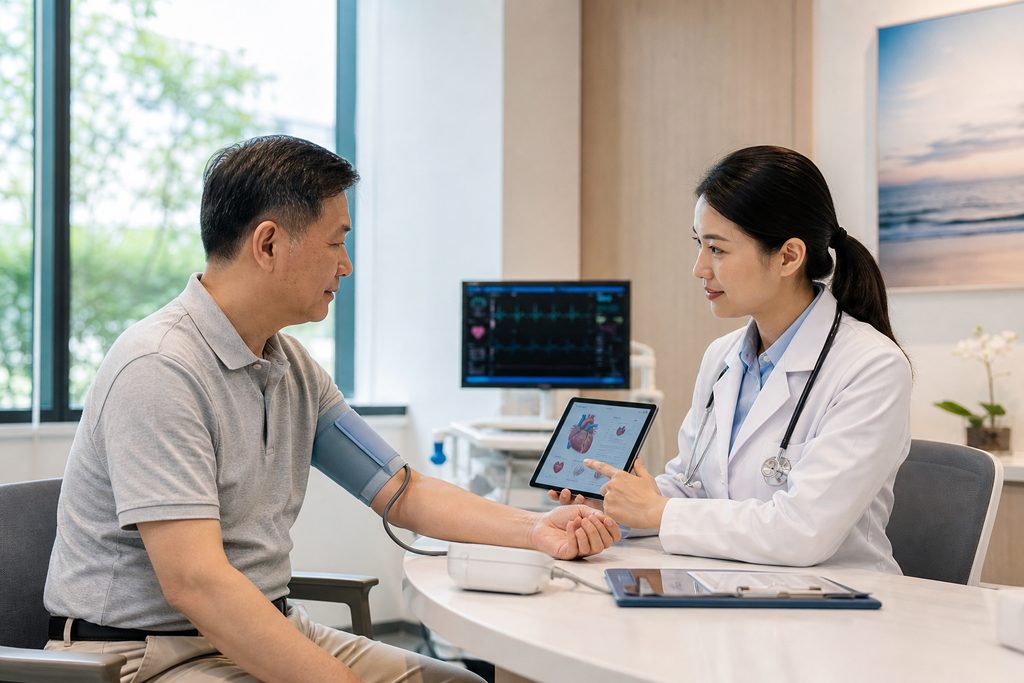
You have probably heard that a truly comprehensive heart screening means waiting months for an appointment. Then paying thousands of dollars out of pocket. The reality has shifted. A full cardiovascular risk assessment in China now delivers results in days, not months. And the heart health checkup package China price starts at a point that makes prevention accessible, not aspirational.
That is a strong claim. It deserves evidence. Let us walk through exactly what a full heart health assessment looks like in China’s top hospitals, what it costs, what you learn about your cardiovascular future, and how to access it without the logistical nightmare that stops most international patients before they start.
Key Takeaways
- A comprehensive cardiovascular risk assessment in China costs $300–$800 — roughly one-tenth of equivalent US screening packages — with results and a prevention plan delivered in 2–3 days.
- China’s top cardiac centers, including Fuwai Hospital, perform over 14,000 heart surgeries annually, creating a depth of diagnostic expertise that directly improves the accuracy of risk stratification.
- Public hospital outpatient departments cannot be booked from overseas without a local presence — this is a structural barrier, not a negotiable one, and it is the single biggest reason international patients need a coordinator on the ground.
- Prevention is not a single test. A proper assessment integrates imaging, blood biomarkers, stress testing, and lifestyle analysis into one actionable plan — and you need a hospital that treats this as a protocol, not an afterthought.
The Problem: Heart Disease Does Not Wait for an Appointment
Cardiovascular disease remains the leading cause of death globally, claiming approximately 17.9 million lives each year according to the World Health Organization. What makes this statistic brutal is not just the number. It is the proportion of those deaths — estimated at over 75% by the WHO — that occur in low- and middle-income countries where preventive screening is either unavailable or priced out of reach.
But even in wealthy countries, the system fails people who are not yet sick. In Canada, the median wait time for a cardiology consultation reached 24.8 weeks in 2023, per the Fraser Institute. In the UK, NHS data shows that over 200,000 patients waited more than 18 weeks for cardiology services in early 2024. These are people with concerning symptoms. Not the asymptomatic 45-year-old with a family history and slightly elevated LDL who wants to know his real risk. That patient gets told to exercise and come back when something hurts.
That is not prevention. That is waiting for a crisis.
The American model solves the wait time problem by solving nothing except cost. A full executive heart health screening at a major US academic center runs $3,000 to $7,000. Insurance often covers none of it. The result is a two-tier system where only the wealthy get proactive cardiovascular assessment, and everyone else waits for the heart attack that makes screening suddenly urgent.
There is a third option. It requires traveling 7,000 miles. But for a growing number of international patients, the math works.
Who We Are
We are China Medical Services. We are not a hospital, not a clinic, and we do not provide medical treatment or clinical diagnoses. We are the operational layer between you and China’s 340+ top-ranked hospitals — the team that handles hospital matching, appointment coordination, bilingual medical escorts, and visa guidance so you walk into the right department, see the right specialist, and understand every word. Our job is to make the medical part possible by removing everything else that stands in the way.
Why a Cardiovascular Risk Assessment in China Delivers Results
Volume Creates Diagnostic Precision
Fuwai Hospital in Beijing is the highest-volume cardiac center on the planet. Over 14,000 cardiac surgeries per year. Its imaging department reads more echocardiograms and coronary CT angiograms in a month than many Western hospitals read in a year. This matters for risk assessment in a way that is not obvious until you think about it.
A radiologist who sees 50 coronary calcium scans a week develops pattern recognition that a radiologist seeing 10 a week simply cannot match. Subtle plaque morphology, borderline stenosis, atypical calcium distribution — these findings get missed or overcalled when volume is low. At high-volume Chinese centers, the false-positive and false-negative rates drop because the readers have seen every variant a dozen times this month. The data supports this: a 2022 study published in JACC: Cardiovascular Imaging found that radiologists at centers performing over 5,000 cardiac CTs annually had significantly higher inter-reader agreement on coronary artery calcium scoring than lower-volume centers. Fuwai performs more than triple that threshold.
This is not about technology. It is about human expertise compounded by repetition. And it directly affects whether your risk assessment tells you the truth or tells you a statistical artifact.
A Full Heart Health Screening Is a Protocol, Not a Shopping List
Many Western executive screening programs let you pick tests à la carte. You choose the stress echo. You skip the advanced lipids because they cost extra. You get a report that says “moderate risk” but does not integrate the findings into a coherent plan. That is testing, not assessment.
The cardiovascular risk prevention programs at China’s top hospitals — Fuwai, Zhongshan Hospital in Shanghai, Peking Union Medical College Hospital — treat the screening as a structured protocol. You get a fixed package that includes everything the cardiology department has determined, through internal clinical pathways, constitutes a complete risk evaluation. Nothing is optional. Nothing is upsold. The protocol is the protocol.
So what does a full heart health screening include in China? The standard comprehensive package at a top-tier hospital typically covers: resting and stress electrocardiogram, transthoracic echocardiography with Doppler, carotid intima-media thickness ultrasound, coronary artery calcium scoring via low-dose CT, advanced lipid panel including apolipoprotein B and lipoprotein(a), high-sensitivity C-reactive protein, HbA1c and fasting glucose, and a structured consultation with a preventive cardiologist who synthesizes the data into a 5- or 10-year risk score and a written prevention plan. Some centers add a cardiopulmonary exercise test for patients with higher baseline risk. The entire process takes two to three days from check-in to final report.
This is not a wellness spa with a heart theme. This is a clinical risk stratification exercise conducted inside a working cardiac hospital. The output is a document you can take to your doctor at home and act on.
Cost Advantage Without Quality Compromise
Let us address the elephant directly. A heart health checkup package China price of $300 to $800 sounds too cheap to be good. That skepticism is rational. It is also based on an assumption that healthcare costs track quality. They do not. They track labor costs, administrative overhead, malpractice insurance, and billing complexity. China’s cost structure is lower on all four dimensions — not because cardiologists earn less relative to their local economy, but because the entire system operates at a scale and efficiency that Western hospitals cannot replicate.
Consider the coronary calcium scan alone. In the US, this test costs $100 to $400 as a standalone procedure. At Fuwai Hospital, it is one component of a package that costs $300 to $500 total. The CT scanner is the same manufacturer — Siemens, GE, Canon — that you would find at Massachusetts General or Cleveland Clinic. The technologist is trained on the same protocols. The difference is that Fuwai runs its CT scanners 14 hours a day, six days a week, with patient throughput that amortizes the equipment cost across thousands more scans per year. The unit economics are completely different, and the clinical quality is, by any objective measure — volume, outcomes data, peer-reviewed publication output — at least equivalent, and in some sub-specialties superior.
For patients asking about cardiovascular risk assessment Shanghai cost specifically, Zhongshan Hospital’s packages run in a similar range — $400 to $800 for the full protocol, depending on whether advanced imaging like CT angiography is included. This compares to $3,000 to $5,000 for a comparable screening at a private London clinic or $2,500 to $6,000 at a major US center. The savings cover the flight, the hotel, and a week of excellent meals. With money left over.
And no, lower cost does not mean lower standards. Both Fuwai and Zhongshan hold JCI accreditation. Their cardiology departments publish in The Lancet, JACC, and Circulation. Their preventive cardiology protocols are informed by the same trials — JUPITER, FOURIER, ODYSSEY Outcomes — that guide Western practice. The medicine is the same. The price tag is not.
What You Need to Know Before Going Alone
We have painted an attractive picture. Now let us be blunt about what makes this difficult to execute without local support. These barriers are real. They are not exaggerated to sell a service. They are the reasons patients call us after trying to arrange things themselves and hitting a wall.
- Public hospital outpatient departments cannot be booked from overseas: China’s public hospital system operates on a same-day registration model for outpatient clinics. You cannot email Fuwai Hospital from London and reserve a cardiology slot for March 15th. Registration opens on the day, often through a Chinese-language app or an on-site kiosk, and specialist slots fill within minutes. The international department or VIP clinic is the only channel that accepts advance bookings from overseas — and even then, you need someone who speaks Mandarin and understands the hospital’s internal scheduling logic to make it happen.
- Language is not a minor inconvenience — it is a clinical risk: A coronary calcium score is a number. But the preventive cardiologist’s interpretation of that number — what it means given your age, your family history, your lipid profile — is a conversation. That conversation happens in Mandarin. Google Translate cannot handle a discussion about the clinical implications of an apolipoprotein B level in the 90th percentile. Misunderstanding here is not embarrassing. It is dangerous. You need a medically fluent interpreter in the room.
- Payment systems assume a Chinese bank account: Public hospitals accept WeChat Pay, Alipay, and UnionPay. Your Visa card will not work at the cashier. International departments can process wire transfers, but the logistics involve pre-approval, invoice generation in Chinese, and coordination with the hospital’s finance office. This is solvable. It is not solvable from your laptop at midnight.
- Medical records and follow-up plans need translation in both directions: Your pre-existing records — lipid panels, stress test results, family history documentation — must be translated into Chinese before the visit. The hospital’s final report and prevention plan must be translated into English afterward. Neither translation can be done by a generalist. Medical terminology does not forgive approximation.
How We Help You Navigate This
These barriers exist for structural reasons, not because anyone is trying to make things hard. China’s hospital system was built to serve 1.4 billion domestic patients. International visitors are an afterthought in the workflow. Our entire reason for existing is to insert a layer of operational competence between that system and you.
We start with hospital matching. Not every cardiac center is right for every patient. A 40-year-old with borderline hypertension and a family history of early MI needs a different preventive cardiology team than a 65-year-old with known coronary artery disease and multiple risk factors. We know which hospitals excel at which patient profiles because we work with them every day. Our database covers 340+ top-ranked hospitals across 37 cities, and we narrow that to the one or two that fit your specific situation.
Then we handle the booking. We coordinate directly with the hospital’s international department or VIP clinic to secure your appointment dates before you book a flight. We do not promise a specific doctor on a specific Tuesday — that is not how the system works, and anyone who says otherwise is misleading you. We promise that when you arrive, you will have confirmed appointments for every component of your cardiovascular risk assessment, with a senior preventive cardiologist overseeing the protocol and interpreting your results.
On the ground, a bilingual medical companion meets you at the hospital. This person handles registration, payment, navigation between departments, and — most critically — real-time interpretation during your consultations. They know the hospital layout, they know which floor does echocardiography and which building does CT, and they know how to get your results to the cardiologist without a three-hour delay. This is not a translator with a phrasebook. This is a professional who has accompanied dozens of cardiac patients through the same workflow.
After your assessment, we translate your final report and prevention plan into English. We can also arrange a follow-up video consultation with the same cardiologist three or six months later, so you can discuss your progress without returning to China. The video consultation fee — typically $100 to $300 — is credited in full toward any future in-person coordination if you decide to come back. This is not a marketing gimmick. It is a structural incentive for continuity of care.
For patients who want the deepest level of support — airport pickup, hotel arrangements, a dedicated coordinator managing every logistical detail — we offer a VIP coordination package. For most preventive cardiology patients, the standard coordination is sufficient. We will tell you honestly which level you need. We do not upsell.
Frequently Asked Questions
Yes — and in some measurable ways, better. Beijing’s Fuwai Hospital and Peking Union Medical College Hospital run preventive cardiology programs that are protocol-driven, high-volume, and informed by the same clinical evidence base as top Western centers. The difference is operational: these hospitals perform more cardiac imaging studies per year than any Western hospital, which sharpens diagnostic accuracy. Their risk stratification models are validated on Asian and international cohorts. The quality of the medicine is not the concern. The logistical friction of accessing it is — and that is what we solve.
The standard comprehensive protocol at a top Chinese cardiac center typically includes carotid intima-media thickness ultrasound and lipoprotein(a) testing — two assessments that are evidence-backed predictors of cardiovascular risk but are often excluded from Western screening packages because they are not reimbursed by insurance. You also get a structured written prevention plan that integrates all findings into a single risk score and actionable recommendations. Many Western screenings give you a stack of test results and a brief summary letter. The Chinese protocol treats the synthesis as the product, not an afterthought.
Shanghai and Beijing are broadly comparable, with packages ranging from $400 to $800 at top centers like Zhongshan Hospital (Shanghai) and Fuwai Hospital (Beijing). Shanghai can run slightly higher for international department services, but the difference is marginal — typically $50 to $100. The larger variable is which hospital’s preventive cardiology team is the better match for your risk profile. We help you make that call based on your medical history, not based on a $50 price difference.
Not directly with a public hospital. The public outpatient system does not accept international advance bookings. You can — and should — arrange everything through a coordinator who works with the hospital’s international department or VIP clinic. That is the channel that confirms appointments, schedules your tests across multiple departments, and ensures the cardiologist has your translated records before you arrive. We handle this end-to-end. Attempting to book directly usually results in arriving in Beijing with no confirmed appointments and a lot of frustration.
Fuwai Hospital (Beijing) and Zhongshan Hospital (Shanghai) are the two highest-volume cardiac centers in Asia and among the best globally for cardiovascular medicine. The National University Heart Centre in Singapore and Samsung Medical Center in Seoul are also excellent — but their screening packages cost three to five times more than the Chinese equivalents for comparable protocols. If clinical quality is equal and cost matters, Beijing and Shanghai win on value. If proximity and insurance network compatibility are your primary constraints, Singapore may be the better logistical fit. We can help you compare options honestly — even when the honest answer is that China is not the right choice for your situation.
Your Next Step
A cardiovascular risk assessment is one of the highest-leverage health decisions you can make. It either gives you the all-clear and peace of mind, or it catches disease early enough to change the trajectory. The tragedy is that cost and access barriers stop most people from ever getting one. China’s top cardiac centers have removed the cost barrier. We handle the access barrier. What remains is your decision about whether this is the year you stop guessing about your heart.
If you want to understand your options — which hospital, which protocol, what timeline, what total cost — start with a free consultation. We will ask about your medical history, your risk factors, and what you hope to learn. Then we will tell you honestly whether China is the right fit and exactly what the path looks like. No pressure. No sales pitch. Just the information you need to make a clear-eyed decision.
For more medical information and treatment options in China, visit chinamedservices.com (China Medical Services).
