Carotid Ultrasound in China: Stroke Risk Check Cost & Top Hospitals
Carotid Ultrasound in China: Stroke Risk Check Cost and Access Guide
A carotid ultrasound in China typically costs between $80 and $350 at a top-tier public hospital, and $400 to $900 at a private international facility. That is the short answer most people are searching for when they look up carotid ultrasound cost China. The longer answer involves where you go, how you book, and what happens after the scan — because a stroke risk check is only as useful as the follow-up it triggers.
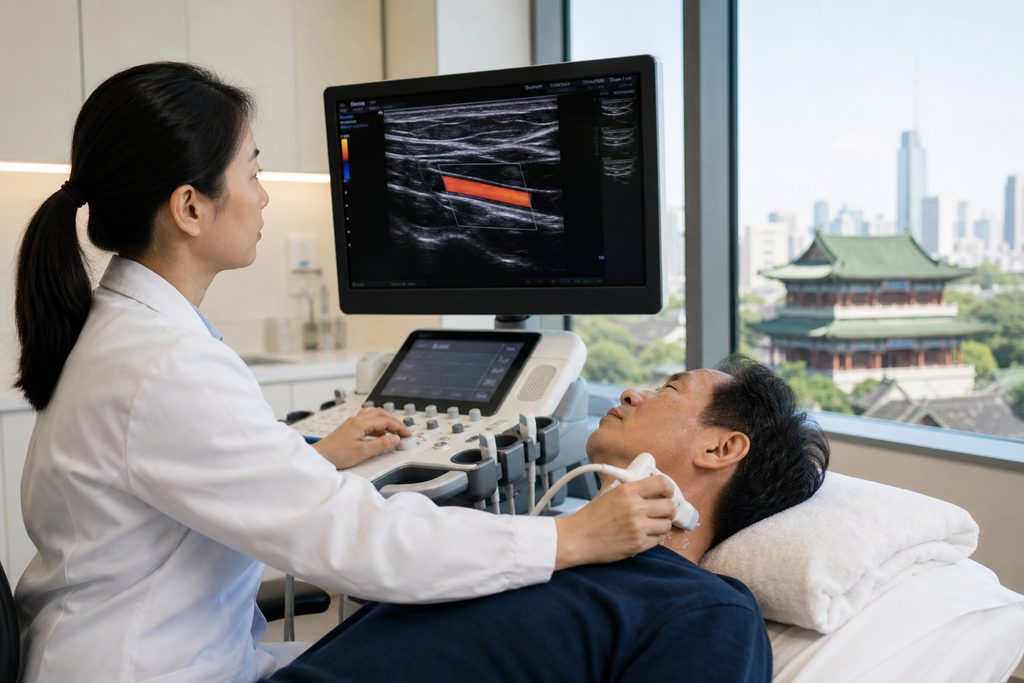
Let’s start with the basics, because the terminology trips people up. A carotid ultrasound — sometimes called a carotid duplex or carotid Doppler — is a painless scan that uses sound waves to create pictures of the two large arteries on either side of your neck. Those arteries supply blood to your brain. When plaque builds up inside them, blood flow narrows, and that narrowing is one of the leading preventable causes of stroke. The scan itself takes about 20 to 30 minutes. No needles, no radiation, no dye. You lie down, a technician moves a probe along your neck, and you leave.
What the scan tells your doctor matters far more than the scan itself. It measures the speed of blood flow through each artery and estimates how much of the vessel is blocked. A result showing less than 50% narrowing usually means medication and monitoring. Above 70%, and the conversation shifts toward procedures like carotid endarterectomy or stenting. That distinction — the number, not the scan — is what drives treatment decisions.
Who This Is Right For — and Who It Isn’t
Carotid ultrasound is not a routine screening test for everyone. Most major medical bodies, including the American Heart Association, recommend it for specific risk profiles rather than the general public. If you fall into one of these groups, a scan in China can be a sensible, affordable option.
You are likely a good candidate if you:
- Have had a transient ischemic attack (TIA) — a “mini-stroke” that resolved within minutes or hours
- Have a bruit, an abnormal sound your doctor heard through a stethoscope on your neck
- Carry risk factors: high blood pressure, diabetes, high cholesterol, or a smoking history of 20+ pack-years
- Are over 60 with at least two cardiovascular risk factors and want a baseline assessment
- Have known coronary artery disease or peripheral artery disease
You should probably not pursue this if you:
- Have no symptoms and no major risk factors — the false-positive rate creates unnecessary anxiety and follow-up testing
- Are looking for a “full body scan” style checkup — carotid ultrasound is targeted, not comprehensive
- Have an active infection or open wound on the neck (rare, but the probe cannot be placed safely)
- Need an urgent evaluation for acute stroke symptoms — that requires CT or MRI immediately, not an outpatient ultrasound
The Options, Compared
Where you get a carotid ultrasound changes the price dramatically. The table below compares the realistic paths for an international patient. All figures are in USD and reflect typical ranges — your actual cost varies by hospital and case complexity.
| Option | Typical Cost | Wait Time | English Support | Best For |
|---|---|---|---|---|
| US hospital (outpatient) | $500 – $1,200 | 1–4 weeks | Yes | Local patients with insurance |
| UK private clinic | £300 – £600 ($380 – $760) | 1–3 weeks | Yes | Patients avoiding NHS waitlists |
| China public tertiary hospital (standard) | $80 – $180 | Same day to 3 days | Limited | Budget-conscious, self-directed |
| China public hospital international/VIP wing | $200 – $400 | 1–3 days | Yes | Patients wanting speed + English |
| China private international hospital | $400 – $900 | Same day to 2 days | Yes, native-level | Insurance direct billing, comfort |
Which column suits you depends on what you value. If you are already in China or planning a broader medical trip, the public international wing offers the best balance of price and communication. If you need direct insurance billing and a Western-style experience, the private route is worth the premium. And if you are paying entirely out of pocket and can navigate with a translator, the standard public pathway is remarkably cheap by Western standards.
Finding the Best Hospital in China for Carotid Artery Ultrasound
China has more than 35,000 hospitals. The top 5% — roughly 340 institutions — are ranked by the Fudan University Hospital Rankings and carry JCI accreditation in many cases. For vascular imaging, you want a hospital with a dedicated vascular surgery or neurology department, not just a general imaging center.
Stroke centers matter here. A hospital that handles hundreds of carotid endarterectomies per year will have sonographers who see narrowing every day and radiologists who interpret the results accurately. That volume translates into reliability.
Three cities concentrate the strongest options. Beijing leads with 21 Fudan Top 100 hospitals, including Peking Union Medical College Hospital, which is widely regarded as China’s flagship institution. Shanghai follows with 18, and Guangzhou with 10. If you are specifically looking to book carotid ultrasound in Shanghai, hospitals like Zhongshan Hospital and Ruijin Hospital both offer international departments with English-speaking coordinators.
For a full list of ranked institutions by city, see our Fudan Top 100 hospital directory. You can also browse by specialty through our department guides, which list the top 10 hospitals for neurology and vascular surgery specifically.
One practical note: public hospitals in China generally do not allow overseas patients to book an outpatient appointment in advance through standard channels. You register the same day, in person. The exception is the international or VIP wing, where advance booking is possible. This is the single biggest logistical hurdle for foreign patients, and it is why many choose to work with a coordinator.
How Much Does a Stroke Risk Check Cost in China?
A carotid ultrasound alone is inexpensive. But a proper stroke risk check usually includes more than one test. Here is what a realistic package looks like at a Chinese tertiary hospital.
- Carotid duplex ultrasound: $80 – $350
- Blood panel (lipid profile, glucose, HbA1c, homocysteine): $50 – $120
- Electrocardiogram (ECG): $20 – $60
- Echocardiogram (if indicated): $150 – $400
- Neurology consultation: $30 – $150
Total for a comprehensive workup: roughly $330 to $1,080 at a public hospital, or $800 to $2,000 at a private international facility. Compare that to the United States, where the same bundle routinely exceeds $3,000 before insurance.
What drives the variance? Hospital tier, city, whether you use the international wing, and whether additional imaging like CT angiography or MRI is added. Your doctor may recommend those if the ultrasound shows significant narrowing.
Is Carotid Ultrasound Safe in China? Addressing the Real Concern
This question — is carotid ultrasound safe in China — comes up often, and it deserves a direct answer. The procedure itself is safe everywhere. It uses no radiation, no contrast dye, and no invasive instruments. The risk is essentially zero regardless of country.
The legitimate question underneath is about quality and accountability. Does the hospital use calibrated equipment? Are the sonographers trained to international standards? Will the report be interpretable by your doctor back home?
At China’s top-tier hospitals, the answer is generally yes. Equipment at Fudan-ranked institutions is comparable to what you would find in a Western academic medical center. Reports are issued in Chinese, but international departments provide English translations. If you use a standard public pathway, you will need to arrange translation yourself.
What China does not offer is a uniform experience. A county-level hospital and a top-tier stroke center are not the same. The gap between them is wider than in countries with more centralized quality control. Choosing the right institution is the variable that matters most.
Practical Considerations for Medical Tourism
If you are considering a carotid artery scan medical tourism China trip, several logistics need attention before you book flights.
Visa. Foreign patients traveling to China for medical treatment typically use the S2 visa, which covers short-stay private affairs including medical consultation and treatment. Accompanying family members apply under the same category. The M visa is for commercial and trade activities and is not the correct category for medical travel. Requirements change, so confirm current documentation with your nearest Chinese embassy or consulate. You will generally need an invitation or appointment letter from the hospital.
Medical records. Bring your existing imaging, lab results, and medication list. If you have had a prior carotid ultrasound, the comparison is valuable. Have documents translated into Chinese if possible — or use a service that handles this.
Payment. Public hospitals require prepayment; you settle the bill before or during service and seek reimbursement from your insurer afterward. Private international hospitals often bill insurance directly, but confirm coverage before you arrive.
Language. This is the biggest practical barrier. Most public hospital staff do not speak English. Signage, registration systems, and pharmacy instructions are in Chinese. A bilingual medical companion — someone who handles registration, queuing, payment, and translation — costs from $300 per day and is, in our experience, the difference between a smooth visit and a frustrating one.
Follow-up. Get your report and images on a USB drive or via hospital portal before you leave. Your home physician will need them. If the scan shows significant narrowing, you may need to discuss treatment options before flying home — which is why building in an extra day or two is wise.
For a broader overview of how medical travel to China works, our main resource hub covers hospital selection, cost comparisons, and process guides.
Frequently Asked Questions
At private international hospitals and the VIP wings of top public hospitals, yes — English-speaking staff handle registration and explain results. At standard public hospitals, no. You will need a translator or a bilingual companion to navigate registration, payment, and the report pickup. This is not a minor inconvenience; it is the primary reason foreign patients seek coordination support.
At most Chinese hospitals, the ultrasound report is ready within a few hours, often the same day. Complex cases may take 24 to 48 hours if a senior radiologist reviews the images. Private hospitals typically deliver results faster, sometimes within an hour. Plan to wait on-site or return the next morning.
Usually, yes — with caveats. The images and measurements are standardized, so a competent vascular specialist can interpret them. The written narrative will be in Chinese unless you request translation. Ask for both the images (DICOM files) and a translated summary. Some physicians prefer to repeat the scan themselves, which is a reasonable position given differences in equipment calibration.
Honestly, no — not for the scan alone. The savings do not justify international travel for a single $100 test. It makes sense when the ultrasound is part of a broader evaluation, when you are already in Asia, or when you are combining it with other procedures or a comprehensive health check. For a standalone scan, your local hospital is almost certainly the better choice.
Significant narrowing (above 70%) may require intervention — either medication optimization, carotid endarterectomy, or stenting. Chinese hospitals perform these procedures at high volume and at a fraction of Western costs. But you should decide in advance whether you are prepared to extend your trip for treatment, or whether you would rather return home with the diagnosis and pursue care there. Neither choice is wrong. What matters is having a plan before you are in the situation.
Your Next Step
A carotid ultrasound is one of the simplest, cheapest, and most useful tests in preventive stroke care. Getting one in China can cost less than a dinner out in Manhattan — but only if you know where to go and how to navigate the system. The scan itself is easy. The logistics are not.
We are China Medical Services, a coordination service that connects international patients with top-ranked Chinese hospitals. We are not a hospital and we do not provide diagnoses. What we do is handle the parts that trip people up: hospital matching, appointment coordination, bilingual medical companions who stay with you through registration and results, and visa guidance for the S2 category. We also arrange written second opinions and video consultations with Chinese specialists if you want expert input before deciding whether to travel.
If you would like to explore whether a stroke risk check in China makes sense for your situation, start with a free consultation through our patient services page. No pressure, no obligation — just a conversation about what is possible.
This article is for informational purposes only and does not constitute medical advice. Always consult a qualified healthcare provider before making decisions about your health. Costs are estimates and vary by hospital and case complexity.
For more medical information and treatment options in China, visit chinamedservices.com (China Medical Services).
