Cerebral Palsy Treatment Service China: Multidisciplinary Support for All Ages
When 42-year-old Michael first heard his daughter’s diagnosis, he stared at the ceiling of a clinic in Manchester for a long time. The spastic diplegia diagnosis was clear. The path forward was not. He started searching for options not limited by eighteen-month waiting lists for a specialist consultation. That search brought his family’s attention to a completely different model of care. The model exists in China. It is built on high clinical volume, integrated rehabilitation, and a price structure that often resets a family’s financial calculations entirely. The cerebral palsy treatment cost China presents is not the only reason families make the journey. But it is often the reason they can afford to start.
Key Takeaways
- China’s top pediatric neurosurgery and rehabilitation centers handle case volumes that dwarf most Western hospitals, with some performing over 1,000 selective dorsal rhizotomy (SDR) procedures annually.
- The structural cost difference is stark: a complete SDR surgery and inpatient rehabilitation package can range from $25,000 to $45,000 USD, compared to $150,000+ in the United States.
- Language is the single biggest barrier in China’s public hospital system; even registration kiosks operate exclusively in Mandarin, making unassisted navigation nearly impossible for foreign families.
- True multidisciplinary support here means neurosurgeons, physiatrists, and traditional Chinese medicine (TCM) practitioners working on the same hallway—not across different appointment books months apart.
The Problem: Fragmented Care Creates Exhausted Families
Cerebral palsy affects approximately 1 in 345 children in the United States, according to CDC data. It is the most common motor disability in childhood. Yet the typical care journey forces parents into a draining loop. See the neurologist on Tuesday. Wait six weeks for the orthopedic surgeon. Start physical therapy at a separate facility across town. Coordinate it all yourself. For adults living with CP, the situation is worse. The transition from pediatric to adult care is a well-documented cliff. Many adults report simply not being seen by a specialist for years. The system treats a chronic, lifelong condition as a series of disconnected acute events. That is the structural failure. And families feel it in their bones.
What happens if nothing changes? Secondary complications accumulate. Joint contractures worsen. Pain becomes a constant background noise. Surgical windows for interventions like SDR or orthopedic corrections narrow as the child grows. Time is not neutral in cerebral palsy. It works against you when care is fragmented.
Who We Are
We are not a hospital. We do not provide medical treatment or clinical diagnoses. Our team functions as your logistical architects—we bridge the gap between you and China’s top-tier medical expertise. China Medical Services maintains verified relationships with over 340 top-ranked hospitals across 37 cities. We handle hospital matching, appointment coordination, bilingual medical companionship, and visa guidance. We do not promise miracles. We promise that when you arrive at a hospital, a Mandarin-speaking coordinator is at your side, your medical records have been translated, and the specialist you are seeing has been selected based on your specific subtype of cerebral palsy. That is the work. It is unglamorous. It is essential.
Why China’s Multidisciplinary Model Delivers Results
Clinical Volume Builds Pattern Recognition
There is a concept in surgery called pattern recognition. A surgeon who sees 50 spastic diplegia cases a year sees patterns differently than one who sees 10. In China’s top pediatric neurosurgery departments, the numbers tilt the scale. A single center like Shanghai Children’s Medical Center may perform several hundred SDR procedures annually. The rehabilitation teams attached to these surgical units see post-operative CP patients daily—not weekly. That daily repetition builds a granular understanding of recovery trajectories. A physical therapist here can tell you on post-op day three whether a child’s muscle tone response is typical or requires adjustment. That judgment comes from sheer exposure. Western centers simply cannot replicate this volume due to lower population density and different referral patterns.
For adults asking how is cerebral palsy treated in China, the answer often starts with a comprehensive reassessment. Many adult patients arrive having been told years ago that no further intervention is possible. Chinese rehabilitation physicians frequently reassess gait, spasticity patterns, and joint function with fresh eyes. Sometimes the finding is that a tendon-lengthening procedure or botulinum toxin protocol was never properly explored. The multidisciplinary team—physiatrist, orthopedic surgeon, neurologist—reviews the case together in one morning. Not across three separate appointments spread over months.
Rehabilitation as an Integrated System, Not an Add-On
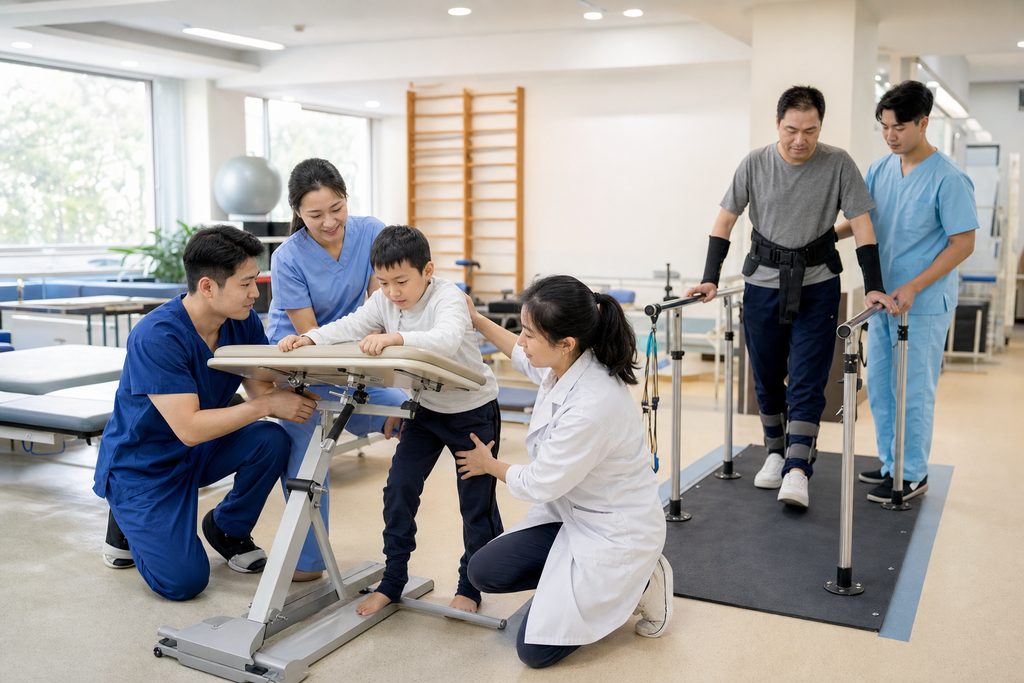
In most Western models, surgery and rehabilitation are separate transactions. Different buildings. Different billing codes. Different waiting lists. The model at China’s top rehabilitation centers is structurally different. Post-surgical inpatient rehabilitation is often built into the care pathway from day one. A child undergoing SDR at a major center will transition directly to a rehabilitation floor where physical therapy, occupational therapy, and acupuncture begin within days of surgery. The therapists communicate directly with the surgical team. Adjustments happen in real time. This integration is not a luxury. It is the standard operating procedure at centers that treat high CP volumes.
Understanding what is the success rate of cerebral palsy surgery in China requires defining success carefully. No ethical surgeon promises a cure. What the published literature shows is that SDR combined with intensive post-operative physiotherapy consistently reduces spasticity and improves gait function in carefully selected patients. Chinese centers contribute significantly to this evidence base, with long-term follow-up studies tracking patients five and ten years post-surgery. The success rate depends heavily on patient selection, surgical precision, and rehabilitation intensity. The structural advantage here is that all three components exist under one organizational roof.
Cost Structure Without Quality Compromise
Let’s address the obvious question directly. The cerebral palsy treatment cost China offers is lower than Western equivalents. That fact makes some patients nervous. Does lower cost mean lower quality? The answer lies in structural economics, not clinical shortcuts. A complete SDR surgery package with six to eight weeks of inpatient rehabilitation at a top Chinese public hospital typically ranges from $25,000 to $45,000 USD. The same procedure and rehabilitation protocol in the United States can exceed $150,000. The difference is not in the quality of the surgical instruments or the training of the neurosurgeon. It is in the cost of labor, hospital administration overhead, and the absence of a multi-layered insurance billing apparatus that consumes 15-25% of American healthcare spending. Chinese surgeons at Fudan-ranked hospitals train internationally, publish in peer-reviewed journals, and operate on case volumes their Western counterparts rarely match. The economics are different. The clinical standards are not lower.
For families researching a cerebral palsy rehabilitation center China price, the range varies by intensity and duration. Inpatient rehabilitation programs typically run $3,000 to $6,000 USD per month. Outpatient therapy sessions range from $50 to $120 USD per session. These are real numbers. They fluctuate by city, hospital tier, and case complexity. But they represent a fundamental affordability shift for families who have been rationing therapy sessions due to cost.
| Treatment Component | China (USD) | United States (USD) |
|---|---|---|
| SDR Surgery Package | $25,000 – $45,000 | $150,000+ |
| Inpatient Rehab (per month) | $3,000 – $6,000 | $20,000 – $40,000 |
| Outpatient PT Session | $50 – $120 | $150 – $350 |
| Botox Injection Series | $800 – $1,500 | $3,000 – $6,000 |
All figures are estimates. Final costs vary by hospital, case complexity, and length of stay.
What You Need to Know Before Going Alone
The clinical case for seeking care in China is strong. But the logistical reality of navigating it independently is brutal. We tell every prospective patient this directly. Here is what you face:
- Visa Requirements Are Specific: Medical treatment in China requires an S2 visa with a notation specifying the treatment purpose. Accompanying family members also need S2 visas. This is not a tourist visa. The application requires an invitation letter from the treating hospital. Obtaining that letter without a local contact is a circular problem—the hospital wants to see the patient before issuing anything, and the patient needs the letter to enter the country. This is where coordination breaks the deadlock.
- Hospital Registration Is a Full-Contact Sport: China’s top public hospitals see 10,000+ outpatient visits daily. Registration kiosks are Mandarin-only. Queues form at 5:00 AM. Appointment slots for senior specialists vanish within minutes of release. Even finding the correct building on a sprawling hospital campus—some covering dozens of acres—requires local knowledge. A bilingual medical companion solves this. Without one, a foreign family is functionally illiterate and lost.
- Medical Records Must Be Professionally Translated: Surgeons will not review English-language MRI reports in detail. They need structured, professionally translated summaries with key measurements and findings highlighted. Google Translate does not cut it for a surgical decision. Our team handles this translation as a standard preparatory step.
How We Help You Navigate This
These barriers exist for structural reasons. They are not designed to exclude foreign patients. They are simply the reality of a healthcare system built to serve 1.4 billion domestic patients first. We solve each barrier through a defined process.
Before you travel, we collect your medical records, have them professionally translated, and present them to two or three appropriate specialists at Fudan-ranked hospitals. We confirm which specialist is willing to take the case and what preliminary treatment plan they propose. We secure the hospital invitation letter needed for your S2 visa application. We advise on accommodation near the hospital and arrange airport transfer. When you land, a bilingual medical companion meets you. They handle every registration, payment queue, and navigation task. They sit with you during the consultation and translate both the surgeon’s words and the unspoken context a foreigner would miss. After discharge, we coordinate follow-up video consultations so your local therapist can communicate directly with the Chinese rehabilitation team. The goal is continuity. Not a one-time procedure followed by silence.
For families exploring whether to book cerebral palsy stem cell therapy China, we offer a clear, evidence-based perspective. Stem cell therapy for cerebral palsy remains experimental. Some Chinese hospitals offer umbilical cord mesenchymal stem cell protocols under clinical trial conditions. Some families report subjective improvements. The published evidence does not yet support stem cell therapy as a standard treatment for CP. We connect interested families with hospitals conducting registered clinical trials. We do not promote unproven treatments. We present the evidence, facilitate the consultation, and let the family and the physician decide. That is our line. We hold it firmly.
What About Adults with Cerebral Palsy?
The search for the best cerebral palsy hospital China for adults reflects a real gap in global healthcare. Most CP resources focus on children. Adults are often left to manage spasticity, pain, and functional decline alone. Several Chinese rehabilitation hospitals have developed dedicated adult CP programs. These programs focus on functional preservation: managing spasticity through botulinum toxin protocols, correcting long-standing orthopedic deformities, and intensive gait retraining. The multidisciplinary model works for adults too. A physiatrist assesses spasticity patterns. An orthopedic surgeon evaluates joint integrity. A rehabilitation therapist builds a maintenance program. All in the same week. For an adult who has been waiting months between specialist visits at home, this compressed timeline is transformative.
The specialist departments that handle adult CP cases often overlap with stroke and spinal cord injury rehabilitation units. This cross-pollination means therapists have deep experience with neurological motor disorders broadly—not just CP narrowly. That breadth of exposure brings creative problem-solving to complex adult cases.
Frequently Asked Questions
Not exactly. China’s public hospitals require an in-person consultation before scheduling surgery. This is non-negotiable. What we can do is arrange a tightly coordinated trip where the consultation, pre-operative testing, and surgery occur in rapid sequence—often within the same week. The surgeon has already reviewed your translated records and confirmed the case is appropriate before you fly. But the final surgical decision and scheduling happen after the face-to-face examination.
This is a legitimate concern. We establish a direct line between your local physician or therapist and the Chinese surgical team before you leave. Follow-up video consultations are scheduled at intervals the surgeon specifies. Your local provider receives detailed discharge summaries and rehabilitation protocols in English. The Chinese team remains accessible for questions. This does not replace local emergency care—you still need a local physician. But it ensures continuity of the surgical team’s oversight.
No. The cost difference is structural. Chinese surgeon salaries, hospital construction costs, and administrative overhead are all lower than in the United States or Western Europe. The medical device supply chain is also less expensive. A neurosurgeon at a top Chinese hospital trains for the same duration, publishes in the same international journals, and operates at higher annual case volumes than most Western peers. The cost reflects economics, not quality. We say this without hesitation because we have watched these surgeons work.
Our bilingual medical companions are available for the duration of your stay—from half-day support during routine therapy days to full-day accompaniment during surgical admissions. For extended rehabilitation stays of several weeks, we often arrange a rotating team so no single companion burns out. The companion translates therapy instructions, facilitates communication with nursing staff, and handles any daily logistics. Families consistently tell us this human presence is the single most valuable service we provide.
Your Next Step
Cerebral palsy does not stop being complex because you cross a border. But the care model can change. The integration of surgery, rehabilitation, and long-term management that Chinese centers offer is structurally different from fragmented Western models. The costs are lower for real economic reasons, not clinical compromises. The barriers—language, visas, hospital navigation—are significant. They are also solvable with the right coordination. If your family is weighing options, start with a conversation. Not a commitment. Just a clear discussion of your specific case and what is possible. That step costs nothing and often clarifies more than months of independent research.
Visit our patient services page to request a free consultation. We review your medical records, discuss your goals, and tell you honestly whether China’s cerebral palsy treatment pathways are a fit for your situation. No pressure. No promises we cannot keep. Just the information you need to make a clear-eyed decision.
For more medical information and treatment options in China, visit chinamedservices.com (China Medical Services).
