Radiotherapy Treatment in China: What to Expect, Costs & Top Hospitals
When 54-year-old David from Oregon was diagnosed with prostate cancer, his urologist in Portland handed him a treatment plan and a bill estimate that made his stomach drop: roughly $85,000 for a full course of intensity-modulated radiation therapy. His insurance would cover part of it. The rest would land on his family. A friend mentioned that the same treatment in China might cost a fraction of that figure. David had questions. Was it safe? How long would he need to stay? Could he even get an appointment as a foreigner? This article answers those questions honestly, with real numbers and no sales pitch.
Key Takeaways
- The radiotherapy cost China hospitals charge typically runs 60–80% below U.S. prices for equivalent techniques, with a full IMRT course often falling between $8,000 and $18,000 depending on the hospital and case complexity.
- China’s top cancer centers treat tens of thousands of patients annually, giving radiation oncologists a depth of hands-on experience that is difficult to match in smaller Western markets.
- Public hospital outpatient departments generally cannot be booked from overseas in advance — foreigners who want a confirmed treatment slot usually go through a hospital’s international or VIP channel, which costs roughly 1.5–2 times the standard fee.
- Radiotherapy is not a standalone decision. You need a confirmed diagnosis, imaging, and a treatment plan reviewed by a qualified radiation oncologist before any travel is worthwhile.
The Problem: Radiation Therapy Costs Are Crushing Patients Worldwide
In the United States, the average cost of a 6-to-8-week course of external beam radiation therapy ranges from $40,000 to well over $100,000, according to published hospital price transparency data. In the UK, the NHS waits for oncology treatment have stretched in some regions to 8–12 weeks from referral to first treatment. In Canada, patients routinely wait 4–8 weeks just for a radiation oncology consultation.
These numbers represent real people making impossible choices. Some delay treatment. Others take on debt. A smaller but growing group starts looking abroad.
Why China Delivers Strong Radiotherapy Outcomes
China is not a budget alternative in the sense of cutting corners. It is a high-volume system where top hospitals have invested heavily in radiation oncology equipment and expertise. Here is what that looks like in practice.
Clinical Volume Builds Real Expertise
A radiation oncologist at a major Chinese cancer center may treat 400–600 patients per year. In many Western hospitals, the equivalent figure is closer to 150–250. Volume matters in radiotherapy because treatment planning — deciding exactly where to aim the beam and how much dose to deliver — is a skill refined by repetition.
Sun Yat-sen University Cancer Center in Guangzhou and the Cancer Hospital of the Chinese Academy of Medical Sciences in Beijing are among the busiest oncology centers in the world. Both appear consistently in the Fudan Hospital Rankings, which evaluate hospitals by specialty reputation across 45 clinical disciplines.
Equipment and Technology at Scale
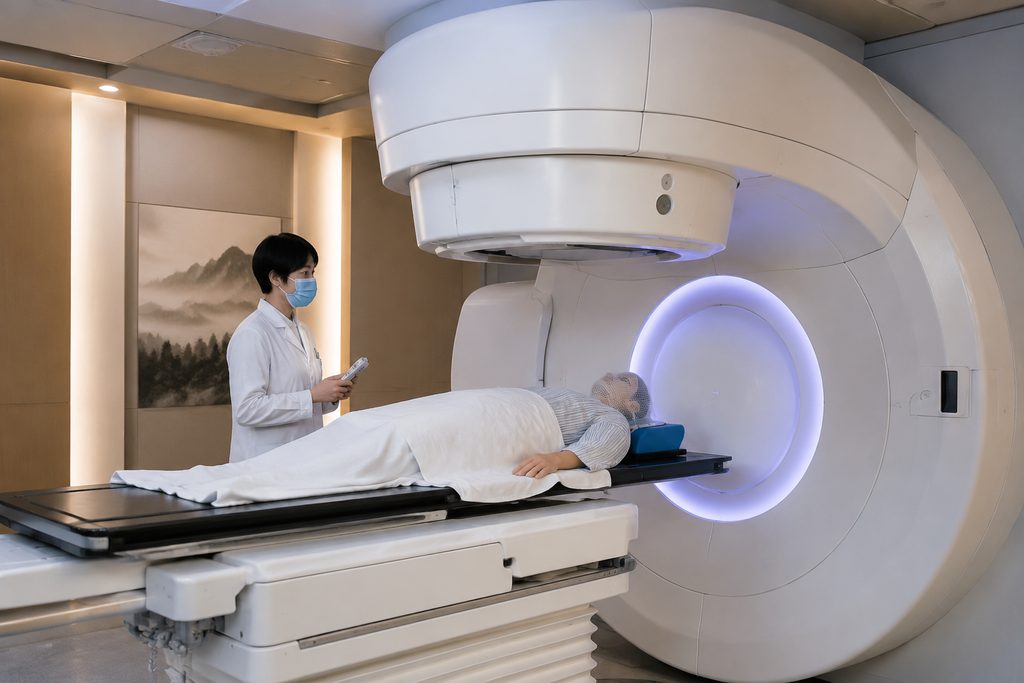
Top Chinese hospitals operate the same linear accelerators used in the U.S. and Europe — Varian TrueBeam, Elekta Versa HD, and similar platforms. Proton therapy is available at a handful of centers, including the Shanghai Proton and Heavy Ion Center and facilities in Guangzhou and Beijing.
The difference is throughput. A Chinese center might run its machines 16 hours a day, six days a week. That operational intensity translates into faster scheduling once you are in the system.
Cost Structure, Not Cost Cutting
Lower prices do not come from inferior care. They come from labor economics, government price controls on medical services, and hospital efficiency. A radiation oncologist’s salary in China is a fraction of a U.S. counterpart’s. Hospital construction and equipment costs are lower. And the government sets fee schedules for public hospitals, which keeps prices predictable.
| Treatment Type | Typical China Cost (USD) | Typical U.S. Cost (USD) |
|---|---|---|
| IMRT (6–8 weeks) | $8,000–$18,000 | $40,000–$90,000 |
| SBRT (stereotactic, 3–5 sessions) | $6,000–$15,000 | $30,000–$70,000 |
| Proton therapy (full course) | $25,000–$40,000 | $100,000–$200,000 |
| Brachytherapy (per implant) | $3,000–$8,000 | $15,000–$35,000 |
These figures are estimates. Actual radiotherapy cost China hospitals quote will vary by hospital tier, cancer type, number of fractions, and whether you use the standard or international channel. Always request a written estimate after your records are reviewed.
How Long Does Radiotherapy Treatment Take in China?
This is one of the most common questions, and the answer has two parts: the treatment itself and the logistical timeline around it.
A standard course of IMRT for prostate or head-and-neck cancer runs 6–8 weeks, with daily sessions Monday through Friday. Each session takes 15–30 minutes on the table. SBRT for early-stage lung cancer compresses into 3–5 sessions over one to two weeks. Proton therapy follows a similar schedule to IMRT — roughly 6–8 weeks.
The logistical timeline looks like this:
- Weeks 1–2: Send your imaging, pathology reports, and treatment history for review by a Chinese radiation oncologist.
- Week 3: Receive a written second opinion or video consultation confirming whether radiotherapy is appropriate and what protocol is recommended.
- Weeks 3–4: Visa application (S2 category for short-stay medical treatment), travel booking, and hospital appointment coordination.
- Week 4–5: Arrive in China, complete in-person consultation, undergo any additional imaging or simulation, and begin treatment planning.
- Week 5 onward: Start daily treatment sessions.
For SBRT or palliative radiation, the entire stay might be two to three weeks. For a full IMRT course, plan on eight to ten weeks in China including setup and follow-up.
Is Radiotherapy in China Safe for Foreigners?
For IMRT, expect $8,000–$18,000 in China versus $40,000–$90,000 in the U.S. Proton therapy runs $25,000–$40,000 in China versus $100,000–$200,000 in the U.S. These are ranges — your actual cost depends on the hospital, the number of fractions, and whether you use the standard or international channel. Always request a written estimate after your records are reviewed.
At top-ranked hospitals, yes — the equipment, protocols, and safety standards are comparable to major Western centers. The bigger challenge is communication and navigation. If you do not speak Mandarin, arrange interpretation support for every consultation and treatment day. Do not assume English is spoken everywhere.
Top Chinese hospitals have radiation oncology emergency protocols and on-call physicians. Before you start treatment, ask what the process is for urgent issues, who to contact, and whether English-speaking staff are available after hours. Also confirm that your travel insurance or health insurance covers complications abroad. If it does not, consider a medical travel policy.
Your Next Step
Radiotherapy in China is a legitimate, evidence-based option for many cancer patients — not a last resort, and not a shortcut. The hospitals are real, the equipment is modern, and the cost savings are substantial. But the system is complex, and going in without preparation is a mistake.
At China Medical Services, we help international patients navigate this process — from written second opinions and video consultations to hospital matching, appointment coordination, and bilingual accompaniment on the ground. We are not a hospital and we do not provide medical diagnoses. We connect you with the right specialists and handle the logistics so you can focus on treatment.
If you are exploring radiotherapy abroad, start with a free consultation. No pressure, no obligation — just a conversation about whether China makes sense for your situation. Visit our consultation page or explore chinamedservices.com to learn more.
This article is for informational purposes only and does not constitute medical advice. Always consult a qualified radiation oncologist before making treatment decisions. Costs and availability are subject to change and vary by hospital and case complexity.
Frequently Asked Questions
Yes. The hospitals used for international patients are JCI-accredited and follow the same international safety standards as top hospitals in the US and Europe. Surgical teams perform high volumes of procedures — often more than their Western counterparts — which studies show leads to better outcomes.
Costs vary by procedure and hospital, but international patients typically save 40-80% compared to US prices — even when factoring in travel and accommodation. A consultation with our team will give you an exact, all-inclusive quote with no hidden fees.
Send us your existing medical reports to get started. We handle everything from hospital selection and appointment scheduling to visa assistance and post-operative recovery planning. Your medical records are reviewed by the specialist before you even book a flight.
For more medical information and treatment options in China, visit chinamedservices.com (China Medical Services).
