Is That Chat Doctor Genuine? How to Verify a Real Chinese Specialist
Is That Chat Doctor Genuine? How to Verify a Real Specialist Before You Fly
You have been messaging someone who claims to be a cardiothoracic surgeon at a top Chinese hospital. The credentials look impressive. The English is fluent. The price quote for heart surgery cost China came back at $18,000 — roughly one-sixth of what you were quoted in Houston. But one question keeps you up at night: is that chat doctor genuine?
This is the single most important question you can ask before booking a medical trip. China’s healthcare system is enormous — over 35,000 hospitals — and its top tier is genuinely world-class. But the internet is full of intermediaries, some legitimate, some not. Verifying who you are actually talking to is not paranoia. It is due diligence. Our team at China Medical Services has spent years helping international patients navigate exactly this problem, and we will walk you through the verification process step by step.
Key Takeaways
- China’s top 340+ hospitals represent the top 5% of the country’s 35,000+ medical institutions, ranked by Fudan University and JCI accreditation standards.
- Heart bypass surgery in a top Chinese public hospital typically costs $12,000–20,000, compared to $120,000+ in the United States — a 5–10x difference.
- Legitimate Chinese specialists can be verified through hospital directories, medical license registries, and official international department channels.
- Public hospital outpatient clinics in China generally cannot be booked from overseas — real specialists require in-person registration or official international department coordination.
The Problem: Medical Tourism Fraud Is More Common Than You Think
Medical tourism fraud affects thousands of patients globally each year. One study published in the Journal of Medical Internet Research found that up to 40% of “medical facilitators” advertising online had no verifiable hospital affiliation. Patients have wired deposits to fake clinics, arrived at airports with no one waiting, and discovered that the “professor” they chatted with on WhatsApp was a call center employee reading from a script.
This is not a China-specific problem. It happens in Thailand, Turkey, Mexico, India. But China’s language barrier and opaque hospital system make verification harder for Western patients. A patient from Ohio cannot easily call a Shanghai hospital’s front desk and ask, “Does Dr. Zhang actually work there?” The receptionist may not speak English. The hospital directory may not be indexed on Google. The doctor’s name might be romanized three different ways.
So what happens? Patients either abandon the idea entirely — losing access to genuinely excellent care at a fraction of Western prices — or they proceed without verification and hope for the best. Neither outcome is acceptable.
Why China’s Top Hospitals Are Worth the Verification Effort
The reason scammers target Chinese medical tourism is simple: the real thing is extremely attractive. China’s top-tier hospitals perform clinical volumes that would be unimaginable in most Western institutions. Fuwai Hospital in Beijing performs over 14,000 cardiac surgeries annually — the highest volume of any heart center on the planet. That volume translates into surgical teams that have seen every possible complication and refined their protocols accordingly.
Cost is the other driver. The structural economics of Chinese healthcare are fundamentally different from the American system. Labor costs are lower. Malpractice insurance is not a multi-million-dollar line item. Hospital construction is government-subsidized. None of these factors reduce the quality of a surgeon’s training — they reduce the price of the procedure.
Clinical Volume Creates Competence
A top Chinese cardiac surgeon may perform 300–500 bypass procedures per year. The average American cardiac surgeon performs roughly 100–150. Studies in The Lancet and the New England Journal of Medicine have repeatedly shown a direct correlation between surgical volume and patient outcomes, particularly for complex procedures. When a surgical team does something thousands of times, the muscle memory is real.
This applies across specialties. Orthopedic surgeons at Beijing Jishuitan Hospital — one of China’s leading joint replacement centers — perform knee replacements at volumes that dwarf most Western institutions. Oncologists at Fudan University Shanghai Cancer Center treat patient cohorts that generate clinical data at a scale most Western cancer centers cannot match. So when someone asks “is cancer treatment in China good,” the honest answer is: at the top hospitals, yes — and the volume data supports that.
Technology Without the Wait
Chinese hospitals adopted robotic surgery, proton therapy, and advanced imaging at an aggressive pace over the past decade. The da Vinci surgical system is installed in dozens of Chinese hospitals. Proton therapy centers have opened in Shanghai and Beijing. The reason this matters for international patients is capacity: a patient who might wait months for a robotic prostatectomy in London can often be scheduled within weeks at a top Chinese hospital.
The Cost Gap Is Structural, Not Suspicious
Let us be direct: a $12,000 quote for heart surgery cost China is not a red flag. It is the market rate at a top public hospital. The same procedure at a private international hospital in Shanghai — think United Family or Jiahui — might run $40,000–60,000, still well below US prices. The low public hospital price reflects Chinese healthcare economics, not substandard care. But it also means that a quote of $5,000 for a full bypass should trigger skepticism. Too cheap is also a warning sign.
Any intermediary who quotes a price without first reviewing your medical records is not doing real case management. Legitimate quotes require a specialist to review your imaging, lab work, and history. A genuine chat doctor will ask for records before quoting a price.
How to Verify That Chat Doctor in Five Steps
You have been messaging someone. They claim to be a specialist or to represent one. Here is exactly how to verify them before you send a single dollar.
Step 1: Demand the Hospital’s Official Name — in Chinese and English
A real doctor works at a real hospital. Ask for the full official hospital name, in both English and Chinese characters. Then search for that hospital on the Fudan University Hospital Ranking — the most authoritative hospital ranking in China. If the hospital is not on the Fudan Top 100 list or JCI-accredited, ask why. Many excellent hospitals are not on the list, but you should know where yours stands. Our top hospitals directory covers the Fudan-ranked institutions across 37 cities.
Step 2: Verify the Doctor’s License Through the National Registry
China’s National Health Commission maintains a public database of licensed physicians. Every practicing doctor in China has a license number. Ask the chat doctor for their license number and the province where they are registered. You can verify this through the NHC’s official website or through a hospital’s international department. A genuine doctor will provide this information without hesitation. A fake one will deflect, make excuses, or disappear.
Step 3: Request a Video Consultation Through Official Channels
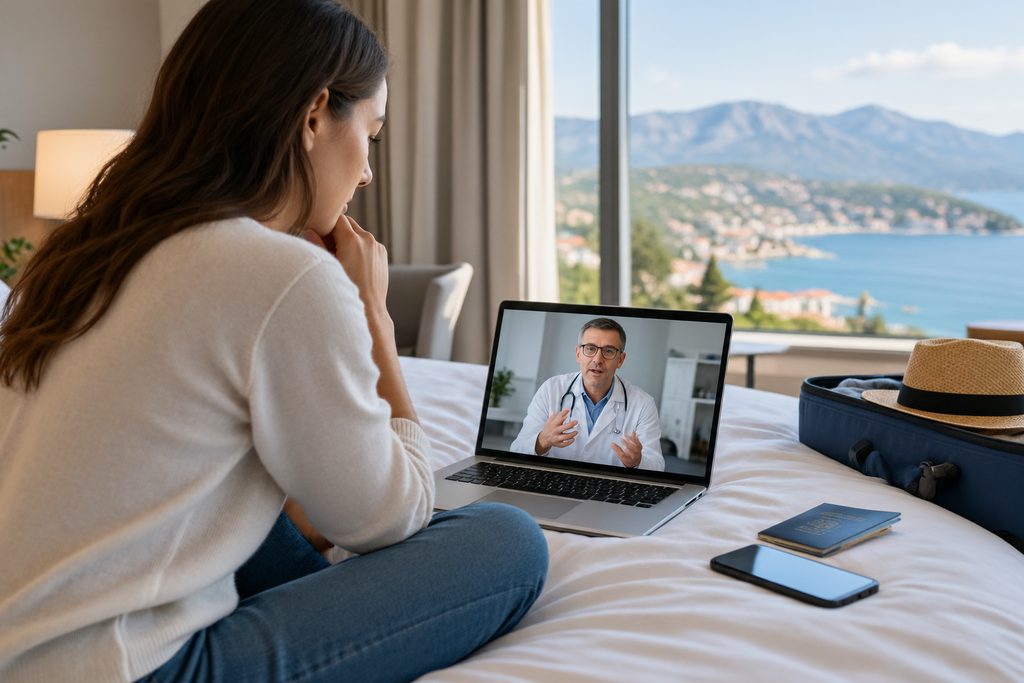
This is the single most effective verification tool. Request a video consultation that takes place through the hospital’s official international department — not through WhatsApp, not through a personal WeChat account. A legitimate specialist will be willing to meet you on a hospital-affiliated platform, with hospital staff present. Our team facilitates these consultations through official hospital international departments, with fees ranging from $100–300 for a standard specialist video consultation, up to $500–800 for a top-specialist session.
Step 4: Ask for a Written Second Opinion on Hospital Letterhead
A written second opinion is a document, not a chat message. It comes on hospital letterhead, signed by the specialist, with the hospital’s official seal. It reviews your actual medical records and provides a clinical assessment. The cost for a written second opinion from a top Chinese specialist typically ranges from $300–500. This document serves two purposes: it gives you real clinical value, and it proves the doctor is who they claim to be. A chat doctor who refuses to provide a written opinion on letterhead is not a doctor you want to trust.
Step 5: Check the Visa Requirements
Here is a practical filter: any legitimate medical travel to China requires an S2 visa, which is the short-stay category used for medical treatment and private affairs. Accompanying family members also apply for S2 visas. If the person you are chatting with tells you to apply for an M visa — which is a commercial and trade visa — they do not understand Chinese medical travel. That is a disqualifying error. Legitimate facilitators know the visa categories cold.
What a Real Chinese Medical Consultation Actually Looks Like
Understanding the normal process helps you spot the abnormal. Here is what a legitimate remote consultation with a Chinese specialist involves:
| Service Type | What It Includes | Typical Cost | Verification Value |
|---|---|---|---|
| Written Second Opinion | Specialist reviews your records, provides written analysis and treatment direction on hospital letterhead | $300–500 | High — proves specialist identity and hospital affiliation |
| Standard Video Consultation | Online meeting with specialist at a public hospital international department or private international hospital | $100–300 | High — you see the doctor, the hospital setting, and the staff |
| Top-Specialist Video Consultation | Online meeting with a leading specialist, often department chair level | $500–800 | Very high — top specialists are easily verifiable through public rankings and publications |
| MDT Video Consultation | Multidisciplinary team reviews your case together — typically 3–5 specialists | $1,500–2,000 | Highest — multiple named specialists, multiple verifiable identities |
Notice what all of these have in common: they produce documentation. A real consultation leaves a paper trail. A chat conversation with a “doctor” who never produces a document, never appears on video, and never gives you a license number is not a consultation — it is a sales pitch.
Common Mistakes That Lead Patients to the Wrong Doctor
The verification failures we see follow predictable patterns. Patients want to save money, so they skip the second opinion and go straight to booking surgery. Patients are in pain, so they rush. Patients do not speak Chinese, so they rely on whoever speaks English best — not whoever is most qualified.
One of the most common mistakes is searching for “medical tourism package China surgery” and choosing the first result that offers an all-inclusive deal. Package deals are not inherently bad. But a package that includes surgery without any prior specialist review of your records is a red flag. Real Chinese hospitals do not book surgery from overseas without a specialist first reviewing your case. The public hospital system simply does not work that way — you cannot email a hospital and reserve a surgery slot. Surgery requires an in-person outpatient consultation first, unless you are going through an official international department or VIP channel.
Another mistake: assuming that a low price quote means a scam. The reality is nuanced. A $12,000 quote for cardiac bypass at a top public hospital is plausible. A $50,000 quote for the same procedure at a private international hospital is also plausible. A $4,000 quote is not. Understanding the normal price ranges — and the structural reasons behind them — protects you from both scams and overpriced middlemen.
And a third mistake: trusting reviews on social media. Facebook groups and Reddit threads are full of “patient stories” that may be entirely fabricated. A single positive review from a stranger means nothing. A pattern of verifiable, documented consultations means everything.
Practical Considerations: What You Need Before Contacting Any Chinese Hospital
Before you even start messaging doctors, gather your medical records. This means imaging files (CT, MRI, X-ray), lab results, pathology reports, and a summary of your diagnosis and treatment history. Chinese specialists expect to see these before offering any opinion. A chat doctor who offers a treatment plan without seeing your records is not practicing medicine — they are guessing.
Visa logistics come next. The S2 visa application requires supporting documents from the hospital — an invitation letter or treatment confirmation. The exact requirements vary by embassy and consulate, and they change. Do not rely on a chat doctor for visa advice; check with the Chinese embassy or consulate in your country directly. Our team can help you understand what hospital documents you will need, but the embassy has the final word.
Payment methods matter too. Chinese public hospitals generally require prepayment for inpatient care, and international patients typically pay by bank transfer or credit card through the hospital’s international department. Insurance reimbursement is usually on a post-payment basis — you pay the hospital, then submit claims to your insurer. Private international hospitals like United Family and Jiahui often have direct billing arrangements with major international insurers. Ask about this before you commit.
Language is the final practical hurdle. Top public hospitals in China handle enormous patient volumes — some see over 10,000 outpatient visits per day. The doctors may speak some English, but the registration desks, payment windows, and pharmacy counters generally do not. A bilingual medical companion is not a luxury in this environment; it is the difference between a smooth visit and a day lost in confusion. Our companion service starts at $300 per day and covers registration, queueing, payment, navigation, and interpretation.
Frequently Asked Questions
Ask for the doctor’s license number and the province where they are registered, then verify through the National Health Commission’s public database. Also request a written second opinion on official hospital letterhead. A genuine specialist will provide both without hesitation. If the doctor refuses or deflects, walk away.
No. The price difference is structural — lower labor costs, lower malpractice insurance, government-subsidized hospital infrastructure — not a reflection of surgical quality. Top Chinese cardiac centers like Fuwai Hospital perform more heart surgeries annually than any Western institution. The clinical outcomes at these centers are comparable to top Western hospitals. But be wary of prices far below the normal range, as those can indicate a non-top-tier facility or a scam.
Chinese law provides mechanisms for medical dispute resolution, and top hospitals carry liability insurance. Your home country’s legal system generally does not extend to medical care received overseas, so understand that you are operating under Chinese jurisdiction. This is one reason why choosing a top-ranked hospital with a strong international department matters — these institutions have established protocols for handling complications and complaints. Discuss the hospital’s complication management process before you commit.
No. Solid organ transplantation in China is governed by strict national regulations, and donor organs are allocated through a centralized national system. No legitimate doctor or facilitator can promise you a transplant slot, a short waitlist, or guaranteed access to a donor organ. Any chat doctor who makes such promises is not legitimate. If you are exploring transplant options, the only responsible path is a formal evaluation through a hospital’s transplant program, with full understanding that eligibility and waitlist rules apply equally to foreign and domestic patients.
Start with the Fudan University specialty rankings, which rank hospitals by department. For orthopedics, Beijing Jishuitan Hospital and Peking University Third Hospital are consistently ranked among China’s top orthopedic centers. Request written second opinions from two different hospitals and compare their surgical approaches, implant choices, and rehabilitation protocols. The best hospital is the one whose approach matches your specific condition — not simply the one with the highest ranking.
Your Next Step
Verifying a chat doctor is not difficult once you know what to ask for: a license number, a hospital letterhead, a video call through official channels, and a written second opinion. These four items separate genuine specialists from intermediaries and scammers. Our team at China Medical Services helps international patients navigate this verification process — we are not a hospital, we do not provide diagnoses, and we never promise outcomes. We connect you with verifiable specialists at China’s top-ranked hospitals and handle the logistics in between. If you want help determining whether the person you are chatting with is genuine, start with a free consultation and bring us what you have. We will help you sort out what is real.
Verify first. Fly second. That is the order that keeps patients safe.
For more medical information and treatment options in China, visit chinamedservices.com (China Medical Services).
