Checkup in China: Public vs Private Centers for Foreigners
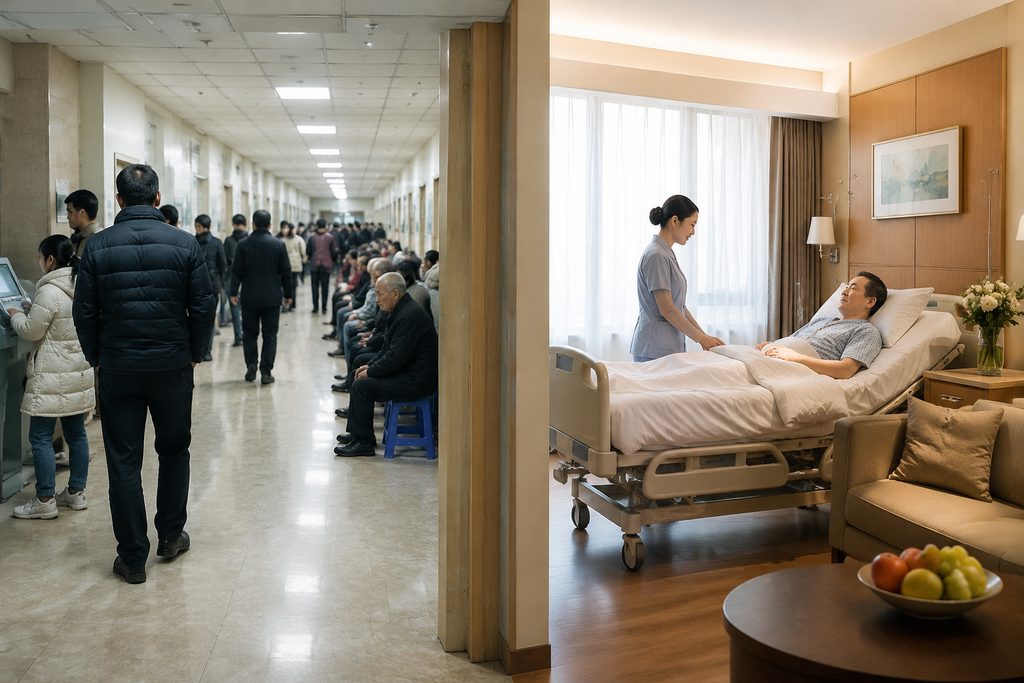
When 47-year-old David from Portland booked a routine physical in Shanghai, he assumed it would work like his clinic back home. He walked into a large public hospital at 8 a.m., stood in a queue he couldn’t read, and spent forty minutes trying to find someone who spoke English. The checkup itself was excellent and cost him under $200. The experience around it was exhausting.
That story captures the real question behind this article. A checkup in China can be world-class and remarkably affordable. The variable isn’t quality. It’s which type of center you walk into, and how much navigation you’re willing to do yourself.
## How This Actually Works, Step by Step
Here’s the honest sequence, from first inquiry to finished report.
You decide what you need screened. A basic annual physical? A cardiac workup? A full-body executive screening with imaging? The scope determines everything downstream.
You send us your requirements and any prior records. We review them, then match you to either a public hospital’s international department or a private international clinic, depending on your priorities.
We coordinate the appointment. Public hospital general outpatient slots usually cannot be pre-booked from overseas — you take a number the same day. Private centers and public international/VIP departments can typically be scheduled in advance.
You arrive, register, and complete the screening. At a private center, staff speak English and guide you room to room. At a public hospital, you’ll move between departments on your own unless you have a bilingual companion.
Results come back. Private centers often deliver a translated report within 3–7 days. Public hospitals may issue results in Chinese, requiring translation.
A physician reviews the findings with you, and if something needs follow-up, that’s when the real value of having a coordinated pathway shows up.
## Public vs Private Hospital Checkup in China: The Core Differences
This is the decision that shapes your entire experience.
Public hospitals — especially the top-ranked ones in the Fudan rankings — hold the deepest diagnostic expertise in the country. Their equipment is current, their volume is enormous, and their pricing is the lowest you’ll find anywhere in the developed world. A basic health checkup at a public hospital might run $150–$400. The catch is infrastructure built for Chinese-speaking locals at scale. Some flagship hospitals see over 10,000 outpatient visits a day.
Private international hospitals and clinics — names like United Family, Jiahui, Parkway, and Raffles — are designed around the foreign patient. English-speaking staff, JCI accreditation, direct insurance billing, appointment-based scheduling, and Western-style comfort. You pay for that. A comparable checkup might run $500–$2,000 or more.
| Factor | Public Hospital | Private International Center |
|---|---|---|
| Typical basic checkup cost | $150–$400 | $500–$2,000+ |
| English support | Limited outside international dept. | Standard |
| Advance booking | Often same-day only | Yes |
| Insurance | Pay upfront, claim later | Often direct billing |
| Report language | Usually Chinese | English standard |
| Wait experience | Crowded, self-navigated | Calm, guided |
Neither column is “better.” A 60-year-old with a suspected cardiac issue may want the diagnostic depth of a top public cardiology program. A busy executive who wants a smooth two-hour annual screening and an English report will be happier private.
## A Realistic Timeline
People consistently underestimate the administrative runway. Here’s what a checkup trip actually looks like.
| Stage | Realistic Duration |
|---|---|
| Deciding scope and choosing center type | 3–10 days |
| Gathering and translating prior records | 3–7 days |
| Appointment coordination | 2 days–3 weeks (varies by center and season) |
| Visa application (S2, if needed) | 1–3 weeks |
| Travel and arrival | 1–2 days |
| The checkup itself | Half day to 2 days |
| Report delivery and translation | 3–10 days |
| Physician review and follow-up planning | 1–2 weeks |
Add buffer. Peak seasons, national holidays, and specialist availability all shift these ranges. Anyone promising a fixed date for a specific doctor is overselling.
## What Can Go Wrong — and What Happens Then
Honest failure modes matter more than glossy promises.
You arrive and the public hospital won’t see you without a same-day registration number, and the department is full. Recourse: return early the next morning, or pivot to the hospital’s international department, which usually has reserved capacity.
Your results come back in Chinese and you can’t interpret them. Recourse: professional medical translation, which is standard in any coordinated service.
A screening flags something abnormal and you need a specialist follow-up. This is common. Recourse: this is exactly when advance coordination pays off — you don’t want to be cold-calling departments in a second language.
Your insurance won’t reimburse because you paid a public hospital directly. Recourse: keep every receipt and the itemized report; most insurers reimburse after the fact, but documentation standards vary.
The scan you wanted isn’t offered at the center you chose. Recourse: verify the specific test is available before you commit. Not every hospital offers every imaging modality.
None of these are disasters. All of them are avoidable with planning.
## Is a Health Checkup in China Reliable for Foreigners?
Yes — with context.
China’s top hospitals rank among the best in the world for diagnostic volume and technology. Fuwai Hospital performs more cardiac surgeries annually than almost any center globally. The equipment at major public and private centers is current-generation. The physicians are rigorously trained.
The reliability question isn’t about medicine. It’s about the wrapper around it: language, scheduling, report format, and continuity of care.
For a straightforward annual physical, reliability is high almost anywhere reputable. For a complex executive screening with multiple imaging studies and specialist interpretation, reliability depends heavily on choosing the right center and having someone coordinate the pieces.
One more honest note. A checkup is a snapshot, not a diagnosis. Abnormal findings require a physician’s evaluation. No screening package replaces a real clinical conversation.
## Executive Health Screening Price in China: What Drives the Number
If you’re comparing an executive health screening price in China against what you’d pay at home, the gap is dramatic — often a fifth to a tenth of Western pricing for equivalent depth.
What pushes a package higher:
– Advanced imaging (MRI, CT, PET if indicated)
– Cardiac stress testing and echocardiography
– Endoscopy or colonoscopy
– Genetic or tumor-marker panels
– Specialist consultations bundled in
– English-language reporting and coordination
A basic package sits at the low end. A comprehensive executive program with imaging and specialist review climbs toward the top. The private health checkup package cost Shanghai patients see advertised often reflects a premium for convenience, English service, and insurance billing — not superior medicine.
## Practical Considerations: Records, Visas, Payment, and Follow-Up
Bring your medical history. Prior reports, medication lists, and imaging help the Chinese team interpret findings accurately. Get them translated if they’re not in English or Chinese.
Visa category matters. For medical travel, the applicable short-stay category is the S2 visa, used for medical treatment and private affairs, subject to the latest embassy or consulate requirements and supporting hospital documents. Accompanying family members apply under the same category. Do not confuse this with the M visa, which is for commercial and trade activities and has nothing to do with medical care. Visa approval is never guaranteed.
Payment. Public hospitals generally require upfront payment, with insurance reimbursement handled afterward. Private international centers frequently bill insurers directly.
Language. Outside international departments, assume Chinese is the working language. A bilingual companion handles registration, queues, payment, wayfinding, and translation.
Follow-up. Decide before you leave how results will be shared with your doctor at home, and whether any recommended follow-up happens in China or locally.
How much does a medical checkup cost in China?
Basic checkups at public hospitals typically run $150–$400. Private international centers range from $500 to $2,000 or more for comprehensive packages. Final pricing varies by hospital, screening scope, and case complexity.
Can I book a full body checkup in Beijing for international patients in advance?
At private centers and public hospital international departments, yes — advance scheduling is standard. At general public outpatient clinics, same-day registration is usually required, so plan accordingly. Our team can coordinate the booking through the appropriate channel.
Will my home insurance cover a checkup in China?
Often yes, on a reimbursement basis, but coverage depends entirely on your policy. Private international hospitals frequently offer direct billing; public hospitals typically require you to pay first and claim later. Confirm with your insurer before traveling.
Do I need a visa for a medical checkup in China?
If you’re traveling specifically for medical purposes, the S2 short-stay category applies, subject to current embassy requirements and supporting hospital documents. Requirements change, so verify with your nearest Chinese consulate before applying.
Is a checkup in China as thorough as one back home?
At reputable centers, yes — often more thorough, given the diagnostic volume and technology. The difference is usually in service design and language, not medical capability. Abnormal results still require proper physician evaluation.
## Your Next Step
The core message is simple: quality is not the variable in a Chinese checkup — coordination is. Choose public for depth and price, private for comfort and English support, and plan the logistics either way.
We’re China Medical Services, a concierge team that connects international patients with 340+ top-ranked hospitals across 37 cities. We don’t provide medical care and we don’t promise outcomes. We handle the navigation — hospital matching, appointment coordination, bilingual companions, and visa guidance.
If you’d like help deciding between a public and private center for your situation, start with a free consultation. No pressure, no obligation — just a clear picture of your options. You can also browse top-ranked hospitals by city or explore private international centers to see what fits.
This article is for general informational purposes only and does not constitute medical advice. Always consult a qualified physician regarding your individual health and treatment decisions.
Frequently Asked Questions
Yes. The hospitals used for international patients are JCI-accredited and follow the same international safety standards as top hospitals in the US and Europe. Surgical teams perform high volumes of procedures — often more than their Western counterparts — which studies show leads to better outcomes.
Costs vary by procedure and hospital, but international patients typically save 40-80% compared to US prices — even when factoring in travel and accommodation. A consultation with our team will give you an exact, all-inclusive quote with no hidden fees.
Send us your existing medical reports to get started. We handle everything from hospital selection and appointment scheduling to visa assistance and post-operative recovery planning. Your medical records are reviewed by the specialist before you even book a flight.
For more medical information and treatment options in China, visit chinamedservices.com (China Medical Services).
