Chemotherapy in China: Wait Times, Costs, and Our Booking Guide
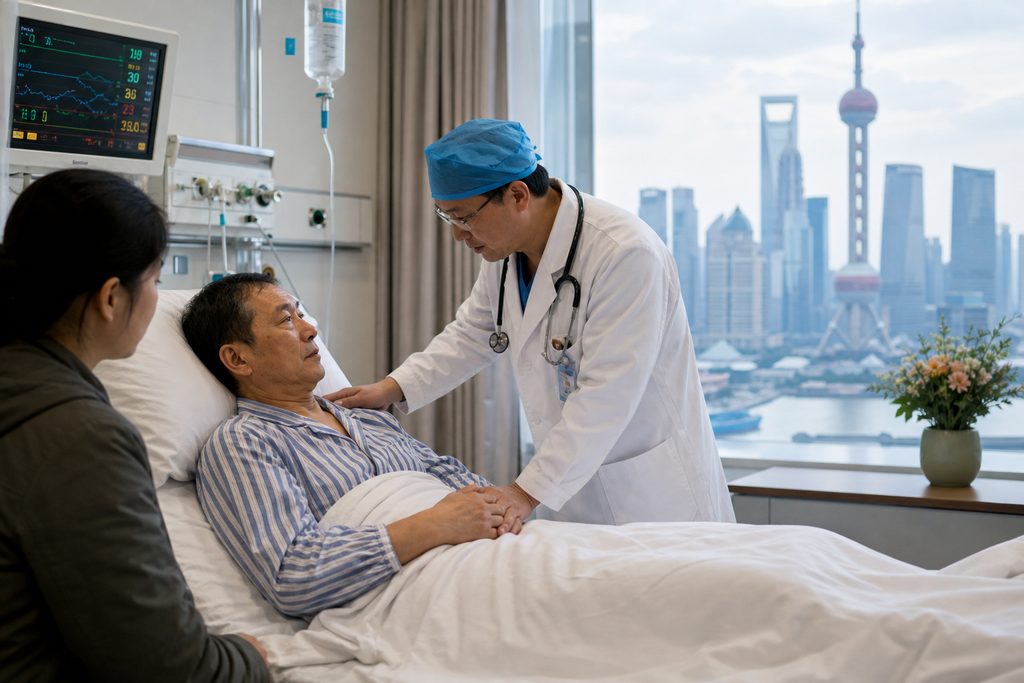
A patient in the UK waits a median of 62 days from urgent GP referral to first chemotherapy. In Canada, that figure stretches past 90 days in some provinces. At major Chinese oncology centers, once your case is accepted and documents are complete, first infusion often starts within 7 to 14 days. The gap is not about magic. It is about capacity, process, and how the system is built.
But getting to that point requires understanding how oncology care actually works in China for international patients. You cannot simply book a chemotherapy slot online like a hotel room. There are steps, documents, and decisions that determine whether your wait is one week or one month. This guide walks through the real sequence, the costs, the delays, and what you can reasonably expect.
How This Actually Works, Step by Step
The process starts before you ever board a plane. Here is the real sequence, from where you are now to first infusion.
First, you send your existing medical records. That means pathology reports, imaging results (CT, PET-CT, MRI), blood work, and any prior treatment summaries. If your documents are not in English or Chinese, they need certified translation. This step alone can take 2 to 4 days depending on volume and complexity.
Second, a Chinese oncology team reviews your case. For international patients, this usually happens through a hospital’s international department or a designated VIP channel. The team determines whether your diagnosis and proposed regimen match what they can offer, and whether additional staging tests are needed before treatment can begin. A written second opinion from a top-tier specialist typically costs $300–500 and takes 3 to 7 days. A video consultation with a senior oncologist runs $500–800 and can happen within 5 to 10 days of document receipt.
Third, you decide on a hospital and a pathway. Public hospital standard outpatient clinics cannot be pre-booked from overseas. You would need to appear in person, queue for registration, and see a doctor before any treatment is scheduled. For most international patients, the practical route is the hospital’s international medical center or VIP department. These channels allow pre-arranged appointments with senior specialists, English-speaking coordination, and faster scheduling. The cost is roughly 1.5 to 2 times the standard public rate — still far below Western private care.
Fourth, your visa. Medical treatment in China falls under the S2 visa category, with a note indicating the purpose of treatment. Family members accompanying you also apply for S2. Processing times vary by embassy, but plan for 2 to 4 weeks from application to issuance in most countries. Some embassies offer expedited processing for documented medical cases, but this is never guaranteed.
Fifth, you arrive, complete any required pre-treatment tests, and begin chemotherapy. Depending on the hospital and your clinical status, the gap between arrival and first infusion is usually 3 to 10 days. That includes registration, payment deposit, port placement if needed, and final regimen confirmation.
Chemotherapy Cost China: What You Actually Pay
The chemotherapy cost China question is the first thing most patients ask. The honest answer: it depends heavily on the drug regimen, the hospital tier, and whether you go through the standard or international channel.
For generic, well-established regimens using drugs like paclitaxel, cisplatin, 5-FU, or cyclophosphamide, a single cycle at a top public hospital’s international department typically ranges from $1,500 to $4,000. That includes drug costs, administration, monitoring, and basic supportive care. At a private international hospital in Shanghai or Beijing, the same cycle might run $4,000 to $8,000.
Targeted therapies and immunotherapies change the math completely. Drugs like trastuzumab, rituximab, bevacizumab, or PD-1 inhibitors can add $2,000 to $6,000 per cycle depending on dose and brand. Many of these drugs are now manufactured in China under domestic brands, which has driven prices down by 40–70% compared to Western list prices. A PD-1 inhibitor cycle that costs $8,000 in the US often costs $2,000 to $3,500 in China.
Compared to the UK, where NHS care is free at point of use but wait times are long, the question “is chemotherapy in China cheaper than UK” has a nuanced answer. For UK patients going private, yes — Chinese care is typically 50–70% cheaper than private oncology in London. For NHS patients, the cost comparison is irrelevant; the real variable is time. For US patients, the savings are stark: a full course of standard adjuvant chemotherapy that costs $45,000–70,000 in the US often totals $12,000–25,000 in China, including international department fees.
Here is a reference table for common scenarios:
| Scenario | China (International Dept, per cycle) | US (Private, per cycle) | UK (Private, per cycle) |
|---|---|---|---|
| Standard adjuvant chemo (breast/colon) | $1,800–3,500 | $6,000–12,000 | $4,500–8,000 |
| Targeted therapy add-on | $1,500–4,000 | $5,000–10,000 | $4,000–7,500 |
| Immunotherapy (PD-1/PD-L1) | $2,000–3,500 | $8,000–14,000 | $6,000–10,000 |
| Supportive care package (per cycle) | $300–800 | $1,500–3,000 | $1,000–2,000 |
These are ranges, not quotes. Final pricing depends on your exact regimen, body surface area, hospital, and whether complications arise. Always request a written treatment plan with itemized costs before committing.
A Realistic Timeline
People underestimate the pre-treatment phase. Here is what a realistic timeline looks like for an international patient seeking chemotherapy in China, assuming no major clinical surprises.
| Stage | Duration | What Happens |
|---|---|---|
| Document collection & translation | 2–7 days | You gather pathology, imaging, blood work. Translation into Chinese if required. |
| Remote specialist review | 3–10 days | Written second opinion or video consultation. The oncology team confirms treatment feasibility. |
| Hospital selection & coordination | 3–14 days | You choose a hospital. International department confirms acceptance and provides a treatment plan and cost estimate. |
| Visa application (S2) | 10–28 days | Embassy processing. Faster with complete hospital invitation documents. |
| Arrival & pre-treatment tests | 2–7 days | Registration, deposit payment, blood work, ECG, possible port placement, final regimen confirmation. |
| First chemotherapy infusion | Day 1 of treatment | Usually within 3–10 days of arrival. |
Total realistic time from first contact to first infusion: 3 to 8 weeks. The fastest cases — complete documents, straightforward regimen, efficient visa processing — can be done in under 3 weeks. Complex cases requiring additional staging or molecular testing will take longer.
And here is the part most people forget: the waiting step they did not plan for is document translation. A pathology report in German or Arabic needs certified medical translation before any Chinese oncologist will review it. Budget 2–5 days for that alone.
What Can Go Wrong — and What Happens Then
This is where honesty matters. Things do go wrong. Here are the common failure modes and what recourse you actually have.
Your case is not accepted for treatment. Not every patient is a candidate for travel. If your disease has progressed significantly, if you are too frail for long-haul travel, or if the proposed regimen is not available in China, the oncology team may decline. What happens then: you receive a written explanation and, in most cases, alternative suggestions. A remote consultation fee is not refunded for a negative decision — the specialist’s time was spent reviewing your case. But you avoid the far greater cost of flying to China only to be turned away.
The visa is delayed. S2 visa processing times fluctuate. Some embassies take 4 weeks or more. What happens then: your hospital appointment may need to be rescheduled. The international department usually holds your file and rebooks when your visa is issued. You lose time, not money — most coordination fees are not charged until the appointment is confirmed.
Pre-treatment tests reveal a problem. Sometimes the staging in China shows disease progression that changes the treatment plan. What happens then: the regimen is adjusted. You may need additional cycles, a different drug, or a shift from curative to palliative intent. This is not a failure of the system — it is the system working correctly. But it can extend your stay and increase costs.
You cannot tolerate the travel. Long-haul flights are hard on cancer patients. Some patients arrive and are too weak to begin treatment immediately. What happens then: the hospital admits you for supportive care first — hydration, nutrition, pain management — before chemotherapy starts. This adds days and cost but is sometimes clinically necessary.
None of these are reasons to avoid the path. They are reasons to plan with margin, carry complete documents, and work with a coordinator who knows the system.
How Long to Start Chemo in China: What the Numbers Mean
The question how long to start chemo in China is really two questions. How long does the system take once you are in it? And how long does it take to get into the system?
The first answer is short: 3 to 10 days from arrival to first infusion at a major center. That assumes your case was pre-reviewed, your regimen was confirmed remotely, and your pre-treatment tests are uncomplicated. The second answer is longer: 3 to 8 weeks from first contact, because of document review, hospital coordination, and visa processing.
For patients seeking fast track oncology treatment China, the realistic path is the international department route. Standard public outpatient clinics do not offer overseas pre-booking. You cannot email a public hospital and reserve a chemotherapy chair. The international department is not a “skip the line” trick — it is a separate, staffed channel designed for patients who need pre-arranged care, English coordination, and consolidated scheduling. You pay more for it. In exchange, you get a defined timeline instead of an open-ended queue.
The best cancer hospital Shanghai waiting time question deserves a specific answer. Fudan University Shanghai Cancer Center and Zhongshan Hospital are the two most recognized oncology centers in Shanghai. Through their international departments, first consultation can usually be arranged within 5 to 14 days of document acceptance. Chemotherapy initiation follows within a week of arrival if the case is straightforward. Standard public clinic waits are longer and require in-person registration.
What do the numbers actually mean for you? They mean the bottleneck is rarely the hospital. It is your documents, your visa, and your own decision-making speed. Patients who move quickly through the early steps get treated quickly. Patients who hesitate at each stage add weeks to their own timeline.
Practical Considerations: Records, Visa, Payment, and Follow-Up
Compared to private UK oncology care, yes — typically 50–70% less. Compared to NHS care, the cost is not the point; NHS treatment is free but wait times are longer. For UK patients facing a multi-month NHS queue, paying out of pocket in China can mean starting treatment months earlier at a total cost that is still manageable for many families.
This is a real risk, and it is why remote review happens first. If the Chinese team sees evidence of rapid progression, they may recommend against travel or suggest a modified approach. Some patients are better served by starting treatment at home immediately and considering China only for second-line therapy or clinical trials. A remote consultation helps you make that call before spending time and money on travel.
You need an S2 visa, which covers short-term private affairs including medical treatment. Your accompanying family members also apply for S2. The hospital provides supporting documents. Processing time varies by country. There is no special “medical visa” category — S2 is the applicable short-stay visa for this purpose.
Your treating hospital provides emergency contact information and usually has a 24-hour line for international patients. For severe complications like febrile neutropenia, you go to the hospital’s emergency department — the international department coordinates admission. Travel insurance with medical evacuation coverage is strongly recommended for any patient traveling for cancer care.
Your Next Step
The core message: chemotherapy in China is faster and less expensive than most Western patients expect, but only if you enter through the right channel with the right documents. The international department route is not a luxury — it is the practical mechanism that makes overseas treatment possible at all.
We help international patients navigate this process — from document review and hospital matching to appointment coordination and bilingual medical support on the ground. We do not provide medical advice or guarantee treatment outcomes. What we do is reduce the friction between you and a Chinese oncology team. If you are considering chemotherapy in China, start with a free consultation to understand your options.
Frequently Asked Questions
Yes. The hospitals used for international patients are JCI-accredited and follow the same international safety standards as top hospitals in the US and Europe. Surgical teams perform high volumes of procedures — often more than their Western counterparts — which studies show leads to better outcomes.
Costs vary by procedure and hospital, but international patients typically save 40-80% compared to US prices — even when factoring in travel and accommodation. A consultation with our team will give you an exact, all-inclusive quote with no hidden fees.
Send us your existing medical reports to get started. We handle everything from hospital selection and appointment scheduling to visa assistance and post-operative recovery planning. Your medical records are reviewed by the specialist before you even book a flight.
For more medical information and treatment options in China, visit chinamedservices.com (China Medical Services).
