Childcare Support During Your Hospital Stay in China: Babysitting and Activity Services
Key Takeaways
- Several top-tier private hospitals in China offer integrated childcare services, with prices typically starting from $15–25 per hour for a professional babysitter.
- China’s best international hospitals feature dedicated children’s play areas and activity coordinators, making a family-centered medical trip logistically possible.
- Public hospitals rarely provide any childcare support; navigating a large Chinese public hospital with a child without a bilingual assistant is incredibly difficult.
- Always verify a caregiver’s qualifications, background checks, and language capabilities independently before your procedure, as standards vary significantly between facilities.
The Problem: When Medical Necessity Collides with Parental Responsibility
When 34-year-old Sarah from London scheduled her orthopedic surgery in Shanghai, her spreadsheet was meticulous. She had the hospital’s international department contact, a detailed cost breakdown, and her S2 visa approved. One variable nearly derailed everything: her four-year-old son, Leo. Her husband could only take one week off work. That left a critical 48-hour window where she would be in surgery and early recovery, and her child would need constant supervision in a foreign country where they knew no one. Sarah is not alone. Approximately 1 in 8 international patients traveling for treatment are parents of young children, according to internal inquiries fielded by our coordination team. The question is universal: what support is there for children during hospital stay abroad?
The anxiety is not just logistical. It is visceral. The thought of a child sitting in a hospital room for hours, or being cared for by a stranger in an unfamiliar environment, can cause patients to postpone essential procedures. The good news is that the Chinese medical tourism infrastructure has evolved rapidly to address this exact pain point.
Who We Are
Our team at China Medical Services is not a healthcare provider. We do not treat patients or offer clinical diagnoses. We are your logistical architects on the ground, connecting international patients with the right resources within our network of 340+ top-ranked hospitals across 37 cities. We handle the friction points—from visa guidance to bilingual medical companions—so you can focus on recovery. When it comes to childcare, we bridge the gap between your family’s needs and the hospital’s facilities, ensuring you know exactly what to expect before you board the plane.
Can I Bring My Child to a Hospital in China? Understanding the Landscape
The short answer is yes, but the experience diverges sharply depending on where you go. Asking “can I bring my child to hospital in China” is the right question, but the answer depends entirely on choosing the right facility. China’s healthcare system is a tale of two worlds: the massive, high-volume public institutions and the boutique, Western-style international clinics.
A standard public Grade A tertiary hospital in Beijing might see over 10,000 outpatient visits daily. Corridors are crowded. Waiting areas are standing-room only. There is no concept of a “kids play area” in these environments. Bringing a child into this setting without a dedicated minder is stressful for the parent and potentially unsafe for the child. You will be navigating a sea of people while trying to manage a stroller, often with signage exclusively in Chinese characters.
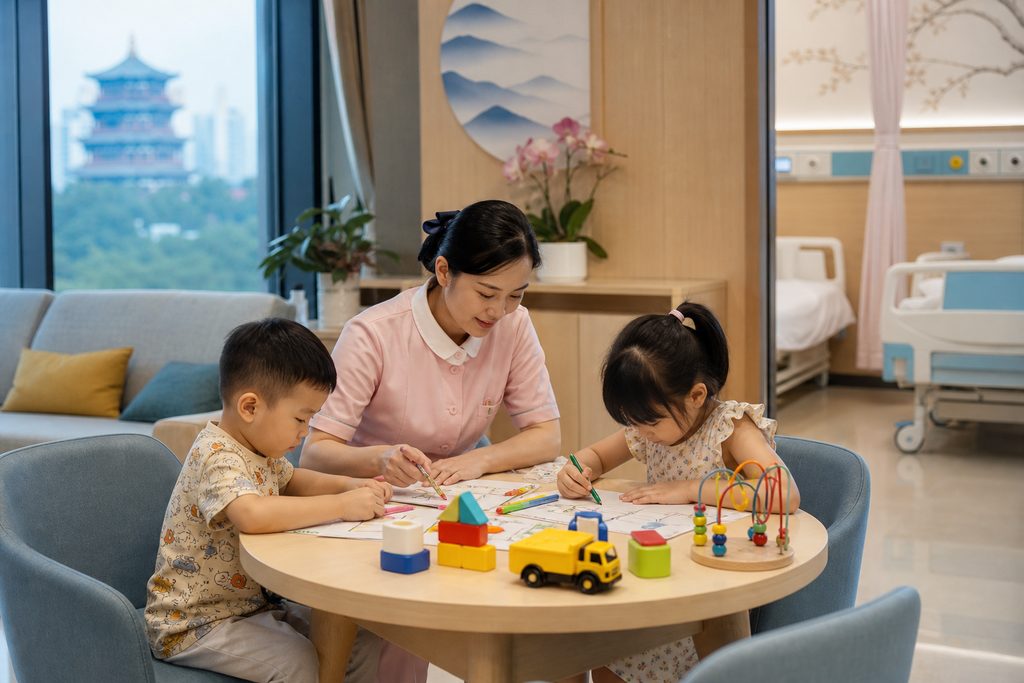
Contrast this with the private international wing. These facilities operate on a fundamentally different model. They anticipate the needs of accompanying families. You will find dedicated pediatric waiting zones, playrooms with toys and books, and, critically, access to vetted childcare providers. The difference is not just comfort; it is clinical safety. A calm, supervised child means a less stressed patient, which contributes to a smoother recovery trajectory.
What Support Is There for Children During a Hospital Stay Abroad?
When we break down “what support is there for children during hospital stay abroad,” we look at three distinct layers: the physical environment, the professional staffing, and the activity programming. China’s top international hospitals have invested heavily in all three.
The Physical Space: Best Hospitals in Beijing with Kids Play Area
If you are searching for the “best hospitals in Beijing with kids play area,” your list will be dominated by JCI-accredited private brands. Beijing United Family Hospital, for instance, designs its family medicine and inpatient floors with dedicated playrooms. These are not just a corner with a few blocks. They are spacious, sanitized environments with climbing structures, art supplies, and age-appropriate media. Shanghai’s Jiahui International Hospital features a similar setup, with large windows and natural light to reduce the institutional feel.
These spaces serve a dual purpose. They give children a safe place to expend energy. They also signal to the parent that the institution respects the family unit, not just the patient. This psychological safety net is a critical component of the medical tourism childcare package Shanghai facilities have developed. Guangzhou‘s Clifford Hospital, while a hybrid model, also maintains a dedicated international wing with a smaller but functional children’s corner. The key is to confirm square footage and supervision policies before booking; a room with toys but no supervision is not a childcare solution.
Professional Staffing: Hospital with Babysitter for International Patients China
A physical playroom is only as good as the adult watching the child. The search for a “hospital with babysitter for international patients China” usually leads to two models: hospital-employed activity coordinators and third-party vetted nannies.
Hospital-employed coordinators are common in the VIP wards of United Family and Raffles Medical Group facilities. They are trained in basic pediatric first aid and CPR. Their English proficiency is generally high, as they interact with a diverse expatriate and medical tourist population daily. They cannot typically leave the hospital premises with your child, but they can engage them for several hours within the safe confines of the pediatric floor.
The second model involves a third-party caregiver. Some hospitals maintain a roster of background-checked, English-speaking nannies who can be booked for in-room care. This is particularly useful for patients on bed rest who need the child close by. The caregiver can read stories, manage meals, and escort the child to the playroom, giving the recovering parent true rest. We always advise families to request documentation of background checks and to conduct a video interview with the caregiver before the medical trip begins.
Childcare Service Hospital China Price: A Transparent Breakdown
Let’s address the budget. The “childcare service hospital China price” varies based on the facility tier, the caregiver’s qualifications, and the duration of care. Here is a realistic snapshot of what you can expect to budget, based on current rates at private international hospitals in major cities.
| Service Type | Provider Example | Price Range (USD) | Notes |
|---|---|---|---|
| Hospital Playroom Supervision | In-house Activity Coordinator | $15 – $25 per hour | Child remains in the hospital’s designated pediatric zone. Minimum 2-hour booking. |
| Private In-Room Babysitting | Vetted Third-Party Nanny | $20 – $35 per hour | Caregiver stays in your private suite. Often requires 24-hour advance booking. |
| Full-Day Childcare Package (8 hrs) | Medical Tourism Childcare Package Shanghai | $150 – $250 per day | Bundled rate. May include meals and structured activities. Available at Jiahui and United Family. |
| Bilingual Medical Companion (Family Focus) | China Medical Services Coordination | from $200 per day | Not a nanny, but a logistics expert who can help a family member manage the child during hospital navigation. |
These figures are “from” prices. Final costs depend on the specific hospital and the complexity of your case. A child with special needs requiring a medically trained sitter will fall at the higher end of the spectrum. Always confirm whether meals, materials, and gratuity are included in the quoted rate.
Why are these costs structurally lower than in Western private hospitals? The labor economics of China allow hospitals to staff these positions at a rate that, while premium for the local market, remains accessible for international patients. A similar service in a private London or New York hospital can easily run $50–$80 per hour. The cost advantage does not reflect a compromise in safety standards at JCI-accredited facilities; it reflects the broader economic context.
Crafting a Medical Tourism Childcare Package Shanghai: What to Ask For
When negotiating a “medical tourism childcare package Shanghai,” do not accept vague promises. Demand specifics. A proper package should delineate the ratio of caregivers to children. For toddlers, a 1:1 ratio is non-negotiable. For school-aged children, a 1:3 ratio can work in a supervised playroom setting.
Ask about the physical boundaries. Is the caregiver permitted to take the child to the hospital garden or cafeteria? Are there off-limit zones? Clarify the communication protocol. The best packages include a check-in system—a text update every hour with a photo of your child engaged in an activity. This simple measure transforms the recovery experience. Instead of worrying, you rest.
Also, investigate the activity curriculum. Shanghai’s international hospitals often employ teachers or child-life specialists, not just babysitters. They run structured sessions: Mandarin calligraphy, origami, or basic Chinese language games. Your child leaves the hospital not just cared for, but culturally enriched. This turns a potential source of stress into a unique educational opportunity.
What You Need to Know Before Going Alone
Attempting to arrange childcare independently in China presents real barriers. We believe in total transparency about these challenges, because understanding them highlights the value of a coordinated approach.
- Language Verification: A local agency might claim their nanny speaks English, but the reality can be a handful of memorized phrases. In a medical context, you need a caregiver who can understand instructions like “he has a nut allergy” or “she needs her inhaler at 2 PM.” Without a trusted intermediary to vet language skills, you are gambling.
- Background Screening Standards: China’s private childcare industry is maturing, but screening standards are not uniform. A hospital-vetted roster involves criminal background checks and health screenings. A freelance nanny found on a local app may not have undergone any scrutiny. Knowing the difference is critical.
- Payment and Liability: Independent caregivers often require cash payment in RMB. They rarely carry professional liability insurance. Hospital-employed coordinators are covered under the institution’s umbrella policy. If an accident happens, this distinction matters enormously.
How We Help You Navigate This
These barriers exist for structural reasons, but they are not insurmountable. Our role is to de-risk the childcare component of your medical trip. We do this by connecting you exclusively with the international patient centers that have formalized childcare protocols.
Before you travel, we confirm the childcare roster for your specific dates. We facilitate the video interview with the proposed caregiver. We clarify the billing structure so there are no surprises. During your stay, if you have also engaged our bilingual medical companion service, that professional can serve as a bridge—helping the caregiver understand your child’s routine while you are in surgery. After discharge, if you require a nanny for the remainder of your recovery in a serviced apartment, we can extend the arrangement through our network.
The goal is continuity. Your child sees a familiar face. You maintain peace of mind. The logistical seams are invisible.
Frequently Asked Questions
This depends on the hospital’s specific ward rules. In most private international suites, a fold-out sofa is provided for one family member or caregiver. You must register the caregiver as your designated companion upon admission. Overnight stays by third-party nannies typically incur a surcharge of 20-30% on the hourly rate. Always confirm this policy with the hospital’s international patient liaison before finalizing the childcare service hospital China price.
This is a scenario we plan for explicitly. If the child develops a fever or requires medical attention, the hospital’s pediatric department is on the same campus. The caregiver’s protocol is to immediately take the child to the pediatric ER, where international insurance is accepted. We ensure the hospital has your signed consent form on file, authorizing emergency treatment for your child in your temporary absence. This is a non-negotiable part of our pre-departure checklist.
Teenagers require a different approach. While they do not need a “babysitter,” they do need supervision and engagement in an unfamiliar city. We can arrange a bilingual companion who acts more like a cultural guide—taking a teenager to nearby museums, historical sites, or shopping districts while you are in treatment. This service is billed at the standard bilingual companion rate, from $200 per day, and keeps a restless teenager constructively occupied rather than bored in a hospital room.
We strongly advise against this. Public hospital wards in China are shared spaces with no room for a nanny to sit. The noise level and crowding make it a distressing environment for a child. Furthermore, a freelance nanny has no institutional accountability. If they fail to show up on the day of your surgery, you have no recourse. The slightly higher cost of a private international hospital with an in-house childcare program buys you reliability and safety. It is the one line item we urge families not to cut.
Your Next Step
Bringing a child on a medical trip to China is not a complication to be feared. It is a logistics challenge to be solved. With the right hospital selection and a clearly defined childcare support plan, your procedure can coexist with your responsibilities as a parent. The hospitals exist. The vetted caregivers exist. The playrooms are ready. You simply need a team that can connect those dots before you arrive.
If you are evaluating your options and want to understand which facilities in Shanghai or Beijing have immediate childcare availability for your dates, our coordinators can provide a shortlist. Visit our patient coordination page to start a conversation. There is no cost for the initial consultation, and no obligation—just clarity on how to make your treatment timeline work for your whole family.
For more medical information and treatment options in China, visit chinamedservices.com (China Medical Services).
