Sir Run Run Shaw Hospital Hangzhou: Western-Managed Academic Hospital International Care
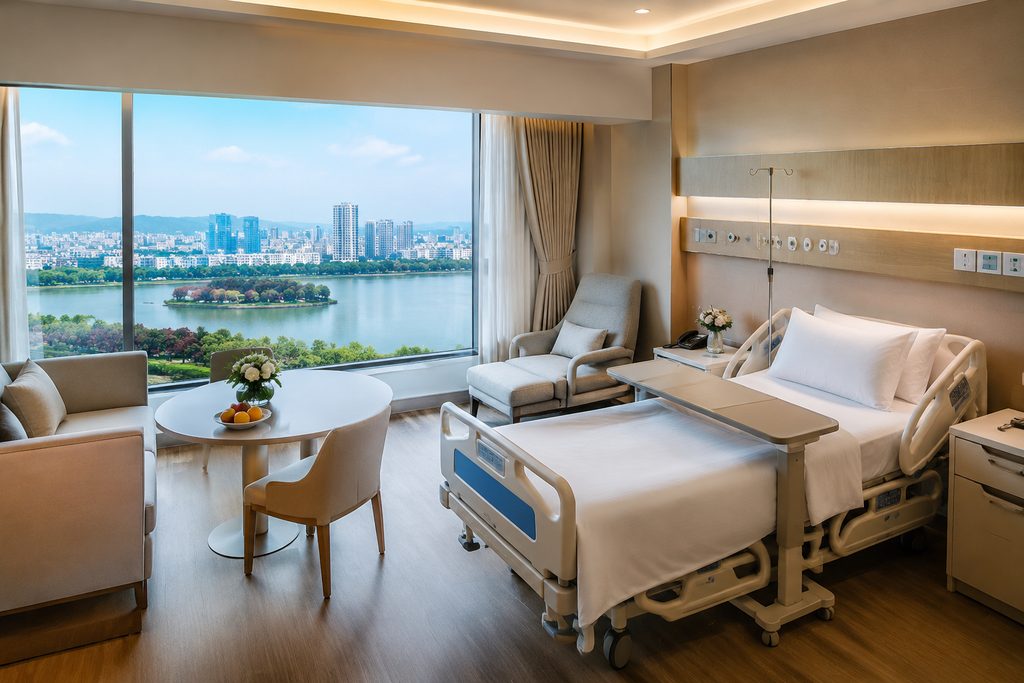
Walking into a Chinese public hospital can feel like stepping into a city. The sheer scale hits you first. Thousands of people, a wall of indecipherable characters, and a registration system that runs on local apps. For a foreigner, it is overwhelming. But there is an exception in Hangzhou. A hospital modeled on an entirely different philosophy. Sir Run Run Shaw Hospital (SRRSH), affiliated with Zhejiang University’s medical school, operates under a mandate you will not find anywhere else in China’s public system: it is contractually managed according to Western medical standards and administrative protocols. Its founding partnership with Loma Linda University in California was not a branding exercise. It created a structural DNA that persists decades later. The Sir Run Run Shaw Hospital international patient price reflects this hybrid identity—public infrastructure, private-university rigor, and a dedicated international care pathway.
Key Takeaways
- SRRSH is one of China’s few public hospitals founded on a Western management charter, maintaining JCI accreditation and English-language operational standards.
- International patient pricing at SRRSH is transparent and sits between standard public fees and private international hospital rates—typically 1.5 to 2 times the local cost for VIP/international wing access.
- The hospital’s international medical center handles everything from appointment booking to discharge summaries in English, but it cannot bypass the mandatory in-person consultation requirement before any surgery.
- Hangzhou’s medical tourism infrastructure is maturing but still fragmented; independent patients face real friction with payment systems, visa documentation, and post-discharge follow-up without a coordinator.
The Problem: Western-Managed Care Is Rare in China’s Public System
China has over 35,000 hospitals. Only a tiny fraction hold active JCI accreditation. Fewer still were founded with a governance structure that embeds Western clinical and administrative standards into their bylaws. Most international patients assume they must choose between two extremes: a local public hospital with strong clinical volume but zero language support, or a private international hospital with English-speaking staff and eye-watering prices. Sir Run Run Shaw Hospital breaks that binary. It is a public, university-affiliated hospital with a statutory commitment to operate like a Western academic medical center. The distinction matters because it changes how physicians communicate, how medical records are kept, and how international patients are processed.
Many Western patients researching a Western managed hospital Hangzhou cost are surprised to learn that SRRSH’s international wing charges fees that are higher than standard public rates but significantly lower than comparable care at private international chains. A consultation with a senior specialist through the international center might run $150 to $300 USD. An inpatient surgical procedure, depending on complexity, could range from $8,000 to $25,000 USD. These are not bargain-basement numbers. But they are structurally lower than equivalent care in Singapore, Hong Kong, or the United States. The hospital’s public funding base keeps its cost floor anchored, while the international surcharge covers dedicated English coordination, private inpatient rooms, and expedited access to senior faculty.
Who We Are
We are not a hospital. We do not provide medical treatment, clinical diagnoses, or second opinions. Our team at China Medical Services functions as your logistical architects—we bridge the gap between you and China’s top-tier medical institutions, including Sir Run Run Shaw Hospital. We handle the architecture of your medical journey: hospital matching based on your clinical needs, appointment coordination through official international departments, bilingual medical companion services on the ground, and visa guidance for S2 medical visas. We work within the system’s rules. We do not sell access. We sell expertise, translation, and the kind of local knowledge that prevents a miscommunication from becoming a medical error. For patients considering medical tourism packages Hangzhou academic hospital, we design the non-clinical framework so you can focus entirely on your treatment and recovery.
Why Sir Run Run Shaw Hospital Delivers for International Patients
Clinical Volume That Drives Surgical Precision
SRRSH handles over 2.5 million outpatient visits and more than 80,000 inpatient admissions annually. Its surgical teams perform roughly 60,000 operations per year. These are not abstract statistics. For a patient, they translate into a simple reality: the surgeon assigned to your case has likely performed your procedure hundreds or thousands of times. A knee replacement is not an annual event for an SRRSH orthopedist. It is a Tuesday. And then another one on Wednesday. This volume-driven proficiency is one reason international patients seek out the hospital for complex procedures like minimally invasive cardiac surgery, laparoscopic cancer resections, and robotic-assisted urological surgery.
But volume alone is not enough. Plenty of Chinese hospitals have staggering numbers. What separates SRRSH is the clinical governance overlay inherited from its Loma Linda partnership. Multidisciplinary team meetings are standard, not exceptional. Medical records in the international center are maintained in bilingual format. Physicians who staff the international wing are selected not only for clinical seniority but for communication style—they expect to explain treatment rationales, discuss alternatives, and answer questions in English. When a patient asks if Sir Run Run Shaw Hospital is good for foreigners, the answer rests on this combination: high procedural volume plus a communication culture that was deliberately built, not retrofitted.
A JCI-Accredited Infrastructure with Western Roots
SRRSH first earned JCI accreditation in 2006 and has maintained it through successive recertification cycles. JCI is not a rubber stamp. It audits everything: medication safety protocols, surgical timeout procedures, infection control metrics, patient identification systems, and the readability of discharge instructions. For a hospital to hold JCI status for nearly two decades, it must embed these standards into daily operations, not just prepare for inspection visits. The hospital’s founding charter with Loma Linda University Medical Center established this orientation from day one. Loma Linda physicians and administrators were embedded in SRRSH’s early leadership, and the hospital’s internal policies were drafted to mirror a US academic medical center’s structure.
This heritage shows up in small but meaningful ways. Nurses in the international ward use SBAR (Situation-Background-Assessment-Recommendation) communication when handing off patients between shifts. Informed consent forms explain risks and alternatives in plain language. Pharmacy staff reconcile medications on admission and discharge. These are standard practices in a good Western hospital. They are not standard across China’s public system. That gap explains why the JCI accredited hospital Hangzhou international medical services search leads so consistently to SRRSH. It is not the only JCI hospital in Hangzhou, but it is the one where accreditation reflects a founding philosophy rather than a compliance exercise.
Cost Structure That Makes Sense on a Spreadsheet
Let us put numbers on the table. A coronary artery bypass graft at a top US academic hospital costs $120,000 to $200,000 USD. The same procedure at a private hospital in Singapore runs $40,000 to $60,000 USD. At SRRSH’s international center, it falls between $15,000 and $25,000 USD. A total hip replacement: $40,000 to $70,000 in the US, $18,000 to $30,000 in Singapore, and $8,000 to $15,000 at SRRSH. These are real, verified ranges. They are not promises for any individual case. Your final Sir Run Run Shaw Hospital international patient price depends on your specific diagnosis, the seniority of your surgical team, your choice of private room tier, and the length of your inpatient stay. But the structural differential is real and persistent.
Why are costs lower? Not because of compromised quality. The drivers are economic: lower physician labor costs, lower facility overhead, and a public hospital’s mission-driven pricing for core services. The international surcharge you pay covers the coordination layer—English-speaking case managers, private accommodations, expedited imaging and lab turnaround, and the administrative work of preparing discharge summaries and billing statements formatted for international insurers. You are paying for access infrastructure, not for the clinical expertise itself. That expertise is already there, funded by the hospital’s public mission and its enormous domestic patient volume.
What You Need to Know Before Going Alone
Yes, with a qualification. It is arguably the best-structured public hospital in mainland China for English-speaking patients. The international center physicians communicate in English. Nursing staff on the international ward have at least basic English competency. Medical records are bilingual. The hospital’s administrative culture, shaped by its Loma Linda heritage, is more consultative and patient-facing than a typical Chinese public hospital. But it is still a Chinese hospital. The food is Chinese. The nursing model expects family members to assist with certain aspects of bedside care. Cultural expectations around privacy and personal space differ. If you arrive expecting a replica of a US or UK private hospital, you will notice the gaps. If you arrive understanding that you are accessing high-volume clinical expertise in a setting that has been deliberately adapted for international patients, you will find the experience smooth and reassuring.
SRRSH carries the full clinical infrastructure of a major academic medical center. It has a 24-hour emergency department, intensive care units staffed by critical care specialists, and rapid-response teams for in-hospital emergencies. The international center has protocols for escalating complications and communicating with family members in English. From a medico-legal standpoint, the hospital operates under Chinese law, and international patients sign consent forms that acknowledge this jurisdiction. We strongly recommend that every patient carry medical travel insurance that explicitly covers treatment in China and includes provisions for medical evacuation if needed. We can advise on policy selection, but we are not insurers. Our role in a complication scenario is communication and logistics—ensuring your family is informed, facilitating discussions with the care team, and coordinating any necessary transfers or extended stays.
The term “medical tourism package” is used loosely. Some agencies sell pre-bundled deals that include a specific procedure, hotel stay, airport transfers, and sightseeing excursions. SRRSH itself does not sell packages. The hospital provides clinical care. Everything around it—accommodation, transport, visa support, translation—must be arranged separately or through a coordinator. Our approach is modular rather than packaged. We build a coordination plan around your specific treatment timeline and preferences. You are not buying a one-size-fits-all bundle. You are paying for the specific services you need, whether that is a single day of bilingual companion support or a full end-to-end coordination spanning visa, appointments, admission, and post-discharge follow-up. For patients researching medical tourism packages Hangzhou academic hospital, the key is to separate the clinical component from the logistics component and ensure both are handled by reputable, accountable providers.
Your Next Step
Sir Run Run Shaw Hospital represents a genuine third option for international patients considering care in China. It is neither a chaotic public hospital nor a high-priced private clinic. It is a public academic center that was built from the ground up to think and operate like a Western hospital. The Sir Run Run Shaw Hospital international patient price reflects that hybrid model—more than local rates, less than private international alternatives, and backed by clinical volumes that few Western centers can match. The question is not whether the hospital is capable. It is whether you have the logistical support to access it smoothly. If you want to explore whether SRRSH is the right fit for your clinical needs, our free consultation is the place to start. No pressure. No pitch. Just an honest conversation about your options.
Frequently Asked Questions
Yes. We work with JCI-accredited and major Grade 3A tertiary hospitals that follow international safety standards comparable to top hospitals in the US and Europe. Surgical teams perform high volumes of procedures — often more than their Western counterparts — which studies show leads to better outcomes.
Costs vary by procedure and hospital, but international patients typically save 40-80% compared to US prices — even when factoring in travel and accommodation. A consultation with our team will give you an exact, all-inclusive quote with no hidden fees.
Send us your existing medical reports. The relevant specialty reviews them and gives you a written opinion, including treatment direction and options, before you commit to any travel. From there you can add a video consultation with the doctor, or have us attend an appointment on your behalf.
For more medical information and treatment options in China, visit chinamedservices.com (China Medical Services).
