Corporate Health Checkups in China: Exact Costs, Packages & How to Book
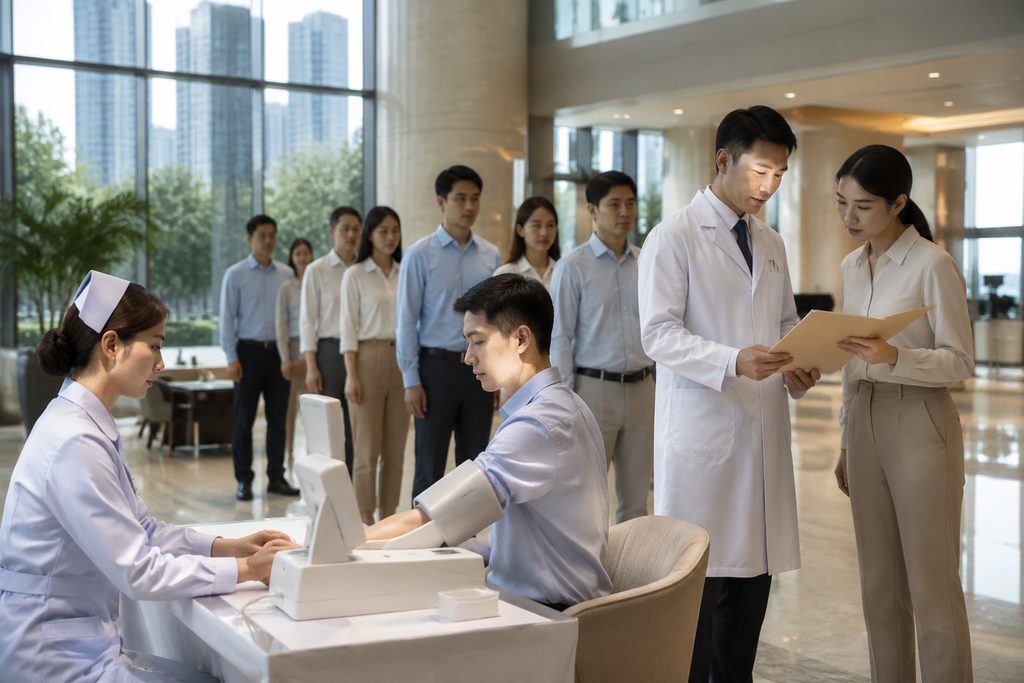
You have probably heard that corporate health screening in China is either a cheap, cursory assembly line or an overpriced luxury gimmick for expatriates. The truth sits somewhere far more practical. A well-structured executive physical in Shanghai or Beijing delivers imaging, blood panels, and specialist reviews that would cost four to eight times more in the United States — often completed in half a day. The challenge is not whether the medical infrastructure exists. It is whether you know which package to choose, what the real corporate health checkup packages China price range looks like, and how to avoid paying for redundant tests. Our team coordinates these bookings weekly for foreign companies and individual executives. We see what works.
Key Takeaways
- Executive health screening packages at top-tier Chinese hospitals typically range from $250 to $1,800 depending on depth, imaging included, and hospital tier.
- Private international hospitals in Shanghai and Beijing offer English-speaking staff and direct insurance billing, but charge 2–3 times more than public hospital VIP departments for similar panels.
- A full-body employee checkup in China usually takes 3–5 hours on-site, with results delivered within 3–7 working days.
- Language barriers and booking logistics are the biggest friction points — not medical quality — for foreign nationals using public hospital executive centers.
The Problem: Employee Health Screening in Western Markets Is Slow and Expensive
In the United States, a comprehensive executive physical at a reputable institution like the Mayo Clinic or Cleveland Clinic runs between $3,000 and $10,000. Booking windows stretch four to six months. In the United Kingdom, private health assessments at BUPA or Nuffield Health start around £600 for a basic screen, while advanced imaging packages push past £2,500. Most corporate plans cover only a fraction of these costs.
That leaves HR directors and expatriate managers with a dilemma. Fly key staff home for screening? Disruptive and expensive. Skip the checkup? Risky for senior employees with undiagnosed cardiovascular or metabolic conditions. The alternative — booking a corporate health checkup in China — remains underused because most foreign companies simply do not know the price structure or the booking pathway.
China now operates over 35,000 hospitals. The top tier — roughly 5% — includes public grade-A tertiary hospitals ranked by Fudan University and private facilities accredited by JCI. Many of these run dedicated executive health centers designed for high-volume, same-day screening. The economics are different. So is the workflow.
Why Corporate Health Checkup Packages in China Deliver Real Value
Clinical Volume Drives Efficiency and Diagnostic Familiarity
A single top-tier hospital in Shanghai may process 10,000 outpatient visits per day. The executive screening centers within these hospitals are built for throughput without sacrificing diagnostic rigor. Radiologists at Fuwai Hospital, for example, read cardiac imaging at volumes unmatched anywhere in the Western world — the hospital performs over 14,000 cardiac surgeries annually. That pattern repeats across specialties. A radiologist who has reviewed 50,000 chest CT scans sees subtle nodules that a lower-volume reader might dismiss.
This volume translates into operational speed. Blood draws, ultrasound, CT, and specialist consultations happen on a defined route within one building. You are not scheduling five separate appointments across three weeks. You arrive at 7:30 AM and leave before lunch.
Package Transparency Is Better Than Most Western Markets
Chinese executive health centers publish detailed package menus. A standard package lists every test: complete blood count, liver and kidney function panels, lipid profile, fasting glucose, HbA1c, tumor markers (AFP, CEA, CA19-9, PSA for men, CA-125 for women), thyroid function, chest X-ray or low-dose CT, abdominal ultrasound, ECG, and a physical examination by an internal medicine physician. Premium packages add cardiac ultrasound, carotid artery ultrasound, head MRI, coronary calcium scoring, gastroscopy, and colonoscopy.
You know exactly what you are buying. That is rarer than it should be.
Cost Advantage Without Quality Compromise
Why are corporate health checkup packages China price levels so much lower? Labor economics explain part of it. A senior radiologist in Shanghai earns a fraction of a comparable US specialist. Hospital construction and equipment amortization costs are also lower. But the bigger factor is volume. Chinese executive centers run hundreds of patients daily. Fixed costs spread thin. The result: a comprehensive executive screening with low-dose CT and full blood panels costs $400–$800 at a top public hospital VIP department. The same panel in the US costs $2,500–$5,000.
Lower cost does not mean lower quality. Fudan University’s hospital rankings evaluate clinical reputation, research output, and specialty strength. Many hospitals on that list also hold JCI accreditation — the same international standard used by leading hospitals in Singapore, Germany, and the US.
What a Full Body Checkup for Employees in China Actually Includes
Most corporate clients ask us the same question: what is the difference between a $300 package and a $1,500 package? The answer is imaging depth and specialist access.
| Package Tier | Typical Price Range (USD) | Core Tests Included | Imaging | Best For |
|---|---|---|---|---|
| Basic Employee Screen | $250–$450 | CBC, metabolic panel, lipid profile, liver/kidney function, urinalysis, ECG, chest X-ray, physical exam | X-ray, abdominal ultrasound | Annual screening for employees under 40 |
| Standard Executive | $450–$800 | All basic tests plus tumor markers, thyroid panel, HbA1c, vitamin D, inflammatory markers | Low-dose chest CT, abdominal ultrasound, thyroid ultrasound | Managers and staff over 40 |
| Premium Executive | $800–$1,800 | All standard tests plus cardiac ultrasound, carotid ultrasound, head MRI, coronary calcium score | CT, MRI, ultrasound suite | Senior executives, those with family history of heart disease or cancer |
Prices vary by hospital and case complexity. Private international hospitals such as United Family or Jiahui charge $1,200–$3,000 for comparable executive panels. The premium buys English-speaking physicians throughout, Western-style reporting, and direct insurance billing. Public hospital VIP departments offer similar medical quality at half the price — but you will need a bilingual coordinator or companion to navigate registration, payment, and result collection.
How Long Does a Company Health Screening Take in Beijing?
Plan for a half-day. Most executive centers in Beijing open at 7:00 AM. Fasting blood draws happen first. Then imaging. Then specialist consultations. A standard executive package at a hospital like Peking Union Medical College Hospital‘s international medical center takes 3–4 hours. Premium packages with gastroscopy or cardiac stress testing run 5–6 hours.
Results arrive in stages. Blood panels: 24–48 hours. Imaging reports: 3–5 working days. Full consolidated report with physician summary: 5–7 working days. Many hospitals now offer electronic delivery through WeChat or a patient portal, though English-language reporting varies. Private international hospitals always provide English reports. Public hospital VIP departments usually do, but confirm before booking.
Is Corporate Health Checkup in China Reliable?
The short answer: yes, at the right hospitals. The longer answer requires nuance. China’s hospital system spans enormous quality variance. A basic physical at a community clinic is not the same as an executive screen at a Fudan-ranked grade-A tertiary hospital. The Fudan hospital rankings — published annually by Fudan University’s Hospital Management Institute — cover 45 clinical specialties and the top 100 comprehensive hospitals. Hospitals on that list meet rigorous clinical reputation and research benchmarks.
Reliability also depends on what the package actually measures. Chinese executive panels are strong on metabolic, cardiovascular, and oncological screening. They are less focused on mental health assessments, sleep studies, or lifestyle coaching — areas where Western executive physicals invest more. If your employees need those services, you may need to supplement.
One more reliability factor: follow-up. A screening that finds an abnormality must connect to treatment. Top Chinese hospitals handle this well internally — an abnormal lung nodule on CT leads to a thoracic surgery referral within the same institution. Our team has seen this pathway work smoothly dozens of times. But it requires someone to coordinate the referral. Without Chinese language ability, that coordination is hard.
How to Book an Executive Medical Checkup Package in China
You cannot simply walk into a public hospital executive center and book a same-day package as a foreign national. The process requires advance arrangement, passport documentation, and often a deposit. Here is the realistic workflow:
Step 1: Choose the hospital tier. Public VIP department for cost efficiency. Private international hospital for language convenience and insurance direct billing. Our guide to Fudan-ranked top hospitals breaks down the strongest options by city.
Step 2: Select the package. Match the package depth to employee age, role, and family history. A 28-year-old junior employee does not need a coronary calcium score. A 55-year-old executive with a smoking history does.
Step 3: Confirm dates and fasting requirements. Most centers require 8–12 hours of fasting before blood work. Some premium packages require bowel preparation for colonoscopy. Confirm all instructions in writing before employees travel.
Step 4: Arrange on-the-ground support. If using a public hospital, book a bilingual medical companion. This person handles registration, queues, payment, and translation. Without this, a half-day screening can stretch into a frustrating full-day ordeal.
Step 5: Collect and interpret results. Ensure the hospital provides English reports. Schedule a follow-up video consultation if any results require specialist review. Our team coordinates bilingual companion services and appointment logistics for corporate groups and individual executives.
Practical Considerations: Visas, Payment, and Insurance for Corporate Screening
Foreign nationals coming to China specifically for medical screening use an S2 visa, which covers short-stay medical treatment and private affairs. The hospital issues an invitation letter and treatment confirmation document. Processing typically takes 5–10 working days at the nearest Chinese embassy or consulate. Requirements change, so verify current rules with the embassy before booking flights.
Payment is straightforward. Public hospital VIP departments accept cash, UnionPay, and major international credit cards. Private international hospitals accept all major cards and often bill insurers directly. If your company uses a global insurer like Cigna, Aetna, or Allianz, check whether the specific hospital has a direct billing agreement. Public hospital VIP departments generally require upfront payment with reimbursement claimed afterward.
One practical note: bring all prior medical records and imaging. Chinese physicians will want baseline comparisons. Digital copies on a USB drive or cloud folder work best. If employees take regular medications, bring a full list with generic names.
Frequently Asked Questions
Basic employee screens start around $250. Standard executive packages at top public hospital VIP departments run $450–$800. Premium packages with MRI and cardiac imaging reach $1,800. Private international hospitals charge $1,200–$3,000 for comparable panels. Final pricing varies by hospital and case complexity.
At Fudan-ranked grade-A tertiary hospitals, yes — often more thorough on imaging. Chinese executive centers routinely include low-dose chest CT and abdominal ultrasound in standard packages, tests that cost extra or require justification in Western markets. The main gaps are mental health screening and lifestyle coaching.
The hospital will recommend follow-up testing or specialist referral, usually within the same institution. For foreign nationals, this can lead to treatment in China or a referral back to a home-country specialist. You retain full control. No one is obligated to proceed with treatment at the screening hospital.
At private international hospitals, no — English is the working language. At public hospital VIP departments, some physicians speak English, but registration, payment, and logistics staff often do not. A bilingual companion eliminates this friction. Budget $300 per day for that service.
Yes. Most executive centers handle corporate groups of 5–50 people. Group bookings require 2–4 weeks of advance notice and a deposit. The hospital assigns a dedicated coordinator for large groups. Our team has arranged screening days for multinational teams in Shanghai and Beijing with staggered arrival times to minimize wait.
Your Next Step
Corporate health screening in China works best when you match the right hospital tier to your budget and language needs. China Medical Services maintains a database of 340+ top-ranked hospitals across 37 cities. We coordinate bookings, bilingual companions, and result follow-up for corporate clients and individual executives. We are not a hospital and do not provide diagnoses — we connect you with the right medical team and make the logistics manageable. If you are weighing options, reach out for a consultation. We will help you compare packages honestly.
For more medical information and treatment options in China, visit chinamedservices.com (China Medical Services).
