Dental Checkup and Cleaning in China: Full Exam & X-Ray Packages for Foreign Visitors
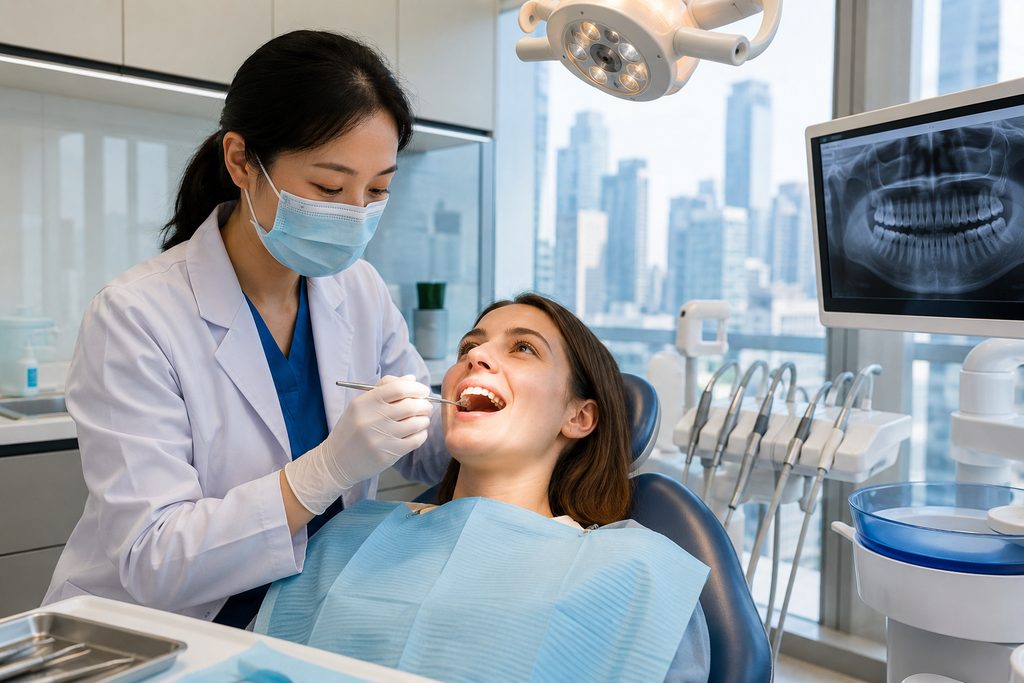
Have you ever skipped a routine dental cleaning because the out-of-pocket bill felt like a ransom note? A full-mouth exam with X-rays shouldn’t cost a month’s rent.
Key Takeaways
- A full dental checkup with cleaning, exam, and panoramic X-ray in China typically ranges from $50 to $180 at international-standard clinics — roughly 70-85% less than comparable US pricing.
- China’s top-tier dental facilities in Beijing and Shanghai use the same imaging technology and sterilization protocols found in Western clinics, with many dentists holding postgraduate training from Europe or North America.
- Language barriers at public hospitals are real and significant. Walk-in care without a bilingual coordinator can lead to miscommunication about treatment plans, pricing, and post-procedure instructions.
- Not all clinics accept foreign insurance for direct billing. You need to verify this before booking, or plan to pay upfront and seek reimbursement later.
The Problem: A Routine Visit Shouldn’t Break the Bank
Dental care costs in Western countries have spiraled out of control. In the United States, a standard cleaning, exam, and bitewing X-ray set runs between $200 and $350 without insurance. Throw in a panoramic X-ray, and the bill can climb past $400. For the roughly 74 million Americans without dental coverage, according to the CDC’s most recent National Health Interview Survey, that price tag means one thing: postponement. And postponement turns small cavities into root canals.
The math doesn’t improve much in the UK, where NHS dental access has tightened dramatically since the pandemic. A 2023 Healthwatch England report found that 1 in 10 people surveyed had attempted DIY dentistry — filing down teeth, pulling out their own — because they couldn’t get an appointment. Private cleanings in London start around £90 and climb fast.
What if the same preventive care — a thorough cleaning, a comprehensive full-mouth exam, and diagnostic X-rays — cost the equivalent of a nice dinner for two? That’s not a hypothetical. It’s the reality at licensed international dental clinics across China’s major cities. The gap between Western pricing and Chinese pricing isn’t a discount. It’s a structural difference in how healthcare is delivered and priced. And for foreign visitors already traveling for business or tourism, adding a dental visit to the itinerary is simpler than most people assume.
Who We Are
We are not a hospital. We do not employ dentists, nor do we provide clinical treatment or diagnoses. Our team at China Medical Services functions as your logistical backbone — we connect you with vetted, English-speaking dental clinics inside China’s top-tier hospital network, coordinate appointments, arrange bilingual accompaniment, and handle the practical barriers that make navigating a foreign healthcare system intimidating. Think of us as the bridge between where you are now and the dental care you need, without the guesswork.
Why China’s Dental Clinics Deliver Comparable Care at a Fraction of the Cost
Technology That Matches — and Sometimes Exceeds — Western Standards
Walk into a private international dental clinic in Shanghai or Beijing and you’ll find the same equipment brands you’d see in Munich or Toronto. Digital panoramic and cephalometric X-ray units from Planmeca and Sirona. Cone-beam CT scanners for 3D imaging. Intraoral cameras, laser-assisted soft tissue tools, and CAD/CAM systems for same-day crowns. These aren’t hand-me-downs. China’s dental market has expanded rapidly over the past decade, and the top clinics have invested heavily in new-generation hardware to compete for both domestic and international patients.
At public hospitals, the equipment varies more. A Grade A tertiary hospital in a major city will have modern imaging suites. A smaller district clinic might not. That’s why clinic selection matters enormously. Our database covers over 340 top-ranked hospitals across 37 cities, including those with dedicated international dental departments that meet JCI accreditation standards or equivalent Chinese benchmarks. We steer patients toward facilities where the technology stack is verifiable, not assumed.
Clinical Volume That Sharpens Skill
There’s a quiet truth in dentistry: the more procedures a clinician performs, the better their pattern recognition becomes. A dentist who sees 40 patients a day develops a different level of diagnostic intuition than one who sees 12. In China’s busy urban hospitals, dental departments operate at high throughput. A senior periodontist at a major Shanghai teaching hospital might treat more cases of advanced gum disease in a month than a suburban US practitioner sees in a year.
This volume effect shows up in routine care, too. Scaling and root planing — the deep cleaning that patients with periodontal pockets need — is performed so frequently that the workflow is refined to an art. The clinicians aren’t rushed. But they’re efficient. And efficiency, combined with repetition, tends to produce consistent results. For foreign visitors needing a straightforward full mouth exam x-ray package Shanghai clinics offer, that consistency translates to a thorough, unhurried appointment that still respects your time.
Why the Dental Cleaning Cost China Foreigner Patients Pay Is So Low
Let’s address the obvious question head-on. If the equipment is the same and the training is comparable, why is the dental cleaning cost China foreigner visitors encounter so much lower than back home? The answer isn’t lower quality. It’s lower structural overhead.
Commercial real estate, while expensive in Shanghai and Beijing, doesn’t carry the per-square-foot burden of a Manhattan or London medical suite. Staff salaries for dental hygienists and support personnel are lower in absolute terms, though competitive within the local market. Malpractice insurance premiums — a silent cost driver in Western healthcare — are a fraction of US rates. And the administrative overhead of insurance coding, prior authorization, and claims processing is far lighter, especially at clinics that operate on a direct-pay model. None of these savings come from cutting corners on sterilization or materials. They come from a system that simply costs less to run.
What does that mean in real numbers? A full package — comprehensive oral exam, full-mouth periodontal probing, ultrasonic scaling, polishing, fluoride treatment, and a panoramic X-ray — runs between $50 and $180 at reputable international clinics. The same package in the US, billed without insurance, can hit $400 to $600. That’s not a sale price. That’s the standard rate.
What the Package Actually Includes
When you search for “how much is dental checkup in China,” the answers you find online are often vague or outdated. Let’s be specific. A standard comprehensive package at a private international clinic or a hospital international medical center typically covers these components:
- Full-mouth periodontal examination: Probing depths measured at six points per tooth, recorded in a periodontal chart. This is the gold standard for detecting gum disease early — not a quick visual glance.
- Digital panoramic X-ray (orthopantomogram): A single 2D image capturing all teeth, both jaws, temporomandibular joints, and sinuses. Useful for spotting impacted teeth, cysts, bone loss, and asymptomatic pathology.
- Intraoral camera imaging: High-resolution photos of any suspicious lesions, worn fillings, or cracked cusps, shown to you on a screen in real time.
- Ultrasonic scaling and hand instrumentation: Removal of supragingival and subgingival calculus, followed by polishing to smooth the tooth surface and slow future plaque accumulation.
- Oral hygiene instruction: Specific, personalized guidance — not a generic lecture — based on what the exam revealed about your brushing and flossing technique.
- Written treatment plan: If further work is needed, you receive a documented plan with itemized pricing before you leave the chair.
Some clinics bundle a fluoride varnish application into the base price. Others offer it as an add-on for $15 to $30. Either way, the total remains modest by Western standards.
Where to Find the Best Dental Clinic for Foreigners Beijing and Shanghai Have to Offer
Not every dental office in China is equipped to serve an English-speaking international patient. But a growing number are. In Beijing, the best dental clinic for foreigners Beijing visitors trust tend to cluster in the Chaoyang and Shunyi districts, near the diplomatic compounds and international schools. These clinics employ reception staff fluent in English, use bilingual consent forms, and maintain the direct billing relationships with international insurers that expatriates rely on.
Shanghai’s international dental scene is similarly concentrated — Jing’an, Xuhui, and Pudong host several JCI-accredited facilities where a full mouth exam x-ray package Shanghai residents and visitors book is a routine offering. Some operate as standalone private clinics. Others sit inside the international departments of major public hospitals, giving patients access to the hospital’s specialist network if a referral becomes necessary.
What about cities beyond Beijing and Shanghai? Guangzhou, Shenzhen, Chengdu, and Hangzhou all have at least one or two English-capable dental clinics. The density drops as you move into second-tier cities, but the quality at the top end remains high. Our team maintains current profiles on clinics across 37 cities, so we can verify English-language capability before you commit to an appointment.
Is Dental Care in China Safe for Tourists?
The short answer is yes — at the right facility. Is dental care in China safe for tourists who do their homework? Absolutely. The same question, asked about a random street-front clinic with no international accreditation and no English-speaking staff, gets a more complicated answer. Safety isn’t a binary property of a whole country’s healthcare system. It’s a function of the specific clinic, its infection control protocols, and the training of its practitioners.
Here’s what to look for. Autoclave sterilization pouches with indicator strips that change color when the cycle is complete. Unwrapped instruments opened in front of you from sealed packages. Gloves put on after the previous patient’s chair is wiped down, not before. These are universal signals, and they’re standard practice at the clinics we work with.
HIV and hepatitis B transmission in dental settings is extraordinarily rare when proper sterilization is followed — the risk is comparable to that in any developed country’s dental system. A 2019 systematic review published in the International Dental Journal found no evidence of elevated infection risk in Chinese dental facilities that followed national infection control guidelines. The variable isn’t the country. It’s the clinic.
Can You Book Dental Cleaning China Online Before You Travel?
Yes and no. Some private international clinics allow direct online booking through their own websites or through third-party platforms. But the experience can be frustrating. Time slots shown as available may not be real-time. The English interface may be poorly translated. And if you need to communicate a specific concern — a sensitive tooth, a medical condition that requires antibiotic prophylaxis — the intake form may not give you space to explain it properly.
At public hospital dental departments, the situation is more complicated. Most do not accept advance bookings from overseas patients through any online portal. You show up, queue for a registration number, and wait. If you don’t speak Chinese, you navigate this process in silence or with a translation app. That’s the reality. It works for some people. For others, the friction outweighs the savings.
Our approach is different. When you reach out to us, we handle the booking on your behalf. We confirm the appointment time directly with the clinic’s international patient coordinator, relay any medical history details that matter, and arrange a bilingual medical companion to meet you at the clinic, handle registration, translate your conversation with the dentist, and make sure you understand the treatment plan and costs before anything proceeds. You don’t need to figure out how to book dental cleaning China online by trial and error. We do it for you.
What You Need to Know Before Going Alone
Dental tourism sounds simple on paper. In practice, a few predictable friction points trip up even seasoned travelers. Knowing them in advance saves time, money, and stress.
- Language at public hospitals: The clinical staff at a top public hospital may be world-class, but their English is often limited. Consent forms, post-operative instructions, and pricing sheets are frequently in Chinese only. A misunderstanding about which tooth needs treatment or what the quoted price covers is not a theoretical risk — it happens.
- Payment systems: Many clinics accept international credit cards, but not all. Some rely on WeChat Pay or Alipay, which require a Chinese bank account to set up fully. Foreign visitors can sometimes use a linked international card, but transaction limits and verification glitches are common. Carrying enough cash in RMB as a backup is wise.
- Insurance and direct billing: Even clinics that advertise direct billing may only have agreements with a handful of insurers. If your plan isn’t on their list, you pay upfront and file for reimbursement yourself. That means getting an itemized receipt in English — something not every clinic automatically provides unless you ask.
- Radiograph access: You’ll want copies of your X-rays to take home. Some clinics provide digital files on a USB drive or via email. Others hand you a printed film and a CD-ROM. If you need DICOM files for your home dentist, specify that before the appointment. Not every clinic exports in that format by default.
How We Help You Navigate This
These barriers exist for structural reasons, not because anyone is trying to make things difficult. A public hospital designed to serve 10,000 local patients a day doesn’t optimize its workflow for a foreign visitor who needs an English treatment plan. That’s not a flaw. It’s just reality. Our job is to bridge that gap.
When you contact us, we start with a conversation — no forms, no commitment. You tell us what you need: a routine cleaning and checkup, a specific concern like a cracked tooth, or a full-mouth exam with X-rays before you start orthodontic work back home. We match you with a clinic that fits your location, budget, and language requirements. We book the appointment. We send a bilingual coordinator to meet you there. They handle registration, payment logistics, translation during the exam, and collection of your records afterward. You focus on your teeth. We handle everything else.
Our coordination fee starts from $300 for appointment booking and basic facilitation. If you need a full-day bilingual medical companion, that starts from $200. These are separate from the clinic’s own charges for the dental work itself, which you pay directly to the clinic. The total — our coordination plus the dental package — still lands well below what the same care would cost uninsured in the US or Europe.
For patients considering broader medical care in China — not just dentistry — a free consultation with our team is the natural starting point. We help you understand what’s possible before you book a flight.
Frequently Asked Questions
At an international private clinic, expect to pay between $50 and $180 for a comprehensive package that includes exam, cleaning, and panoramic X-ray. Public hospital dental departments may charge less — sometimes as low as $30 to $60 — but English support is rarely available, and you’ll navigate the visit independently. The final price depends on the clinic tier, the city, and whether you need additional imaging like bitewings or a cone-beam CT.
At accredited international clinics and the international departments of top public hospitals, yes. Look for autoclave sterilization indicators, sealed instrument pouches, and gloves changed between patients. These are standard at the facilities in our network. Street-front clinics with no international accreditation are harder to vet, and we don’t recommend them for visitors who can’t independently verify their infection control practices.
Some private clinics accept direct online bookings, but the process can be unreliable — time slots may not be real-time, and medical history communication is often limited. Public hospitals generally don’t accept advance bookings from overseas patients at all. We handle the booking for you, confirming directly with the clinic’s international coordinator and ensuring your concerns are communicated before you arrive.
You’ll receive a written treatment plan with itemized pricing before any additional work begins. There’s no obligation to proceed immediately. Some patients choose to have the work done during the same trip. Others take the plan home to consult their regular dentist. The choice is always yours. Our bilingual companion ensures you understand exactly what’s being recommended and why.
That depends entirely on your plan. Some international insurers and a few US PPO plans offer out-of-network coverage for overseas treatment. You typically pay the clinic directly and submit an itemized receipt for reimbursement. Ask the clinic for an English-language invoice with procedure codes before you leave. We can help you request this, but we don’t handle insurance claims on your behalf.
Your Next Step
A dental checkup shouldn’t be a financial decision. It should be a routine one. The cost gap between Western dental care and the same treatment at China’s international clinics is wide enough that a cleaning and exam can pay for a significant portion of your flight. The quality, at the right clinic, is comparable. The logistics, with the right support, are manageable.
If you’re considering a trip to China — for business, tourism, or specifically for medical care — and a dental visit would fit naturally into your itinerary, let’s talk. A free consultation with our team is the quickest way to understand your options, confirm pricing, and decide whether this makes sense for you. No pressure. Just clarity.
For more medical information and treatment options in China, visit chinamedservices.com (China Medical Services).
