Dental Care in China: Sterilization Standards and Implant Costs Explained
Key Takeaways
- Dental implants cost China providers quote typically runs $800 to $2,500 per implant, against $3,000 to $6,000 in the United States — same titanium, same brands, different labor economics.
- Top Chinese dental hospitals sterilize instruments under the same autoclave protocols used in Western operating rooms, and many hold JCI accreditation that audits those protocols every three years.
- The real friction is not safety. It is scheduling. Public hospital dental clinics rarely accept overseas bookings in advance, so walk-in queues and same-day registration are the norm.
- Anyone comparing clinics should ask for the sterilization log, not just the price list. A cheap implant placed with a reused bur is not a bargain.
The Problem: A $6,000 Tooth and a System That Makes You Wait
Roughly 120 million Americans are missing at least one tooth, according to the CDC’s National Health and Nutrition Examination Survey, and a single implant to fix that gap often lands between $3,000 and $6,000 before the crown is even attached. In the UK, private implant treatment regularly exceeds £2,500 per tooth. Australia and Canada sit in similar territory.
That number is not the whole story. Insurance rarely covers implants. Waiting lists for subsidized dental care in countries like the UK and Canada stretch into months for procedures that are classified as non-urgent. So patients do the math themselves. They search for alternatives, and increasingly they look east.
Here is where the fear creeps in. A dental implant is a surgical procedure. It involves drilling into the jawbone. The instruments touch blood and bone. If a clinic cuts corners on sterilization, the patient is the one exposed to hepatitis B, hepatitis C, or HIV. That fear is rational, and it deserves a direct answer rather than a marketing slogan.
Is Dental Care in China Safe? What the Sterilization Standards Actually Require
China’s dental infection-control rules are not vague. The National Health Commission issues mandatory disinfection protocols for dental clinics, and they follow the same core logic as CDC and WHO guidance: every instrument that penetrates tissue must be cleaned, then sterilized in a Class B autoclave — the same vacuum-assisted steam sterilizers used in European and North American surgical suites.
How Do Chinese Dental Clinics Sterilize Instruments?
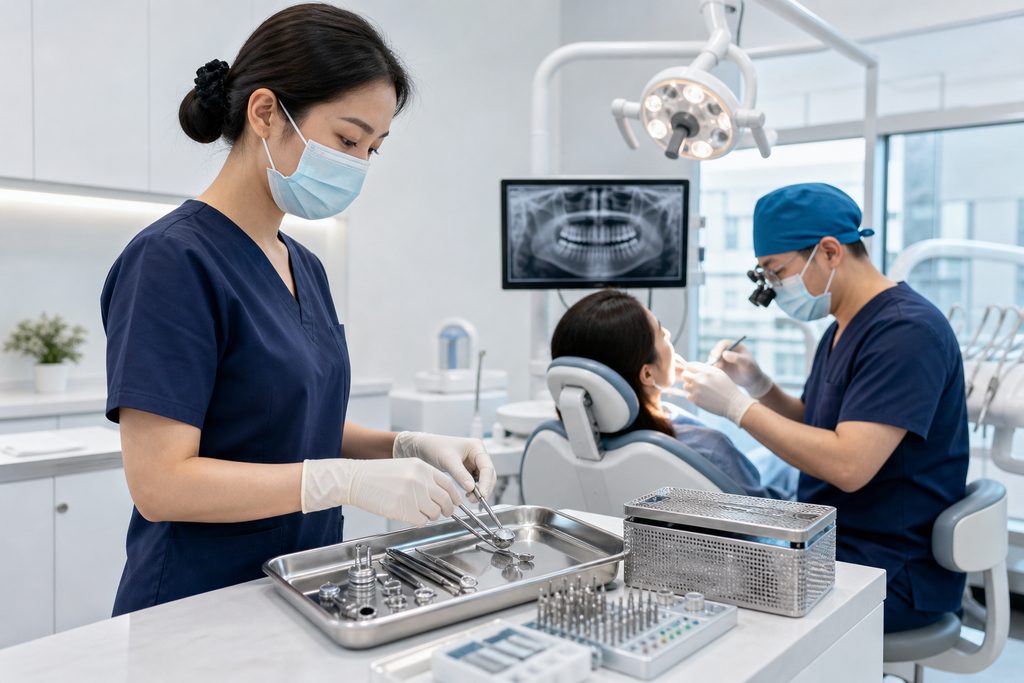
The standard workflow at a compliant clinic looks like this. Used instruments go into a sealed transport container at the chairside. They are ultrasonically cleaned, then hand-inspected, then sealed in individual sterilization pouches with a chemical indicator strip. The pouches go into a Class B autoclave, and each cycle is logged with a date, a batch number, and a biological spore-test result. Handpieces — the drills — are sterilized between every single patient, not once a day.
That last point matters. In some lower-cost markets, dental handpieces are wiped down with alcohol between patients because autoclaving shortens their lifespan. Wiping does not kill bloodborne pathogens. A clinic that autoclaves handpieces between patients is spending real money on compliance, and it shows.
What Separates a Safe Clinic From a Risky One
Look for three things. First, JCI accreditation. Joint Commission International audits sterilization, waste handling, and instrument tracking on a three-year cycle, and its standards are published openly. Second, visible packaging. If the instrument tray arrives uncovered, or the pouch has no indicator strip, ask why. Third, traceability. Strong clinics can show you the sterilization log for the batch used in your procedure.
Private international hospitals in cities like Shanghai and Beijing are built around this kind of transparency because their patients demand it. Public tertiary hospitals follow the same national protocols but run at a volume that can make individual verification harder to arrange on a short visit.
Why Dental Implants Cost China Clinics Charge So Much Less
This is the question every reader wants answered. How can the same Straumann or Nobel Biocare implant, placed by a surgeon with 15 years of experience, cost a third of the US price?
Labor Economics, Not Material Substitution
The implant fixture itself is a global product. A Swiss-made Straumann implant costs roughly the same wholesale everywhere. What differs is the labor wrapped around it: the surgeon’s fee, the assistant, the sterilization technician, the chair time, the facility overhead. In the US, a specialist implant surgeon may bill $2,000 to $3,000 for the placement alone. In China’s top public hospitals, the equivalent professional fee is a fraction of that.
Volume plays a role too. A leading Chinese dental hospital may place several thousand implants a year. That throughput spreads equipment costs and keeps per-case pricing low without cutting corners on the parts that matter.
A Realistic Cost Comparison
| Procedure | China (top public hospital) | China (private international clinic) | United States |
|---|---|---|---|
| Single implant (fixture + abutment) | $800 – $1,500 | $1,800 – $2,500 | $3,000 – $6,000 |
| Implant crown | $300 – $600 | $700 – $1,200 | $1,500 – $3,000 |
| Root canal (molar) | $150 – $400 | $500 – $900 | $1,000 – $2,000 |
| Full ceramic crown | $200 – $500 | $600 – $1,000 | $1,200 – $2,500 |
| Full-mouth restoration (All-on-4) | $8,000 – $14,000 | $18,000 – $30,000 | $50,000 – $90,000 |
These figures vary by hospital and case complexity. Bone grafting, sinus lifts, and extraction of failed prior implants all add cost. Get a written quote after imaging, never before.
How to Book Dental Treatment in China Without Getting Burned
Booking is where most overseas patients stumble. Chinese public hospitals generally do not accept advance appointments from abroad for standard dental outpatient care. You register on the day, in person, and you wait. For a simple cleaning that is fine. For a multi-stage implant plan, it is a problem, because the surgeon who places the fixture needs to see you before scheduling the surgery.
The workaround is the hospital’s international department or VIP channel. These units handle foreign patients, provide English-speaking staff, and can pre-arrange consultations. The trade-off is price: expect roughly 1.5 to 2 times the standard public rate. That still undercuts Western pricing by a wide margin.
Private international clinics — the JCI-accredited names in Shanghai, Beijing, and Guangzhou — operate more like Western dental offices. You can book online, they bill insurance directly in many cases, and the experience is familiar. You pay for that familiarity.
If you want to compare specific institutions before committing, our directory of top-ranked Chinese hospitals groups options by city, and the specialty rankings show which hospitals lead in dental and oral surgery.
Dental Tourism China Packages: What to Expect and What to Avoid
A “package” in this market usually bundles consultation, imaging, the procedure, and sometimes a hotel. Some are legitimate. Others hide the fact that the quoted price covers only the fixture, not the abutment or crown, which are billed later.
Ask four questions before paying a deposit. Does the quote include the abutment and the final crown? Which implant brand, by name? Who performs the surgery — a resident, or an attending specialist? And what happens if the implant fails within the first year?
The most common mistake is treating this as a shopping transaction. It is a staged medical process. Imaging comes first. Then a treatment plan. Then the surgery. Then a healing period of three to six months before the crown goes on. If you are only in China for two weeks, you may need to split the work across two trips, or plan a longer stay.
Never agree to implant placement without a CBCT scan and a written treatment plan. A clinic willing to skip imaging to close a sale is not one you want drilling into your jaw.
Practical Considerations: Visas, Payment, and Follow-Up
Yes, at a top public hospital, for a single implant fixture and abutment. The crown is often billed separately, and bone grafting adds cost. A realistic all-in figure for one complete implant is $1,200 to $2,200 at a public hospital, or $2,500 to $3,700 at a private international clinic. Prices vary by hospital and case complexity.
Implant failure within the first year is uncommon but possible — typically under 5% for healthy patients with good bone quality. Reputable clinics offer a warranty on the fixture itself, though it usually requires returning to the clinic for replacement. Discuss the warranty terms in writing before surgery, and confirm what your home dentist can handle independently.
For short treatment trips, the S2 visa is the applicable category for medical treatment and private affairs. The M visa is for commercial and trade activities and does not cover medical care. Confirm current documentation requirements with your nearest Chinese embassy or consulate before applying.
Your Next Step
The gap between a $6,000 implant in the US and a $1,200 one in Shanghai is real, and it is not explained by corner-cutting — it is labor economics and volume. What determines your outcome is not the country. It is the specific clinic, its sterilization discipline, and whether the surgeon has done the procedure a thousand times or ten.
We are China Medical Services, a coordination team that connects international patients with top-ranked Chinese hospitals. We are not a dental clinic and we do not provide diagnoses. What we do is help you compare institutions, understand the staged nature of implant treatment, and plan realistically around visa timelines and follow-up. If you want a starting point, our free consultation page is where the conversation begins — no pressure, no obligation.
Frequently Asked Questions
Yes. The hospitals used for international patients are JCI-accredited and follow the same international safety standards as top hospitals in the US and Europe. Surgical teams perform high volumes of procedures — often more than their Western counterparts — which studies show leads to better outcomes.
Costs vary by procedure and hospital, but international patients typically save 40-80% compared to US prices — even when factoring in travel and accommodation. A consultation with our team will give you an exact, all-inclusive quote with no hidden fees.
Send us your existing medical reports to get started. We handle everything from hospital selection and appointment scheduling to visa assistance and post-operative recovery planning. Your medical records are reviewed by the specialist before you even book a flight.
For more medical information and treatment options in China, visit chinamedservices.com (China Medical Services).
