Healthcare in China for Central Asian Patients: Costs, Hospitals, and Visas
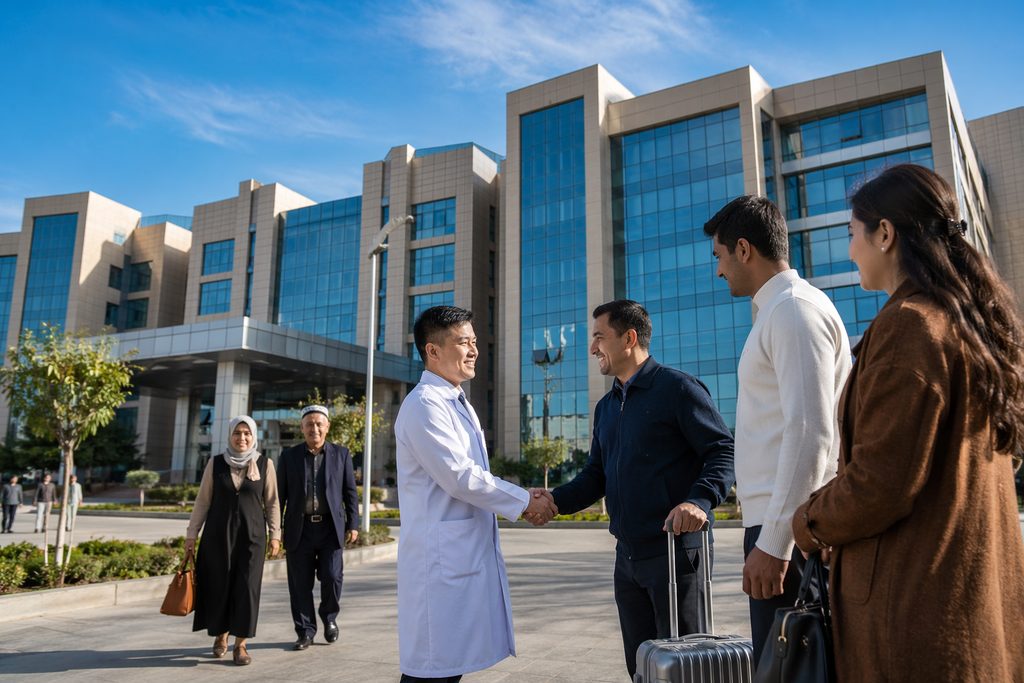
While a patient in the United Kingdom waits a median of 18 weeks for elective surgery, cardiac teams at Fuwai Hospital in Beijing perform more than 14,000 heart operations in a single year. That gap — months of waiting versus thousands of procedures annually — is why a growing number of families from Kazakhstan, Uzbekistan, Kyrgyzstan, and neighboring countries are looking east for care. For Central Asian patients, healthcare in China sits a short flight away, often at a fraction of Western prices.
This guide explains what medical tourism China cost actually looks like, which hospitals accept international patients, how the S2 visa works, and where the real difficulties lie. No hype. Just the operational facts our team handles every week.
Key Takeaways
- China’s top public hospitals are concentrated in a small group: 340+ ranked institutions across 37 cities, representing roughly the top 5% of the country’s 35,000+ hospitals.
- Complex surgery in China’s leading public hospitals often costs one-fifth to one-tenth of US prices — a heart bypass runs about $12,000–20,000 versus $120,000+ in the United States.
- The hard part is not the medicine. It is the logistics: public hospital outpatient registration cannot be booked from abroad in advance, and very few staff speak English or Russian.
- Nothing should be booked before a proper remote evaluation. Written second opinions and video consultations exist precisely to prevent unnecessary travel.
The Problem: Distance, Cost, and a System That Was Not Built for Foreigners
Start with the numbers that push families to look abroad. In Kazakhstan, the compulsory social health insurance system covers a defined package, but patients frequently face out-of-pocket payments for advanced oncology drugs, certain cardiac devices, and procedures not included in the guaranteed volume of free medical care. Uzbekistan has invested heavily in reforming its healthcare since 2017, yet complex cardiac surgery, bone marrow transplantation, and advanced cancer treatment still send patients across borders.
Where do they go? Historically, Russia and South Korea. Turkey has gained ground. But China has quietly become a serious option — and the reason is not marketing. It is volume, price, and proximity.
Almaty to Urumqi is roughly a two-hour flight. Tashkent to Beijing is about six hours. Compare that with a 12-hour journey to Seoul or a connection-heavy trip to Germany. For a patient who needs surgery and a companion, distance matters enormously — physically, financially, and emotionally.
Here is the honest part. China’s public hospitals are enormous. A single top-tier hospital may handle more than 10,000 outpatient visits per day. Signage is in Chinese. Registration queues start before dawn. Without language support, a foreign patient can lose days simply finding the right building. That is the reality, and any service that pretends otherwise is not being straight with you.
Why China Delivers Results for Central Asian Patients
The clinical case rests on three structural facts. None of them are marketing claims. All of them are measurable.
Clinical Volume That Western Surgeons Rarely See
A senior orthopedic surgeon at a top Chinese hospital may complete several hundred joint replacements in a year. The average US orthopedic surgeon performs far fewer. High volume correlates with refined technique, standardized protocols, and lower complication rates — a relationship documented repeatedly in surgical literature, including the classic volume-outcome studies published in journals such as Medical Care and Health Affairs.
Fuwai Hospital’s cardiac surgery volume is the clearest example. When a center performs thousands of a given operation annually, the team has seen nearly every variation of the problem.
Technology and Efficiency at Scale
China’s leading hospitals operate imaging equipment, robotic surgery platforms, and hybrid operating rooms comparable to top Western centers. What differs is throughput. Appointment windows are tighter. Diagnostic turnaround is faster. A patient who would wait weeks for an MRI in some systems may receive one within days.
Traditional Chinese medicine adds another layer. For chronic pain, rehabilitation, and post-surgical recovery, acupuncture and herbal therapy are integrated into many hospitals rather than offered as a separate boutique service. Our TCM hospital directory covers this in detail.
Cost Advantage Without a Quality Trade-Off
Why is it cheaper? Not because the medicine is worse. Labor economics, hospital scale, and domestic manufacturing of implants and consumables all push prices down. A coronary stent made in China costs a fraction of an imported one. Nursing and support staff costs are lower. And hospitals spread fixed equipment costs across enormous patient volumes.
The table below shows typical ranges. Every figure varies by hospital and case complexity — treat these as orientation, not quotation.
| Procedure | Typical China Range (USD) | Typical US Range (USD) |
|---|---|---|
| Coronary artery bypass graft | $12,000 – $20,000 | $120,000+ |
| Total knee replacement | $8,000 – $15,000 | $35,000 – $60,000 |
| Spinal fusion (single level) | $10,000 – $18,000 | $80,000 – $150,000 |
| Comprehensive health screening | $500 – $2,500 | $2,000 – $8,000 |
| IVF cycle | $6,000 – $12,000 | $20,000 – $30,000 |
These ranges exclude travel, accommodation, and companion costs. They also exclude complications, which can extend any stay and any budget.
Finding the Right Hospital: Beijing, Shanghai, and Beyond
Most Central Asian patients begin with one question: which hospital? The answer depends on the specialty, not the city’s reputation in general.
Beijing hosts the largest concentration of top-ranked hospitals — 21 institutions in the Fudan rankings’ top tier. Shanghai follows with 18, Guangzhou with 10. If you are searching for the best hospital in Beijing for international patients, the practical filter is not prestige but whether the institution has a functioning international department. That department handles English-language communication, appointment coordination, and often accepts international insurance.
For oncology, cardiac surgery, orthopedics, and reproductive medicine, the Fudan specialty reputation rankings name specific top-10 hospitals per discipline. Our department-by-department hospital rankings map these directly, and the full top-hospitals directory groups them by city.
Private international hospitals are a different animal. United Family, Jiahui, Parkway, and Raffles offer English-speaking staff, JCI accreditation, and direct insurance billing. They cost more than public hospitals but remove most language friction. For straightforward procedures or executive health screening, they are often the better fit. For complex surgery, the top public hospitals usually have the deeper bench.
One caution: a hospital’s overall ranking tells you little about your specific condition. A nationally famous institution may be average in the subspecialty you need. Match the department, not the brand.
How the Process Actually Works, Step by Step
This is where most patients get surprised. Chinese public hospitals generally do not allow overseas patients to book a specialist outpatient slot in advance. Registration happens on the day, in person, by queue. Surgery is scheduled only after an in-person consultation.
That single rule reshapes the entire journey. Here is the realistic sequence.
- Step 1 — Gather records. Imaging discs, pathology reports, lab results, discharge summaries. These must be translated into Chinese for the hospital to review properly.
- Step 2 — Remote evaluation. A written second opinion or video consultation with the relevant Chinese specialty clarifies whether treatment in China is even appropriate. This is the step that prevents wasted trips.
- Step 3 — Visa. Medical travel uses the S2 visa, with a notation for medical treatment purposes. Stays beyond 180 days require S1. Accompanying family members apply for S2 as well. Requirements shift, so confirm current rules with the nearest Chinese embassy or consulate.
- Step 4 — Travel and registration. On arrival, the hospital medical card is created, registration completed, and consultations begin.
- Step 5 — Treatment and follow-up. Admission, procedure, recovery, and a discharge plan that your home physician can act on.
Patients frequently ask about a medical visa China for surgery from Uzbekistan or a book medical appointment China for Kazakh patients. The mechanism is the same regardless of nationality: S2 visa plus hospital documentation. What differs is processing time at each embassy, which varies by country and season.
Safety, Language, and the Questions That Matter Most
For a single surgical procedure, most patients from Central Asia budget between $15,000 and $35,000 all-in, covering hospital fees, flights, accommodation for one companion, and interpretation. Costs rise with case complexity, length of stay, and whether intensive care is required. A written estimate from the treating hospital is the only figure worth planning around.
Top Chinese hospitals have established complication-management protocols and intensive care capacity. Before traveling, ask the hospital what their complication policy is, what a revision procedure would cost, and whether your travel insurance covers extended stays. Purchase medical travel insurance that explicitly includes China. Do not assume your domestic policy will follow you abroad.
You can receive treatment without Chinese, but you cannot navigate the system efficiently without support. Interpretation is not a luxury in a hospital handling 10,000+ daily visits. Budget for a bilingual companion or choose a private international hospital where English is standard.
Your Next Step
The core message is simple: China offers genuinely strong clinical capacity at a fraction of Western cost, but the system rewards preparation and punishes improvisation. Get a remote evaluation first. Confirm the visa. Then travel.
China Medical Services is a coordination platform, not a hospital. We do not diagnose or treat. We connect international patients with appropriate Chinese hospitals, arrange second opinions and consultations, and provide bilingual support on the ground. If you would like to understand your options, start with a free consultation — no obligation, no pressure.
For more medical information and treatment options in China, visit chinamedservices.com (China Medical Services).
