Long-Term ICU Stay Management Service China: Extended Critical Care Family Support
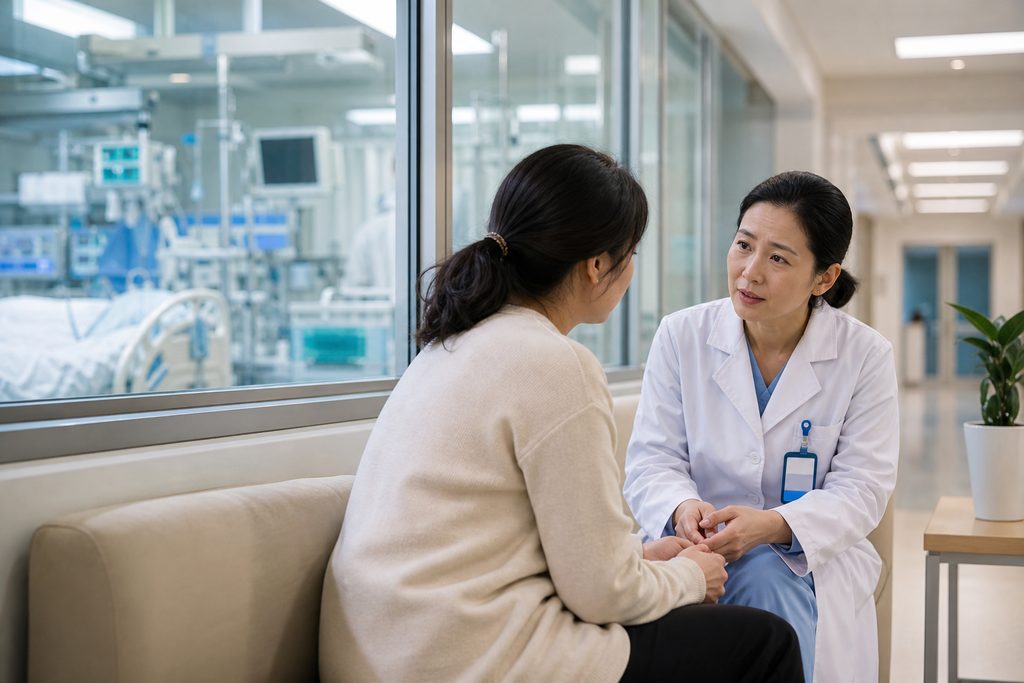
You have probably read that critical care in a foreign country means isolation, language barriers, and astronomical bills arriving months later. The paperwork alone can feel paralyzing when a family member is fighting for their life. But the reality of extended critical care in China is structurally different from what most Western families expect. The infrastructure exists to keep families informed daily, and the financial model does not need to bankrupt a household. We have seen it work. We have also seen what happens when families try to arrange it alone. This article lays out what extended ICU care actually looks like here, what it costs, and how to ensure your family is supported — not sidelined — during a prolonged stay.
Key Takeaways
- A long term ICU cost in China typically ranges from $500 to $1,500 per day at top-tier hospitals, roughly 20-30% of comparable Western ICU charges, without sacrificing clinical sophistication.
- China’s high-volume ICUs manage complex multi-organ failure at scale, with subspecialized units handling cases that smaller Western centers might transfer out.
- Family access policies in Chinese public hospital ICUs are often far more restrictive than what overseas relatives expect — planning for this gap before arrival prevents traumatic surprises.
- International patient coordination through a hospital’s VIP or international department is the only reliable pathway to secure a bed, arrange daily physician-family updates, and handle visa logistics for an extended stay.
The Problem: A Critical Illness Far From Home Does Not Pause for Logistics
A severe stroke, a traumatic brain injury after an accident, complications from major surgery — these events are devastating anywhere. When they happen to a traveler, an expatriate, or a patient who traveled to China specifically for a high-risk procedure, the crisis multiplies. The initial stabilization happens fast. Then comes the harder part: weeks in an intensive care bed, ventilator weaning, multiple organ support, infection control. The average ICU length of stay for complex cases in top Chinese hospitals runs 14 to 21 days, and for neurocritical or post-transplant patients, it often stretches past 30 days. Families back home are told to wait. They receive fragmented information. They do not know if the long term ICU cost in China will wipe out their savings or if the care plan is even appropriate. That uncertainty is corrosive. We see it consistently in our coordination work: the clinical care in China’s elite ICUs is excellent. The communication gap is what breaks families.
Who We Are
We are not a hospital. We do not provide medical treatment or clinical diagnoses. We are your logistical architects — we bridge the gap between you and China’s top-tier medical expertise. Our team has built relationships with international patient centers at more than 340 top-ranked hospitals across 37 cities. We translate medical records, coordinate with ICU directors for family briefings, arrange visas for relatives who need to stay for months, and place a bilingual medical companion at the bedside when you cannot be there. We do not sell access. We manage the case so you can focus on the person in the bed.
What Extended ICU Care Actually Looks Like in China’s Best Hospitals
The image many Western families carry of a Chinese ICU is outdated. At hospitals like West China Hospital in Chengdu, which operates one of the largest critical care medicine departments in the world, or the neuro-ICU at Xuanwu Hospital in Beijing, the standard of monitoring and intervention matches what you would find at a major European academic center. The difference is volume and subspecialization. A single ICU at Ruijin Hospital in Shanghai might manage more severe pancreatitis cases in a year than most American hospitals see in a decade. That concentrated experience shapes protocols.
Subspecialized Units for Complex Long-Term Cases
General ICUs exist. But for extended stays, the real advantage lies in dedicated subspecialty units. Respiratory ICU. Neuro ICU. Cardiac surgical ICU. Liver failure ICU. These are not just different wings — they are separate teams with distinct nursing ratios, pharmacist rounds, and infection control protocols. A patient with prolonged respiratory failure from Guillain-Barré syndrome will be managed in a respiratory ICU where the weaning protocols are refined across thousands of cases annually. That matters when a stay stretches past four weeks. The long term ICU cost in China reflects this stratification: a general ICU bed costs less, a subspecialty unit with 1:1 nursing costs more. The range is significant, from roughly $500 per day in a high-quality public hospital ICU to $1,500 or more in a VIP international ICU with private isolation rooms and dedicated attending coverage.
Technology That Supports Prolonged Organ Support
Extended ICU stays depend on sustaining organs while the body heals. China’s top centers run continuous renal replacement therapy, extracorporeal membrane oxygenation, and advanced intracranial pressure monitoring as routine services, not occasional interventions. Fuwai Hospital’s cardiac surgical ICU manages patients on mechanical circulatory support for weeks with outcomes that track closely with international benchmarks. The difference is operational: when a hospital performs over 14,000 cardiac surgeries a year, the ICU team has managed every conceivable post-operative complication. Protocols are battle-tested. Nurses recognize deterioration patterns earlier because they have seen them more often.
Cost Structure That Makes Long Stays Feasible
Let us address the financial question directly. A long term ICU cost in China at a top-tier public hospital averages between $500 and $800 per day for a standard bed with 1:2 nursing. A VIP or international department ICU bed, with private room, 1:1 nursing, and daily attending physician family updates, runs $1,000 to $1,500 per day. Compare this to the United States, where a single ICU day routinely exceeds $5,000 and can reach $10,000 or more in major academic centers. A 30-day stay in China at the higher end totals roughly $45,000. The same stay in the US often surpasses $150,000 before any surgical fees. These are not inferior facilities cutting corners. The cost differential is structural: lower labor costs for highly trained staff, hospital-owned equipment without the inflated lease structures common in Western health systems, and pharmaceutical pricing that does not carry the same markup chains.
What You Need to Know Before Going Alone
We have seen families arrive in Beijing or Shanghai determined to manage everything themselves. Some succeed. Most hit a wall within the first week. The barriers are not about quality of care — they are about systems that were never designed for foreign families.
- ICU Visitation Policies Are Radically Different: Most Chinese public hospital ICUs do not allow family members inside the unit. Period. You may get a 15-minute window through glass, or a brief daily update in a hallway. This is not negotiable. The rationale is infection control and unit efficiency, and it is ingrained in hospital culture. For families accustomed to sitting at the bedside for hours, this is a shock. VIP and international department ICUs are the exception — many allow scheduled visitation and provide private family waiting areas. Knowing this before you choose a hospital changes everything.
- Payment Is Prepaid in Blocks: Public hospitals require a deposit at admission, and when the balance runs low, treatment slows until it is replenished. There is no billing cycle. There is no “we will sort it out later.” An extended ICU stay might require topping up the deposit weekly or even every few days. International departments can often arrange direct insurance billing or smoother prepayment schedules, but the core system remains: care is paid for as it is delivered.
- Visa Duration Must Match the Medical Reality: A standard S2 visa for medical treatment covers 180 days or fewer. If the ICU stay plus rehabilitation will exceed six months, the patient and accompanying family members need S1 visas. We have seen families scramble when a S2 visa nears expiration while a patient is still on a ventilator. Extensions are possible but require hospital documentation, local public security bureau processing, and time — none of which you want to be handling during a medical crisis.
How We Help You Navigate This
These barriers exist for structural reasons. They are not malice or indifference. They are simply how a massive hospital system operates when foreign patients represent a tiny fraction of its volume. Our job is to make that system work for you.
When a family contacts us about an extended ICU stay, we start with the clinical picture. We need current medical records, imaging, and a clear statement of the treating physician’s plan. Our team translates these documents and presents the case to the international patient center at two or three hospitals best suited to the condition — matching the specific subspecialty ICU to the diagnosis. We do not send records to every hospital. We target the ones where the ICU director has specific experience with the condition in question.
Once a hospital accepts the transfer or agrees to continue care, we handle the prepayment negotiation, the room category selection, and the daily communication protocol. We place a bilingual medical companion at the hospital who visits the ICU daily, speaks with the nursing team and attending physician, and relays a structured update to the family — by phone, video call, or written summary, depending on what the family needs. That companion also manages the deposit account, flags billing issues, and coordinates with the hospital’s international office for visa extension letters. The family does not need to be in China for any of this to function. Many of our families stay home during the acute phase and travel only when the patient is stable enough for transfer to a step-down unit or rehabilitation facility.
Can Family Stay With the Patient in a Chinese ICU?
The short answer is: rarely in a public hospital, and yes in most private international hospitals. But the full picture is more nuanced. Some public hospital ICUs will allow one family member in for 10 minutes, once per day, wearing full protective gear. Others have a video call system where a nurse holds a tablet at the bedside. A few have dedicated family communication rooms where the attending physician briefs relatives daily. The variation is enormous, even between hospitals in the same city. This is why we are blunt with families during the initial consultation: if physical presence at the bedside is non-negotiable for you, we need to focus on hospitals that permit it. Those hospitals will cost more. The trade-off is real, and only the family can make it.
Best Hospitals in China for Long Term Critical Care
There is no single “best” ICU in China. There is the best ICU for your family member’s specific condition. A neurocritical care patient belongs at Xuanwu Hospital or Huashan Hospital, where the neuro-ICUs manage cerebral vasospasm and intracranial hypertension at volumes that sharpen clinical instincts. A post-cardiac surgery patient with prolonged low cardiac output syndrome needs the mechanical circulatory support experience at Fuwai Hospital or Zhongshan Hospital. A polytrauma patient with multiple organ failure will benefit from the general surgical ICU at West China Hospital, which handles some of the highest-acuity trauma in the country.
For families who prioritize communication, private rooms, and daily family access, the international ICUs at Jiahui, United Family, and Raffles deliver Western-style critical care with English-speaking intensivists and transparent billing. The clinical capabilities are narrower — these hospitals typically do not manage ECMO or complex multi-organ transplants — but for prolonged weaning, infection management, and stable critical illness, they provide an experience much closer to what Western families expect. The long term ICU cost in China at these private facilities runs at the higher end of the range, typically $1,200 to $1,500 per day, but includes family accommodation support and dedicated case management.
Frequently Asked Questions
Expect $500 to $800 per day in a standard public hospital ICU bed, and $1,000 to $1,500 per day in a VIP or international department ICU. These figures cover room, nursing, monitoring, and standard medications. Procedures, surgeries, specialized therapies like CRRT or ECMO, and expensive antibiotics add to the total. A 30-day stay with moderate complexity at a top public hospital typically totals between $25,000 and $45,000. We always advise families to budget for a 20% buffer above the initial hospital estimate — prolonged stays have a way of generating unplanned costs.
Extended ICU care packages for foreigners in China are not standardized products you can book online. They are negotiated arrangements. The hospital’s international department assesses the case, proposes a care plan, and quotes a per-day rate based on the required level of monitoring and nursing. Some hospitals offer bundled rates that include daily physician updates, translation services, and a private family waiting area. Others charge these as separate line items. Our team negotiates these packages on the family’s behalf, clarifies what is included and what is not, and ensures the deposit structure aligns with the expected length of stay.
Clinically, it is comparable at top-tier hospitals. The physicians are trained in evidence-based critical care, many with fellowships in Europe or North America. The nursing ratios in subspecialty ICUs meet international standards. The difference is operational: less family presence, more physician-directed decision-making with less family consultation on daily adjustments, and a prepaid financial model. Families who expect a collaborative, shared-decision-making model will find the culture different. International department ICUs bridge this gap somewhat, with dedicated staff who facilitate family communication. But the underlying medical culture is more hierarchical — the attending physician’s plan is the plan. That can be unsettling or reassuring, depending on your perspective.
Yes, but only through a hospital’s international department or VIP channel. Standard public hospital ICUs do not accept advance bookings from overseas — patients are admitted through the emergency department or transferred from another unit. To book an extended ICU stay in China with family support arranged in advance, you need a hospital that reserves beds for international patients and assigns a coordinator to manage the non-clinical logistics. This is what our team does: we confirm bed availability, negotiate the care package, arrange the family visa documentation, and have a bilingual companion ready before the patient arrives. The process typically takes 5 to 10 business days from record submission to confirmed admission, depending on the hospital and the urgency of the case.
In most public hospital ICUs, no. Family members are not permitted inside the unit except for brief, scheduled visits in some hospitals. In private international hospital ICUs, yes — many allow a family member to stay in the patient’s room or in an adjacent family suite. If bedside presence is critical to your family, we will direct you toward hospitals that accommodate this. It will increase the daily cost. For many families, the trade-off is worth it.
Your Next Step
An extended ICU stay in a foreign country is never going to be easy. But it does not have to be chaotic. China’s best critical care units deliver outcomes that rival any system in the world, at a fraction of the cost that would exhaust a family’s resources in weeks elsewhere. The challenge is not the medicine. It is the system around the medicine. We exist to solve that system. If your family is facing a prolonged ICU stay in China — or considering transferring a loved one here for extended critical care — reach out for a free consultation. We will review the clinical situation, explain which hospitals are best suited to the case, and lay out what the first week, the first month, and the path to recovery would actually look like. No pressure. Just clarity, from a team that has done this before.
Request a free consultation to discuss your situation with our coordination team.
For more medical information and treatment options in China, visit chinamedservices.com (China Medical Services).
