Ventilator Weaning Center Transfer Service China: Long-Term Respiratory Care
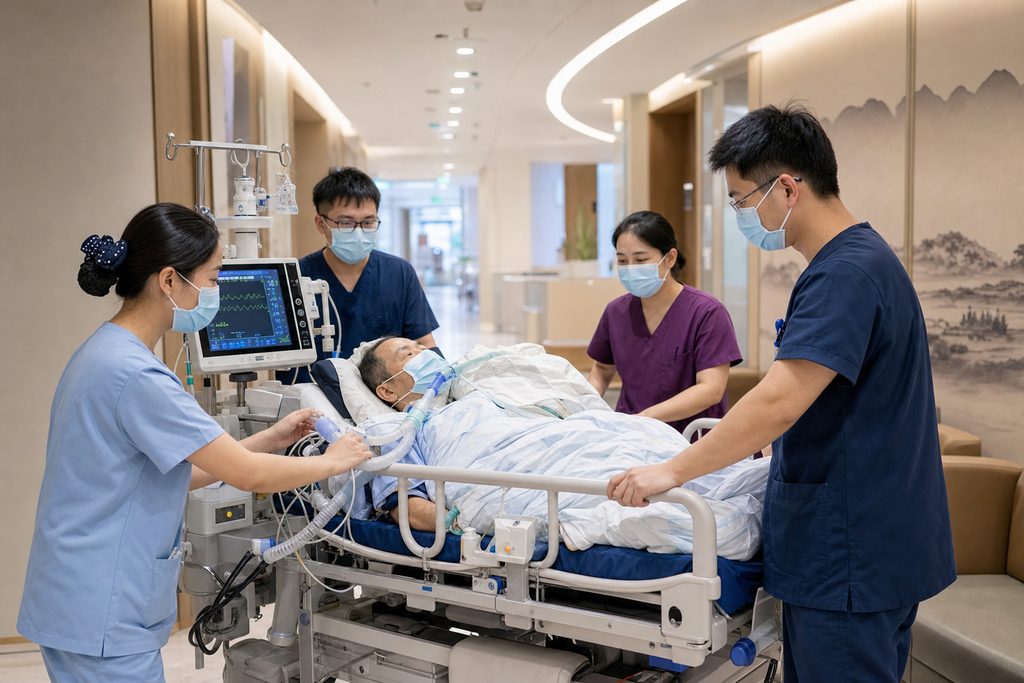
Key Takeaways
- China’s top respiratory hospitals manage weaning success rates above 60% for patients who have been ventilator-dependent for over 21 days, matching or exceeding rates reported in major US and European ICUs.
- The structural cost advantage is significant—a full month of specialized weaning and respiratory care in China often costs less than a single week in a comparable Western long-term acute care facility.
- Transferring a ventilator-dependent patient internationally is a high-risk logistical puzzle. Commercial medical evacuation without a confirmed admission plan can exhaust a family’s resources before treatment even starts.
- No one should attempt a self-directed transfer. The sequence must be: clinical acceptance first, then medical repatriation, then arrival. Getting this order wrong is the most common and most dangerous mistake we see.
The Problem: When the Ventilator Doesn’t Stop
Prolonged mechanical ventilation—defined as a dependency lasting 21 days or more—affects approximately 5% to 10% of ICU patients who initially require intubation. In the United States alone, that translates to over 100,000 new prolonged-weaning cases each year. The downstream reality for families is brutal. Insurance coverage for long-term acute care hospitals (LTACHs) frequently caps at 20 to 30 days. Once that limit hits, the daily out-of-pocket cost can exceed $3,500. A single month of weaning care can consume $100,000. And there is no guarantee of liberation from the machine at the end of it.
Families find themselves trapped between two terrible options. Option one: watch a loved one linger in a facility that has exhausted its reimbursement clock, while bills accumulate. Option two: consider a transfer abroad to a center that specializes in this exact problem, at a fraction of the cost, but face the terrifying logistics of moving someone who cannot breathe on their own. Most families freeze. They do not know that a structured pathway already exists. The ventilator weaning center China cost structure, combined with clinical volume that breeds genuine expertise, has quietly made certain Chinese hospitals a legitimate consideration for families who refuse to give up.
Who We Are
We are not a hospital. We do not provide medical treatment, write prescriptions, or make clinical decisions. Our team operates as the logistical bridge between international patients and China’s top-tier medical infrastructure. We handle the sequence: identifying the right hospital for the specific clinical profile, securing a formal acceptance letter from the receiving ICU, coordinating medical evacuation transport, managing S2 visa documentation for both the patient and accompanying family, and providing bilingual medical companions on the ground. We are case managers, not clinicians. But we have coordinated enough prolonged-weaning transfers to know exactly what fails and exactly what works.
Why Specialized Ventilator Weaning Centers in China Deliver Results
Clinical Volume Drives Weaning Protocols
A respiratory ICU in a top Chinese hospital may manage 80 to 120 prolonged-weaning cases annually. That concentrated volume forces the development of protocolized, stepwise weaning approaches—daily spontaneous breathing trials, protocol-driven sedation vacations, and early mobilization even while intubated. Compare this to a general ICU in a Western community hospital that might see 10 to 15 such cases per year. The difference is not in the intelligence of the physicians. It is in the institutional muscle memory. When a team has seen 500 failed weaning attempts, they recognize the pattern on day three, not day ten. The best respiratory care hospital China for long-term ventilation is not a single institution—it is a small group of hospitals with dedicated respiratory failure units that publish their weaning outcomes and refine their protocols annually.
Structural Cost Differences That Actually Matter
The ventilator weaning center China cost sits at roughly $800 to $1,500 per day for a fully equipped respiratory ICU bed with 24-hour intensivist coverage. That includes mechanical ventilation support, daily blood gas analysis, chest physiotherapy, and nursing ratios of 1:1 or 1:2. A comparable LTACH bed in the United States runs $3,500 to $5,000 per day. The gap is not explained by lower quality. It is explained by labor economics, hospital construction costs, and the absence of the multi-layered administrative overhead that defines Western healthcare billing. A 30-day weaning program that might cost $120,000 in the US can be completed for $24,000 to $45,000 in China, including all ICU charges. That is not a promotional claim. It is a verifiable price comparison that any family can confirm by requesting itemized quotes from both systems.
Technology Without the Wait
Hospitals in our network use the same ventilator platforms found in any major Western ICU—Dräger, Hamilton, and Philips Respironics systems dominate. High-flow nasal cannula, non-invasive ventilation bridges, and percutaneous tracheostomy techniques are standard. The difference is access speed. A patient accepted for transfer can be placed in a bed within 72 hours of confirmed payment. No six-week wait for an LTACH bed to open. No insurance peer-to-peer review delays. When a family has decided to pursue this path, the bottleneck should be the medical evacuation flight logistics, not the hospital’s admission calendar.
What You Need to Know Before Going Alone
We have seen families attempt to arrange a transfer independently. Some succeed. Most do not. The barriers are not insurmountable, but they are specific and unforgiving.
- Visa Requirements Are Non-Negotiable: A ventilator-dependent patient cannot enter China on a tourist visa. The correct visa is an S2, annotated for medical treatment purposes. The accompanying family members also require S2 visas. The application requires a formal invitation letter from the receiving hospital, a detailed treatment plan, and proof of financial capacity. Chinese consulates reject incomplete applications without explanation. We have seen families book flights, arrange medical escorts, and then get denied at the visa stage because the hospital’s invitation letter lacked the required official stamp. That mistake costs weeks and thousands of dollars.
- Medical Evacuation Requires Clinical Handoff, Not Just Transport: A commercial air ambulance from Europe or North America to China costs $80,000 to $150,000. A commercial medical escort on a scheduled flight runs $25,000 to $50,000. But the transport company needs a confirmed receiving physician and bed number before departure. No reputable medical evacuation provider will take off without a destination handoff confirmed in writing. Families who book transport first and then look for a hospital learn this lesson the hard way—often while the clock is ticking on a deteriorating patient.
- Language and Documentation Gaps Are Real: The receiving ICU team may include English-speaking intensivists, but the nursing staff, respiratory therapists, and administrative personnel will communicate in Mandarin. Medical records must be translated into Chinese before the clinical review can proceed. A 200-page ICU chart takes a professional medical translator roughly three to four days to convert accurately. Google Translate cannot handle ventilator flow sheets, ABG trends, or sedation weaning logs.
How We Help You Navigate This
These barriers exist for structural reasons, not because anyone is trying to make the process difficult. Our job is to solve each one in sequence, so the family never faces a dead end alone.
The process starts with clinical triage. We collect the patient’s complete ICU records—ventilator settings history, ABG trends, chest imaging, microbiology, medication logs—and have them professionally translated. We then submit the package to one to three respiratory failure centers that match the clinical profile. Not every hospital accepts every patient. A center that excels at weaning post-cardiac-surgery patients may decline a COPD-related prolonged-weaning case. We know which centers prefer which profiles. Once a hospital issues a formal acceptance letter, we coordinate the S2 visa applications for the patient and up to two family members. Simultaneously, we work with the family’s chosen medical evacuation provider to align the transport date with the bed availability.
On the ground in China, our bilingual medical companions meet the patient at the airport and stay through the admission process. They translate during the initial intensivist consultation, ensure the receiving team has every translated record, and remain available throughout the hospitalization to bridge communication gaps. They do not provide clinical care. They ensure nothing is lost in translation. The weaning program itself is entirely under the control of the Chinese clinical team. We stay involved as logistical support—extending visas if the stay lengthens, coordinating family accommodation, and managing discharge planning when the patient is liberated from the ventilator.
Frequently Asked Questions
Safety in a respiratory ICU is determined by three factors: intensivist coverage ratios, nursing staffing levels, and infection control protocols. The hospitals we work with maintain 24-hour in-house intensivist coverage, 1:1 or 1:2 nurse-to-patient ratios in their respiratory ICUs, and JCI or equivalent accreditation for infection control. These are the same structural safety markers you would look for in any Western ICU. The clinical outcomes data—ventilator-associated pneumonia rates, weaning success percentages, ICU mortality—are comparable to published benchmarks from major US and European centers. A 2023 review of weaning outcomes at a major Shanghai respiratory hospital reported a 64% liberation rate at 45 days for prolonged-mechanical-ventilation patients, which aligns closely with the 55% to 65% range reported in the landmark WEAN and PROVENT studies. The care is safe. The question is whether the transfer logistics can be executed without clinical deterioration en route—and that depends entirely on proper planning.
You do not book it like a hotel room. The sequence is: clinical records collection, professional translation, submission to the receiving hospital’s international department, formal clinical review by the receiving intensivist team, issuance of an acceptance letter with a bed confirmation, visa application, and medical evacuation coordination. This process takes 10 to 21 days from first contact to patient arrival, depending on how quickly records can be assembled and translated. Our team manages the entire sequence. The hospital will not accept a booking without a full clinical review first—and no family should want them to. A hospital that accepts a ventilator-dependent patient without reviewing the chart is not a hospital you should trust.
Not every patient weans. The published liberation rates for prolonged-mechanical-ventilation patients cluster between 50% and 65% across all major centers globally. Some patients will require permanent ventilatory support. In those cases, the clinical team shifts focus to optimizing the patient for home ventilation with a portable device and training family members in tracheostomy care and ventilator management. The goal becomes discharge to home or to a long-term care facility, not indefinite ICU occupancy. The cost structure in China makes long-term respiratory care more sustainable than in many Western systems, but families need to understand that weaning is not guaranteed. We never promise liberation. We promise access to a team that has done this thousands of times and will give the patient the best possible chance.
There are three separate cost categories. First, the medical evacuation: $25,000 to $150,000 depending on whether a commercial medical escort or a dedicated air ambulance is required. Second, our coordination fee for case management, translation, visa support, and ground accompaniment: from $5,000 to $8,000 depending on case complexity. Third, the hospital charges: $800 to $1,500 per day for the respiratory ICU bed, ventilator support, and clinical care. A 30-day weaning attempt, all-in, typically ranges from $55,000 to $100,000. That is a wide range because every case is different. A patient flying from Dubai on a commercial medical escort will have a very different cost profile than a patient requiring a trans-Pacific air ambulance from Los Angeles. We provide a detailed, line-by-line estimate only after we have reviewed the clinical records and confirmed the receiving hospital’s acceptance.
Your Next Step
Transferring a ventilator-dependent loved one to another country for specialized weaning care is not a decision anyone makes lightly. The risks are real. The logistics are unforgiving. But for families facing the exhaustion of insurance limits and the slow erosion of hope in a system that has run out of options, the existence of a structured, clinically credible pathway matters. It changes the calculus from “we have no choice” to “we have a difficult choice, but it is ours to make.”
If you are considering this path, start with the clinical records. Gather everything. Then reach out to our team for a free consultation. We will review the case honestly and tell you whether a transfer is feasible—or whether the risks outweigh the potential benefit. No pressure. No pitch. Just a clear-eyed assessment from a team that has navigated this road before.
For more medical information and treatment options in China, visit chinamedservices.com (China Medical Services).
