Solo Patient Guide to China Medical Care: Full Companion Service
Solo Patient Medical Travel to China: The Short Answer
Yes, you can have surgery alone in China. A full companion service for surgery in China makes it feasible by pairing you with a bilingual coordinator who manages hospital navigation, translation, and daily logistics from arrival through discharge. But it is not a substitute for a family member, and it does not eliminate every risk of traveling solo for a major procedure.
The honest caveat: Chinese public hospitals operate at enormous scale. A top-tier facility may see 10,000 outpatient visits in a single day. Without Chinese language ability, even checking in for a scheduled appointment can take hours of confusion. That is precisely where a structured companion service earns its cost.
Who This Is Right For — and Who It Isn’t
Traveling alone for medical care works best when the procedure is well-defined, the recovery is predictable, and the patient is mentally prepared for a different healthcare culture. It is not for every case.
Good candidates typically include:
- Patients undergoing elective procedures with clear pre-operative requirements, such as orthopedic joint replacement, cardiac catheterization, or minimally invasive gynecological surgery
- People who have already completed a remote consultation and received a written treatment plan from a Chinese hospital
- Independent travelers comfortable with long flights and unfamiliar food, who do not require emotional support from family during recovery
- Patients whose procedures require a hospital stay of less than 10 days
Who should reconsider:
- Anyone undergoing major open surgery with a high risk of post-operative complications requiring rapid decision-making
- Patients with cognitive decline, severe anxiety, or conditions that impair communication even in their native language
- Those who cannot arrange a trusted contact back home to receive updates and make decisions if incapacitated
- People expecting Western-style bedside nursing ratios. Chinese hospitals rely heavily on family members for basic care tasks — feeding, bathing, repositioning. A companion service can arrange a private nurse, but this must be planned in advance.
Being explicit about who should not do this matters. A companion coordinator is not a legal guardian or medical proxy.
The Options, Compared
If you are traveling solo, you essentially have three service models to choose from. They differ sharply in cost, coverage, and control.
| Option | What You Get | Typical Cost | Best For |
|---|---|---|---|
| Hospital international department only | English-speaking registration staff, priority scheduling, VIP ward access. No outside coordination beyond hospital walls. | 1.5–2x standard hospital charges | Patients who speak some Mandarin or have local contacts |
| Bilingual medical companion (day-rate) | A coordinator escorts you to appointments, translates, handles payment queues, and communicates with nurses. Does not include 24-hour bedside care. | from $300/day | Short diagnostic trips, second opinions, minor procedures |
| Full companion service for surgery in China | End-to-end case management: pre-arrival record translation, hospital matching, appointment coordination, airport pickup, daily companion, post-discharge follow-up coordination, private nurse arrangement if needed. | $5,000–8,000 for VIP end-to-end coordination, plus daily companion fees | Solo patients undergoing surgery or multi-day hospitalization |
Most solo patients fall into the third category. The day-rate companion works if you only need help navigating outpatient visits. But surgery means hospital admission, pre-operative testing across multiple departments, and post-operative instructions you must understand precisely. That requires someone who knows the hospital’s internal workflow, not just the language.
What a Full Companion Service Actually Does During Your Hospital Stay
This is the section that answers the question behind the search: what exactly am I paying for when I hire a full companion service for surgery in China?
The service breaks into three phases.
Pre-arrival. Your coordinator collects all existing medical records, imaging files, and lab reports. These get translated into Chinese by medical translators — not general linguists. The coordinator then submits them to the target hospital’s international department or specialty department for review. If the hospital requests additional tests, you learn about this before booking a flight. This alone can save thousands of dollars in wasted travel.
Admission and surgery. On arrival, the companion meets you at the airport, handles hotel or hospital check-in, and escorts you through every department: blood draws, ECG, imaging, anesthesia consultation. They hold your documents, pay deposits at the correct windows, and confirm that each department knows your case. When the surgeon explains the consent form, the companion translates it line by line and asks the questions you wrote down the night before.
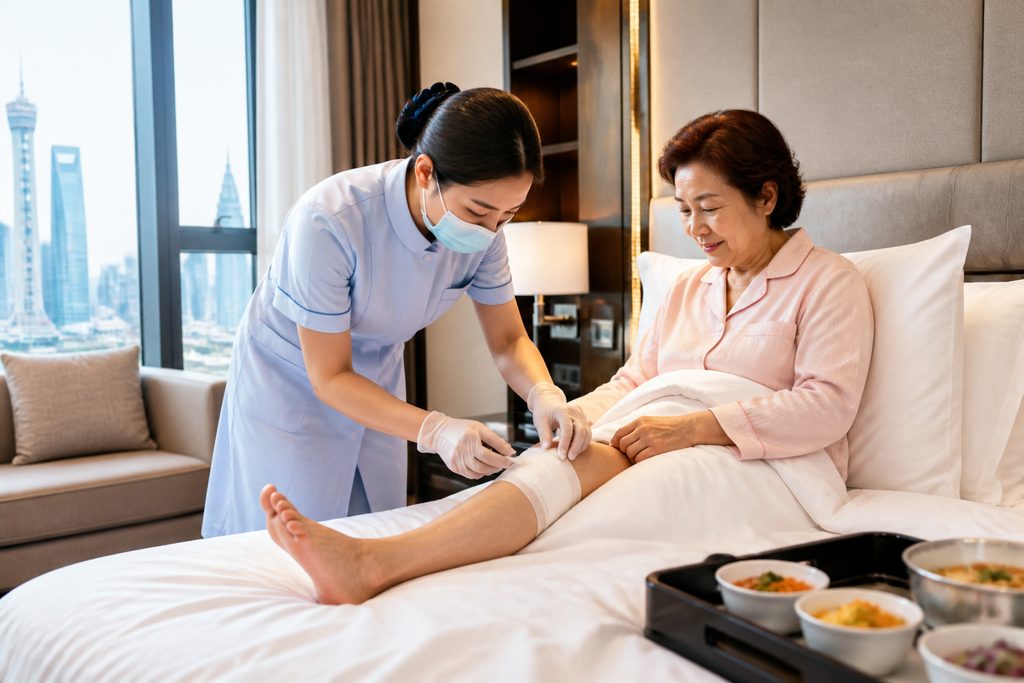
Post-operative recovery. This is where solo travel gets hard. You wake up groggy. You need to communicate pain levels. You need to understand wound care instructions, medication schedules, and dietary restrictions. The companion visits daily, relays your concerns to the nursing station, and arranges a private nurse if you need overnight assistance. Before discharge, they collect your discharge summary, medication list, and follow-up imaging schedule, and translate everything into English for your doctor at home.
Solo Patient Medical Travel China Cost: What to Budget
Your designated emergency contact is called. If you have not designated one, the hospital follows its internal protocols, which may mean making decisions without your input. This is why solo patients should execute a medical power of attorney before travel and provide a translated copy to the hospital and their companion service. A companion is not authorized to make medical decisions for you.
Most international health insurance plans do not reimburse companion service fees. Some medical tourism policies include a coordination benefit, but this is rare. The hospital’s medical charges may be reimbursable, depending on your plan’s out-of-network and international coverage terms. Ask your insurer specifically about treatment in China before committing to anything.
For a surgical case, allow at least four to six weeks. Record translation, hospital review, visa processing, and scheduling all take time. For a written second opinion, two to three weeks is usually sufficient. Rushed cases can be accommodated, but the risk of miscommunication rises sharply when timelines compress.
A medical companion handles logistics: translation, queueing, payment, directions, and daily communication with hospital staff. A patient advocate does all of that plus actively represents your interests in disputes, questions treatment recommendations, and negotiates on your behalf. In practice, a good companion service provides both functions, but confirm this before signing anything.
Your Next Step
Traveling alone for surgery in China is a serious undertaking, but thousands of international patients do it every year with the right preparation. The key is separating the medical decision from the logistical one. Choose your hospital based on clinical reputation — our database of 340+ top-ranked hospitals is a starting point. Then build a support system around that decision.
We are China Medical Services, a coordination team that connects international patients with top-tier Chinese hospitals. We are not a hospital, we do not employ doctors, and we do not offer diagnoses or treatment recommendations. What we do is handle the practical layer: record translation, hospital matching, appointment coordination, and bilingual companionship on the ground. If you want to explore whether a full companion service for surgery in China fits your case, request a free consultation. We will ask about your diagnosis, your records, and your goals — then tell you honestly whether this path makes sense for you.
Frequently Asked Questions
Yes. The hospitals used for international patients are JCI-accredited and follow the same international safety standards as top hospitals in the US and Europe. Surgical teams perform high volumes of procedures — often more than their Western counterparts — which studies show leads to better outcomes.
Costs vary by procedure and hospital, but international patients typically save 40-80% compared to US prices — even when factoring in travel and accommodation. A consultation with our team will give you an exact, all-inclusive quote with no hidden fees.
Send us your existing medical reports to get started. We handle everything from hospital selection and appointment scheduling to visa assistance and post-operative recovery planning. Your medical records are reviewed by the specialist before you even book a flight.
For more medical information and treatment options in China, visit chinamedservices.com (China Medical Services).
