Hospital Matching for Central Asian Patients: A Practical Guide to China’s Top Medical Centers
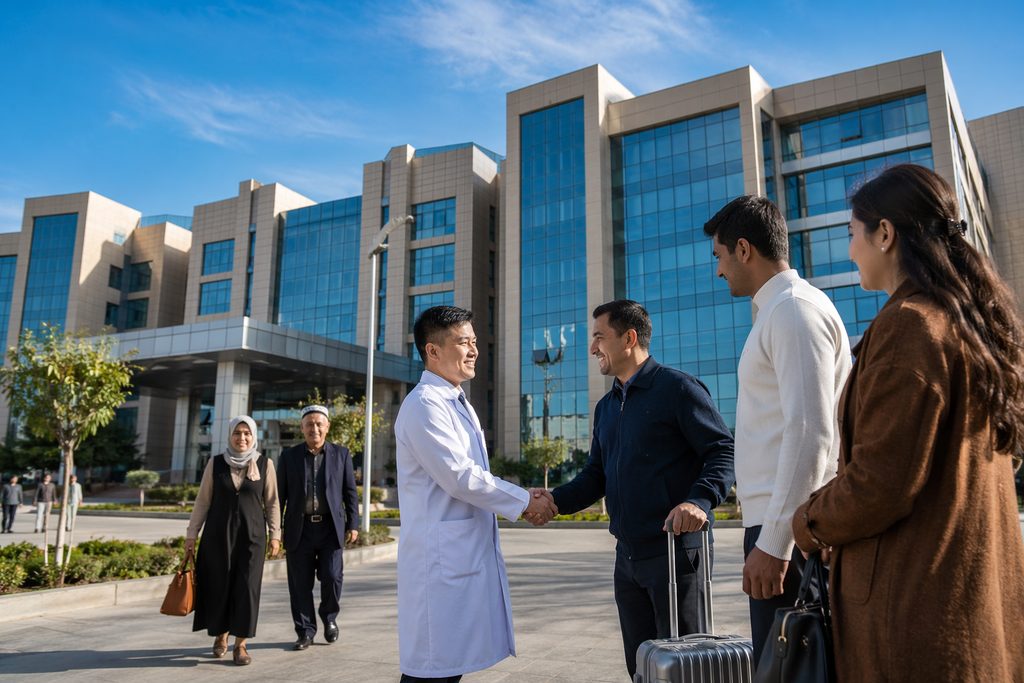
Hospital Matching for Central Asian Patients: Finding the Right Chinese Medical Center Without the Guesswork
Key Takeaways
- China’s top-tier hospitals handle surgical volumes that dwarf Western centers — Fuwai Hospital alone performs over 14,000 cardiac surgeries annually, more than any other heart center on earth.
- The cancer treatment cost in China for foreigners typically runs 70-80% below US prices, with comparable clinical outcomes at Fudan-ranked institutions.
- Public hospital outpatient departments cannot be pre-booked from abroad — you must physically queue on the day. International VIP channels are the only way to lock in a schedule before flying.
- Language is the single biggest barrier. Without a bilingual coordinator, navigating a hospital that sees 10,000+ outpatients daily becomes nearly impossible for non-Chinese speakers.
The Problem: Central Asian Patients Face a Brutal Gap Between Need and Access
Kazakhstan’s Ministry of Health reported in 2023 that over 31,000 citizens sought treatment abroad annually, with oncology, cardiac surgery, and orthopedics topping the list. The reasons are structural. Domestic wait times for complex procedures stretch past six months in Almaty and Astana. Advanced radiation therapy equipment remains concentrated in two or three urban centers. And for rare or aggressive cancers, local treatment protocols often lag international guidelines by three to five years.
Uzbekistan, Kyrgyzstan, and Tajikistan face even steeper constraints. A 2022 WHO assessment of Central Asian healthcare infrastructure noted that fewer than 15% of regional hospitals met international accreditation standards for complex surgical care. Patients with means look outward. Turkey, South Korea, and Germany have traditionally absorbed this demand — but costs in those destinations have climbed sharply since 2020. A cardiac bypass in Seoul now runs $35,000-50,000. In Berlin, closer to $45,000. That’s where the arithmetic changes.
China offers a different equation. Same flight time from Almaty as Istanbul. Procedures at Fudan-ranked hospitals priced at one-fifth to one-tenth of Western benchmarks. And surgical teams that perform complex interventions at volumes no European center can match. But access isn’t automatic. The system is opaque, language is a wall, and the wrong hospital choice can waste thousands of dollars and weeks of time.
Why Hospital Matching for Central Asian Patients Works Better With a Structured Approach
Clinical Volume Creates Competence You Can’t Replicate Elsewhere
The numbers are stark. A top Chinese orthopedic surgeon completes 300-500 joint replacements every year. The average US surgeon does roughly 65. For cardiac surgery, the gap widens further — Chinese teams at Fuwai and Zhongshan routinely log 400+ bypass procedures annually per surgeon, versus 100-150 for their American counterparts. Volume drives outcomes. Studies published in The Lancet and JAMA have repeatedly shown that higher surgical volume correlates directly with lower mortality rates and fewer complications. When you’re choosing where to have your chest opened or your spine fused, that correlation matters more than any marketing brochure.
For Central Asian patients specifically, this volume advantage translates into something concrete: Chinese surgeons have seen your condition hundreds of times, including the complex presentations that get referred away from smaller regional centers. A cardiac surgeon in Urumqi or Beijing isn’t surprised by advanced coronary disease in a 45-year-old Kazakh patient with a heavy smoking history. They’ve operated on hundreds of similar cases.
Technology That Matches or Exceeds Western Standards — At Scale
Walk through any Fudan Top 100 hospital in Shanghai or Beijing and you’ll find equipment that would be the pride of any US academic medical center. Robotic surgical systems. Proton therapy centers. Hybrid operating suites. The difference is throughput. China has installed more da Vinci robotic systems than any country except the US, and Chinese surgeons use them relentlessly — some centers log 1,000+ robotic procedures annually. That operational tempo breeds proficiency.
But the technology story isn’t just about machines. It’s about workflow. Chinese hospitals operate on a scale that forces efficiency. A single oncology department in Shanghai might see 3,000 patients daily. That means diagnostic pathways are compressed, imaging turnaround is measured in hours not weeks, and treatment planning happens fast. For a patient who’s already waited six months at home, that speed has real value.
The Cost Advantage Is Structural, Not a Quality Compromise
Let’s address the elephant directly. When Central Asian patients hear that a cancer treatment cost in China for foreigners runs $15,000-30,000 for a full course of radiation and chemotherapy — versus $80,000-150,000 in the US — they wonder what’s being cut. The answer: nothing clinical. Chinese healthcare costs less because labor costs less. A senior surgeon’s salary in Shanghai is a fraction of what a comparable specialist earns in Houston or Munich. Hospital construction costs less. Malpractice insurance costs less. Administrative overhead is leaner. The savings are structural, not clinical.
That means you’re not buying a discount version of care. You’re buying the same care at local labor prices. The Fudan-ranked hospital performing your knee replacement uses the same implant brands — Zimmer, Stryker, DePuy — that you’d get in Seoul or Berlin. The difference is the price tag attached to the hands installing it.
How Hospital Matching Actually Works for Central Asian Patients: The Real Process
Here’s the unvarnished truth about how to book medical treatment package China from Kazakhstan or any other Central Asian country. There’s no single portal. No centralized booking system. Each hospital runs its own process, and most public hospitals don’t accept international patients through their standard outpatient channels at all.
The pathway that works looks like this. First, you compile your complete medical records — imaging, pathology reports, prior treatment summaries — and have them translated into Chinese or English. Second, you identify the right hospital and department based on your specific diagnosis. This is where hospital matching earns its keep. A patient with liver cancer needs a different institution than one with a failed knee. Sending your records to the wrong specialty wastes weeks.
Third, you secure access through one of two routes: the hospital’s international department, or a private international hospital that accepts foreign patients directly. Public hospital international departments charge 1.5-2x standard rates but offer English-speaking coordinators, expedited scheduling, and private rooms. Private JCI-accredited hospitals like United Family or Jiahui charge more still but provide Western-style service and direct insurance billing.
Fourth, you travel. Most Central Asian patients fly into Urumqi (closest major hub), Beijing, or Shanghai, depending on where their matched hospital is located. The S2 visa covers medical treatment stays of up to 180 days. Family members traveling with you apply for the same category.
Fifth, you undergo in-person evaluation. This is non-negotiable. Chinese surgeons will not operate without examining you first. Expect 3-7 days of diagnostic workup before any surgical date is confirmed.
Choosing Between Public, Private, and Specialty Hospitals: What Central Asian Patients Need to Compare
Not all Chinese hospitals are interchangeable. The right choice depends on your diagnosis, your budget, and how much hand-holding you need. Here’s the breakdown that matters for Central Asian patients weighing their options.
| Hospital Type | Best For | Cost Range (USD) | Language Support | Insurance Billing |
|---|---|---|---|---|
| Fudan Top 100 Public (International Dept.) | Complex surgery, rare cancers, cardiac procedures | $12,000-40,000 per procedure | English-speaking coordinators | Pre-pay, then reimburse |
| JCI-Accredited Private (United Family, Jiahui) | Routine surgery, obstetrics, wellness | $20,000-60,000 per procedure | Full English staff | Direct billing accepted |
| Specialty Centers (Fuwai, Eye & ENT Hospital) | Single-organ expertise, highest volumes | $15,000-35,000 per procedure | Limited English | Pre-pay, then reimburse |
The JCI accredited hospitals in Beijing list includes names like Beijing United Family Hospital, OASIS International Hospital, and Beijing Puhua International Hospital. These facilities offer the smoothest experience for English-speaking patients but at a premium. For complex oncology or cardiac cases, the Fudan-ranked public hospitals remain the clinical gold standard — even if the administrative experience is rougher.
For orthopedic procedures like knee replacement, the best hospital in Shanghai for knee replacement is typically Shanghai Sixth People’s Hospital or Huashan Hospital, both of which run orthopedic departments that perform 2,000+ joint replacements annually. Their international departments handle Central Asian patients regularly and have streamlined the pre-operative workup process.
Practical Considerations: Visas, Payments, and What Happens After You Fly Home
The S2 visa is the correct category for medical treatment in China. It’s issued for private affairs, including medical care, and allows stays up to 180 days. Your accompanying family members apply for S2 visas as well. You’ll need an invitation letter from the Chinese hospital confirming your treatment plan, plus your passport, photo, and completed application form. Processing takes 1-2 weeks at Chinese embassies in Almaty, Tashkent, or Bishkek. No visa is guaranteed — the hospital’s documentation strengthens your application but doesn’t guarantee approval.
Payment is another reality to plan for. Chinese public hospitals require pre-payment. You’ll deposit an estimated treatment cost upfront — typically 50-100% of the quoted amount — and the hospital draws down from that deposit as services are rendered. Bring a credit card with a high limit, or arrange a wire transfer in advance. Cash is accepted but impractical for amounts over a few thousand dollars. Private international hospitals are more flexible and often bill insurance directly.
Language remains the persistent challenge. Even hospitals with international departments have gaps. Your surgeon may speak English. The radiology technician almost certainly won’t. The pharmacy counter staff won’t. The billing office won’t. That’s why bilingual support isn’t a luxury for Central Asian patients — it’s the difference between a smooth treatment journey and a week of confusion in a hospital corridor. If you travel without it, budget extra time for every administrative step.
Follow-up care after returning home is the final piece. Chinese hospitals provide discharge summaries in English upon request, and many departments offer remote follow-up consultations via video. But your local doctors in Kazakhstan or Uzbekistan will need to manage ongoing care. Bring your complete medical records home with you, translated if possible, and schedule a handoff appointment with your local specialist within two weeks of return.
Frequently Asked Questions
The safety record at top Chinese cardiac centers is comparable to Western benchmarks. Fuwai Hospital’s mortality rate for coronary bypass surgery runs below 1%, matching or beating US national averages. The key is hospital selection — outcomes at Fudan-ranked centers are excellent, while smaller regional hospitals show more variance. How safe is heart surgery in China depends almost entirely on which hospital you choose.
Yes, but only through international departments or private hospitals. Standard public hospital outpatient clinics cannot be pre-booked from abroad — you must queue in person on the day. International VIP channels allow advance scheduling, but expect to pay 1.5-2x standard rates for that privilege. The package typically includes initial consultation, diagnostic workup, and a tentative surgical date, though final scheduling depends on in-person evaluation.
Chinese hospitals provide post-operative care protocols and typically offer remote follow-up consultations for international patients. However, any complications requiring surgical intervention would need to be managed locally or through a return trip to China. This is a real limitation of medical tourism anywhere, not just China. Discuss your specific risk profile with the treating surgeon before committing to travel.
Generally yes. A lumbar fusion that costs $25,000-35,000 in Turkey runs $12,000-20,000 at a top Chinese orthopedic center. The gap narrows for minimally invasive procedures where technology costs dominate, but China still holds a 20-40% price advantage across most spine surgeries. The trade-off is language support and international patient infrastructure, which Turkey has built out more aggressively.
Your Next Step
Hospital matching for Central Asian patients isn’t about finding the cheapest option — it’s about finding the right clinical team for your specific diagnosis, then navigating the administrative path to reach them. China Medical Services maintains a database of 340+ top-ranked hospitals across 37 Chinese cities and helps international patients identify the right institution, coordinate appointments, and arrange bilingual support on the ground. We’re not a hospital and we don’t provide medical advice. But if you’re weighing treatment options in China, we can help you understand the landscape before you commit to a flight. Start with a free consultation — tell us your diagnosis and we’ll tell you which hospitals actually make sense for your case.
For more medical information and treatment options in China, visit chinamedservices.com (China Medical Services).
