China Pharmacy for Foreigners: How to Fill Prescriptions Safely
Key Takeaways
- China has no Walgreens or CVS equivalent. Prescription medicine is dispensed almost entirely through hospital pharmacies, not standalone retail chains.
- You do not need a Chinese ID card to be seen or treated — but registration systems are built around the national ID, so a passport plus a hospital medical card is the practical workaround.
- Language is the real barrier. Most pharmacy counters operate in Mandarin only, and drug names differ from Western brands.
- Never buy prescription drugs from unlicensed online sellers. Counterfeit and improperly stored medicine is a genuine risk, and enforcement is uneven.
Have you ever stood at a pharmacy counter in a foreign country, holding a prescription you cannot read, hoping someone speaks your language?
That moment captures the whole challenge of navigating medicine in China as a visitor. The system works well — it just was not designed with you in mind.
The Problem: A Pharmacy System Built for Residents, Not Visitors
China’s healthcare system serves 1.4 billion people, and its pharmacy infrastructure reflects that scale. According to the National Medical Products Administration, the country has roughly 600,000 licensed retail pharmacy outlets — but the overwhelming majority are small neighborhood shops that stock basic over-the-counter remedies and traditional Chinese medicine, not the specialty prescription drugs a foreign patient typically needs.
For a visitor with a chronic condition, that gap becomes urgent fast. A traveler managing diabetes, thyroid disease, or hypertension may arrive with a 30-day supply and no clear route to a refill. Someone diagnosed during a trip faces a harder problem: they need a prescription written inside China before any pharmacy will dispense anything.
Then there is the identification issue. Hospital registration systems, pharmacy dispensing records, and online prescription platforms are all keyed to the Chinese resident ID card. A passport works for identity verification at a hospital, but it does not plug into the same automated pipelines. That single mismatch explains why so many foreigners describe the experience as “possible but exhausting.”
Can Foreigners Use Hospitals and Pharmacies in China?
Yes. There is no rule barring foreign nationals from receiving care or filling prescriptions at Chinese medical institutions. What exists instead is a set of practical friction points.
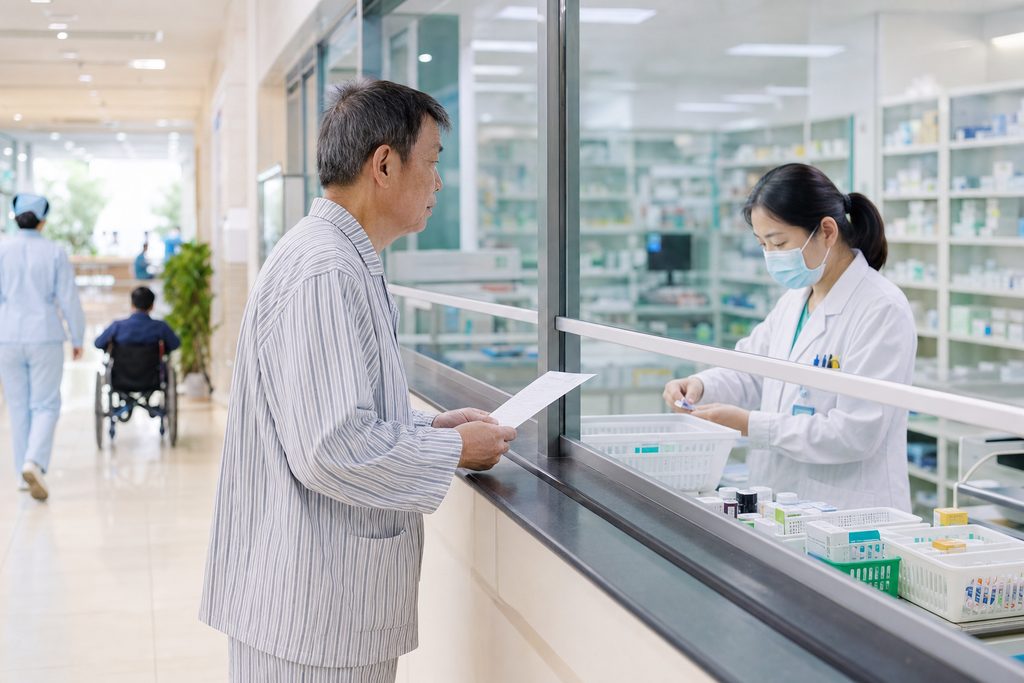
Public hospitals — including the top-tier facilities ranked by Fudan University — treat international patients every day. The catch is workflow. Outpatient registration at most public hospitals happens on-site, often through a queue-and-ticket system. You register, see a physician, receive a prescription, then walk that prescription to the hospital’s own pharmacy window. It is a closed loop, and it works.
Private international hospitals take a different approach. Facilities like United Family, Jiahui, and Parkway operate with English-speaking staff, JCI accreditation, and direct insurance billing. Their in-house pharmacies stock Western-brand medications and can explain dosing in English. The trade-off is cost — typically higher than public hospital pricing.
How to Get Medicine in China Without a Chinese ID
The workaround is straightforward once you understand it: get a hospital medical card.
When you register at a Chinese hospital as a foreign patient, the hospital creates a record tied to your passport number. That record functions as your local identifier. From that point, prescriptions written by that hospital’s physicians flow into its own pharmacy system, and you can collect your medication at the counter.
A few practical notes:
- Bring your passport every time. It is your registration document.
- Expect to pay upfront. Public hospitals require prepayment; insurance reimbursement happens afterward, often after you return home.
- Ask for the generic name. If you take Lipitor, ask whether atorvastatin is stocked. It usually is.
- Keep your receipts. Itemized invoices in English are available at international departments and are essential for insurance claims.
For anything beyond a simple refill, the sequencing matters. A physician must see you in person before writing a prescription for most regulated medications. That is not bureaucracy for its own sake — it reflects China’s controlled-substance rules, which are strict. Narcotics and certain psychotropics face additional layers of oversight that can make short-term visitor access genuinely difficult.
English Speaking Pharmacy Options in Shanghai and Beijing
Where you are in China changes your options considerably.
Shanghai has the deepest bench for international patients. The city hosts 18 hospitals on the Fudan Top 100 list, and several operate dedicated international or VIP wings with English-capable pharmacy counters. Private international hospitals cluster in districts like Pudong and Jing’an, and their pharmacies routinely handle foreign prescriptions and insurance paperwork.
Beijing is comparable in quality, with 21 Fudan-ranked hospitals — more than any other Chinese city. Peking Union Medical College Hospital operates a well-established international medical department. For routine needs, the international clinics attached to private hospitals are the path of least resistance.
Outside these two cities, English-language pharmacy support thins out quickly. A hospital in Chengdu or Xi’an may offer excellent clinical care while its pharmacy counter operates entirely in Mandarin.
Where to Buy Medicine in Beijing as a Tourist
Tourists need to separate two very different needs: everyday remedies and prescription medication.
For headaches, colds, digestive upset, or minor injuries, hotel-adjacent pharmacies and convenience stores carry adequate over-the-counter options. Brand names will look unfamiliar, but the active ingredients are standard. Asking for the generic name — “ibuprofen,” “acetaminophen,” “oral rehydration salts” — gets you further than brand names.
For prescription medication, the tourist route is the hospital route. There is no shortcut. Walk-in retail pharmacies in China generally cannot dispense prescription drugs without a valid domestic prescription, and a prescription from your home country does not transfer automatically.
If you are in Beijing specifically and need prescription medicine, the practical sequence is: register at a hospital with an international department, see a physician, receive the prescription, fill it at that hospital’s pharmacy. Budget most of a day for the first visit.
Prescription Medicine Delivery in China for Foreigners
Delivery exists, and it is fast. Platforms like JD Health and Alibaba’s Taobao-linked pharmacy services move medication to doorsteps within hours in major cities.
Here is the friction: those platforms are built for Chinese residents. Account creation typically requires a Chinese mobile number, and prescription verification runs through domestic systems. Some international hospitals now offer their own delivery or courier arrangements for established patients, which sidesteps the problem entirely.
If you are staying long enough to set up a Chinese phone number, delivery becomes genuinely convenient. For short trips, it usually is not worth the setup effort.
One caution worth repeating: buy only from licensed, traceable sources. Unregulated online sellers advertising steep discounts on prescription drugs are a known vector for counterfeit products. The savings are not worth the risk.
Practical Considerations Before You Travel
Documentation comes first. Carry your original prescriptions, a letter from your home physician listing diagnoses and current medications with generic names and dosages, and enough supply to cover your trip plus a buffer. A two-week buffer is sensible.
On visas, the category that applies to medical treatment is S2, used for short-stay private affairs including medical care, with S1 for stays beyond 180 days. Accompanying family members apply under the same category. Requirements shift, so confirm current specifics with the nearest Chinese embassy or consulate and bring supporting hospital documentation. Note that the M visa is for commercial and trade activity — it is not the medical route.
Payment in public hospitals is upfront, by card or mobile payment. International cards work at larger hospitals but not universally, so carry a backup. Private international hospitals often bill insurance directly, which reduces the cash-flow burden considerably.
If you would like to understand how hospital selection works before committing to a trip, our overview of China’s top-ranked hospitals by city is a useful starting point. For private facilities with English-speaking staff and direct insurance billing, see our guide to private international hospitals.
Frequently Asked Questions
No. A prescription written outside China does not authorize dispensing inside China. You need a Chinese-licensed physician to write a domestic prescription, which means an in-person consultation at a hospital. Bring your foreign prescription as documentation of your treatment history — it helps the Chinese physician, but it does not substitute for their own prescription.
No. Your passport is sufficient for registration. The hospital will issue a medical card linked to your passport number, and that card becomes your identifier for prescriptions and follow-up visits. The process takes a few extra minutes at registration but is routine at hospitals that see international patients.
Go to a hospital with an international department as early as possible — do not wait until your supply is exhausted. Bring your medication packaging and any documentation you have. Most common maintenance drugs are available in China under generic names. For controlled substances, expect additional restrictions and plan ahead rather than relying on local access.
From licensed platforms tied to registered pharmacies, generally yes. From unregulated sellers, no — counterfeit and improperly stored medication is a documented problem. If a price looks implausibly low or the seller cannot show a pharmacy license, walk away.
Your Next Step
Navigating Chinese pharmacies as a foreigner is entirely doable once you know that the hospital — not the retail pharmacy — is the center of the system. Bring documentation, expect to register in person, and plan for language as your main obstacle rather than access.
We are China Medical Services, a coordination team that helps international patients find appropriate hospitals, arrange appointments, and navigate language and logistics on the ground. We are not a hospital and we do not provide diagnoses or medical advice. If you would like to talk through your situation before your trip, you can start with a free consultation — no commitment, just clarity.
This article is for general information only and does not constitute medical advice. Always consult a qualified physician regarding your specific medications and treatment.
For more medical information and treatment options in China, visit chinamedservices.com (China Medical Services).
