Post-Surgery Recovery in China: Hotel Nursing, Wound Care & Full-Service Companions
Post-Surgery Recovery in China: The Short Answer
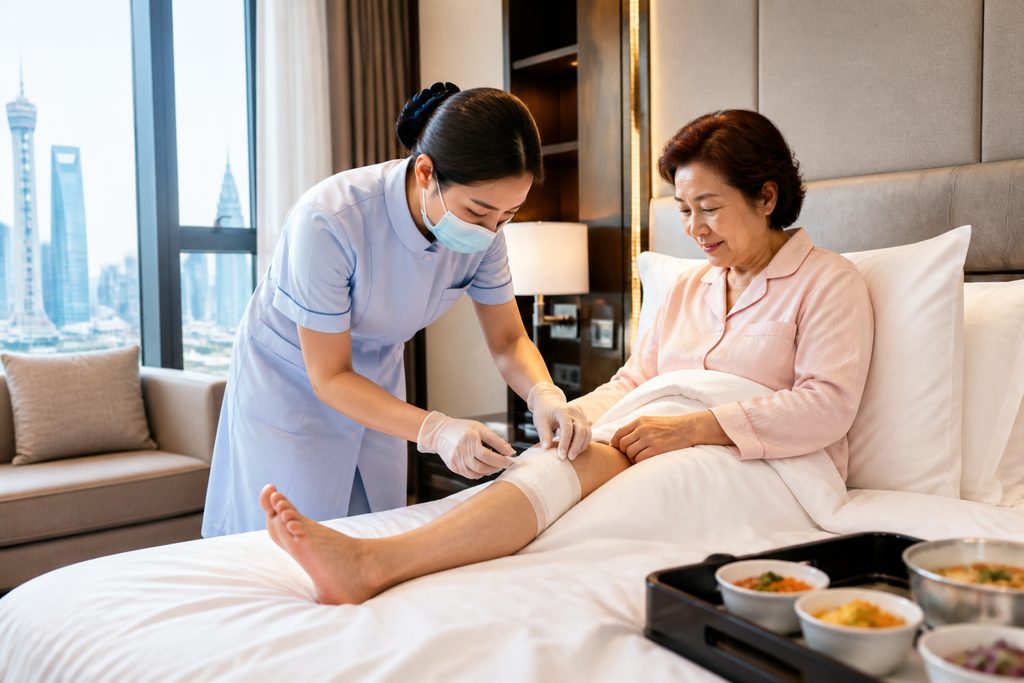
For a medically stable patient, the post surgery recovery hotel nursing China price typically starts from $300 per day for a bilingual companion who handles logistics and basic care oversight. Adding a registered nurse for clinical wound care and monitoring brings the daily rate higher, often into the $500–$800 range depending on the city and the complexity of the dressing changes. It is a real, functioning model—thousands of domestic and international patients use it annually, particularly in Shanghai and Beijing, where top-tier hospitals discharge patients quickly but the city’s private service infrastructure can step in seamlessly.
But the sticker price is only the beginning of the story. Whether this model is safe for you depends on your surgery type, your post-operative stability at discharge, and the specific hotel’s willingness to accommodate clinical care. A hotel room is not a hospital ward. It works brilliantly for some recoveries and is genuinely dangerous for others.
Who This Is Right For — and Who It Isn’t
When 37-year-old Aisha from Dubai traveled to Shanghai for a laparoscopic myomectomy, she was discharged on day three. Her surgeon cleared her for hotel-based recovery because her vitals were stable, her incisions were small, and she had no drains. For her, a hotel suite with daily nursing visits for wound checks was ideal. She avoided a prolonged hospital stay and recovered in comfort with her mother beside her.
That same model would be reckless for a patient with a fresh sternotomy, a newly placed surgical drain, or labile blood pressure. So we are direct about eligibility.
Typically a good candidate:
- Discharged in stable condition with written clearance from the operating surgeon for outpatient recovery.
- Minimally invasive or superficial surgery: laparoscopic procedures, arthroscopy, cosmetic surgery, minor spinal interventions, thyroidectomy, hernia repair.
- Wound care needs that are manageable with once- or twice-daily dressing changes, not continuous vacuum-assisted closure or complex irrigation.
- Independent mobility—can transfer to a wheelchair or walk to the bathroom with minimal assistance.
- A companion (family or hired) present overnight.
Not suitable:
- Open thoracic or major abdominal surgery within the first 5–7 days post-op.
- Active surgical drains still outputting significant fluid.
- Unstable vital signs, new-onset arrhythmia, or oxygen saturation below 92% on room air.
- High risk of pulmonary embolism or post-operative bleeding where immediate ICU-level intervention might be needed.
- Any condition where the surgeon explicitly recommends continued inpatient monitoring.
This is not about toughness. It is about physiology. Bleeding, sepsis, and pulmonary embolism do not announce themselves politely. They happen fast. A hotel, no matter how luxurious, does not have a rapid response team down the hall.
The Options, Compared
Patients recovering in China after surgery typically face three genuine paths. The right one depends on clinical need, budget, and personal tolerance for risk.
| Recovery Setting | Daily Cost (USD) | Clinical Oversight | Best For |
|---|---|---|---|
| Inpatient extended stay (hospital ward) | $200–$600 (public hospital international ward) | 24/7 nursing, daily surgeon rounds, rapid emergency response | Major surgery, unstable patients, those with drains or oxygen needs |
| Hotel + visiting nurse + companion | $300–$800 (room, nursing, companion combined) | Scheduled nursing visits, companion present during waking hours, no overnight clinical staff | Stable, minimally invasive post-op patients cleared for discharge |
| Private rehabilitation center or post-acute care facility | $500–$1,200 | On-site nursing, physiotherapy, structured rehabilitation programs | Orthopedic surgery, stroke recovery, patients needing daily rehab |
The hotel route is the middle ground—less clinical than a hospital ward, far more comfortable, and significantly cheaper than a private rehab facility. For the right patient, it is the sweet spot. But the hotel itself must cooperate. Not every property will allow a nurse to perform sterile wound care in a guest room. We always confirm this with the hotel management before booking, and in Shanghai and Beijing, we maintain a list of properties that have said yes in the past.
How the Hotel Nursing Model Actually Works on the Ground
This is not a packaged product you can buy on an e-commerce site. It is a coordination effort involving at least four parties: the discharging hospital, the nursing provider, the companion service, and the hotel. Here is what a typical day looks like for a patient recovering from, say, a laparoscopic cholecystectomy in Shanghai.
The patient is discharged around 10:00 AM. Our bilingual companion is already at the hospital, handling discharge paperwork, collecting the discharge summary and wound care instructions in both Chinese and English, and confirming the follow-up appointment date. A private vehicle takes the patient to a serviced apartment or hotel within 15 minutes of the hospital—this proximity is non-negotiable. If something goes wrong, you need to be back at the emergency department fast.
By 2:00 PM, a registered nurse arrives for the first wound assessment. She checks the incision sites, changes dressings using sterile technique, and documents the wound status with photographs. She also checks vital signs—temperature, blood pressure, heart rate, oxygen saturation. This visit lasts 30–45 minutes. The companion remains in the room, translating every question and answer.
Evening brings a second nursing check, usually shorter—vitals and a quick wound inspection. The companion helps with medication reminders, meal ordering, and communication with the patient’s family back home. The companion leaves by 9:00 PM unless an overnight stay has been arranged, which increases the daily rate.
This rhythm continues for 3–7 days, tapering to once-daily nursing visits as the wound heals. The companion remains throughout. The patient never touches a registration kiosk, never struggles with a food delivery app in Chinese, never wonders whether the mild redness at the incision edge is normal or needs a surgeon’s attention.
The wound care service after surgery China cost component—the nursing visits alone—typically runs $100–$200 per visit, with the total depending on frequency and whether the nurse must travel across the city. Bundling nursing with companion services usually yields a better overall rate.
What It Costs, and What Drives the Variance
The post surgery recovery hotel nursing China price breaks down into three layers, and the final number shifts with each layer’s intensity.
Layer one: the room. A serviced apartment or extended-stay hotel suite in Shanghai’s Jing’an district or near the Beijing CBD runs $120–$250 per night. Proximity to the hospital matters more than luxury. A room 10 minutes from Huashan Hospital costs more than an equivalent room 40 minutes away, and it is worth every dollar.
Layer two: the companion. A bilingual companion starts from $300 per day for an 8-hour shift. This person handles translation, logistics, medication reminders, meal coordination, and communication with the nursing team and the original surgeon’s office. Overnight companionship adds roughly $150–$200. Some families send a relative and only hire the companion for daytime translation, which cuts costs significantly.
Layer three: the nursing visits. A registered nurse for wound care and vital sign monitoring costs $100–$200 per visit. Most patients need twice-daily visits for the first 2–3 days, then once daily for the remainder of the recovery week. Complex wound care—packing a deep incision, managing multiple drain sites—pushes the per-visit rate higher.
A realistic total for a 5-day hotel recovery in Shanghai, with a companion and twice-daily nursing, lands between $2,500 and $4,000. That excludes the hotel room. Add the room, and you are at $3,100 to $5,250. This is not cheap. But compared to extending a hospital stay in the international ward at $400–$600 per night without the comfort and privacy of a hotel, the math often makes sense.
We never quote a single fixed number without understanding the surgery, the discharge status, and the city. Anyone who does is guessing.
Practical Considerations: Safety, Hotels, and the Paper Trail
The question is it safe to recover from surgery in a hotel in China is the one every sensible patient asks. The honest answer: it is safe under specific, narrow conditions, and it is unsafe outside them. The dividing line is not the hotel’s star rating. It is the medical backup plan.
We require three things before we will coordinate a hotel recovery. First, written discharge clearance from the operating surgeon that explicitly states the patient is stable for outpatient recovery. Second, a hotel within 15 minutes’ drive of the hospital that performed the surgery—not any hospital, that specific one, because the surgical team knows the case. Third, a direct phone line to the surgeon’s department, not just the general emergency number. If the patient spikes a fever or the wound looks suspicious at 10:00 PM, the companion calls the department directly, describes the findings, and gets a clinical decision within minutes.
Hotels present their own challenges. Many five-star properties are uneasy about clinical procedures in guest rooms. We negotiate this upfront. The conversation goes something like: “Our guest is recovering from surgery. A registered nurse will visit twice daily to change sterile dressings and check vital signs. No medical equipment beyond a blood pressure cuff and a thermometer. No biohazardous waste beyond sealed dressing packets, which the nurse removes.” Most serviced apartments and extended-stay hotels accustomed to medical tourists agree. Some do not. We find out before you book.
Payment is another layer. Hospital international departments in China typically require a deposit upfront, settled by cash, UnionPay, or major credit cards. The companion and nursing services are paid separately, usually by bank transfer or card, and we provide a single invoice for insurance reimbursement where applicable. Most international insurers will reimburse post-operative nursing care if it is prescribed by the surgeon and documented properly. We provide the documentation package—discharge summary, nursing notes, receipts—formatted for insurance submission.
Language is the invisible risk. A post-operative complication does not wait for a translator. If your companion steps out for lunch and you develop sudden shortness of breath, you need to communicate with hotel staff, ambulance dispatch, and the emergency department in Chinese. This is why we recommend overnight companionship for the first 48 hours after discharge, even if the patient feels fine. It is also why the companion carries a one-page summary of the patient’s surgery, allergies, and surgeon contact details in Chinese, ready to hand to any emergency physician.
Frequently Asked Questions
You cannot safely do it alone. The nursing provider may or may not speak English—many do not. The hotel staff almost certainly will not, at least not at a clinical level. The bilingual companion is the linchpin. That person translates every interaction between you and the nurse, calls the hospital if something changes, and handles every logistical task that requires Chinese. Without that layer, a hotel recovery is a gamble. With it, the language barrier becomes manageable.
Yes, but it is assembled, not pre-packaged. We coordinate the hotel booking, the nursing schedule, and the companion assignment as a single book full service recovery hotel after surgery China arrangement, giving you one point of contact and one consolidated cost estimate. The components—hotel, nurse, companion—remain separate providers behind the scenes, which is why the total varies case by case. No legitimate service will sell you a fixed-price “recovery package” without first reviewing your discharge summary and confirming hotel availability.
This is the hardest question, and the answer is not comforting by design. If you develop a serious complication—a pulmonary embolism, internal bleeding, a wound dehiscence—the hotel room is the wrong place to be. The companion’s job is to recognize red flags early and get you to the hospital before a situation becomes a crisis. But the companion is not a nurse, and the nurse is not present overnight unless you have arranged and paid for that. The safety net is the 15-minute proximity to the hospital and the direct phone line to the surgical department. It is a net, not a guarantee. Patients with conditions that carry a high risk of rapid deterioration should stay inpatient.
In Shanghai, 24 hour companion care post surgery Shanghai packages typically run from $450 to $600 per day when booked as a continuous block. This covers a bilingual companion who remains with you around the clock, handling translation, medication reminders, meal ordering, communication with the nursing team, and emergency coordination. The companion sleeps in the room or an adjacent room depending on the hotel layout. For the first 48 hours after discharge, this is the configuration we recommend most often. After that, most patients step down to daytime-only companionship.
It depends entirely on your policy. Many international plans cover post-operative nursing care when prescribed by the treating surgeon, and some cover medical companion services if deemed medically necessary. The hotel room itself is almost never covered—that is an out-of-pocket expense. We provide the documentation you need to submit a claim, but we cannot guarantee reimbursement. Check with your insurer before you travel, and get pre-authorization in writing if possible.
Your Next Step
Recovering in a hotel after surgery in China is not for everyone. For the right patient—stable, cleared by the surgeon, with a manageable wound and a solid support plan—it offers comfort, privacy, and a faster return to normal life than a prolonged hospital stay. For the wrong patient, it is an unnecessary risk. The decision starts with your surgeon’s discharge assessment, and it ends with honest answers about your own tolerance for being outside a monitored setting.
Our team at China Medical Services does not make that clinical decision for you—we are not doctors, and we do not give medical advice. What we do is build the infrastructure around a safe discharge: the hotel confirmation, the nursing roster, the bilingual companion who ensures nothing gets lost in translation, and the direct line back to your surgical team. If you are considering surgery in China and want to understand your post-operative options, send us your discharge plan and we will give you a transparent, no-pressure breakdown of what a hotel-based recovery would look like for your specific case.
For more medical information and treatment options in China, visit chinamedservices.com (China Medical Services).
