Retina Scan in China: Cost and Booking for International Patients
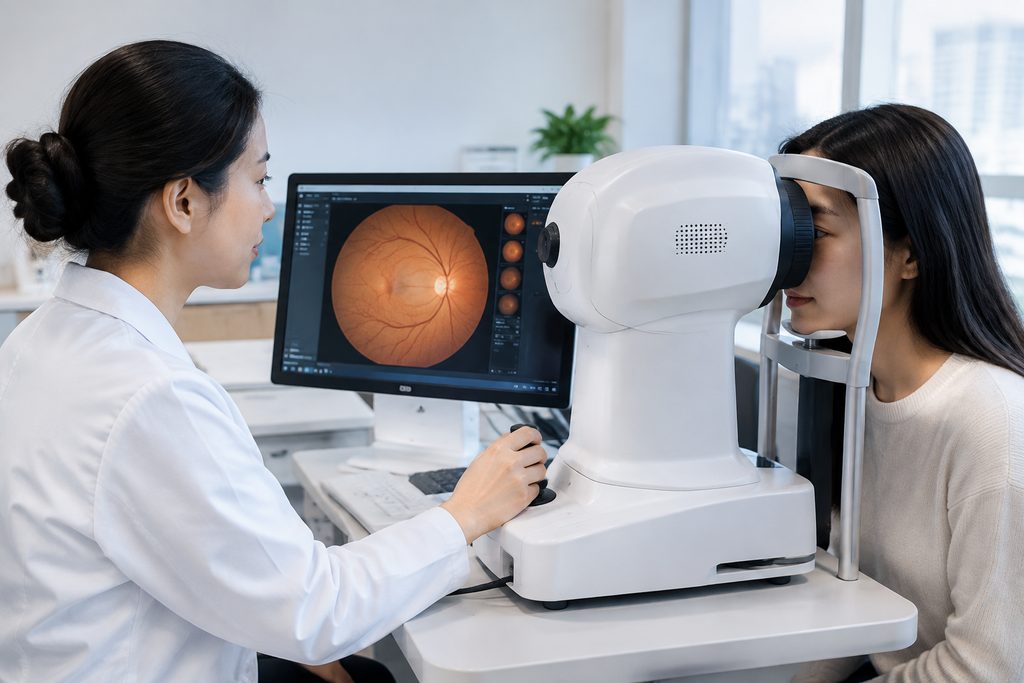
Retina Scan in China: Cost and Booking for International Patients
What if the eye test you need costs a fraction of what you’d pay at home — but you have no idea how to get an appointment from 6,000 miles away? That’s the exact question international patients bring to us every week about the retina scan cost in China, and it deserves a straight answer rather than a sales pitch.
Here it is up front. An OCT (optical coherence tomography) scan at a top-tier Chinese public hospital typically runs $30–$120. A fundus photograph costs $10–$40. A fluorescein angiography (FFA) study lands somewhere between $80 and $250. Compare that to $200–$500 for a single OCT in the United States, and the gap becomes obvious. The real work isn’t the price — it’s the booking.
How This Actually Works, Step by Step
Here’s the honest sequence, from your couch to the imaging chair.
Step one — you send records. You email us your existing eye reports: previous OCT printouts, fundus photos, visual field tests, your prescription, and any diagnosis notes from your ophthalmologist or retina specialist. If you have nothing yet, that’s fine too — you tell us your symptoms (flashes, floaters, distorted vision, diabetic screening, or a routine check).
Step two — a Chinese ophthalmology team reviews the file. Not a call center. An actual eye department at a hospital that performs retina imaging daily. They tell you which scans are appropriate. This matters, because ordering the wrong test wastes your money and your trip.
Step three — you get a written opinion or a video consultation. A written second opinion runs $300–$500. A video consultation with a public hospital international department or private international clinic runs $100–$300. Top-specialist video consults sit at $500–$800, and a multidisciplinary team review is $1,500–$2,000.
Step four — appointment coordination. Once the plan is clear, we handle registration, hospital card creation, and scheduling. Coordination starts from $300, and if we can’t secure the appointment shown in your order, you get a full refund.
Step five — you arrive, and someone walks you through it. Bilingual medical companion service starts from $300/day for a half or full day: queuing, registration, payment, wayfinding, and translation. You are not navigating a 10,000-patient-per-day hospital alone.
What a Retina Scan Actually Costs in China — and Why
Let’s break the numbers down properly, because “retina scan” is a family of tests, not one thing.
| Test | Typical China price (USD) | Typical US price (USD) |
|---|---|---|
| OCT (optical coherence tomography) | $30–$120 | $200–$500 |
| Fundus photography | $10–$40 | $80–$200 |
| Fluorescein angiography (FFA) | $80–$250 | $300–$800 |
| OCT angiography (OCTA) | $60–$180 | $250–$600 |
| B-scan ultrasound | $20–$70 | $150–$400 |
| Comprehensive retina evaluation (exam + imaging) | $150–$400 | $500–$1,200 |
Prices vary by hospital and case complexity. A private international clinic with English-speaking staff and direct insurance billing will sit at the higher end or slightly above these ranges. A public tertiary hospital’s standard channel sits at the lower end.
Why the gap? Volume, mostly. China’s largest eye hospitals perform retina imaging at a scale that spreads equipment costs across enormous patient numbers. The equipment itself — spectral-domain and swept-source OCT devices — is the same hardware you’d see in a Western clinic, often the same brands.
If you want to see how Chinese hospitals are ranked and grouped by specialty, our specialty rankings by department page lists the top centers across 45 clinical fields, ophthalmology included.
A Realistic Timeline
Nobody plans a medical trip around a single scan. Here’s how the calendar usually shakes out, including the steps people forget.
| Stage | Time needed | What’s happening |
|---|---|---|
| Records gathering & translation | 3–10 days | You collect reports; medical documents get translated into Chinese for the hospital |
| Remote review / second opinion | 2–7 days | Chinese ophthalmology team reviews and recommends which scans apply |
| Appointment coordination | 3–14 days | Registration, hospital card, slot confirmation. Popular specialists take longer |
| Visa (S2, short-stay for medical treatment) | 1–3 weeks | Applied for with supporting hospital documents; timelines depend on your local consulate |
| Travel & arrival | 1–2 days | Flights, airport transfer ($200 round-trip), hotel check-in |
| In-hospital visit | Half day to 2 days | Consultation, imaging, results review. Some scans need pupil dilation and same-day reading |
| Results & follow-up plan | Same day to 1 week | Imaging report plus treatment direction, translated for your home doctor |
Realistic total from first email to sitting in the imaging chair: 3 to 6 weeks. If you’re already in China, you can compress that to under a week — but only through the international or VIP channel, and only if the schedule allows.
What Can Go Wrong — and What Happens Then
This is the part most guides skip. We won’t.
You can’t get the exact slot you wanted. Public hospital outpatient registration is same-day and first-come. If a specific professor’s clinic is full, the answer is no. Recourse: we look at alternative dates, alternative specialists in the same department, or a different hospital of comparable rank. If nothing works, the coordination fee is refunded in full.
Your scan reveals something that needs treatment. A retina scan is diagnostic. If it shows a retinal tear, macular edema, or diabetic retinopathy requiring intervention, that’s a separate conversation — and any admission or procedure is subject to the hospital’s own rules and evaluation. We do not promise admission, priority, or outcomes. Ever.
Language breaks down at the wrong moment. Chinese tertiary hospitals are enormous. Signage, payment kiosks, and department navigation are overwhelmingly in Chinese. This is exactly why bilingual companion service exists — and why patients who skip it often lose a full day to confusion.
Insurance doesn’t reimburse as expected. Public hospitals generally require prepayment, with reimbursement claimed afterward from your insurer. Private international hospitals often bill insurance directly. Confirm your policy’s overseas coverage before you book anything.
Choosing the Best Eye Hospital in China for a Retina Scan
China has more than 35,000 hospitals. Our database covers 340+ top-ranked institutions across 37 cities, selected by Fudan rankings and JCI accreditation — roughly the top 5% nationally. For retina work, three categories matter.
Public tertiary eye hospitals and major general hospitals. These carry the deepest retina expertise and the highest imaging volumes. Beijing, Shanghai, and Guangzhou concentrate the strongest ophthalmology departments, and the Fudan specialty reputation rankings name the leading centers in each field. If you’re weighing cities, our Beijing hospital guide and Shanghai hospital guide break down what’s available in each.
Private international hospitals. English-speaking staff, JCI accreditation, direct insurance billing, and Western-style scheduling. You’ll pay more, but the process is smoother and the waiting room is quieter. See our private international hospital directory.
Hospital international departments. The middle path. Senior specialists, English-capable service, and pricing around 1.5–2 times the standard channel — without private-hospital pricing.
How do you judge whether a hospital is right for your case? Three criteria. Does the ophthalmology department perform retina imaging daily at volume? Does it have the specific equipment your condition requires — swept-source OCT, OCTA, or widefield angiography? And can the hospital produce a written imaging report your home doctor can read?
Practical Considerations: Records, Visa, Payment, Language
Records. Bring everything: prior OCT scans, fundus photos, visual fields, OCTA, FFA reports, surgical history, current medications, and your glasses or contact lens prescription. Digital copies plus printed translations save days.
Visa. International patients coming to China for medical treatment use the S2 visa, the short-stay category for medical treatment and private affairs, with supporting hospital documents. Stays beyond 180 days use S1. Accompanying family members apply for S2 as well. Requirements shift — always confirm with the latest embassy or consulate guidance. Note that the M visa is for commercial and trade activity and has nothing to do with medical care.
Payment. Public hospitals: prepay, then claim reimbursement. Private international hospitals: often direct billing. Budget for the scan, the consultation, translation, and companion time separately.
Language. Assume you need help. Even a simple OCT visit involves registration, payment, dilation waiting time, and a results consultation.
Follow-up at home. Ask for the imaging files in DICOM format plus a written report. Your ophthalmologist at home can then compare future scans against a real baseline.
Frequently Asked Questions
Yes. The imaging equipment used at major Chinese hospitals is the same technology found in Western clinics, and the scans themselves are non-invasive. The main safety consideration is the contrast dye used in fluorescein angiography, which carries a small risk of allergic reaction — the same risk anywhere in the world. Tell the team about any prior dye reactions, kidney issues, or pregnancy.
Shanghai pricing tracks the national ranges closely: OCT around $40–$130, fundus photography $15–$45, and FFA $90–$260 at major public hospitals. Private international clinics in the city run higher. Final cost varies by hospital and case complexity, so treat these as planning figures, not quotes.
Not directly at a standard public outpatient clinic — those slots are same-day. What you can do is arrange a remote review first, then have the appointment coordinated through the hospital’s international or VIP channel, which does allow advance scheduling. That’s the practical route for anyone flying in.
Some private international hospitals offer bundled executive eye checkup packages that include retina imaging, and a few combine ophthalmology with broader health screening. These are convenient but rarely cheaper than paying item by item at a public hospital. Compare the contents before choosing.
It depends on your fluency and the hospital. At a large tertiary center, registration systems, payment apps, and department routing are almost entirely in Chinese. If your Mandarin is conversational, you may manage. If it isn’t, a bilingual companion typically saves more time than it costs.
Your Next Step
The retina scan itself is fast, affordable, and technically excellent at China’s top eye centers. The hard part is everything around it — records, scheduling, visa, language, and knowing which test you actually need. That’s the gap we exist to close. We’re a medical concierge service that connects international patients with 340+ top-ranked Chinese hospitals across 37 cities; we are not a hospital and we do not provide medical care or promise clinical outcomes. If you’d like a straight assessment of your case and what it would realistically take, start with a free consultation through our patient support page — no obligation, no pressure, just a clear picture of your options.
For more medical information and treatment options in China, visit chinamedservices.com (China Medical Services).
