Mobility-Limited Senior Medical Service in China: Accessible Transport and Facility Support
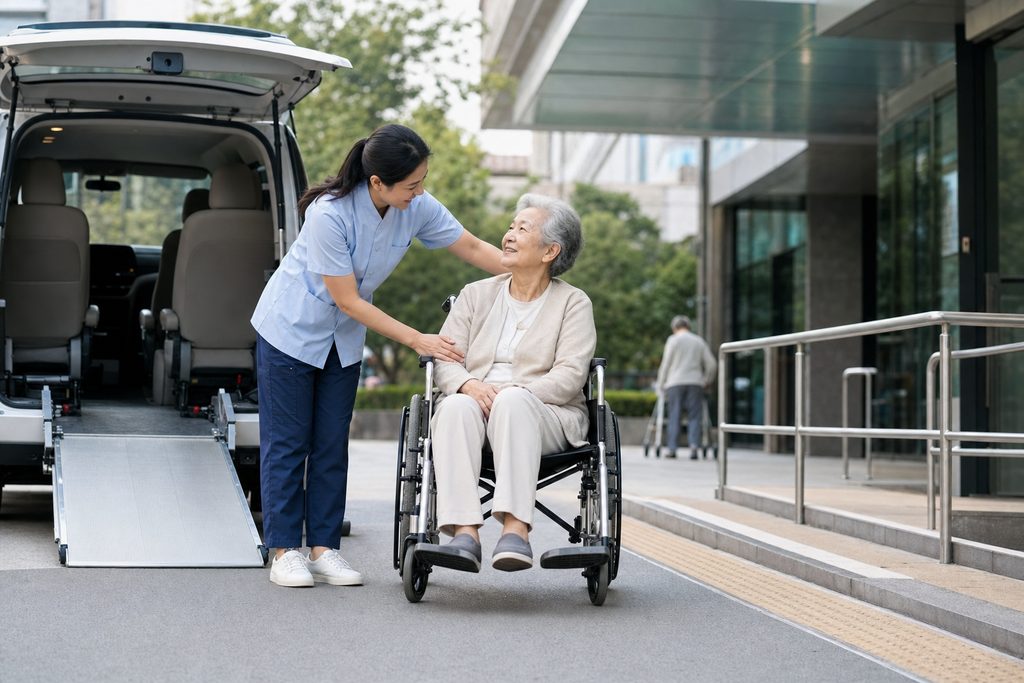
Key Takeaways
- China’s top-tier hospitals perform staggering surgical volumes — Fuwai Hospital alone completes over 14,000 cardiac surgeries annually — creating clinical teams deeply experienced with high-risk geriatric cases.
- Accessible medical transport for seniors China cost runs from approximately $200 for round-trip airport transfers to customized vehicle arrangements with lift-equipped vans coordinated through hospital international departments.
- China’s public hospital infrastructure was not designed with universal accessibility as a first principle. Ground-floor entrances may have ramps, but internal navigation — crowded elevators, narrow corridors, limited grab bars — demands an experienced local companion.
- Success depends entirely on advance coordination. Walking into a Chinese hospital without a pre-arranged wheelchair route, confirmed accessible exam room, and bilingual support creates genuine safety risks for mobility-limited seniors.
The Problem: When Medical Expertise Exists But Physical Access Does Not
According to the World Health Organization, approximately 1 in 6 people globally will be aged 60 or older by 2030. Among this population, mobility limitations — from osteoarthritis to post-stroke weakness to Parkinson’s disease — affect roughly 46% of those over 75. These are the very patients who most need specialized medical care. And they are the patients for whom travel feels impossible.
A 73-year-old from London needs a knee replacement. She has read about robotic-assisted orthopedic surgery at Shanghai’s Sixth People’s Hospital. But she uses a walker. She cannot stand for more than four minutes. The idea of navigating a Chinese airport, then a hospital that sees 10,000 outpatient visits daily, stops her cold. She stays home. Her pain worsens.
This is not a rare story. It is the default. The medical capability exists. The physical pathway to reach it does not — at least, not without deliberate, experienced coordination. That gap is where families give up. And it is precisely the gap that structured medical concierge services exist to close.
Who We Are
We are not a hospital. We do not provide medical treatment, clinical diagnoses, or rehabilitation therapy. Our team functions as logistical architects for international patients — we bridge the distance between your medical needs and China’s 340+ top-ranked hospitals across 37 cities. We handle hospital matching, appointment coordination through official international departments, bilingual medical companion services, visa guidance, and accessible transport logistics. We do not promise miracle cures. We promise that if China’s medical system can help you, we will get you through the door — safely, efficiently, and with your dignity intact.
What Accessible Medical Transport for Seniors China Cost Actually Looks Like
The question families ask us first is almost always practical: how do we physically move? The second question follows immediately: what does it cost? Let us address both directly.
Accessible medical transport for seniors China cost breaks into three categories. Airport transfers — private vehicle pickup with wheelchair assistance through immigration and baggage claim — run approximately $200 round-trip. This is not a taxi. It is a pre-booked vehicle with a driver who knows the international terminal layout, coordinated with our bilingual staff who meet the patient at the arrival gate.
For daily hospital transfers during treatment, costs depend on the vehicle type. Standard private cars with a companion who assists with boarding and alighting start around $80-120 per day. Vehicles equipped with wheelchair ramps or lift systems — which must be arranged in advance through specific providers in cities like Beijing, Shanghai, and Guangzhou — typically run $150-250 per day. These are not available everywhere. Smaller cities may require manual transfer assistance, which our companions are trained to provide safely.
Inter-city medical transport, such as moving a patient from a diagnostic center in Hangzhou to a surgical hospital in Shanghai, involves ambulance-style vehicles with stretcher capability and medical monitoring. These arrangements cost $500-800 per transfer and require 48-72 hours advance booking.
Every figure here is a starting point. Final costs vary by city, vehicle availability, distance, and the patient’s specific mobility requirements. But this is the realistic landscape — not a glossy brochure, but the actual numbers families need to budget for.
Hospitals in China with Wheelchair Accessible Facilities: What Exists and What Does Not
Let us be blunt. If you expect every Chinese hospital to match the accessibility standards of a modern Western medical center, you will be disappointed. China’s public hospital infrastructure was built in waves — some facilities date to the 1950s, others opened in 2023. The variation is extreme.
That said, hospitals in China with wheelchair accessible facilities do exist, and the best of them are genuinely impressive. The international departments and VIP wings of top-tier hospitals have invested heavily in accessibility over the past decade. Peking Union Medical College Hospital‘s international medical center features wide corridors, wheelchair-accessible examination rooms, and elevators with Braille panels and voice announcements. Shanghai’s Huashan Hospital international wing includes accessible restrooms with emergency call buttons and examination beds that lower to wheelchair height.
The private international hospital sector — United Family Healthcare, Jiahui International Hospital, ParkwayHealth — was built to Western accessibility standards from the ground up. These facilities have step-free entrances, wide automatic doors, accessible patient rooms with roll-in showers, and English-speaking staff trained in safe patient transfer techniques. They also accept direct insurance billing from major international carriers.
But here is the uncomfortable truth. The main public outpatient halls of even China’s most famous hospitals are overwhelming. Elevators are packed. Corridors narrow. Wheelchair users without a companion will find themselves blocked by crowds, unable to reach registration windows designed at standing height, and facing examination tables that do not adjust. The physical environment is navigable — but only with an experienced local guide who knows which elevators are less crowded, which entrances have ramps, and how to communicate mobility needs to clinical staff who may not speak English.
Can Elderly with Mobility Issues Get Surgery in Shanghai? Yes — With Conditions
This question comes to us frequently, usually from adult children researching on behalf of a parent. Can elderly with mobility issues get surgery in Shanghai? The answer is yes. Shanghai’s top hospitals perform complex procedures on patients in their 70s, 80s, and beyond every single day. But the pathway requires specific preparation that most international families do not anticipate.
First, the pre-operative assessment. Chinese surgeons will evaluate not just the surgical condition but the patient’s overall frailty status — cardiac function, pulmonary reserve, cognitive baseline, nutritional status. This is standard geriatric surgical practice globally. What differs in China is that this assessment happens after you arrive, not before. Remote pre-approval for surgery is not standard practice. You travel. You undergo evaluation. Then a surgical date is set. For a mobility-limited senior, this means planning for an extended stay — typically 2-4 weeks minimum, not a quick in-and-out trip.
Second, the hospital stay itself. Inpatient wards in Shanghai’s international departments can accommodate wheelchair users and patients who need assistance with transfers. But family involvement in bedside care is culturally expected in China to a degree that surprises Western patients. Nurses administer medications and monitor vitals. Families — or hired companions — handle feeding, bathing assistance, and mobility support. Our bilingual medical companions fill this role for international patients who travel without family.
Third, post-discharge recovery. Shanghai has excellent rehabilitation hospitals and TCM-based recovery programs, including acupuncture and tuina massage for post-surgical pain and mobility restoration. But these require separate coordination — transportation, appointments, translation. A patient who cannot walk independently will need a wheelchair-accessible vehicle for every single one of these visits. We arrange this. Without it, recovery stalls.
How Do Disabled Seniors Travel to Medical Appointments in Beijing? The Real Answer
Beijing’s public transportation system has made genuine accessibility improvements in recent years. Most subway stations now have elevators. Many buses feature low-floor boarding and wheelchair ramps. But “most” is not “all.” And a wheelchair user trying to navigate the Beijing subway during rush hour — even with functioning elevators — faces crushing crowds that make the experience genuinely unsafe for a frail senior.
So how do disabled seniors travel to medical appointments in Beijing in practice? They do not use public transportation. They use private vehicles. Our team arranges door-to-door transport from the patient’s accommodation — typically a serviced apartment near the hospital, which we also help book — directly to the hospital entrance. The driver waits. After the appointment, the same vehicle returns the patient. The companion stays throughout: pushing the wheelchair, navigating registration, translating during the consultation, collecting medications.
For patients staying at international hospitals like Beijing United Family, the hospital itself can sometimes arrange transport. But for those attending the international department of a major public hospital — say, Beijing’s Fuwai Hospital for cardiac evaluation — external coordination is essential. The hospital will not send a car. Our team will.
One detail families often miss: Beijing’s winter. From November through February, temperatures drop well below freezing. Sidewalks ice over. Ramps become slippery. Wheelchair wheels lose traction. We schedule appointments to avoid early morning ice, use vehicles with heated interiors, and ensure companions carry salt spray for unexpected slick patches. These are not luxuries. They are safety measures that prevent falls and fractures in patients who cannot afford either.
Medical Tourism Packages China for Mobility Limited Patients: What to Expect
The phrase “medical tourism package” suggests something tidy. A brochure. A fixed price. A seamless experience. Reality is messier — especially for patients with mobility limitations. Medical tourism packages China for mobility limited patients do exist, but they require customization that generic packages do not provide.
A well-designed package for a mobility-limited senior includes several layers. The medical layer: hospital selection based on both clinical expertise and physical accessibility, appointment scheduling that minimizes waiting time (a senior in a wheelchair cannot sit in a crowded hallway for three hours), and pre-arranged admission to an accessible inpatient room. The logistical layer: accessible airport transfers, daily hospital transport, accommodation within 1-2 kilometers of the hospital with step-free access and a roll-in shower. The human layer: a bilingual companion who is physically capable of assisting with transfers and has the clinical vocabulary to communicate symptoms, medications, and post-operative instructions accurately.
Costs for such packages vary enormously. A two-week surgical trip to Shanghai for a hip replacement, including hospital coordination, accessible transport, accommodation guidance, and daily companion service, typically ranges from $3,000-6,000 in coordination fees — separate from hospital charges. The hospital costs themselves, for a procedure that might cost $40,000-60,000 in the United States, often land between $8,000-15,000 at a top Chinese public hospital’s international wing.
We do not sell fixed packages off a menu. Every mobility-limited patient presents different needs — different transfer capabilities, different pain tolerances, different accommodation requirements. We design each plan individually, quote transparently, and adjust as conditions change. That is not marketing language. It is operational reality.
Is There Accessible Hospital Transport for International Patients China? Yes — But Book Ahead
Is there accessible hospital transport for international patients China? The short answer is yes. The longer answer is that it requires advance booking, city-specific knowledge, and a willingness to pay for private services rather than relying on public options.
In major medical cities — Beijing, Shanghai, Guangzhou, Chengdu — private medical transport companies operate vehicles equipped with wheelchair lifts, stretchers, and oxygen support. These companies primarily serve the domestic market, which means their drivers and dispatchers speak Mandarin. Booking through them directly as a non-Chinese speaker is functionally impossible. We book through them on your behalf, confirming vehicle specifications, pickup times, and accessibility equipment 48 hours before each transfer.
For patients traveling to smaller cities — say, a TCM rehabilitation hospital in Hangzhou or a specialized orthopedic center in Xi’an — accessible vehicle availability is thinner. In these cases, we often arrange a standard private vehicle with a companion trained in safe manual transfers, supplemented by portable ramps and transfer boards. It is not ideal. But it works, and we are honest about the limitations before any commitment is made.
The key principle: do not arrive expecting to figure out transport on the ground. A tired, jet-lagged senior in a wheelchair outside baggage claim at Beijing Capital International Airport, with no pre-arranged vehicle and no Chinese-language ability, is in a genuinely vulnerable position. We eliminate that scenario entirely. The car is there. The companion is there. The route to the hospital is confirmed.
What You Need to Know Before Going Alone
Some families consider handling all of this independently — booking a flight, booking a hotel, showing up at the hospital’s international department. For a fully mobile, English-speaking adult traveling to a private international hospital, this is feasible. For a mobility-limited senior, it carries real risks.
- Visa Requirements: Medical travel to China requires an S2 visa with a notation specifying medical treatment as the purpose. The application requires a formal invitation letter from the Chinese hospital — a document that public hospital international departments will issue, but only after confirming an appointment. Obtaining this without local assistance means navigating Chinese hospital phone systems, language barriers, and administrative processes that assume in-person contact. Family members accompanying the patient also need S2 visas. M visas — the business visa category — are not valid for medical treatment and will result in denied entry if the purpose of visit is disclosed at immigration.
- Hospital Navigation Reality: China’s top public hospitals serve staggering patient volumes. Fuwai Hospital’s outpatient department processes thousands of patients daily. Registration windows, payment counters, blood draw stations, and imaging departments are often on different floors, in different buildings. Signage in English exists in international departments but is inconsistent elsewhere. A wheelchair user attempting this independently will face physical barriers — crowded elevators, narrow doorways, high counters — that a companion anticipates and routes around.
- Payment Systems: Chinese public hospitals operate on a prepaid deposit system. Patients load funds onto a hospital card, which is then debited for each service — consultation, lab work, imaging, pharmacy. The card must be physically presented at each station. Reloading requires queuing at specific cashier windows, often on different floors than the clinical services. International credit cards are not universally accepted. Our companions handle all of this — the queuing, the reloading, the payment — while the patient rests.
How We Help You Navigate This
These barriers are not signs of a broken system. They are features of a healthcare infrastructure built to serve a billion-plus domestic population at extraordinary scale and speed. International patients are not the design priority. That is not a complaint — it is context. Our job is to build the bridge between that system and your needs.
Before travel, we handle hospital matching — identifying which of China’s 340+ top-ranked hospitals offers both the clinical expertise you need and the physical accessibility your mobility requires. We coordinate with the hospital’s international department to secure appointments, communicate special needs, and confirm that accessible examination rooms and inpatient facilities are available. We guide you through the S2 visa process, providing the invitation documentation and application instructions.
During your stay, our bilingual medical companions are with you from airport arrival through hospital discharge. They push wheelchairs. They navigate crowded hallways. They translate between you and doctors, nurses, pharmacists, and cashiers. They handle registration, payment, prescription pickup. They communicate with your family back home. They are not clinical staff — they do not make medical decisions — but they ensure that every logistical barrier between you and your doctor is removed.
After treatment, we coordinate follow-up appointments, rehabilitation sessions, and eventual airport transfer for your return flight. If you need continued care at home, we help arrange translated medical records and discharge summaries that your local physician can act on.
Our coordination fees start from $300 for hospital appointment coordination and $200 per day for bilingual companion service. Any consultation or second opinion fees — such as a $300-500 written second opinion from a top specialist — are fully credited toward on-the-ground coordination if you proceed with treatment in China within 90 days. We structure our pricing this way deliberately: you test our expertise with a small commitment, and if we earn your trust, that investment applies directly to the larger coordination work ahead.
Frequently Asked Questions
Yes — if you plan thoroughly and accept that the trip will not be quick. She will need an S2 medical visa, a pre-arranged accessible vehicle for all transport, a bilingual companion for every hospital visit, and accommodation with step-free access and a roll-in shower. The hospital will evaluate her surgical fitness after arrival, not before. Plan for a 3-4 week stay minimum. Thousands of international seniors complete this journey annually. But it requires experienced coordination, not DIY optimism.
Our companions are trained in basic emergency response and know exactly which hospitals have 24-hour emergency departments with English-speaking international staff. In Beijing, Shanghai, and Guangzhou, private international hospitals like United Family operate full emergency rooms with Western-trained physicians. For public hospital emergencies, our companions handle registration, translation, and family communication. We also recommend comprehensive travel medical insurance that covers emergency evacuation — we do not sell insurance, but we will tell you which policies have worked reliably for previous patients.
Are Chinese hospital bathrooms accessible for wheelchair users?
In international department inpatient rooms and private international hospitals, yes — you will find roll-in showers, grab bars, and emergency call buttons. In standard public hospital wards and outpatient areas, accessibility is inconsistent. Some have accessible stalls. Many do not. We verify bathroom accessibility at your specific hospital before you travel and, if necessary, arrange accommodation nearby with fully accessible facilities and a short
For more medical information and treatment options in China, visit chinamedservices.com (China Medical Services).
