Spouse Hospital Accommodation Service China: Keeping Your Partner Close and Comfortable
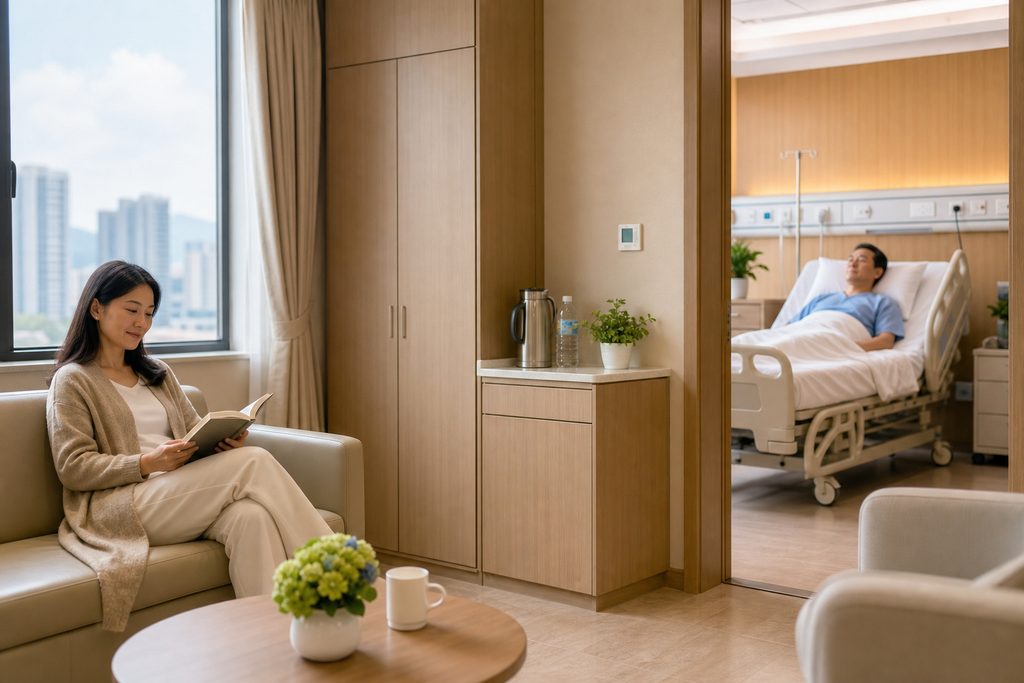
Have you ever tried to book a hotel room in a city you have never visited, in a language you do not speak, while someone you love is preparing for major surgery? That knot in your stomach is real. And it is exactly what thousands of families face each year when they choose China for advanced medical care. The clinical decision might be clear — a top-ranked cardiac center, an oncology department with technology unavailable back home. But the human logistics? Those can feel overwhelming.
Key Takeaways
- China’s top-tier hospitals perform over 14,000 cardiac surgeries annually at a single center, drawing international patients seeking both expertise and costs that are typically one-fifth to one-tenth of US prices.
- Most public hospitals in China do not provide on-site family accommodation, making advance planning for your spouse’s stay essential rather than optional.
- Language barriers and unfamiliar booking platforms can turn a simple hotel reservation into a significant source of stress during an already difficult time.
- Arranging comfortable, proximity-based lodging for a companion requires understanding hospital geography, visa rules, and the real differences between international and public hospital channels.
The Problem: Your Partner’s Comfort Is Not an Afterthought
Medical travel strips away every familiar support structure at the exact moment you need them most. You are in a foreign country. You may not speak the language. And the person who normally handles logistics with you — your spouse — is the one facing treatment. Approximately 1 in 8 international patients traveling to China for complex procedures brings a spouse or partner as their primary companion. That companion needs a place to sleep, eat, decompress, and stay functional. When accommodation is an afterthought, exhaustion compounds quickly.
What actually happens when this goes wrong? We have seen it. A partner books a hotel that looks close on a map, only to discover it is a 45-minute taxi ride through Beijing traffic. Another arrives assuming the hospital has guest rooms, then spends the first night in a plastic chair in a hallway. Neither scenario helps the patient. Both are entirely preventable. The question is not whether your spouse matters to the treatment journey — obviously they do. The question is whether the system is built to accommodate them. In most Chinese public hospitals, it is not. That gap is what we fill.
Who We Are
We are China Medical Services. We are not a hospital. We do not provide medical treatment, diagnoses, or clinical opinions. We are the logistical bridge between you and China’s top-ranked medical institutions — a team that handles hospital matching, appointment coordination, bilingual medical companions, visa guidance, and yes, accommodation arrangements for the people who travel with you. We know the geography around 340+ top-ranked hospitals across 37 cities. We know which hotels have English-speaking staff, which apartments allow extended stays, and which neighborhoods put your spouse within a five-minute walk of the hospital entrance. That knowledge does not come from a search engine. It comes from years on the ground.
What Hospital Accommodation for Spouse China Cost Actually Looks Like
Let us talk numbers. Because vague reassurance does not help anyone plan a budget. The phrase you likely typed into Google — hospital accommodation for spouse China cost — reflects a very practical concern. You need a real range, not marketing language. Here is what we tell families during initial consultations.
| Accommodation Type | City Examples | Nightly Rate (USD) | Distance from Hospital |
|---|---|---|---|
| Budget hotel (local chain) | Beijing, Shanghai, Guangzhou | $35–70 | 10–30 min walk or short taxi |
| Mid-range international hotel | Shanghai (near Huashan Hospital), Beijing (near PUMCH) | $80–150 | 5–15 min walk |
| Serviced apartment (1-bedroom) | Shanghai, Beijing, Shenzhen | $90–200 | Varies; many near international hospital zones |
| Upscale international hotel | Shanghai (near Ruijin Hospital), Beijing | $180–350 | Often within walking distance of major centers |
| Hospital-affiliated guest room (rare) | Select private international hospitals | $100–250 | On-site or adjacent |
These figures represent the accommodation cost only. They do not include meals, local transport, or our coordination fee. And they vary by season, hospital location, and how far in advance you book. But this gives you a realistic baseline. A two-week stay for a spouse accompanying a cardiac surgery patient in Shanghai might run $1,200 to $2,500 for a comfortable mid-range option. The same duration near a Beijing oncology center could be similar. What matters is that you know this number before you board the plane.
Can My Partner Stay With Me During Surgery in China?
This is the question that sits underneath the search for accommodation. It is not just about a bed. It is about presence. Can my partner stay with me during surgery in China? The short answer: your partner can be nearby, but not in the operating theater or recovery room. That is universal — not a China-specific rule. The longer answer matters more.
In public hospitals, inpatient wards typically have strict visiting hours. A spouse cannot sleep in the patient’s room overnight. This is not negotiable in most tertiary hospitals. Private international hospitals — United Family, Jiahui, Parkway — often have more flexible policies. Some offer private rooms with a couch or daybed suitable for a family member. But even there, the surgical suite itself is off-limits. What you should expect: your partner can accompany you to the hospital on the morning of surgery, wait in a designated family area during the procedure, and see you once you are transferred to the recovery ward. The quality of that waiting experience depends heavily on which hospital you choose and whether you have someone who can translate updates from the surgical team in real time.
Best Hospitals in China With Family Accommodation: What Exists and What Does Not
Search for best hospitals in China with family accommodation and you will find a mix of hope and marketing. Let us be precise. Most public hospitals in China — including the world-renowned ones — were not designed with international patient families in mind. Fuwai Hospital in Beijing performs more cardiac surgeries annually than any center on earth. It does not have a family guesthouse. Peking Union Medical College Hospital is one of the most respected diagnostic centers in the country. No on-site family rooms. Ruijin Hospital in Shanghai? Same story.
What does exist falls into three categories. First, a handful of private international hospitals have dedicated family accommodation or partnerships with nearby hotels. These are the exception, not the rule. Second, some hospitals have informal arrangements with local guesthouses — but these are rarely bookable online and almost never have English-language support. Third, and this is where we spend most of our coordination effort, there are excellent independent hotels and serviced apartments within walking distance of nearly every major hospital. The challenge is knowing which ones exist, which are actually clean and safe, and which will not cancel your reservation without warning. That is local knowledge. There is no global booking platform that captures it.
Hotel for Patient Family Near Shanghai Hospital: A Practical Breakdown
Shanghai concentrates some of China’s strongest clinical programs. Zhongshan Hospital (Fudan University) leads in liver surgery and cardiac care. Ruijin Hospital excels in endocrinology and burns. Huashan Hospital is a neuroscience powerhouse. If you are searching for a hotel for patient family near Shanghai hospital, you need to think in terms of specific neighborhoods, not just the city name.
Near Zhongshan Hospital, the Fenglin Road corridor has several mid-range international hotels within a 10-minute walk. Near Ruijin, the French Concession offers serviced apartments that work well for extended stays — think two to four weeks. Huashan Hospital sits in Jing’an, where hotel density is higher but prices climb accordingly. A spouse staying near Huashan might pay $120 to $200 per night for walkable access. The same budget near a public hospital in a less central district could secure a larger serviced apartment with a kitchenette. These distinctions matter when you are living the experience, not just researching it. A kitchenette means your partner can prepare familiar food. That sounds small. After a week in a foreign country, it is not small at all.
How to Arrange Accommodation for Companion in Beijing Hospital Zones
Beijing’s hospital geography is distinct. The top institutions cluster in specific districts — Dongcheng, Xicheng, Haidian — and traffic can turn a three-kilometer distance into a 40-minute ordeal. Learning how to arrange accommodation for companion in Beijing hospital zones starts with understanding this: proximity is measured in walking time, not kilometers.
Peking Union Medical College Hospital (PUMCH) sits near Wangfujing, a central area with hotels at every price point. But the affordable ones fill up fast — often booked solid by domestic medical travelers from other provinces. Fuwai Hospital is further north, near Fuchengmen, where hotel options are thinner. A companion staying there needs to book further in advance or accept a longer commute. Beijing’s subway system is excellent and English-signed, which helps. But a spouse who has spent a sleepless night worrying about their partner should not be navigating rush-hour Line 2 alone. We typically arrange accommodation within a 15-minute walk of the target hospital, or we pair the companion with a bilingual medical escort who can manage transport logistics daily. Sometimes the best solution is not the closest hotel — it is the one with staff who understand why you are there and will not create friction at check-in when your plans shift.
Medical Tourism China Spouse Package Price: What Is Included and What Is Not
The term medical tourism China spouse package price implies something tidy. A bundle. A single invoice. Reality is more nuanced. Some facilitators market “packages” that combine hospital fees, hotel bookings, and airport transfers into one number. We take a different approach. We quote coordination fees transparently and pass through hospital and hotel costs at their actual rates. Why? Because a package that looks simple often hides markups or locks you into choices that do not serve you.
Here is what a typical coordination arrangement with us includes: hospital selection and appointment scheduling, visa guidance for both patient and spouse, accommodation research and booking near the chosen hospital, airport transfers, and a bilingual medical companion for critical hospital visits. Our coordination fee for VIP end-to-end service ranges from $5,000 to $8,000, depending on case complexity. That fee covers the logistics, not the treatment. Hospital costs are separate and paid directly to the institution. Hotel costs are separate. The spouse’s accommodation might add $1,200 to $3,000 for a two-week stay, depending on the city and standard chosen. Is that a “package”? Not in the all-inclusive resort sense. But it is comprehensive, transparent, and built around your specific situation — not a template.
What You Need to Know Before Going Alone
We have seen resourceful people attempt to arrange everything independently. Some succeed. Many hit walls they did not expect. Here are the barriers that surface most often — not to discourage you, but so you can plan around them.
- Visa Requirements: Medical travelers and their companions both need S2 visas, specifically annotated for medical treatment purposes. The accompanying spouse must demonstrate the relationship and the treatment plan. Consulates process these at different speeds. A missing document can delay travel by weeks. We have guided families through this process hundreds of times and we know what triggers a rejection versus what sails through.
- Language Barriers in Booking: Most Chinese hotel booking platforms operate in Mandarin. International platforms like Booking.com or Agoda list some properties, but not all — and certainly not the small, well-located guesthouses that local families use. A spouse arriving without confirmed accommodation has few good options at 10 PM.
- Hospital Visiting Policies: Public hospital wards often restrict visitors to specific two-hour windows. Showing up outside those hours means waiting in a crowded lobby. Private international hospitals are more flexible, but their policies still differ from what many Western families expect. Knowing the rules in advance prevents confrontation and disappointment.
- Payment Systems: Chinese hospitals generally require upfront payment or a substantial deposit. International credit cards work at private hospitals but are inconsistently accepted at public ones. Your spouse may need to handle payments while you are incapacitated. Setting up payment methods before travel — WeChat Pay, Alipay, or ensuring sufficient card acceptance — is not optional.
How We Help You Navigate This
These barriers exist for structural reasons, not because anyone wants to make your life difficult. China’s healthcare system evolved to serve a domestic population of 1.4 billion people. The international patient infrastructure is growing, but it is layered on top of that massive domestic system, not separate from it. Our job is to bridge the gap.
Before you travel, we confirm the hospital, the specialist, and the appointment date. We research accommodation options within walking distance of that specific hospital — not the city center, not the tourist district, but the actual hospital campus. We book rooms, confirm reservations in Mandarin, and handle the back-and-forth when check-in dates shift. During your stay, a bilingual medical companion meets you at the hospital. That person handles registration, translates consultations, manages payment queues, and ensures your spouse understands every update. After discharge, we coordinate follow-up appointments and any extended accommodation needs. The goal is straightforward: you focus on treatment and recovery. Your spouse focuses on supporting you. We handle everything else.
Our companion service starts from $200 per day. That covers a trained bilingual professional who knows the hospital layout, the payment counters, the pharmacy location, and how to read a Chinese prescription. It is not a luxury add-on. In a system where everything happens in Mandarin, it is the difference between moving through the process and being stuck in it.
Frequently Asked Questions
Your spouse needs their own S2 visa. The application should reference your medical treatment plan and demonstrate the family relationship. Both visas are processed independently, though you can submit applications together. Processing times vary by consulate, typically ranging from four to ten business days. We provide document checklists and invitation letters to support both applications.
This happens. A pre-operative test result might require additional investigation. A surgeon’s schedule might shift due to an emergency case. When dates change, accommodation bookings need to change with them. We maintain direct relationships with hotel managers near major hospitals and can typically adjust reservations without penalty when the change is medically driven. If you booked independently through a global platform with a rigid cancellation policy, you might absorb that cost. This is one of the practical reasons families work with us rather than going solo.
A small number of private international hospitals offer private rooms with a companion bed or convertible sofa. United Family hospitals in Beijing and Shanghai, Jiahui International Hospital, and certain VIP wards within public hospitals provide this option. It is not standard and it costs more — sometimes significantly more. We can identify which facilities offer companion accommodation before you commit to a treatment plan. In most public hospital wards, overnight family stays are not permitted regardless of room type.
For one companion in a major city like Beijing or Shanghai, budget $25 to $50 per day for meals if eating at local restaurants or hospital cafeterias. Western-style groceries and imported foods cost more. Add $10 to $20 daily for local transport if the accommodation is not within walking distance. A reasonable estimate for a two-week companion stay, excluding accommodation and medical costs, is $500 to $1,000. This covers meals, transport, SIM card, and incidentals. It does not cover emergency purchases or extended stays.
Companions should carry their own travel health insurance. Chinese hospitals treat foreign nationals, but payment is expected at the time of service. Private international hospitals with English-speaking staff are the most practical option for a companion needing care. We can direct your spouse to an appropriate facility and provide translation support if needed. This is not a common occurrence, but it is one we prepare for in every coordination plan.
Your Next Step
You are not planning a vacation. You are planning to be present for someone you love during a medically significant event in a country where you may not speak the language or understand the systems. That deserves more than a hotel booking link. It deserves a team that knows the hospitals, the neighborhoods, the visa rules, and the hundred small friction points that can turn a hard experience into an unbearable one. We have been that team
For more medical information and treatment options in China, visit chinamedservices.com (China Medical Services).
