Chinese Hospital Kiosks for Foreigners: A Step-by-Step Survival Guide
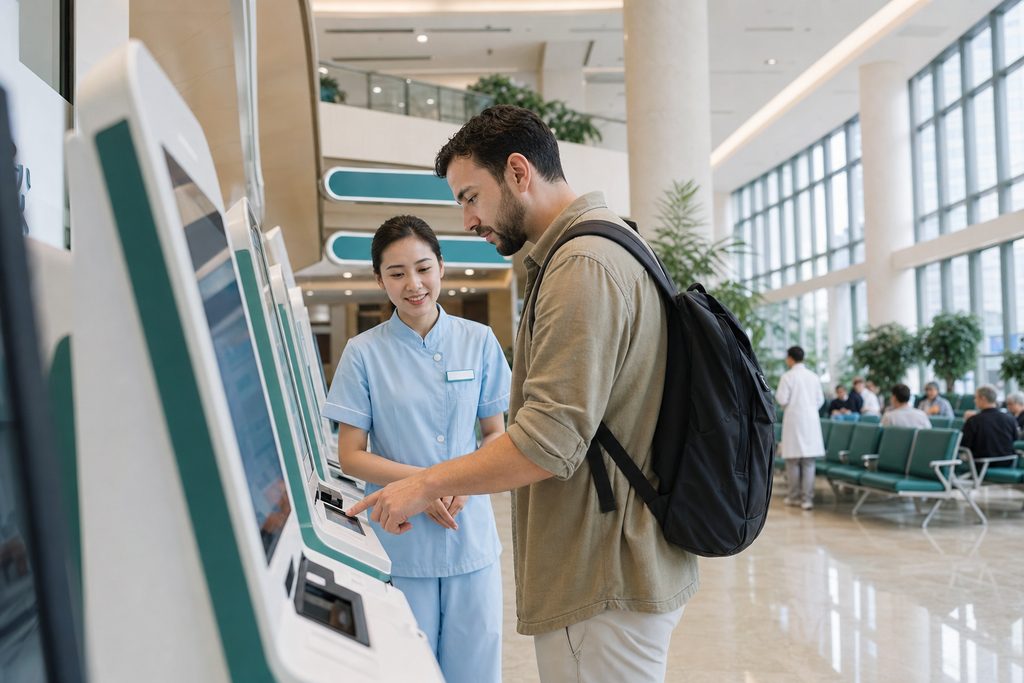
Chinese Hospital Kiosks for Foreigners: The Short Answer
You walk into a Chinese public hospital. The lobby is a wall of noise. Hundreds of people crowd around glowing screens. You need to check in. The machine asks for a Chinese ID card you don’t have. Now what? This guide breaks down exactly how to use hospital self-service kiosk in China as foreigner — what works, what doesn’t, and the one button that saves you when the screen is all Mandarin.
The blunt truth: most self-service kiosks in China’s public hospitals are not built for foreign passports. They are designed for Chinese citizens with national ID cards. But that doesn’t mean you’re stuck. There are workarounds. Some hospitals have upgraded machines with passport scanners and English interfaces. Others require a human counter visit first. We’ll walk through every scenario so you know what to expect before you arrive.
This isn’t a theoretical guide. It’s based on what actually happens inside hospitals like Huashan, Ruijin, and Peking Union Medical College — places where the daily patient count can exceed 10,000. If you’re searching for a China hospital check-in kiosk for international patients, you’ve probably already realized the gap between what the hospital website promises and what the machine actually delivers. Let’s close that gap.
Who This Guide Is For — and Who It Isn’t
This guide is for you if you’re a foreigner with a valid passport, standing in a Chinese hospital lobby, staring at a machine you can’t read. It’s also for you if you’re planning a trip and want to know whether you can handle check-in alone or need backup. Specifically, this is for:
- Expats living in China who have a hospital registration card but have never used the kiosk alone
- Medical travelers holding an S2 visa who need to navigate outpatient registration
- Family members accompanying a patient and trying to handle logistics
- Anyone who has searched for a self-service kiosk English option Chinese hospital and found nothing useful
This guide is not for you if you are going to a private international hospital like United Family or Jiahui. Those facilities have English-speaking reception desks and staff who handle everything. You won’t touch a kiosk at all. It’s also not for you if you expect a fully digital, app-based experience like MyChart in the US. China’s public hospital IT infrastructure is fragmented. Every hospital’s kiosk runs slightly different software.
The Options, Compared
Not all check-in experiences are equal. Here’s how the three main paths into a Chinese public hospital compare for a foreign passport holder.
| Check-In Method | Works with Foreign Passport? | English Interface Available? | Typical Wait Time | Requires Prior Registration Card? |
|---|---|---|---|---|
| Self-service kiosk | Sometimes — newer machines only | Rarely — maybe 10% of kiosks | 2-10 minutes if it works | Yes, almost always |
| Human counter (regular window) | Yes, with passport | No — Chinese only | 30-90 minutes | No — can create one on the spot |
| International/VIP department counter | Yes — designed for it | Yes — English-speaking staff | 5-20 minutes | No — handled at check-in |
The international department path costs more — roughly 1.5 to 2 times the standard registration fee — but eliminates the language barrier entirely. If you’re searching for a Chinese hospital self-service machine guide for expats, you’re probably trying to avoid that premium. Fair enough. But know the tradeoff: you’re trading money for friction. For a one-time specialist consultation, the kiosk gamble might be worth it. For a complex treatment plan involving multiple departments, the international department’s coordination becomes genuinely valuable.
How to Use Hospital Self-Service Kiosk in China as Foreigner: The Step-by-Step Reality
Let’s assume you’ve found a kiosk that accepts foreign passports. These are increasingly common in top-tier hospitals in Beijing, Shanghai, and Guangzhou — but still far from universal. Here’s the actual sequence, including the parts nobody documents.
Step 1: Locate a Passport-Compatible Kiosk
Walk past the machines with only a Chinese ID card slot. Look for a kiosk with a passport scanner — it’s usually a glass plate or a slot marked with a passport icon. These machines are often clustered near the international outpatient area or the main registration hall’s far end. If every machine looks identical and none have visible passport readers, skip to the human counter. Don’t waste 20 minutes jabbing at a screen that will never recognize your document.
This is the core of the hospital kiosk registration foreigner China step by step question: the first step isn’t on the screen. It’s finding the right machine.
Step 2: Language Selection — If You’re Lucky
Some kiosks have a language toggle in the top-right corner. Look for “EN” or a globe icon. Tap it. If the interface switches to English, you’ve beaten the odds. If nothing changes, or if the English mode is broken (disjointed translations, missing buttons), you’re navigating by icon recognition and memory. Common icons to recognize: a calendar (appointment check-in), a document with a checkmark (registration), a credit card symbol (payment).
The question can I use hospital kiosk with foreign passport China is really two questions: does the hardware accept the passport, and does the software have a usable English layer. Both must be true. One without the other leaves you stuck halfway.
Step 3: Scanning Your Passport
Place your passport photo page face-down on the scanner glass, or insert it into the designated slot if it’s a pull-in reader. The machine will take a few seconds to read the MRZ — the two lines of coded text at the bottom of your photo page. If the scan fails, try again with the passport perfectly flat. If it fails three times, the kiosk isn’t going to work for you. Move to the human counter.
Once the scan succeeds, the kiosk will pull up any existing hospital records linked to that passport number. If this is your first visit, you’ll likely be prompted to create a hospital registration card. Some kiosks can issue a physical card on the spot. Others will direct you to a counter. There’s no consistency across hospitals.
Step 4: Selecting Your Appointment or Registration Type
If you pre-booked an appointment (through a service or the hospital’s WeChat mini-program), select “Appointment Check-In.” The kiosk will confirm your time slot and print a queue number. If you’re registering on the spot, select the department and doctor — but be warned: top specialists are often fully booked by 8:00 AM. Walk-in registration through a kiosk works best for general outpatient visits, not for seeing a specific renowned expert.
Step 5: Payment
Chinese hospital kiosks accept WeChat Pay and Alipay almost universally. Some accept UnionPay bank cards. Very few accept Visa or Mastercard directly at the kiosk. If you haven’t set up a Chinese mobile payment account, this is where the process stalls. You’ll need to pay at a human cashier window instead. International credit cards are sometimes accepted at the main cashier counter, but never count on it. Carry sufficient cash in RMB as a backup.
What It Costs and What Drives the Variance
This happens frequently. The English interface on many Chinese hospital kiosks is an afterthought — a partial translation of the main menu, with sub-menus reverting to Chinese. If you tap an English button and the next screen is all characters, you’re in this situation. Your options: use a phone-based OCR translation app (Google Translate’s camera mode works, albeit imperfectly), ask a nearby patient for help (many younger Chinese people speak some English and will assist), or abandon the kiosk for the human counter. There’s no shame in the third option. It’s often the fastest path.
Most international travel insurance policies require itemized receipts and a formal diagnosis document for reimbursement. A kiosk-printed thermal receipt with a few lines of Chinese text won’t satisfy that requirement. You’ll need to request a formal invoice (fapiao) from the hospital’s billing counter — a separate window, usually in a different part of the lobby. The kiosk cannot issue this. If you’re relying on insurance reimbursement, factor in an extra 20-30 minutes to get proper documentation after your consultation. And confirm with your insurer beforehand that treatment at a Chinese public hospital is covered. Many policies have network restrictions.
If the kiosk works perfectly on the first try — passport scans, language switches, payment processes — it’s faster. Maybe five minutes versus an hour in line. But that “if” carries a lot of weight. For a first-time foreign patient who doesn’t read Chinese, the kiosk success rate is low. The human counter is slower but predictable. You’ll wait, but you’ll get registered. Our honest assessment: try the kiosk once. If it doesn’t work within three minutes, queue for the counter. The time you spend fighting a machine is time you could have spent waiting in a line that actually leads somewhere.
A hospital registration card issued during a prior visit. Once you have that card, and once the hospital’s system has your passport number correctly linked, the kiosk becomes dramatically easier. You scan the card (not the passport), the machine recognizes you, and most of the friction disappears. The first visit is the hard one. Every visit after that is simpler. If you’re in China for a multi-appointment treatment plan, invest the time upfront to get the card issued correctly. It pays off at every subsequent check-in.
Your Next Step
You now know what a Chinese hospital self-service kiosk can and cannot do for a foreign passport holder. The machines are improving — slowly — but they’re not yet built with international patients in mind. You can navigate them with patience, a translation app, and a backup plan. Or you can choose a path where the machine isn’t your problem to solve.
Our team at China Medical Services helps international patients connect with the right specialists at China’s top-ranked hospitals. We handle the registration card setup, the appointment coordination, and the on-the-ground logistics — including a bilingual medical companion who stands beside you so the kiosk isn’t your battle to fight alone. We don’t provide medical advice or make diagnoses. We bridge the gap between you and the care you need. If you’d like to explore your options, start with a free consultation. No pressure. Just straight answers about what’s possible.
Frequently Asked Questions
Yes. The hospitals used for international patients are JCI-accredited and follow the same international safety standards as top hospitals in the US and Europe. Surgical teams perform high volumes of procedures — often more than their Western counterparts — which studies show leads to better outcomes.
Costs vary by procedure and hospital, but international patients typically save 40-80% compared to US prices — even when factoring in travel and accommodation. A consultation with our team will give you an exact, all-inclusive quote with no hidden fees.
Send us your existing medical reports to get started. We handle everything from hospital selection and appointment scheduling to visa assistance and post-operative recovery planning. Your medical records are reviewed by the specialist before you even book a flight.
For more medical information and treatment options in China, visit chinamedservices.com (China Medical Services).
