Colorectal Cancer Surgery in China: Costs, Hospitals, and How to Start
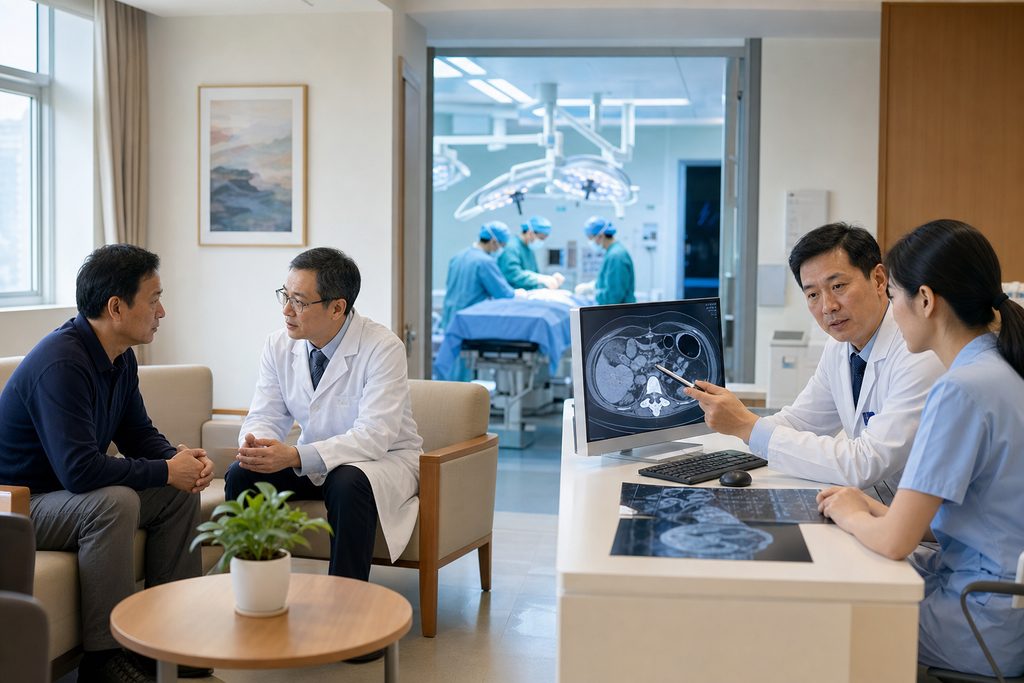
While an American patient without insurance can face bills exceeding $150,000 for a colorectal resection, the same procedure at a top-tier Chinese hospital typically ranges from $12,000 to $25,000. Canadian patients often wait 4 to 8 weeks just to see a surgical oncologist. At Fudan-ranked centers in Shanghai and Beijing, a biopsy-confirmed patient can often be on the operating table within 2 to 3 weeks of arrival.
The question is not whether you can get colorectal cancer surgery in China. The question is how to do it without wasting weeks navigating a system you do not understand. That is what this guide answers.
Key Takeaways
- Cost reality: Total colorectal cancer surgery cost China typically lands between $12,000 and $25,000 at top public hospitals, versus $60,000 to $150,000+ in the United States.
- Clinical volume: Chinese colorectal surgeons at high-volume centers perform 200 to 400 resections annually — multiples of the average Western surgeon’s caseload.
- Structural barrier: You cannot simply book surgery online. Public hospitals require an in-person consultation first; the international or VIP pathway is the only realistic route for foreigners planning ahead.
- Language is the real gatekeeper: Even at top hospitals, most frontline staff do not speak English. Without a bilingual coordinator, the process stalls quickly.
The Problem: Cancer Does Not Wait for Bureaucracy
Colorectal cancer is the third most common cancer worldwide, with approximately 1.9 million new cases diagnosed annually according to the World Health Organization. For patients with resectable disease, surgery remains the cornerstone of curative treatment. Delay is not a neutral variable — it is a clinical risk factor.
In the United Kingdom, the NHS target is that 85% of patients start treatment within 62 days of urgent referral. Reality often falls short. A 2023 report from Bowel Cancer UK documented patients waiting 6 to 9 months from first symptoms to surgery in some regions. In Canada, wait times for colorectal surgery after diagnosis routinely exceed 4 weeks, and in some provinces stretch past 8 weeks for non-emergent cases.
Meanwhile, a patient with a confirmed diagnosis and the financial means to travel faces a different calculation. They are not waiting for a national health system to allocate capacity. They are shopping for speed, quality, and value. And increasingly, they are looking at China.
But the path is not obvious.
Why China Delivers Results for Colorectal Surgery
Clinical Volume Drives Better Outcomes
There is a well-documented relationship between surgical volume and outcomes in colorectal cancer. A landmark study published in The Lancet Oncology found that hospitals performing more than 30 rectal cancer resections annually had significantly lower 30-day mortality than low-volume centers. Chinese high-volume centers operate at a completely different scale.
A senior colorectal surgeon at a top Shanghai hospital will routinely perform 300 to 400 resections per year. That is 6 to 8 surgeries per week, week after week. The average general surgeon in the United States performing colorectal procedures might do 30 to 50 annually. This volume gap is not marketing — it is structural. China’s population of 1.4 billion, combined with a hospital system that concentrates complex cases in designated tertiary centers, produces surgical teams that have seen every anatomical variation, every complication, every difficult case.
Does this translate to better outcomes? The data is encouraging. A 2022 comparative study published in the Annals of Surgical Oncology examining laparoscopic colorectal resections at Chinese teaching hospitals reported 30-day mortality rates below 1% and anastomotic leak rates of 3-5% — comparable to or better than published Western benchmarks.
Technology Adoption Without Legacy Lag
Chinese hospitals adopted minimally invasive colorectal surgery rapidly and comprehensively. At top centers, laparoscopic resection is the default, not the exception. Robotic-assisted surgery using the da Vinci system is available at major hospitals in Beijing, Shanghai, and Guangzhou, with Chinese-manufactured robotic platforms (such as the Toumai system) now deployed in dozens of hospitals.
What does this mean for a patient? Shorter incisions, less postoperative pain, faster return of bowel function, and discharge in 5 to 7 days instead of 10 to 14. Enhanced Recovery After Surgery (ERAS) protocols are standard practice at Fudan-ranked hospitals, with early mobilization and early oral feeding as routine orders, not experimental innovations.
Cost Advantage Without Quality Compromise
The colorectal cancer surgery cost China advantage is real and structural. It is not because Chinese surgeons are less skilled or hospitals are less equipped. It is because labor costs are lower, hospital construction and operational overhead are lower, and the entire supply chain — from sutures to staplers to robotic instruments — is cheaper when sourced domestically.
Here is the honest comparison:
| Procedure Component | Top Chinese Public Hospital (USD) | US Hospital (USD) | UK Private Hospital (USD) |
|---|---|---|---|
| Laparoscopic colon resection (uncomplicated) | $12,000 – $18,000 | $60,000 – $120,000 | $45,000 – $80,000 |
| Robotic rectal resection | $18,000 – $25,000 | $80,000 – $150,000 | $60,000 – $100,000 |
| Hospital stay (per day, ward) | $150 – $400 | $2,000 – $5,000 | $1,500 – $3,500 |
| Pre-operative imaging (CT + MRI + labs) | $800 – $1,500 | $5,000 – $10,000 | $3,000 – $6,000 |
These figures vary by hospital and case complexity. A patient requiring neoadjuvant chemoradiation before surgery, or one with significant comorbidities, will pay more. But the gap is not marginal — it is an order of magnitude. And the clinical outcomes at top Chinese centers are not inferior. They are, in many published series, equivalent.
What the Process Actually Looks Like: From Diagnosis to Discharge
Many international patients imagine they can email a Chinese hospital, book a surgery date, and fly over. That is not how the system works. Understanding the real sequence saves weeks of frustration.
Step 1: Remote evaluation (2-5 days). You send your existing records — pathology report, colonoscopy findings, CT/MRI scans, blood work. A Chinese colorectal surgery team reviews them. For $300-$500, you can get a written second opinion from a senior specialist at a top hospital. For $500-$800, you can get a video consultation with the surgical team directly. This step determines whether you are a surgical candidate and what the recommended approach would be.
Step 2: Travel and in-person consultation (Day 1-3 after arrival). You fly to China on an S2 visa (the short-stay category used for medical treatment and private affairs). Your first hospital visit is a face-to-face consultation with the surgeon. They will order any missing tests — typically a repeat CT, blood work, and possibly a repeat colonoscopy if your records are incomplete.
Step 3: Pre-operative workup (2-5 days). Tests are completed. Anesthesia assessment happens. If neoadjuvant therapy is indicated, this timeline changes significantly — you may need 6-12 weeks of treatment before surgery is appropriate.
Step 4: Surgery and hospital stay (5-10 days). The operation itself. For uncomplicated laparoscopic resections, expect 5-7 days in hospital. For open surgery or rectal resections with temporary ostomy, expect 7-14 days.
Step 5: Post-operative follow-up (1-2 weeks after discharge). Staple removal, wound check, pathology review, and discussion of adjuvant chemotherapy if indicated. Many patients fly home after this point and continue follow-up with their local oncologist.
Total time in China for straightforward surgery: 2 to 4 weeks. For cases requiring neoadjuvant therapy: 3 to 5 months.
How to Evaluate Hospitals: What the Rankings Actually Mean
Searching for the best hospital for colon cancer surgery in China will surface dozens of names. Most of them are genuinely excellent. But “excellent” is not the same as “right for you.”
The Fudan University Hospital Rankings are the most authoritative source. They rank hospitals in two ways: a comprehensive Top 100 list (grouped into tiers, not individually numbered) and specialty-specific reputation rankings. For colorectal surgery, the relevant specialty is General Surgery or Oncology. Hospitals ranked among China’s top 10 for general surgery include Peking Union Medical College Hospital in Beijing, Zhongshan Hospital Fudan University in Shanghai, and West China Hospital in Chengdu.
But here is what the rankings do not tell you: which hospital has an international patient pathway that actually works for foreigners. Some top-ranked hospitals have excellent clinical departments but minimal experience handling international patients. Others have dedicated international medical centers with English-speaking staff, streamlined registration, and experience coordinating care for overseas patients.
For a foreigner, the practical question is not just “which hospital is best for colorectal surgery?” It is “which excellent hospital can I actually navigate?” That is where the choice gets harder. Our department-level hospital rankings break down the top 10 hospitals for general surgery and oncology across China, with notes on international patient access.
Private international hospitals — United Family, Jiahui, Raffles — offer English-speaking care and direct insurance billing. They are comfortable and convenient. But their surgical volumes for complex colorectal cancer are lower than at the major public teaching hospitals. For a straightforward case, a private hospital may be perfectly adequate. For a complex rectal cancer requiring multidisciplinary management, the public academic centers are stronger. Compare private international hospital options here.
Is Colorectal Surgery Safe in China?
The honest answer is: at the right hospital, yes — with outcomes comparable to Western centers. At the wrong hospital, no.
China has over 35,000 hospitals. The top 5% — roughly 1,700 institutions — deliver care that meets or exceeds international standards. The Fudan Top 100 list represents the top 0.3%. These are the hospitals where published surgical outcomes match Western benchmarks, where infection control protocols are enforced, where multidisciplinary tumor boards review complex cases.
Safety in surgery is not about the country. It is about the specific institution, the specific surgical team, and the specific patient. A 2021 systematic review in the World Journal of Gastroenterology examining colorectal cancer surgery outcomes in China found that high-volume centers reported anastomotic leak rates of 3-6% and 30-day mortality below 1% — squarely within the range reported by major Western institutions.
What are the real risks? Communication failure is the biggest one. If you cannot understand your surgeon’s instructions, or your nurse cannot understand your pain report, errors happen. This is not a criticism of Chinese hospitals — it is a structural fact of any cross-border medical care. The solution is a bilingual medical companion who is physically present with you during every interaction.
The second risk is unrealistic expectations about the process. Chinese public hospitals are crowded. Waiting areas are busy. The patient experience is efficient but not luxurious. If you expect a Western private-hospital experience at a Chinese public hospital, you will be disappointed. If you expect excellent surgery at a fraction of Western cost, you will likely be satisfied.
And yes — foreigners can get cancer surgery in Shanghai. Shanghai is home to some of China’s strongest surgical oncology programs, including Zhongshan Hospital and Ruijin Hospital. The international patient pathway exists. It requires documentation, coordination, and patience. But it works. Explore Shanghai hospital options for international patients.
Practical Considerations: Documentation, Visas, and Payment
You will need your complete medical records translated into Chinese. This includes pathology reports, imaging studies (on CD or via secure link), colonoscopy reports, and a summary letter from your treating physician. Translation accuracy matters — a mistranslated pathology report can change the surgical plan. Professional medical translation is worth the cost.
Visa: You will apply for an S2 visa, which is the short-stay category used for medical treatment and private affairs. Supporting documents typically include an invitation letter from the hospital, proof of appointment, and your medical records. Processing times vary by embassy, but plan for 2 to 4 weeks. Family members accompanying you also apply for S2 visas. The M visa is for commercial and trade activities — it is not applicable to medical travel. Never let anyone tell you otherwise.
Payment: Chinese public hospitals require pre-payment. You will deposit funds upfront, and the hospital deducts from that deposit as services are rendered. International credit cards are accepted at major hospitals, but limits apply. Wire transfer is often more practical for large deposits. Insurance: if you have international health insurance, check whether the hospital has direct billing arrangements. Most public hospitals do not — you pay upfront and seek reimbursement. Private international hospitals are more likely to bill insurers directly.
Language: Even at top hospitals with international departments, frontline staff — nurses, technicians, pharmacists — often speak little or no English. A bilingual medical companion handles registration, payment, test scheduling, and translation during consultations. This service typically costs from $300 per day. It is not a luxury; it is the difference between a smooth process and a stalled one.
Follow-up after returning home: Your Chinese surgical team will provide a discharge summary and pathology report in English (upon request). You will need to arrange follow-up with your local oncologist. Adjuvant chemotherapy, if indicated, can usually be administered in your home country based on the Chinese team’s recommendations.
Frequently Asked Questions
Not directly through the public hospital system. Public hospitals require an in-person consultation before scheduling surgery. However, through the hospital’s international department or VIP pathway, you can pre-arrange the consultation, complete remote evaluation, and have a surgical plan tentatively agreed upon before you travel. This is the closest thing to “booking surgery in advance” — and it is how international patients realistically manage the process.
At top Beijing hospitals such as Peking Union Medical College Hospital or Beijing Friendship Hospital, a laparoscopic colon resection through the international department typically ranges from $15,000 to $25,000 including hospital stay and surgical fees. A robotic rectal resection runs $20,000 to $30,000. These figures vary by hospital and case complexity — a straightforward sigmoid resection costs less than a low rectal resection requiring temporary ostomy.
This is the question everyone should ask. Chinese top-tier hospitals have surgical complication rates comparable to Western centers — but complications happen everywhere. What matters is the hospital’s capacity to manage them. Fudan-ranked hospitals have on-site ICU, interventional radiology, and 24-hour surgical coverage. If a complication occurs, you are in a facility equipped to handle it. Your medical companion should also help you understand what is happening at every step. You should know before you travel what the escalation pathway looks like — and who to contact if you have concerns.
Generally yes, if it comes from a reputable hospital. Top Chinese pathology departments follow international standards and many participate in external quality assurance programs. You can request an English-language report. Your home oncologist may still want a second pathology review — this is standard practice for any international care, not a reflection on Chinese quality.
Your Next Step
Colorectal cancer surgery in China is not a gamble. It is a calculated decision — one that makes sense for patients who understand the system, choose the right hospital, and have the right support on the ground. China Medical Services exists to help you make that calculation accurately. We are not a hospital and we do not provide diagnoses or treatment recommendations. We help you identify appropriate hospitals, coordinate remote consultations, and arrange the practical logistics — from visa guidance to bilingual medical companions.
If you have a confirmed diagnosis and want to understand whether surgery in China is a realistic option for your specific case, start with a free consultation. We will review your situation honestly and tell you what is possible — and what is not.
For more medical information and treatment options in China, visit chinamedservices.com (China Medical Services).
