How to Confirm the Exchange Rate Is Fair: Medical Bills in China
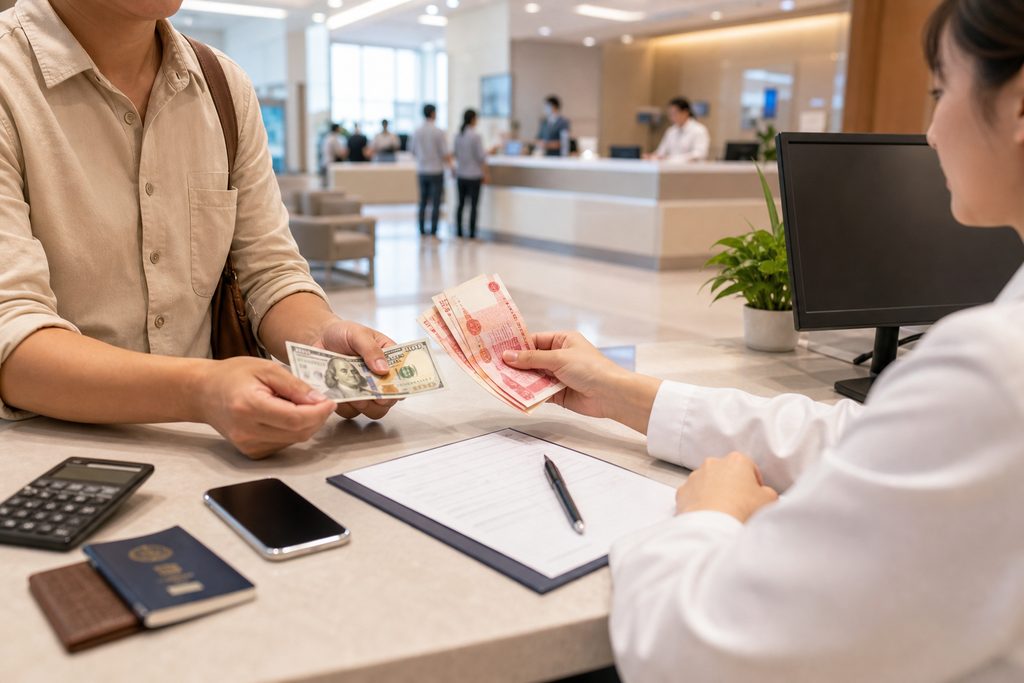
Fair Exchange Rate for Medical Treatment China: The Short Answer
You’ve probably heard that paying for surgery abroad means getting ripped off on currency conversion. The reality is more boring — and more controllable. A fair exchange rate for medical treatment China is the mid-market rate plus 0.5% to 2%. That’s the benchmark. If your bank, card issuer, or payment platform charges more than 2% above the mid-market rate, you are leaving money on the table. On a $30,000 cardiac procedure, a 3% hidden markup costs you an extra $900. A 5% markup costs $1,500. The difference is not trivial.
But here’s the catch: Chinese hospitals do not set the exchange rate. They bill in RMB. Your bank, your card network, or your payment provider converts the amount. So the question is not whether the hospital’s rate is fair. The question is which conversion channel you choose — and whether you check the rate before you pay.
Who This Matters For — and Who It Doesn’t
If you are paying a hospital deposit of $5,000 or more, exchange rate vigilance is worth your time. If you are paying for a video consultation at $100 to $300, the spread between a good rate and a bad rate is a few dollars. Not worth agonizing over.
You should care about the exchange rate if:
- You are scheduling surgery, a hospital stay, or a multi-week treatment program in China
- You are wiring funds from a US, European, Middle Eastern, or Southeast Asian bank account
- You plan to pay hospital fees with a credit card issued outside China
- You are comparing cost estimates between hospitals and need accurate USD equivalents
You probably should not obsess over the rate if you are only paying for a remote written second opinion or a single outpatient consultation. The absolute difference is too small to justify the time spent comparing conversion channels.
The Options, Compared
There are four realistic ways to pay a hospital in China from abroad. Each has a different cost structure, speed, and level of rate transparency. The table below compares them at a glance.
| Payment Method | Typical Markup Over Mid-Market | Speed | Best For |
|---|---|---|---|
| Bank wire transfer (SWIFT) | 1%–3% (bank rate + fees) | 1–5 business days | Large deposits, hospital prepayment |
| Credit card (Visa/Mastercard) | 1%–3% (network + issuer fee) | Instant at POS | Outpatient fees, small balances |
| Wise / OFX / specialist FX provider | 0.5%–1.5% | 1–3 business days | Wire transfers in local currency |
| Cash exchange at airport or hotel | 5%–12% | Instant | Emergency pocket money only |
For a hospital deposit of $10,000 or more, a specialist FX provider usually beats a traditional bank wire. But not always. Some banks negotiate better rates for premium account holders. The point is to compare at least two channels before you commit. A five-minute check can save you $200 to $500 on a single transfer.
How to Check RMB Exchange Rate for Surgery Abroad
This is the step most people skip. They trust their bank’s displayed rate because it looks official. But the rate your bank shows you is not the mid-market rate. It is the mid-market rate plus the bank’s margin. Sometimes the margin is disclosed. Usually it is buried.
Here is the practical sequence we walk our patients through:
- Pull the live mid-market rate from a neutral source — Reuters, Google Finance, or XE.com. Write it down.
- Ask your bank or payment provider for the exact RMB amount you will receive after conversion. Not the rate. The amount.
- Divide: RMB received ÷ USD sent. That gives you the effective rate.
- Compare the effective rate to the mid-market rate. The difference is your markup.
That calculation takes two minutes. And it works for any currency pair — EUR to RMB, GBP to RMB, AED to RMB, whatever you are sending.
Many patients ask us whether the hospital exchange rate in Shanghai is fair. The honest answer is that public hospitals in Shanghai do not publish a retail exchange rate for foreign patients. They bill in RMB. The rate you experience is entirely determined by your payment channel. So the question “is the hospital exchange rate fair in Shanghai” is really a question about your bank, not the hospital.
What It Costs: The Real Numbers
Let’s put the exchange rate spread into context. A typical cardiac bypass at a top Chinese public hospital costs $12,000 to $20,000. A comparable procedure in the United States runs $120,000 or more. The savings dwarf any currency conversion loss. But that does not mean you should accept a bad rate.
On a $20,000 hospital bill:
- A 0.5% FX margin costs you $100
- A 1.5% margin costs $300
- A 3% margin costs $600
- An airport cash exchange at 8% costs $1,600
The spread between the best and worst conversion channel on a single surgery can exceed $1,500. That is real money — enough to cover a bilingual medical companion for several days, or a round-trip airport transfer, or most of a written second opinion.
What drives the variance? Your home bank’s international wire fees, the intermediary bank charges on SWIFT transfers, the card network’s foreign transaction fee, and whether you convert before sending or let the recipient bank convert. Each layer takes a cut unless you actively remove it.
Practical Considerations: Payment Logistics for Foreign Patients
Chinese public hospitals typically require prepayment before admission or surgery. The deposit amount varies by hospital and procedure complexity. International departments at top hospitals like those ranked in the Fudan Top 100 often accept international bank transfers, but the transfer must arrive before your scheduled admission date. Plan for 3 to 5 business days of transfer time.
Private international hospitals in Shanghai and Beijing frequently accept major credit cards and may offer direct insurance billing. That convenience comes with the card network’s foreign transaction fee, typically 1% to 3%. If your insurer reimburses you after the fact, keep every receipt and the conversion confirmation slip. Insurance companies often use their own exchange rate for reimbursement, which may differ from what you actually paid.
One more consideration: Chinese banks have daily and per-transaction limits on incoming foreign wires. If your hospital deposit exceeds the limit, the transfer may be rejected or split. Confirm the receiving bank’s limits with the hospital’s international department before you send anything.
And yes, language matters here. Hospital cashiers in public hospitals rarely speak English. A bilingual medical companion can confirm the exact RMB amount due, verify the payment receipt, and make sure the conversion you negotiated is the one actually applied. That service starts from $300 per day, and it is the difference between a smooth admission and a stressful morning at the payment window.
Frequently Asked Questions
Ignore the advertised rate. Ask every provider for the exact RMB amount you will receive for a specific USD amount. Then divide. That effective rate is the only number that matters. Compare two or three providers on the same day, at the same time, for the same transfer amount. Rates move constantly, so comparing a Monday quote to a Thursday quote tells you nothing.
For deposits over $10,000, a specialist FX provider like Wise or OFX usually beats a traditional bank wire. But not always. Some banks waive wire fees for premium clients. The best way is to check both. Send the transfer in RMB if the provider allows it. That locks in the rate at the time you send, rather than leaving the conversion to the receiving bank in China, which will apply its own less favorable rate.
No. Cash is the worst option. Airport exchange counters and hotel desks routinely mark up the mid-market rate by 5% to 12%. Carrying large amounts of cash also creates security and customs declaration issues. China has strict rules on foreign currency cash entry — amounts over $5,000 USD equivalent must be declared. Do not plan to pay a hospital deposit in cash.
You absorb the difference unless the hospital locks your quote in USD. Most public hospitals quote in RMB and convert at the payment date. If the RMB strengthens against your home currency, your procedure costs more in your home currency. If it weakens, you pay less. To manage this risk, ask the hospital to fix the USD amount in writing for a defined period. Not all hospitals will do this, but it costs nothing to ask.
There is no city-specific hospital exchange rate. Hospitals in Shanghai, Beijing, Guangzhou, and Chengdu all bill in RMB. The rate you get depends entirely on your payment channel, not the city. A patient paying with a specialist FX provider in Shanghai gets the same effective rate as a patient paying with the same provider in Chengdu. The city is irrelevant. Your payment method is everything.
Your Next Step
Exchange rates are a solvable problem. Check the mid-market rate, demand the effective rate, and compare at least two channels before you send money. That discipline saves hundreds or thousands of dollars on a single procedure.
We are China Medical Services, a medical concierge organization connecting international patients with 340+ top-ranked hospitals across 37 Chinese cities. We are not a hospital, and we do not provide diagnoses or medical advice. What we do is handle the logistics — hospital matching, appointment coordination, bilingual medical companions, and payment guidance — so you can focus on treatment. If you are planning surgery in China and want help navigating the payment process, request a free consultation and tell us where you are in the process. No pressure, no obligation.
For more medical information and treatment options in China, visit chinamedservices.com (China Medical Services).
